The Copper Collar

Its my 70th birthday. I get to say whatever I want…flat out. I’m too old a dog to worry. 🙂

America is on the leash…in the collar of Big Money.

Free speech is a basic right in America. But some of us are freer than others. Because the Supreme Court has ruled that money is speech. Some of us have lots of it. Most of us have a buck or two to support candidates for public office.

Montanans once referred to “the copper collar” worn by elected officials (federal, state and local), policy-makers, newspaper publishers and editors, journalists, business people, asnd relgious leaders. The copper collar kept them on the leash of the state’s largest employer and wealthiest campaign contributor, Anaconda Copper Mining Company. Montana was one big company town.

Photo of book “Forging the Copper Collar”

Step in a direction Anaconda didn’t like, and you’d feel a quick tug on the leash – a phone call, a note,  a pink slip, or worse. Want to run for office? Here’s the money. Money for things the average Montanan cannot buy, money for the “free” speech few can afford. Money for professional pollsters to learn voter attitudes and what scares them. Money for advertizing agencies that turn the polling data into ads that flood the airwaves, the internet, roadside billboards, and the print media.Money puts candidates and political parties in the collar. On the leash. Candidates who start to sniff to the side of the path on their morning walks feel a yank on the collar, a reminder that the dog isn’t walking on its own. It’s walking on a leash.  The “free” speech of candidates who stray or bite the hand that feeds them soon disappear. It was paid for by the owner.

The American colonies revolted against the ideas of a king and colonial rule. The political idea of royalty appalls us. We think of ourselves as the home of the brave and the land of the free. But aversion to kings and queens doesn’t mean we can’t be fooled into hoping that any one of us can climb to the top. We gripe about the wealth yet we aspire to it, and we think in personal terms we can understand more easily than the complicated matters of economics and arrangements between private and public institutions. The royalty and colonial privilege we love to hate find a way to disguise themselves as just another citizen with freedom of speech.

The Supreme Court’s Citizens United ruling that corporations are “persons” with the same rights as a voter with “free speech” campaign contributions has put the collar on every candidate for public office. When candidates wear a collar, freedom of speech is a fiction, and the country we love becomes one big corporate town, the colonial town of the new kings and queens.

America is fast becoming a corporate town. We can bark. We can whine. We can vote. But the speech that matters isn’t free. It’s paid for. Democracy and freedom are on the leash…wearing the copper collar.

For a closer work at how it works, click “Goodbye to All That: Reflections of a GOP Operative Who Left the Cult,” an insider’s look at what’s happening to America. Or click  “Confronting Ethical Emptiness of Wall Street” for a powerful piece, including the picture below of the raging bull.

The Wall Street Bull – symbol of ethical emptiness on Wall Street

Every day four or five emails arrive asking for a campaign contribution to fight Big Money. Just a $3 or $5 contribution will make a hug difference, say the appeals. But I know that once I give $3, the next one will be for $50 and then $100, and then…. Makes me feel real small…facing the bull.

But…if I don’t give….

The next time I watch a campaign ad, I’m going to read the small print to see who’s holding the leash to the collar.

You’ll make an old dog happy on his birthday by leaving a comment to promote some discussion.

Glory and Tragedy at Southern Cross

There’s a sermon on Cable Mountain waiting to be preached.

The View from St. Timothy’s Memorial Chapel

Southern Cross, Montana is a ghost town, a former mining community on Cable Mountain west of Anaconda.  It’s also the site of St. Timothy’s Memorial Chapel, a tribute to the glory of God in loving memory of Timothy Dillon Bowman, the 18-year-old son who died tragically in a car accident following his freshman year at Stanford.

St. Timothy’s Memorial Chapel, Southern Cross, MT

Amid the abandoned buildings of the Anaconda Mining Company, one might say that St. Timothy’s Memorial Chapel stands as a witness to 20th century theologian Paul Tillich’s believe that

…[M]an and nature belong together,

in their created glory,

in their tragedy,

and in their salvation.

– Paul Tillich, The Shaking of the Foundations

Here’s the sermon from the pulpit of Shepherd of the Hill Presbyterian Church in Chaska, Minnesota, August 5, 2012.

.

Paul the Ap began each day

Paul the Ap began each day,

apparently ,

thinking that today would be

THE day that He

would return to have his say.

So, he said unless you burn

(that’s sexually),

you should live like him and be

(yes, singly) :

you should live your life alone.

Paul thought when the Trump would sound

triumphally,

there were places we should be

selectively,

than in bed messing around.

Many generations later

Christians thank Paul for his letter,

but think it better far to wait

and live in Heaven like a Saint!

– Steve Shoemaker, Urbana, IL August 2, 2012

“Oh, my!” say I. (Gordon)

Verse: “Christian blood is semen”

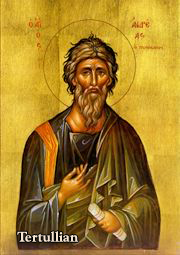
Verse:  “Christian blood is semen.”- Tertullian (180-225 A.D.)

Tertullian

Steve Shoemaker, Urbana, IL, July 29, 2012

Terrible-tempered ,

Ever-

Ready

To

Use his

Lively

Legal mind

In defense of

Attacks on the faith,

Nasty

To all,

Even friends,

Respected

Though for

Urging the

Lord’s followers to

Live faithfully

In spite of the

Authorities’

Never-ending executions.

Tertullian was an “Early Church Father” whose works are required reading in most seminary or graduate school courses in Patristics. Click HERE for more information from The Tertullian Project, or get a chuckle from this post-card produced by The Disseminary: Wisdom wants to be free, re-posted here with permission:

The Prenuptial Dinner

Prologue

Describing  the prenuptial dinner in Bend, Oregon calls to mind my niece’s twinkle-in-the-eye declaration after her first experience with Japanese Sushi (raw fish): “It was,” you might say, “an experience!” The memorable “experience” was the company more than the food.

Scene 1

The room in the back of the Middle Eastern restaurant in cosmopolitan downtown Bend, Oregon was hard to find, but well-prepared for the 16 family members.

We introduce ourselves to Bonnie, the bride’s mother, and Mike, the bride’s second step-father. The next 25 minutes is a tag-team Bonnie and Mike monologue. We learn all the places they have lived, why they are now moving from Maryland – on the Chesapeake Bay – to Texas, Bonnie’s ancestral home. They have put their house on the market…and their boat with a listing price higher than the market value of our house in Minnesota. Third marriage for both Mike and Bonnie. No interest in knowing anything about us. Monologue. Texas monologue. The first taste of what is to come.

Scene 2 

The bride’s 65 year-old gregarious Uncle Billy Bob (“Uncle Bill”) – married to the bride’s Aunt Frances – makes his grand entrance. Uncle Bill is very large – 6’4” 280 lbs. of massive  proportions wearing a khaki work shirt tucked into suspendered khaki work pants hiked up high above his waistline and a tractor hat.

Uncle Bill’s voice is as loud as his body is big. He is a commanding presence. We’d met the night before when the families were gathering from Oregon, New York, Texas, and Minnesota. He’s been told I’m a minister.

“Have s seat,” he says, glad to see me, pulling a chair from the long table and slapping it with his hand like a command from a drill sergeant. “So you’re a minister. What kind?”

Uncle Bill and Gordon

“Yes sir. Presbyterian,” I say, wondering where this is leading.

“Well, lemme tell ya a story,” says Uncle Bill. “Ma Granddaddy was a Hah Babtist. He married my Grandmomma who was a Hah Church of Chrast.”

“What’s ‘high’ mean?” I ask.

Uncle Bill’s face tells me he’s astonished by my ignorance, a man of the cloth and all that. “Well, sir, there are Hah Babtists and Low Babtists; Hah Church of Chrast and Low Church of Chrast. ‘Hah’ means ‘mine is the only way.’ So my Grandaddy and Grandmomma’s son, ma Daddy, was a heathen. He married a Hah Babtist.

“I was raised Hah Baptist, like ma Momma. Now here’s where the story begins…….”

The waiter interrupts by putting a large platter of hummus and Lebanese pita bread in the middle of the wide table. Billy Bob looks at it. He’s hungry. He’s never seen anything like this. He’s wondering what it is and what to do with it. “Frances!” he calls out to the other side of the room. Frances, who’s recovering from hip surgery, walks to where we’re sitting. “What’s this?” “I don’t know,” says Frances, “I’ll ask Bonnie, maybe she’ll know,” and walks across the room to Bonnie and Mike.

“Now, as I was startin’ to say…you take Frances and me. I was a Hah Babtist; Frances was a Hah Church o’ Chrast.  Now I’m a Low Babtist and she’s a Low Church o’ Chrast.”

Frances returns from the other side of the room.  “It’s chick peas,” says Frances. “Well, I’ll be,” says Uncle Bill, pulling the whole platter in front of him from the middle of the table where others could share it. “Now, what do I do with it?” Before Frances can answer, the large serving spoon is filled with hummus in Uncle Bill’s mouth. “You take the bread and dip it in the chick peas,” says Frances. “Where’s the bread?” “It’s right there,” says Francis, “it’s Middle Eastern.”

“Now the story gets really interesting,” he says. “This is where it begins.”

I’m thinking to myself it’s been 20 minutes and all I’ve said was “What’s high mean?” Uncle Bill doesn’t seem to notice or care. He’s reeled in a minister. Ministers are supposed to be nice people who listen. They just smile, nod, and show interest. This is a monologue by a Texas story-teller with a captive audience.

“I go to my Babtist church and Frances goes to her Church o’ Chrast church. Been doing it for 35 years. Now my minister went off to the Holy Land, I guess they call it and went to the seminar. And you know what the other students told him about why they was at the seminar? Money! They was there for the money. What kinda minister’d you say you was?”

“Presbyterian,” I repeat, “and we’re required to go to seminary in order to be ordained. For us it’s not about money. No one gets more money by going to seminary. Every candidate for ministry goes to seminary because we want our ministers to learn the original biblical languages – Hebrew and Greek – and spend three years in graduate school before serving a congregation.”

“How big was your church?” asks Bill. What was the biggest?”

“3,000.”

“See that’s what I mean? Now we’re just a little church o’ 35 people. We pay our minister $1500 a month which seems pretty dang good to me.”

Apparently Bill has concluded that his audience is a money-grubber, although he never says so. He’s Low Babtist; I’m Presbyterian. I’m sipping a vodka martini; he’s drinking lemonade-iced-tea. He’s livin’ the low life; I’m living the hah life.

Scene 3

I’m thinking to myself,

“Funny how Hah (the only way OR the superior way, religion, culture, accent) manages to find an open door even when we think we’ve locked it behind us. High just re-defines itself according to whatever ways my life seems superior to Billy Bob’s or Billy Bob’s seems to him to be superior to mine.”

I poke fun at Billy Bob’sTexas drawl and monologue and laugh at his call across the room to Frances to rescue him in a Middle Eastern restaurant which is stranger to him than the money-grubbing Presbyterian “seminar” graduate from Minnesota. Each of us has managed to place himself on the perch of Hah looking down at the Low.

But there’s something about the two of us sitting there sipping our different drinks, eating the hummus and pita bread, that unifies us. We kind of like each other…maybe the way opposites are attracted to each other, if for no other reason than that they’re interesting.

“Now lemme tell ya another story… As I was startin’ to say…”

“Bill, I’m sorry, I need to catch up with my wife. It’s been a pleasure.”

“You bet. We got a w h o l e evening to get acquainted. We’ve got plenty o’ time.”

Scene 4

As we sit down for the meal, I sit at one end of the long table of 16 people with Kay on the left and Frances to my right. Uncle Bill sits to France’s right.

At the opposite end of the table sits my son Doug with his partner and two of the bride’s relatives, all now living in New York City. They’re on their second bottle of wine, having a great time, as the waiter brings the entrees to our end of the table. Doug flashes a wave to his Dad.

Uncle Bill turns to the head of our table and asks the money-grubbing Presbyterian minister from the seminar, “Would you say the blessing’ for our end of the table?” I offer the blessing on behalf of all the hah and low Baptists, Church of Christ, and Presbyterian people at our end of the table – thankful for new food and friends, for family, and for grace bigger than any of our highs – thankful, you might say, for “the experience.”

I Live with doubt

I live with doubt

A hymn by Steve Shoemaker, Urbana, IL, In honor of John Newton (1725-1807), author of “Amazing Grace.”

I live with doubt:  my faith is weak,
Dark clouds are what I see.
A God of love is all I seek,
Can such a good God be?

The world is full of greed and lies,
Of war and talk of war.
Can any savior hear my cries
And hope and peace restore?

When Jesus met the man born blind,
He touched his eyes with clay.
He bid him wash and he did find
His sight and a new day,

The sun breaks through, I see ahead
My task to feed the poor.
I still have doubts, but grace instead
Of fear I feel much more!

My thoughts and feelings come and go
Like sun dissolves the snow;
But God is firm, and now I see,
That God has faith in me.
Garrison Keillor’s “The Writer’s Almanac”posting on the anniversary of the birthday of John Newton, converted slave ship captain, prompted Steve to write these stanzas in honor of the author of “Amazing Grace.”  Steve’s hymn can be sung to the same tune. The meter is the same.

Verse – We never saw the stars

In memory of Rev. Milton Carothers

As two Protestant pastors, we had no
desire to become eremites, but went
to the monastery  to try to slow
our hectic campus lives in a retreat.
The Benedictine Retreat Master split
us quickly.  I was sent to spend the week
with an old monk–a former architect–
who now designed the gardens for his work
(all of the men must sweat as well as pray.)
We carried rocks; he talked incessantly.
Inside the borders made of stone, each day
we’d pull the sinweeds (never silently.)
At all the common  meals there was no talk
allowed–and in our cells, we were alone,
of course.  At 3 a.m. the bells would wake
us for a walk inside the walls (of stone
also) to sing, to pray the Psalms each night.
We saw no sky:  stained glass kept out starlight.

– Steve Shoemaker, Urbana IL

Editor’s note: I know Milton only through Steve’s tribute to him, but those who have served as campus ministers intuitively understand each other in ways that are unique t those who minister within the walls of the ivory tower. Milton, Steve and I share that history. Milton served in North Carolina, Steve in North Carolina and Champaign-Urbana, IL, and I in Wisconsin, New York, and Ohio. Like Milton and Steve, I have known the need to retreat to the Benedictine retreat center to restore my soul in the solitude and rhythms of Benedictine community.

Although I’ve never risen to pray the Psalms within the walls of stone at 3:00 a.m., I’ve often found myself awake within the starless walls of stone my hardened heart has built. Sometimes at 3:00 a.m. I’m lost among the sinweeds. A Psalm rises up within me to melt the stone, release me from the inner prison, remove the starless plastered ceiling. “When I consider the works of your hands, the moon and the stars which Your fingers have made, what is man that You think of him… and yet” and yet.

“I forgive you”

Another contribution by Views from the Edge  poet laureate Steve Shoemaker.

I forgive you.
Never say that.  This makes you the good
one–superior, in fine control—
condescending to the one that’s bad.
Say nothing, but take the active role:
think, imagine what the other one
likes–what would make them feel happy, whole..
Act in loving ways; make a day fun
for your partner, lover, or your spouse.
Live  forgiveness:  be an act of grace.
Editor’s note: Steve knows about these things. He and Nadja have been sweethearts since high school and have been married forever and a day. To Nadja and his friends…Steve himself is an act if grace.

The Ocean and Homeland Security

Will we risk killing the hand that feeds us – the oceans and the order of nature – to insure homeland security?

I’m not a groupie and I’m not a shouter. I’m tired of all the emails telling me that the sky will fall if I don’t do this or that…give $5.00 by midnight tonight or sign the petition. If I don’t act now, Darth Vader will win. Delete, Delete. Trash.

But this morning’s email got my attention. It alerted me to a July 10 deadline for comment on a Navy testing program which, according to the Navy’s own research, will deafen 1,600 whales and dolphins and kill 1,800 more.

ABC News reported the story on May 11:

The Navy estimates its use of explosives and sonar may unintentionally cause more than 1,600 instances of hearing loss or other injury to marine mammals each year, according to a draft environmental impact statement that covers training and testing planned from 2014 to 2019. The Navy calculates the explosives could potentially kill more than 200 marine mammals a year.

The old Navy analysis – covering 2009-2013 – estimated the service might unintentionally cause injury or death to about 100 marine mammals in Hawaii and California, although no deaths have been reported.

The larger numbers are partially the result of the Navy’s use of new research on marine mammal behavior and updated computer models that predict how sonar affects animals.

The Navy also expanded the scope of its study to include things like in-port sonar testing – something sailors have long done but wasn’t analyzed in the Navy’s last environmental impact statement. The analysis covers training and testing in waters between Hawaii and California for the first time as well.

View from house in Sequim, WA

The request to comment took me back to the summer of 2010 when the house we rented for a week on a beautiful salt water lagoon on the coast of Sequim, Washington turned out to be next door to a highly classified U.S. Department of Energy marine research center.Ours was the last house on Washington Harbor Road which dead-ended  200 yards away at the place whose business  was a mystery to everyone in town.

NO TRESPASSING,” read the sign on the security fence.“Marine Sciences Laboratory, Pacific National Laboratory of the U.S. Department of Energy, managed by Battelle. Under 24-hour camera surveillance. Trespassers will be prosecuted to the full extent of federal  law.”

Marine Sciences Laboratory, Sequim, WA

No one seemed to know what was going on behind the fence. ”It’s top secret,” said the townspeople. No one I asked seemed to care. Our rental property was on the lagoon just around the corner on the other side of the sandbar in this photograph of the lab.I wondered then why a marine environmental research laboratory was under the Department of Energy rather than the Department of the Interior. I assumed it must have to do with the development of oceanic energy and sustainability, but wondered why such a facility would be under wraps as top-secret. I also wondered about the manager of the operation, Battelle. Clearly Battelle was one of vast network of private corporations under federal government contract, but what qualified it to manage this research center? What was Battelle?

This morning’s email about the whales and dolphins piqued my interest again. The website for the Pacific Northwest National Laboratory says the following about our Sequim next door neighbor . The bolded print is mine.

The Marine Sciences Laboratory (MSL), headquartered at the Pacific Northwest National Laboratory’s Sequim Marine Research Operations on Washington State’s Olympic Peninsula, is the Department of Energy’s only marine research laboratory. This unique facility and the capabilities of its researchers deliver science and technology that is critical to the nation’s energy, environmental and security future.

Building upon a history of research related to marine and coastal resources, environmental chemistry, water resources modeling, ecotoxicology and biotechnology—and more recently, national and homeland security—the MSL is emerging as a leader in these three areas:

  • Enabling sustainable development of ocean energy
  • Understanding and mitigating long-term impacts of human activities, including climate change, on marine resources
  • Protecting coastal environments from security threats”

There is no way to know whether MLS was part of the Navy own environmental impact study. The Navy is under the Department of Defense. MSL is under the Department of Energy. But the third area of MSL’s “research operations” – “protecting coastal environments from security threats” – and the use of the word “operations” make it a natural fit for such research.

The recent addition of national and homeland security as a third focus of MSL’s research operations increases the likelihood of its being a player in this debate.

Its three areas of emerging leadership lead me to imagine how vigorous the debate would be among the staff behind the fence next door at the end of Washington Harbor Road. Presumably those who work at a marine sciences lab are oceanographers who stake their lives on protecting Earth’s greatest treasure. Introduce national and homeland security – i.e., national defense operations – and one can imagine how hot the debates would be among the scientists weighing the respective mandates to protect the American coast (the Navy program) and to “mitigate long-term impacts of human activities, including climate change, on marine resources” (high decibel sonar signals and explosions that render whales and dolphins deaf, disoriented, dead).

The National Resources Defense Council (NRDC), a leader in the battle to regulate sonar use and protect marine life, reminds us that whales and other marine mammals rely on their hearing to find food, find a mate, and navigate their ocean habitat.

If you’ve ever seen a submarine movie, you probably came away with a basic understanding of how sonar works. Active sonar systems produce intense sound waves that sweep the ocean like a floodlight, revealing objects in their path.

Some systems operate at more than 235 decibels, producing sound waves that can travel across tens or even hundreds of miles of ocean. During testing off the California coast, noise from the Navy’s main low-frequency sonar system was detected across the breadth of the northern Pacific Ocean. …

Stranded whales are only the most visible symptom of a problem affecting much larger numbers of marine life. Naval sonar has been shown to disrupt feeding and other vital behavior and to cause a wide range of species to panic and flee. Scientists are concerned about the cumulative effect of all of these impacts on marine animals.

Even the Navy estimates that increased sonar training will significantly harm marine mammals more than 10 million times during the next five years off the U.S. coast alone.

Tillich Park - "Man & nature belong together..."

Tillich Park – “Man & nature belong together…”

“Man and nature belong together in their created glory, in their tragedy and in their salvation.” These words of theologian Paul Tillich greet visitors along the path of Tillich Park in New Harmony, Indiana where Tillich’s ashes are buried.

Tillich loved the ocean. It became for him, as it is for me, a symbol for God. The human attempt to conquer nature would not end in human glorification or to salvation. To the contrary, human arrogance regarding nature portended great tragedy.

A nation that defines its security in ways that kill the whales and the dolphins invites such a great tragedy, biting the hand that feeds us – the ocean on which the planetary “homeland” of every nation depends.

Verse – “What to preach?”

Preliminary notes from “the editor”: 1) “The Lectionary scriptures” to which Steve Shoemaker refers are suggested readings for each Sunday; 2) Douglas John Hall is emeritus Professor of Theology at McGill University in Montreal, Quebec and a prolific author on God and human suffering.

Verse —  What to Preach?

(With thanks to Douglas John Hall.)

The Lectionary scriptures are a start,

and in the newer testament, the word

of Jesus burns and leaves a scar:  the heart

is moved, the mind is taught.  The acts of God,

the miracles, may be hard to believe,

but are (in fast close-up) no stranger than

from vine to wine,  from seed to bread,  from eve

to dawn,  that I see every day.  And when

the older testament is read,  I hear

the call to love my foes, to greet the new,

the alien with cheer, to feed the poor:

all lessons good and clear–but hard to do…

….

The Preacher may well be afraid to say it,

but don’t blame failure of the Holy Spirit!

– Steve Shoemaker, Urbana, IL, July 6, 2012.

Steve is a classmate from McCormick Theological Seminary in Chicago, a retired Presbyterian minister, poet, and activist living on the prairie near the University of Illinois. Steve was Pastor and Director of the McKinley Presbyterian Church and  Foundation at the University of Illinois. He concluded his ministry as Executive Director of the University YMCA at the University of Illinois, a vigorous campus student center as big in heart and mind as Steve. His voice is heard every Sunday evening as host of “Keepin’ the Faith” – an interview show on Illinois Public Radio at the University of Illinois, WILL AM.