A sermon from Shepherd of the Hill in Chaska…with a humorous wrinkle.
Click “What is your name?” to sit on the re-telling of the New Testament story of the man who was “occupied” by the Legion, living among the tombs. “My name is ‘Legion’,” he said, “for we are many” (Gospel of Mark 5:1-20).
Rabbi Arthur Waskow of the Shalom Center in Philadelphia sent this email regarding the Supreme Court decision on the Affordable Care Act.
The Supremes have decided:
“Love your neighbor as your self”
is NOT unconstitutional.
Mazeltov to them and to all of us that, when push came to shove, the Justices of the U.S. Supreme Court mostly reaffirmed the notion that fellow-human beings and fellow-citizens owe loving-kindness to each other.
That we owe each other food when we are hungry, a place to live when some bank takes our home away, money to tide us over when some boss or some bank takes away our job. And health care when we are sick.
That notion is rooted, thanks be to God, in our ancient religious traditions. But over and over, it’s up for grabs.
And I do mean “grabs” –- grabs of the merely wealthy to be super-wealthy, grabs of the super-wealthy to invest hundreds of millions in campaign ads and lobbying, to grab still more power…
Even this decision treated some neighbors as not quite worthy of the same respect and loving care as others. This one gave the states a way out of their Medicaid obligations — to the very very poor. No surprise. If somebody’s gonna be left out, who else?
It’s also true that this Supreme Court has done some terrible damage — that ironically misnamed decision “Citizens United,” worst of all. And yet I’m tickled that this time Chief Justice Roberts did what his appointer, President “W,” would not have wanted. The history of Justices whose lives turn out to have a tiny taste of freedom tucked away — it’s delicious.
So there is still more work to do. In the New Declaration of Independence from Corporate Domination we sent yesterday in honor of July 4, we mention Medicare for All. That’s still the fully decent answer.
But for now, take a deep breath, grab your sweethearts and dance a dance of joy.
In the Passover Seder, there is a really strange song. It says, “If we had reached the Red Sea but it had not split, Dayenu! – good enough! If we had reached Sinai but there had been no Revelation, Dayenu! – good enough!”
At one level, this makes no sense. At another, it makes EVERY sense. If we want to transform the world, then we must celebrate each step on the journey, even if it’s only half a step. We know there must be another step; the song has many verses. But if we refuse to celebrate, we will burn out before we can take another step.
Today, right now, rejoice. Tonight, tomorrow, on the FOURTH itself, begin to plan the steps we still must take.
Enjoy the fireworks. They are celebrating one small step of Independence from the Corporate King George.
at the drive-through window? Or tonight when you stay
in a motel, could you leave cash to make the maid
feel good for days? A tip, gratuity, can let
a worker keep their dignity and pay a bill
as well. (A teller in a bank, however, can’t
accept a tip–give them fruit, a sweet, they can sell
or eat.) All folks who earn minimum wage are poor:
be generous, be kind, and share if you have more.
– Steve Shoemaker, Urbana, IL June 18, 2012
*I asked Steve about Dale. Here’s what he wrote:
“Dale Robb is a retired Presbyterian Pastor. For 25 years he served the First Presbyterian Church of Jacksonville, Illinois. Was a Campus Pastor at Miami of Ohio, & Presbyterian missionary in Asia. McCormick Theological Seminay Alum of the year in the 1980s, University of Illinois grad (1943),attended McKinley Presbyterian Church, student officer in McKinley Foundation. Retired to Urbana, he & wife, Arlene, attend First Presbyterian Church of Champaign….. Member of the Reformed Round Table.
“The first question in the verse comes from Dale.”
Things seem to have quieted down recently regarding the objection of the U.S. Conference of Catholic Bishops (USCCB) to a federal mandate to include contraception in health care coverage.
Back in February Catholic News Service (“Obama’s revised HHS mandate won’t solve problems, USCCB president says”) reported on the story. Cardinal-designate Timothy Dolan, President of the USCCB, “said the bishops are ’very, very enthusiastic’ about the Respect for Rights of Conscience Act, introduced by Rep. Jeff Fortenberry, R-Neb. The cardinal said the legislation would produce an ‘ironclad law simply saying that no administrative decrees of the federal government can ever violate the conscience of a religious believer individually or religious institutions.”
A few days later, my son-law’s neighbor left something on Chris’s doorstep. It was an article from The Catholic Servant about someone named Father Hardon, S. J. I’d never heard of Father Hardon.
I love the Jesuits. A small group of Presbyterian and Jesuit students met together for beer and theology the last Friday of the month in 1966 in Chicago. The Jesuits are brilliant.
My first impression reading the piece Chris handed me on Fr. Hardon was that it was a spoof, that John Hardon was a fictional priest, or, if the article was serious, I thought it must be misspelling. Surely it was Harden. Or Hardin. Not Hard-on.
I went home and looked him up. There he was…Father John Hard-on.
“What do we mean by the title,” asks Fr. Hardon, “and what is the thesis of this presentation? We mean that professed Catholics who practice contraception either give up the practice of contraception or they give up their Catholic faith.
“The grave sinfulness of contraception is taught infallibly by the Church’s ordinary universal teaching authority. Therefore, those who defend contraception forfeit their claim to being professed Catholics. Consequently, those who persist in their defense of contraception, deprive themselves of the divine graces which are reserved to bona fide members of the Roman Catholic Church.”
Every one of my priest friends is horrified by Father Hardon. Like him, they are celibate and know how difficult it is to stay morally erect, but, unlike Father Hardon, they don’t walk around calling men and women who use condoms, diaphragms, or the pill “mortal sinners” who have placed themselves beyond the graces if the Church or its God.
My old buddies from the Bellarmine School of Theology welcomed the Second Vatican Council as a breath of fresh air, as did my Protestant classmates. They are now holding their breath because old Father Hardon is back with a vengeance.
None of my Catholic friends – priests or laity – has lived by what Father Hardon believed was an infallible teaching on contraception. Even if, like Father Hardon, they’ve never worn a condom, they’re no longer entitled to the graces of the Church or the grace of God.
The elevation of Fr. Hardon (he’s been nominated for sainthood) causes me to grieve the loss of something very, very precious. I grieve it for all my catholic friends. I grieve for my own loss…. And I wonder…
I wonder if my religious conscientious objection to militarism and war might exempt me from paying my federal income taxes. I think I’ll write Rep. Fortenberry for inclusion in the Respect for Rights of Conscience Act.
These words were spoken on the sidewalk where 12-year-old Sydney Mahkuk died. Community leaders and Sydney’s family asked me to bring some kind of meaning and hope to the sidewalk where Sydney had been dumped from a car by the side of the funeral home.
November 4, 2005
Gordon C. Stewart
Executive Director, Legal Rights Center, Inc.
Once upon a time a proud people lived on this land. They called themselves Ojibwe, Anishinabe, Dakota, Lakota, and Winnebago. Occasionally a Menominee would visit. They lived close to the land. They hunted. They fished. They gave thanks to the Great Spirit for every day. They saw themselves as part of nature. They rose with the sun. When the sun went down, they gathered in a circle by the light of the campfire. By the light of the campfire, they listened to the elders, whose stories broke the silence to told the children who they were. The children went to bed in safety.
Shabbona, Potawatami Chief, c. 1775 – 1859
They were people of great dignity. Their ways were good ways. They respected the land. They respected each other. They honored their elders. They cared for the children. They trained their youth to become adults. They died with dignity. They were buried with honor. Earth was their mother. Gitchi Manitu, Wakan Tonka, the Great Spirit, was the common Grandfather of them all.
Then something terrible happened. A plague came across their land. It took their land. It stole their culture. It laughed at their spiritual practices. It called them names. It tore down their tepees, their longhouses and their sweat lodges. And in their places the plague built big buildings – tall buildings, arrogant buildings, skyscrapers, they called them, that invaded the sky, turning the land into something it is not. The Ojibwe and Dakota who lived here no longer rose with the sun. They no longer gathered around the campfire. They no longer heard the stories of who they were. They knew only what the white plague had taught them – that unless they joined the plague, they were nobody, and that if they challenged it, they would lose. They would die.
And so they lived in grief. A sorrow too hard to bear. A loss too great to carry. And the plague offered them relief to numb the pain – firewater that would make them happy in spite of their despair. Drugs to drive away the memories of who they were. Escapes to make them numb. To numb the pain. Opiates to freeze their tongues.
The elders no longer acted like elders. The parents were numb with grief. There were no aunts. No uncles. No cousins. No grandparents. Nobody dared to be a neighbor. The children were left with no campfire at night – no community to tell them the stories of who they were and who they were not – and so the children and the youth drifted out into the night in search of themselves. Locked in lonely prisons of confusion, the youth no longer knew Mother Earth as their Mother; they no longer knew how to give thanks to the Great Spirit for the day. They no longer went to bed with the sun. They wandered the night in search of the community they had lost and never known. And the gangs and the drugs and the alcohol offered them the promises of a better life that was the kiss of death. Ecstasy was no longer a way of life – it was a pill that would make them higher than the skyscrapers that ruined the once humble landscape. And sometimes the alcohol and the drugs and the gangs that had promised to numb their pain took their lives and they were found in the morning as the sun came up. They were found by strangers.
Sydney Mahkuk, RIP
Then one day a girl named Sidney, a 12 year-old Menominee-Portawatami, was found beside a funeral home on Columbus Avenue. How she got there nobody knew. How she died, nobody knew. But everybody knew why.
The community had unravelled. It had become dry bones in the valley.
But on that day that the people gathered on the sidewalk on Columbus Avenue to mourn her death, there was a sound from heaven – a rattling, the sound of dry bones coming together, a resurrection of the once proud community. And as a result Sidney Mahkuk’s tragic death the community came together as it had not come together since the plague had begun.
On the day they gathered on Columbus Avenue – a street named after the European explorer who had not discovered their land – on that day, the community woke from its sleep. It came together – Ojibwe, Dakota, Menominee, Potawatami, Lakota, African-American, Somali, Hispanic, Hmong …and, yes, even the descendants of Columbus. And on that day, because of a little girl’s unexplained death, they stood together arm in arm and said “Enough” to the plague. “Enough” to numbness. They said, “No more. No more. No more death on Columbus’s Avenue.” And it was more than words. They looked up at the sun again and really saw it…as if for the first time. They looked down at Mother Earth and saw it, as if for the first time. And they gave thanks. Then they looked at each other and they said, “We are a proud people. We will take back this land. We will be the people who honor our elders. We will be the people who support the parents and care for the children. We will be the people who guide the youth. We will be a people of hope, not despair. We will be a people of love, not hate. We are all Menominee-Potawatami. We are all grandchildren of one Grandfather. We are the people who care for each other. We are the people who refuse to go numb. We are the people who will teach the children of Columbus – starting right here, right now… on Columbus Avenue – how to live in a good way with Mother Earth, in a good way with Iraq, in a good way with the rivers and the sky, the ozone and the sun. We are the people whose spirituality will help to cure the cancer of the spiritual and economic plague that has left our people in despair.
From that day on, November 4, 2005 at twelve noon, 12 year-old Sidney Mahkuk – our daughter, our granddaughter, our little sister, our friend, our neighbor – would be forever remembered as the one whose deadly silence on this sidewalk spoke so loudly that we could not stay numb. And we took the city back and brought it back to life.
Merciful God – Wakon Tonka, Gitchi Manitu, God and Father of our Lord Jesus Christ, Jehovah, Allah, Grandfather, Great Spirit who breathes life into all things and receives all life at the end – Your’s is the air we breath, the land on which we walk. Assure us that your love is stronger than every power to divide or hurt us. Receive your child Sidney into your eternal care. Wrap your arms around Glenda, around Sidney’s brothers and sisters, around all the defenseless children of the night, around all of us who mourn their plight and mourn Sidney’s death. Re-kindle the light of faith and hope. Take from our souls the plague of hate, self-hatred and despair. Take away the numbness and the apathy. Make us a people of healing. A humble and quiet people, but a proud people of love and spiritual strength. A people who are not afraid to feel the pain, who really feel the loss, who feel our feelings and do not fear them. A people who dare to believe that every tear that falls from our eyes flows into the common stream of human suffering that leads into the ocean of community restored. A people secure in the knowledge of your love. Amen.
Minnesota Public Radio’s Public Insight Journalism asked the question after release of the film Seeking a Friend for the End of the Earth. Here’s how I responded.
Ernest Becker’s The Denial of Death makes the case that our culture is death-denying.
One could argue that our fascination with end of the world films and stories is an entertaining and objectified way of dealing with one’s own personal destiny. Every death is “The end of the world.” The end of the world writ large on the planetary screen moves the issue into the world of fiction, fantasy and myth from which, like all cultures before ours, we create meaning in the midst of time.
There are other reasons for our fascination, of course. Supreme among them, in my view, is the dualism and the violence that saturate Western culture: God/Satan, Good/Evil, Moral/Immoral, Saved/Damned, Blessed/Cursed.
It is this misreading of ancient Jewish and Christian texts that makes the will to power the central theme of our time. The late Japanese Christian theologian Kosuke Koyama said that all “sin” has the same root. It is the claim of “exceptionalism.” Under the banner of nationalist exceptionalism’s shameless stealing of the metaphor of “the city set on a hill” away from its proper setting in Jesus’ nonviolent Sermon on the Mount, we assume Western Culture and the U.S.A. to be the Golden City and the agent of divine will. The exercise of that fallacious conviction results in wars of foreign intervention, occupation, and “pre-emptive strikes” in the name of national security.
We have become a national security state. The “end of the world” fascination in our time is heightened by the knowledge that global destruction – nuclear night – is entirely possible. We fear it. We know it. Yet we are also a culture addicted to entertainment where our worst nightmares get projected onto a movie or television screen where we know that what we’re watching is fiction. The fiction is almost always a high-tech version of the old racist and xenophobic dualism my generation grew up on: cowboys and Indians.
Beneath the question of why our culture is fascinated with end of the world is human nature itself. We human beings, like all other animals, are mortal. We may be exceptional in that we are (more) conscious and self-conscious, but first and last, we are animals. We are born. We live. We die.
As conscious animals, we are capable of great feats. We are also, so far as we know, the only animal capable of self-deception, denial, illusion, and species suicide. The denial of death is the great denial, and immortality is the human species’ great illusion.
The fact of death looms over life for each of us existentially and for the species itself from the beginning and in the middle, not just at the end. Death is our shared destiny. Death is extinction. Our fascination with the end of the world is a strange Molotov cocktail comprised of all of the ingredients of the human condition, most especially the spiritual terror of annihilation, and the illusion of winning. It is the ongoing legacy of the biblical myth of Cain, humanity’s “first-born” who kills his brother Abel, the myth that describes our time and place in history.
If, like in the movie, you had only three weeks left before the end of the world… What would you do?
I’d do what I’m doing now only more consciously. I’d continue to write each morning. I’d do my best to live gratefully, attending to beauty in nature and in art (classical music and paintings) and to family and friends. I’d pray more thoughtfully. I’d walk my dogs more joyfully, stop yelling at them for barking, and find a place on the North Shore to look out to the horizon of Lake Superior. I’d eat lobster and Dungeness crab with lots of hot butter and salt, rib-eye steaks, garlic mashed potatoes. I would avoid Brussels sprouts! I’d end each meal with a Maine blueberry pie, flan, or Graeter’s ice cream, and a Makers Mark Manhattan. Then I’d settle down on the couch next to the love of my life, Kay, by the fireplace, turn off the news, see if we can make a little fire of our own, get anchored again in the Sermon on the Mount, and return to sources of joy and laughter in the poems of Hafiz. I’d give up being intentional/purposive. I’d live in the moment.
Shepherd of the Hill Presbyterian Church in Chaska has decided to use its space as temporary overnight accommodation for homeless families. The press release and the Chaska Herald’s online story just made its way to AOL.com.
Click HERE for the story. The project is targeting to begin in February, 2013. To help with the project, leave a comment here.
The Dove World Outreach Center (DWOC) is in the news again. Scroll down to the bottom to click the link to the Huffington Post story. Or, you’ve time, read this piece that was published by MPR following the DWOC’s threat to burn the Quran.
How a single voice threatened to spark a forest fire
by Gordon C. Stewart
September 28, 2010
Everyone from time to time feels insignificant. As I did, while watching fires burn across the world, lit by the words of one pastor in Florida. I felt like a spectator in the stands watching the game I care about go terribly wrong, a hostage of verbal terrorism uttered in the name of Christ.
I would imagine that the Rev. Terry Jones and his small congregation also had felt insignificant before they announced the 9/11 Quran burning, and that they were stunned when their pastor’s voice, although terribly misguided, lit the forest on fire without ever burning a Quran. One of their own, one who had felt insignificant, had raised his voice and now had the ear of a commanding general, the secretary of defense and the president of the United States.
The difference between the Rev. Jones and most people is that he has a pulpit. On any given Sunday he speaks and a few people actually listen. Most of us do our ranting and raving in the shower, at the water cooler or with like-minded people at the coffee shop, but we don’t much expect anyone to listen.
But as the Jones story developed, those of us with pulpits were feeling no less beside the point. Then, as I prepared for worship, I was drawn by some old lines about spiritual arson. “Consider what a great forest is set on fire by a small spark. The tongue is a fire … a restless evil, full of deadly poison” and “the seeds of righteousness are sown in peace by those who make peace” (Letter of James 3).
The thought crossed my mind: We could invite a Muslim friend to join me in the pulpit, perhaps my neighbor Muhammad or Abdi or one of their children, whom I meet daily while walking the dogs. I decided to invite Ghafar Lakanwal, a Pashtun Afghan-American cultural diversity trainer, a Muslim and naturalized U.S. citizen, to bring greetings of peace and share some passages about peacemaking from the Quran in our Sunday worship on 9/12.
Our little church in Chaska welcomed Ghafar, and his words about the spiritual “obligation to learn, not burn” still ring in our ears. Our service drew media attention, and Ghafar’s words were heard on the evening news and noticed by a stranger in Australia, who sent a message through the church website. “I was touched,” he wrote, “when I read about your recent Sunday service in the news. … I for one can testify that it has certainly comforted a far away Muslim to know that there are neighbors who will stand together in difficult times. My salaam [to you]. May we all grow together to attain Allah’s pleasure.”
“Ah!” someone will say. How can any Christian rejoice when the author uses the name “Allah” for God? But the reaction to the “name” is misbegotten. It is not the name of God; it’s the Arabic word for what we in English call God. The forest fire lit in defense of “God” in advance of the anniversary of 9/11 reminds us that two kinds of religion potentially exist everywhere people gather to practice their faith. One kind burns. The other kind learns. One hates; the other loves.
As James, writing to those who would follow Jesus, put it: “With [the tongue] we bless the Lord and Father, and with it we curse those who are made in the likeness of God. From the same mouth come blessing and cursing. My brothers and sisters, this ought not to be so” (James 3:9-10). We can set the forest ablaze with our small spark or we can use it to light a candle of hope and peace. But, after the events of this month, none of us can again think that what we say is insignificant.—-
When will we ever learn? Click HERE for the whole story and leave your comment.
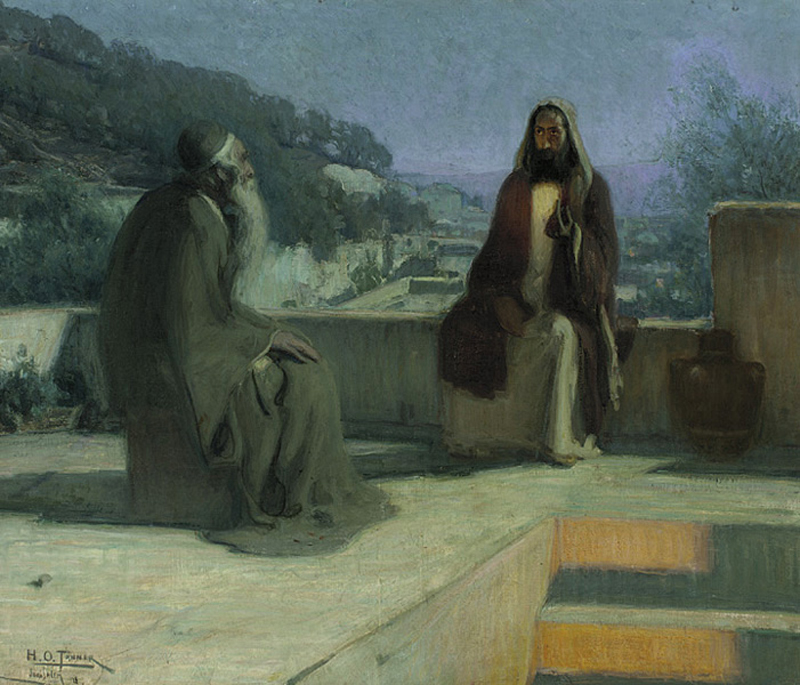
He comes by night. He slips along the buildings of the city streets in hopes that no one will notice. He is a man of position and authority, a learned teacher with a Ph.D. in religion on his way to the kindergarten teacher. “Everything I need to know in life I learned in Kindergarten,” wrote Robert Fulghum. Nicodemus has a sense that he has lost a thing or two along the way, that he needs to start over again.
He’s sent a private message asking for a confidential meeting. The arrangements have been made for the time and place…under the cover of darkness… at Nicodemus’ request.
Dressed in a hooded sweatshirt pulled up around his face and wearing an old trench coat to blend in with displaced people who spend the night on the street, Nicodemus changes his normally stately gait on the way to his secret meeting.
Arriving at the appointed address at the appointed time, he ducks quickly to his left into the alley and darts up the stairs to the flat roof where the kindergarten teacher is waiting.
“Shalom!”
“Shalom aleikem!”
They kiss each other on the cheeks, the left and then the right, as is the custom among their people.
The teacher motions to the wood stool his hands have made for occasions like this. The stool is well-worn by others who have come it at night, some by advance arrangement, others on the spur of the moment, when the darkness outside or within themselves has overwhelmed them and a hot cup of chamomile tea or warm milk won’t help them get back to sleep.
Nicodemus sits on the stool. But there is no second stool or chair. The teacher takes his customary place on the wall at the roof’s edge, his body and face partially lit by a full-moon, the city landscape and the whole world over the teacher’s shoulder, a strange kind of classroom. Nicodemus can see him – sitting calmly, erect, at full attention, his eyes fixed on his eyes, steady and searching and seeing, it seems, what even Nicodemus does not yet know about himself and the real reason he has come.
The man on the wall sits and waits for Nicodemus to break the silence. The wordlessness does not trouble him. He is at home with silence.
“You are a teacher who has come from God because no one can do what you do apart from the presence of God,” declares Nicodemus.
Nicodemus awaits a response to his declaration of honor, but there comes no response except for the eyes beholding him.
Nicodemus fidgets, uncomfortable with the silence. He repeats his declaration, increasing the decibels in case the teacher is hard of hearing, but not so loud as to wake the neighbors, the street people, or the police:
“You are a teacher who has come from God because no one can do what you do apart from the presence of God.”
Jesus gives a slight nod and looks at him from the wall.
“No one can see the kingdom of God unless he is born anew,” he says.
“So it’s about seeing?”
“Yes. It’s about seeing.”
Turning and pointing to the world over his shoulder, he asks Nicodemus, “Do you see this magnificent landscape behind me?… Look at it… Really look… What do you see?”
“I see a mess.”
“Ah, but look again, Nicodemus. You’re looking with the wrong eyes. It is a mess. Anyone can see the mess. If you look, you can see a different outline through the darkness. Maybe you need glasses. Maybe your ears will help you see.”
They fall again into the silence, but the words – “Maybe your ears will help you see” – speak to an inner darkness. Nicodemus looks with his ears at the night landscape and the distant horizon and the stars over the teacher’s shoulder, listening to the faintest sound of a familiar tune they both had learned in kindergarten at the synagogue.
Jesus, is humming. Softly. Without thinking, Nicodemus joins in humming the tune, and then begins to mouth the words, the familiar words spoken quietly by every faithful Jew living under Roman occupation and in the dark nights of the soul, the words sung or spoken in silence by every Jew on the way home from synagogue, a kind of lullaby of faith, a way of seeing with the ears:
“Peace unto you, ministering angels, messengers of the Most High, of the supreme King of kings, the Holy One, blessed be He.” (repeat twice)
“May your coming be in peace angels of peace, messengers of the Most High, of the supreme King of kings, the Holy one, blessed be He. (repeat twice)
“Bless me with peace, angels of peace, messengers of the Most High, of the supreme King of kings, the Holy one, blessed be He.” (repeat twice)
“May your departure be in peace, angels of peace, messengers of the Most High, of the supreme King of kings, the Holy one, blessed be He.” (repeat twice)
“For He will instruct His angels in your behalf, to guard you in all your ways. The Lord will guard your going out and your coming in from now and for evermore.”