
Every head was bowed

A reader of yesterday’s “On the Ship and on the Train” left a comment. The post featured this photograph of my father and his Army Air Force unit on board ship on the high seas on their way to Saipan in World War II.
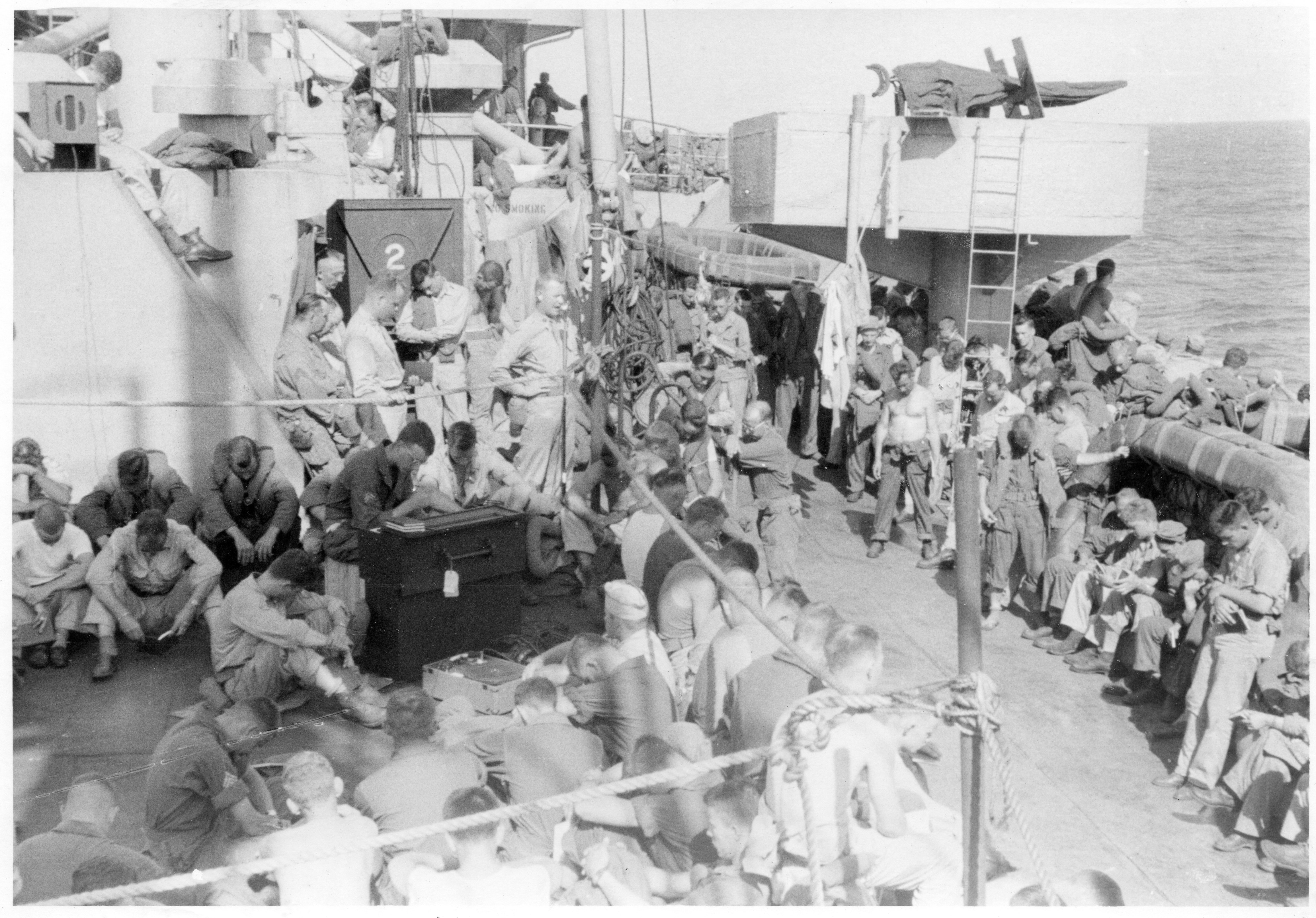
My father, the Chaplain, on board ship to Saipan, WW!!.

My father, the Chaplain, on board ship to Saipan, WW!!.

Karin wrote:

“I clicked on the picture which made it large enough to fill my screen… I was amazed. Every man’s head was bowed. That brought a realization that they all knew what they were headed towards. Profound.”

My father was the Chaplain leading the prayer. Indeed, EVERY HEAD WAS BOWED.

Prayer came naturally to him. My brothers and I were blessed by his prayers every night at the dinner table. His head would bow. My mother’s head would bow. Our heads would bowed. There was a short, reverent silence – a time for centering, as we would call it today – followed by words. He addressed the Divine as “Thou”, not the familiar “you”. Antiquarian by contemporary standards, there was never any question that the “Thees” and “Thous” were not spoken to another one of us.

A remnant of his prayers – a sample of the kind of prayer by which he led the soldiers on the ship – was left in my possession in his old Bible.

God our Father, who hath commended thy love for us in that while we were yet sinners, Christ died for us: worthy was the Lamb that was slain to receive honor and glory and blessing.

Remembering once again him again whom we have pierced by our selfishness and folly, we acknowledge our sins and beseech thy forgiveness. We would learn of thee to forgive,  with thee to suffer, and in thee to overcome. Lord, in thy great mercy we ask that thou remember us now in thy kingdom – confirm our faith.

Forbid that we forget among our earthly comforts the mortal anguish our Lord Jesus endured for our salvation. As we behold him following the way of faith and duty even to the crown of thorns and the cross, grant us grace that we may learn the sterner lessons of life.

So endue us with power from on high that taking up our cross and following our Savior in his patience and humility we may enter in the fellowship of his sufferings and come at last to dwell with him in his eternal Kingdom.

I learned to pray at my father and mother’s table. Over time his theology changed in many ways, but his faith in Divine Goodness never waned.

In my last conversation with him before he died, I asked, “How are you doing with your faith?”

“Good,” he said with the heartiest smile his Parkinson’s would allow. He died two days later. His head was bowed.

On the Ship and on the Train

I was 18 months old when my father shipped out for Saipan in the Mariana Islands of the South Pacific in WW II.

My father, the Chaplain, on board ship to Saipan, WW!!.

My father, the Chaplain, leading worship on board ship to Saipan, WW!!.

I don’t remember the ship. But I remember the emotional wake its departure left behind: the memory of my mother crying on a train. The sounds of the clicketty-clack of the wheels rolling down the track and the whistle blowing like a lost child in the night still plunge me into existential loneliness.

Late in her life, I shared with my mother the memory or her crying on the train.

Because I was so young when it happened, she was surprised that I remembered it, She confirmed it in great detail.

Dad felt “a call” to stand with the brave men who were risking their lives in the war against fascism and imperialism. With my mother’s blessing, he resigned his pastorate in Mechanicsburg, PA to enlist as an Army Air Force Chaplain. After six-months in the States, he left my mother and me behind.

While he was preaching on board ship, my mother and I were on a train from Los Angeles, his point of departure, to Boston, the home of my paternal grandparents.

I never saw the photo or thought of him aboard ship until a phone call and subsequent picture arrived by email from a researcher of my father’s unit on Saipan last month.  Dad was tending his “flock” on board ship. I never knew. Some things, like wine, take time.

Not everything is as it seems or feels. We do the best we can and pray it’s good enough.

Sheep and Goats

Being without a pulpit doesn’t stop the yearning for study and communication. Today Dean Seal stood for the first time in the pulpit where I once stood. I rejoice with Dean and the dear people of Shepherd of the Hill as they begin this new ministry together.

But I also sense the loss of the community that has been Kay and my home for the past eight and a half years. So I do what I have always done. I look at the texts for the day, ponder their meaning, and write about them.

The Hebrew Bible text for today – the last Sunday in the Christian liturgical calendar, “the Reign of Christ” Sunday – is from Ezekiel 34. It reads, in part:

I myself  [i.e. God] will be the shepherd of my sheep, and I will make them lie down, says the Lord GOD.

I will seek the lost, and I will bring back the strayed, and I will bind up the injured, and I will strengthen the weak, but the fat and the strong I will destroy. I will feed them with justice.

Therefore, thus says the Lord GOD to them: I myself will judge between the fat sheep and the lean sheep.

Because you pushed with flank and shoulder, and butted at all the weak animals with your horns until you scattered them far and wide,

I will save my flock, and they shall no longer be ravaged; and I will judge between sheep and sheep.


– Ezekiel 34:15-22

Ezekiel is spoken to the exiles, the aliens in a strange land – you might call them “immigrants” or “exiles” or “refugees”. Or “undocumented workers” who labor for peanuts without the protection of the law.

Ezekiel’s 34th chapter looks to David, the leader of the nation, to be God’s agent to rescue them. Or maybe, in our time, a distant relative named Barack.

During the time I worked outside the church at the Legal Rights Center in Minneapolis, a group of undocumented workers came to the Center. The Hispanic/Latino Community Advocate had identified their need and had convinced them that the LRC was a safe place to bring their case.

Six Mexican “employees” of a cleaning service that sub-contracted for janitorial services at the Mall of America in Bloomington, Minnesota had not received their wages for the past six weeks. The company knew their workers had no recourse. The law was against them; deportation was always one step away. The employer was confident in its privileged position. Those who withheld their wages had not yet read Ezekiel’s proclamation: “I will seek the lost, and I will bring back the strayed, and I will bind up the injured, and I will strengthen the weak, but the fat and the strong I will destroy. I will feed them with justice.”

It took one phone call to the employer to get these men the wages they and their families had been wrongfully denied.

Let those who oppose Immigration reform legislation in the United States of America read Ezekiel, or sit in on the conversation at the Legal Rights Center. Then let them think again about President Obama’s compassionate speech on immigration policy reform and pass the bipartisan bill languishing the House of Representatives.


The Distant Murmurs of Prayer

“In our imaginations, we listen for the distant murmurs of prayer,” wrote Dennis Aubrey in his post “In Seclusio at Thines” posted on Via Lucis Photography.

Listening for the distant murmurs immediately brought to mind a hymn composed by Anne Quigley in 1992. The tune is LONGING. The textual refrain is:

“There is a longing in our hearts, O Lord, for you to reveal yourself to us. There is a longing in our hearts for love we only find in you, O God.”

It was the recollection of the text that drew me to LONGING. I searched YouTube for possible videos for this post but found that the lightness of the tune, like so much contemporary Christian music, left me longing for “the distant murmur of prayers” that echo down the ages in the Gregorian Chants once sung in the now empty or mostly empty monasteries and churches that inspired Dennis to conclude “In Seclusio in Thines”:

“[PJ and I] … hear the echoes of sandaled footsteps in lonely churches long deprived of their monastic communities. And in our imaginations, we listen for the distant murmurs of prayer.”

I long for gravitas awakened by the beauty of silence.

Two Presidents – November 22, 2014

Today is the anniversary of the assassination of President John Fitzgerald Kennedy (JFK), 35th President of the United States of America.

Who killed JFK remains a question for the ages. Someday, perhaps, we will learn the truth of why and by whom he died, but for now the story must be told again, remembered for what it was and for what might have been.

Some things are,
or, so it seems,
“not meant
to be”

Things like
Jack and us
that almost
were

Yet some things,
I repose,
never fade
or die away

Some things not
“meant to be”
like Jack and me,
live on

As things that are,
I surmise,
not meant
to die

For love is not
a thing,
an object that
can die

It hangs around,
like time,
in spaces all
its own

– GCS, Nov. 22, 2014


It must be remembered and mourned afresh today when hatred for his successor runs rampant and “lapses” in White House security inexplicably abound. One theory of President Kennedy’s assassination includes not only a rogue element of the CIA but also the Secret Service, charged to protect the President. Prayers are in order for the President who stood tall this week in his speech on immigration reform.

For our President, Barack, for the leaders of the nations, and for all in authority, let us pray to the Lord. Lord have mercy.

For the poor and the oppressed, for the unemployed and the destitute, for prisoners and captives, and for all who remember and care for them, let us pray to the Lord. Lord have mercy.

Defend us, deliver us, and in Thy compassion protect us, O Lord, by Thy grace. Lord have mercy.

[Excerpts from The Book of Common Prayer, Form I, 1979 Pew Edition, page 384.]

The President’s Speech

President Obama rang the bell last night in his speech on immigration. The President is a Constitutional lawyer. He is also a man of faith, a thoughtful Christian who interprets the Bible the way Abraham Lincoln did, and, like Lincoln before him, the President preached to a divided nation from the White House.

He used the bully pulpit to stop the bullying.

“Scripture tells us, we shall not oppress a stranger, for we know the heart of a stranger — we were strangers once, too. My fellow Americans, we are and always will be a nation of immigrants. We were strangers once, too.”

This morning Speaker of the House John Boehner, who for the past year-and-a-half has personally blocked a vote in the House on the bipartisan Senate immigration reform bill, filed a lawsuit, alleging the President has exceeded his authority. Mr. Boehner and others also threaten impeachment.

Very few of us understand the Constitutional separation of powers well enough to assess knowledgeably whether the President has or has not exceeded his executive authority, but given similar actions by every recent President, both Democrat and Republican, the Las Vegas odds-makers would surely lay heavy odds in favor of the Constitutional lawyer in the White House.

Catholic, Protestant, Jewish, Muslim and secular humanist leaders have led the fight for immigration reform for many years. They have commended the President’s actions and have renewed the call for Congress to pass bipartisan reform.

Because they’re not bomb-throwing religious extremists, there likely will be little media coverage of these religious leaders support for the President’s speech and actions. Like Mr. Obama, their faith, and the faith of the people and congregations they represent, are thoughtful and fairly quiet in demeanor. They don’t make headlines. But once in a while, one of gets to preach from the White House.

In the habit of some preachers who invite response from the pews following prayers or a sermon, “Let all the people say ‘Amen!’

Prayer

“She saw him standing in the parlor with his beautiful old head bowed down…praying looks just like grief. Like shame. Like regret.”
Lila, p. 95, Marilynne Robinson, 2014

Head bowed is the posture of humility, the position of a supplicant, petitioner, intercessor, or giver-of-thanks that looks to the eyes of the misinformed like grief or shame or regret. There is certainly all of that in those who pray, but it’s so much more, so much deeper, so much more reassuring.

We are often our own worst enemies. Every experience of the Beloved causes the head to bow and a tear to fall.

Via Lucis (way of light)

Funny how things slip away. Not really funny. Just strange and sad.

Dennis Aubrey’s posts on Via Lucis Photography have been meaningful to me over the past few year. But because i’m technically challenged and just a bit lazy, Via Lucis has slipped out of site. Until tonight. Wondered why Via Lucis was not popping up on my email notifications. I went to see what Dennis Aubrey and P.J McKay were saying, and there it was. Another thoughtful post , on Weeping for Zion, about which Views from the Edge recently published,

If you haven’t yet noticed Via Lucis Photography, it’s worth your time. Few other authors offer such deep insights into the human condition.

Thank you, Dennis Aubrey and P.J. McKay.

Weeping for Zion (Dennis Aubrey)

This post by Dennis Aubrey on Via Lucis Photography is splendid.

Dennis Aubrey's avatar

By the rivers of Babylon, there we sat down, yea, we wept, when we remembered Zion. Psalm 137:1 (King James Bible)

Aleksandr Solzhenitsyn was quoted as saying, “Over a half century ago, while I was still a child, I recall hearing a number of old people offer the following explanation for the great disasters that had befallen Russia: ‘Men have forgotten God; that’s why all this has happened.’ Since then I have spent well-nigh 50 years working on the history of our revolution; in the process I have read hundreds of books, collected hundreds of personal testimonies, and have already contributed eight volumes of my own toward the effort of clearing away the rubble left by that upheaval. But if I were asked today to formulate as concisely as possible the main cause of the ruinous revolution that swallowed up some 60 million of our people, I could not put…

View original post 765 more words

Incredibly American: the ARU

“It’s incredibly un-American. My DNA is offended by it.”

“It” is the National Basketball Association’s salary cap policy. The speaker is Michele Roberts, the new executive of the NBA Players’ Association (NBAPA), speaking in an interview with ESPN. Click HERE to hear the voice and read more. It’s hardly the DNA of America’s union movement.

pullman newsThe NBAPA is the spoiled great-grandchild of America’s early union movement and costly strikes like the American Railway Union’s sympathy strike in the Pullman strike in 1894.

Professional sports in America is just like America. Sort of. A little bit. Kind of.

There’s management and there’s labor. The NBA team owners (management) and the NBA players (labor) are sparring in preparation for their next big event: re-negotiation of the NBA collective bargaining agreement in 2017.

So, In that regard, the NBA is sort of like the rest of America, except for the likes of Walmart where there is no players’ union, just a company without “incredibly un-American” things like salary caps because they pay their employees peanuts.

But NBA players aren’t making peanuts. They’re making millions. A lot of millions!

It’s hard to feel sorry for a player hauling in an $80,000,000 contract, even if his name is LeBron James or Kobe Bryant. It’s also hard to feel respect for a union that represents only the elitest of the elites while other team employees are picking up the peanut shells after the games and working at Walmart.

My DNA is offended by that. It’s offended by the 1%. It’s offended by the owners. It’s offended by the players’ union. It’s offended by the greed and the self-absorption that sees the fair distribution of extravagant wealth among a small fraction of America’s 1% as a justice issue.

Justice is salary caps and earning caps at the top and an earnings floor at the bottom for the folks who pick up the peanut shells after the NBA games and have no bargaining rights at Walmart.

“It’s incredibly un-American. My DNA is offended by it.”

“There is certainly…something wrong in that form of unionism whose leaders are the lieutenants of capitalism.”—Eugene V. Debs (1855-1926) who, while serving a 10-year sentence in a federal penitentiary following the Pullman Strike, received more than a million votes as Socialist candidate for President.