Purple Martin Mansions

Purple Martin

Purple Martin

The early morning is cool and sunny. The walking trail has been shaded by huge oaks, elms, and ash trees, the path shimmering with light and shadow. I come out of the shadows and suddenly it is there: Purple Martin Place, 76 Purple Martin houses on poles reaching for the sky, each one labeled with a number. “ In my father’s house are many mansions” and a host of chirping Purple Martins flying out across the large open field.I remember the Benedictine morning mass at St. John’s Abbey where I had retreated on the hard walk to the end of my 33-year-old step-daughter Katherine’s terminal cancer. RIP.

From their Purple Martin Mansions

The Purple Martins swoon and swoop

O’er the green grass field shimmering

In early morning light cooled by the breeze


A Purple Martin chorus chants its antiphons

En masse above the green grass field,

A purple Benedictine chorus sings praise

To the morning on their way to breakfast.

–          June 1, 2011

Two Views from the Edge commenters found themselves singing the hymn “Morning Has Broken” after reading the poem. Click  to hear and watch a magnificent instrumental and photographic rendering of the hymn. Here’s the first stanza:

Morning hasd broken

Like the first morning,

Blackbird has spoken

Like the first bird.

Praise for the singing!

Praise for the morning!

Praise for them singing,

Fresh from the Word

– Gaelic melody; lyrics by Eleanor Farjeon, 1931

Escaping the Inner Prison

Corinthian Avenue Penitentiary, Philadelphia, PA

I once worked outside this prison as a street worker in North Philadelphia. Young gang members and I played “stickball” on the lawn outside the prison wall. I thought then that the prisoners were inside, and that the gang members were headed for the inside. The rest of us were free…on the outside. Now I see it differently.

We’re all in prison. Yet we’re free. We’re in the prison of deregulated corporate capitalism.We’re back in the Roman Empire, where Paul and Silas were thrown in prison because they dared to interfere with the free market. They freed a young slave-girl who had been put on the street corner as a fortune-teller. She lived on Main Street; all the money from her fortune-telling went to her slave owners on Wall Street.

By rescuing the slave-girl, Paul and Silas were challenging the morality of the prevailing economic system. So the folks from Wall Street seized them, dragged them “into the market place” before those in power and the judges — who were in the hip pocket of those who owned the marketplace and the market — beat them and threw them in prison for advocating “customs and practices” that were unlawful, according to law of the Roman empire. It’s all there in the New Testament Book of Acts. It was unlawful to be moral, unlawful to mess with the economy of a free market.

After beating them to a pulp, the judicial system ordered the jailer to lock them up in the most secure part of the prison — “the inner prison.” It’s always “the inner prison” — the one in our own hearts and heads — whose walls are the thickest. The people who challenge prison security are put in the “inner prison” — solitary confinement.
As Paul and Silas sang and prayed “at midnight” from their inner prisons and all the others were listening, there was a kind of earthquake that shook the foundations of the prison. All the prison doors swung open and everybody’s chains fell off! Everybody’s! And when the jailer woke up to what was happening and drew his sword to commit suicide, Paul and Silas declared that he, too, had been set free from the prison he had guarded.
In September-October 2008 an earthquake rocked the foundations of deregulated corporate capitalism. The earthquake, of their own making, shook the prison walls owned by the big investment brokerage houses and the big banks and AIG, and the inner cell doors had begun to swing open in the hearts and minds of the American people.
But instead of leaving the prison, we stayed in the “inner prison.” We rebuilt the prison, gave the keys back to Wall Street, and chose three square meals a day, a roof over our heads, some chump change for candy and cigarettes, numbed ourselves TV entertainment, and gave the slave-girl back to her owners so we could all dream about a different future. We rebuilt the Wall Street Prison.
What to do? For me, this is a matter of faith. I’m still an inmate of the Wall Street Prison, but my “inner prison” is free. I’m going to keep singing out loud at midnight about human freedom from the prison economy of a deregulated corporate free market that is anything but free. I’m going to walk out of that inner prison by taking my chump change out of the big banks that give $1,000,000 bonuses to the very people who foreclosed on the family of that slave-girl, and I’m transferring all it to the local credit union which belongs to the people. Then I’m going to invite everyone else to do the same.
I’m going to join Paul and Silas and song-writer Timothy Frantzich until everybody’s chains fall off and all the prison doors swing open.
Questions for comment and discussion:
  1. What is “the inner prison”?
  2. How does “the inner prison” work?
  3. Do you agree, in part or in whole, with the commentary?
  4. Where do you agree and disagree?

I’d love to hear from you. Others would, too. Thanks for coming by.

The First Supper

Steve Shoemaker, 4/18/12

Front gate, Ganghwa Anglican Church

With traitors, cowards, doubters he sat down,

he took the bread, gave thanks, passed it around…

With Adam, Eve, and Sarah, Abraham,

with David and Bathsheba:  sinners all.

With you and me, with the whole human family,

he shared the holy cup of salvation.

The water, flour and heat (bread):

his body broken.  Then his blood was shared:

the fruit of the vine, pressed down, runs over

the land–ocean, flood, eternal river…


Give thanks for grace, for love, for mystery.

(Jesus):  This do in remembrance of me.

Barabbas

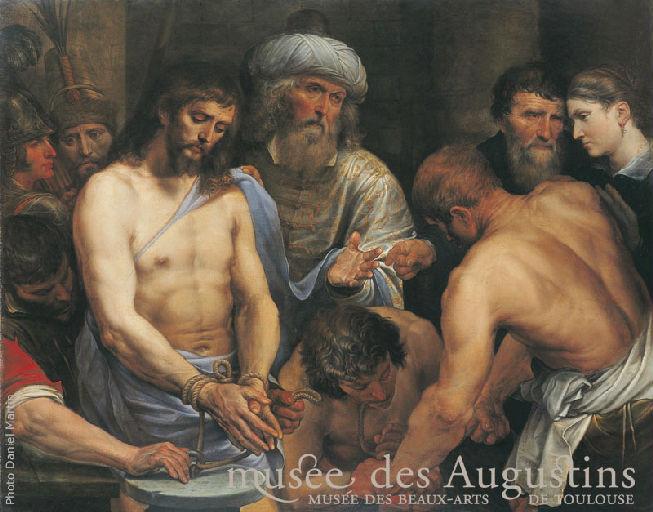
Release of Barabbas - artwork by Wenceslas Coehergher

Another acrostic poem by Steve Shoemaker, April 16, 2012, a reflection from the standpoint of Jesus Barabbas, the man released by Pilate. He is variously described as “among the rebels,” “a notorious prisoner, ” and a bandit/terrorist. Jesus of Nazareth is crucified. Jesus Barabbas is set free.

BARABBAS

Because my father was a Rabbi, when

Assassinations became part of our

Rebellion against Rome, my friends were then

Amazed that I would kill.  But victory

Belongs to us:  power yields only to power.

Being arrested, jailed, soon a martyr,

All will help the cause! Peaceful ways never

Save a soul.  Blood alone will set us free…

The desire for the society that is beyond up-and-down, oppressing-oppressed, haves-and-have-nots takes many forms.  Steve’s “Barabbas” is the son of a peaceful rabbi, a man of peace. Unlike his rabbi father, Barabbas knows that “Peaceful ways never save a soul. Blood alone will set us free.”

What do you think?

Ist Barabbas right that “Power only yields to power!”

Is violence – the taking of blood – necessary “to the cause”?

There are two Jesus figures in the story. One takes life; the other gives it.

How do you understand Steve’s last line?

Stone (Dennis Aubrey)

Stone (Dennis Aubrey) re-posted from Via Lucis: Photography of Religious Architecture (also on Views from the Edge blogroll).

Pontius Pilate

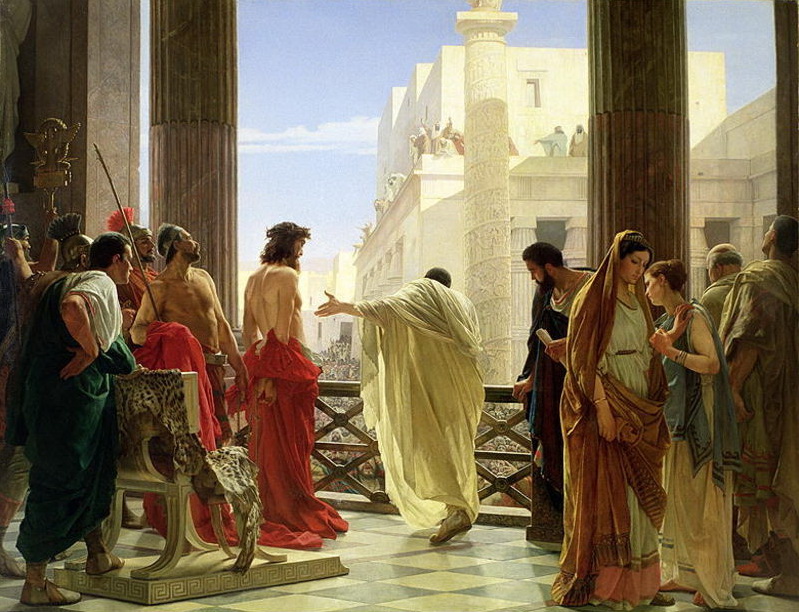
Pontius Pilate with his Prisoner - Antonio Ciseri

Ecce homo - "Here is the man"

“PONTIUS PILATE” – (acrostic) – Steve Shoemaker – April 14, 2012

Position is the most important thing,

Of course…   You say your reign is not in this

Nasty world, but here you are suffering…

Total power is mine.  If this grim choice

I make (and ignore my wife’s dream), nothing

Untoward will come back to haunt me!  I wash

Sand and dirt from my hands as I wash you…


Prefects are not required to be perfect.

If I send tax money to Rome, a few

Lies told against me soon will die.

A sect or uprising I stamp out now will do

The most to make my name remembered. Fact:

Even if I call you “King,” you die a Jew….

If you like Steve’s poem, you might also be interested in “You don’t get to have a non-Jewish Jesus” (CLICK HERE), posted earlier on Views from the Edge on Christian anti-Semitism.

Art work Ciseri, Antonio, 1821-1891. Ecce Homo – “Here is the Man”, from Art in the Christian Tradition, a project of the Vanderbilt Divinity Library, Nashville, TN.  http://diglib.library.vanderbilt.edu/act-imagelink.pl?RC=55115 [retrieved April 14, 2012].

DENIAL

Peter's denial

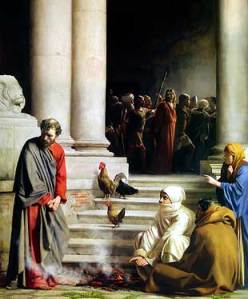
Peter's Denial by Carl Heinrich Bloch

Any faith worth its salt recognizes our capacity for denial, betrayal, and flight, as well as our capacity for truth, love, and courage. Steve Shoemaker’s poem about the Apostle Peter, “the Rock” who crumbled, takes us into the heart of the matter. It;s a reflection on Peter denying that he knew Jesus (represented by Carl Bloch’s painting where he looks away from the woman who claims he knows him) and the post-resurrection appearance where the resurrected Christ offers forgiveness.

“DENIAL” – Steve Shoemaker, 2012


The future Bishop began badly.  He

was “rude, crude and lewd,” as they say.

His fist would shake, would hit,

his mouth could often be a sneer, or leer…

but Jesus chose him first.


The fisherman was big and brash, yes,

bold as well at times.  But after the arrest

a servant girl confronted him and

told those listening that Peter was with Christ.

He swore and then denied it, then again

and still again–she would not stop.


The cry then came of rooster telling of the dawn,

and he wept because he had told a lie.

But Peter felt forgiveness full and deep

when Jesus three times told him,

“Feed my sheep.”

Peter “the Rock” was no rock. Nor are we. He was sinking sand. So are we.

Like “the future Bishop,” we slip badly and yet we are raised up. Betrayal, denial, flight are part of every human story. But grace… even more….so much more, abounds! And to the likes of Peter and of us, there comes to our three-fold denial the Voice of forgiveness with a gentle but bold command: “Re-gain your courage. Live in love!”

In the Strife of Truth with Falsehood

Get ready for the verbal assaults.The PAC ads. The disinformation and misinformation media campaigns funded by big money with big interests that know how powerful words are.

Words are POWERFUL! Sometimes those of us who stand in pulpits doubt that our words matter. But reading this paragraph in Timothy Egan’s NYT,Deconstructing a Demagogue,”reminds me of just how powerful words are:

Back in 1994, while plotting his takeover of the House, Gingrich circulated a memo on how to use words as a weapon. It was called “Language: A Key Mechanism of Control.” Republicans were advised to use certain words in describing opponents — sick, pathetic, lie, decay, failure, destroy. That was the year, of course, when Gingrich showed there was no floor to his descent into a dignity-free zone, equating Democratic Party values with the drowning of two young children by their mother, Susan Smith, in South Carolina.

Today, if you listen carefully to any Gingrich takedown, you’ll usually hear words from the control memo.

And that’s just the beginning of the story of how language is used and abused for purposes of social manipulation. Gingrich knew that language is “A Key Mechanism of Control.”  Those who are well-schooled in theology and politics know that language is the primary mechanism of mind control: truth becomes falsehood and falsehood becomes truth; beauty becomes ugliness and ugliness becomes beauty; goodness becomes evil and evil becomes goodness, twisted by the language of innuendo and word association.

The cynicism that pervades the American electorate is due, in part, to this demagogic use of language. Words are precious things. Holy things. Sacred things. When they get twisted, they become vulgar and profane, one might even say ‘demonic’ in the sense in which Paul Tillich defined ‘demonic’: the twisting of the good. “The claim of something finite to infinity or to divine greatness is the characteristic of the demonic” (Paul Tillich, “Life and It’s Ambiguities,” Systematic Theology, Vol. 1, p. 102).

Paul Tillich, “The Courage to Be”

Paul Tillich was one of the first university professors fired during the Third Reich in 1933. At the invitation of Reinhold Niebuhr, he came to America where he taught at Union Theological Seminary in the City of New York, Harvard Divinity School, and the University of Chicago. Tillich and his academic colleagues in theology, philosophy, and ethics (Willem Zuurdeeg, Martin Niemoller, Karl Barth, Dietrich Bonhoeffer, and Elie Wiesel) left us a rich legacy of linguistic analysis of the language of demagogic use of language.They speak with authority because they each paid a price for their opposition to it.

There are those who say that Hitler won his war after all. His ingenious use of language and rhetoric is the substance of Language: a Key Mechanism of Control. Newt Gingrich is not Adolf Hitler. And we are all well-advised to be very careful with contemporary references to him, the Third Reich, or the Holocaust. Yet the language that once led a nation regarded as “the most sophisticated culture” to swallow the toxin of twisted truth is with us still. The demonic poison how rules the day in America, peddled as cure and candy by candidates bought and sold by the private corporate powers whose PAC ads control the airwaves.

Words are sacred. And those who abuse them enter into the darkness of the demonic twistings that led James Russell Lowell to write the hymn lyrics I sang as a child:

Once to every man and nation Comes the moment to decide, In the strife of truth with falsehood…. Though the cause of evil prosper, Yet t’is truth alone is strong; Though her portion be the scaffold, And upon the throne be wrong;, Yet that scaffold sways the future, And, behind the dim

unknown, Standeth God within the shadows, Keeping watch above His own. – James Russell Lowell, 1945, “Once to Every Man and Nation”

The PAC ads are coming. Plug your ears…or…better yet, listen carefully, listen critically. Then speak out “in the strife of truth with falsehood.”

A Poem for Easter Morning

EASTER MORNING

(double acrostic)


Either Jesus really did rise or

All his followers made up the worst

Series of lies in history…  Poor

Thomas certainly was right to doubt

Even after hearing tales: what four

Reached the tomb (or five?)  Who saw him first?


Matthew says two women, Mark says three;

Or was it just one, as said by John?

Reports of what eye-witnesses can see

Never can be trusted.  Luke said one

In the road joined two who could not see–

Not until he broke the bread…  No one

Got the story straight! Conspiracy?


Even grade school kids could do as well.

And Luke throws in Peter saw him too–

Somewhere unreported…  Who could tell

That this jumble of accounts could do

Enough to give faith and hope to all.

Resurrection?  Who could think it true?


Maybe just the simple:  those whose eyes

Open to the light through grief, through tears…

Reminded of love, of truth, of grace…

Needing to be fed, hands out for bread…

Inspired by the scriptures, in whose head

Grow visions:  life can come from the dead.


-Steve Shoemaker, 2012

The Sin of “American Exceptionalism”

Last night I watched Mitt Romney at a campaign rally in my home town, Broomall, Pennsylvania. What I saw sent chills down my spine. Demagoguery was on display. The people from my home town applauded the scolding of American President for apologizing. No apology for the tragedy of an American soldier(s) walking into the homes of families in Afghanistan to kill. No apology for … well…for ANYTHING. America is the greatest country in the history of the world. We should make no apology, said Mr. Romney.

In light of that speech, I am reposting this piece first published in February. It’s Holy Saturday for me. The one who lay dead on this day was killed, without apology, by The Myth of Roman Exceptionalism. The Roman Empire is long gone. But the myth never goes away. Only the name of the nation changes. Here’s the piece:

Jacket of “My People Is the Enemy”

“The stairway smelled of piss….This [a tenement apartment in East Harlem] was to be my home.  I wondered, for a moment, why. Then I remembered that this is the sort of place in which most people live, in most of the world,  for most of the time. This or something worse. Then I was home.”  – William Stringfellow, My People Is the Enemy: An Autobiographical Polemic.

I’ve been holding my breath, wrestling with whether to speak aloud what I hear and see.

I’m a disciple of Jesus, a Christian, in the debt to the bold witness of the late William Stringfellow, lay theologian. I’m also a religious pluralist. I believe with Chief White Calf of the Blackfeet that there is not just one way, there are many sides to the mountain and many paths on which the Divine Mystery is experienced.

I have learned over the years to respect the multiplicity of ways different sides of the mountain experience the living God. I work hard to understand my Hindu, Buddhist, Muslim, and Jewish neighbors. I often experience these discussions as encounters with God whose vastness, like the ocean, is so much greater than any of the tea cups in which we hold a few drops of the sea.

I also know that some forms of religion are just plain nuts. The religion of Jim Jones whose followers drank the purple Kool Aid in shared suicide in the jungle of Guyana is only the most ludicrous example of why we need to join comedian Lewis Black’s raging objection to political distortions of the truth: “You can’t just make s—t up!” Religion represents the best and the worst of the human psyche (the Greek word for ‘soul’).

Joseph Campbell, among others, long ago opened the aperture on my theological camera. He helped me to see that what we are all dealing with, on all sides of the mountain, is myth, the human spirit’s uniquely creative meaning-making activity that expresses both the grandeur and the terror of finite experience. Myth is not the opposite of truth; it is the story that points us beyond ourselves to the transcendent and the eternal.

My way of looking at the world is shaped by a vast variety of voices. Among them are Fyodor Dostoevsky, Friedrich Nietzsche, Franz Kafka, Jean-Paul Sartre, Albert Camus and Dietrich Bonhoeffer, whose experiences of the horror of the absence of God caused them to poke their fingers in the eyes of prevailing religious traditions whose tidy moral worlds turn God into a cosmic sadist.

Any religion worth its salt in the 21st century has to pass through the existential protests of these thinkers and of the shrieks and cries that still echo across the world from Auschwitz and Buchenwald that poke holes in every theory of a morally ordered universe. The Garden of Eden was lost a long time ago and, in the wake of the closing of the gates to it, any religion has to take account of the human history that looks much more like the trail of tears paved by Cain’s slaying of Abel than like two innocent people in Paradise before the fall.

Yet there is a deep longing for something more tangible, more trustworthy than myth. Something one can touch, see, feel, smell – a story that is not a story but fact. The longing is strongest when we experience great uncertainty and insecurity.

With this perspective, I have been looking again at the fastest growing religion in America, Mormonism, and the Church of Jesus Christ of the Latter Day Saints (LDS).

My first experience with the Mormons came quite by accident thirty years ago. I was riding a bus in New York City on my way uptown to visit African-American theologian James Cone at Union Theological Seminary in Harlem when I noticed the sign “Mormon Visitation Center.”  Already stressed by an unfamiliar transit system and feeling quite alone, I decided to get off the bus and take the tour.

Unlike the streets outside that were filled with trash and lit by flashing neon signs, the Visitation Center was spick-and-span. Everything was in perfect order, complete with a hologram of a Mormon family in a tranquil woods sitting in a circle, listening to the white upper-middle-class family’s father sitting on a stump higher than the other members of the family, reading from the Book of Mormon to an enthralled wife and two perfect, obedient, happy children. The hologram elicited two responses. One was amazement. I had never seen or even heard of a hologram. The other was a sense of outrage at the perpetration of a promise that was, in short, nothing but a hologram, the illusionary projection of someone’s idea of Eden that would strike a chord with visitors who long for the lost woods of the Garden of Eden. It offered a world of perfection: orderly, tidy, white, rural – nothing like the urban world on the street outside – the antidote to the realities and complexities of life in New York City.

When I left the Mormon Visitation Center it never crossed my mind that the Mormon vision or mythology would become the fastest growing mythology in America in the 21st Century. I was relieved to get back on the bus on my way to Harlem.

I ask myself now why this is so. I look again at Mormon beliefs and practices to try to understand.

In Mormon teaching, the Garden of Eden was a historical place, and it was not in the Mesopotamian Valley by the Euphrates River, as in the original biblical myth of Genesis. It was in North America…in Missouri.

“According to Joseph Smith [Mormonism’s founder] the Garden of Eden was located in Jackson County, Missouri and following his expulsion from the Garden, Adam traveled northward to a place near modern-day Gallatin, Missouri. Mormon Apostle Orson Pratt stated that the name Adam-ondi-Ahman “is in the original language spoken by Adam, as revealed to the Prophet Joseph” (Journal of Discourses 18:343) – Bill McKeever, Mormon Research Ministry.

It is to this very spot of physical geography that Jesus will return at the Second Coming. None of this is in the realm of myth. It’s fact. You can go there to touch it and  walk on it, knowing that Adam was there long before you and that, after you have walked there, it will prove to be the epicenter of the universe, the very spot where Christ will return.

Why is the Mormon myth gaining such traction in America? And why would I break the code of silence, the well-advised reticence to those of us who share White Calf’s belief that the Divine Mystery is known differently on different sides of the mountain?

Some things are too important to leave unaddressed. The Mormon mythology is quintessentially American.

The myth that America is the center of transcendent goodness and power, the world’s epicenter, the original Garden of Eden and the place of Christ’s return, the people of “Manifest Destiny”, the one exception to the rising and falling of empires and nations, is losing its hold on us at home and abroad. We are losing our sense of innocence. Yet there lurks the nostalgia for the secure home provided by the illegitimate marriage of Jesus’ gospel of the Kingdom of God with America, “the City set upon a hill” of Jesus’ Sermon on the Mount and of John Winthrop’s sermon to English settlers on their voyage to the new world.

As Nietzsche knew, such gods don’t die easily, even when they’re already dead. When the town crier takes his lantern into the darkened town square at midnight crying “God is dead! God is dead!” in Nietzsche’s Thus Spake Zarathustra, the rest of the town regarded him as a madman. But it would be only a matter of time before the news would reach their ears.  It was the god of Western civilization that Nietzsche’s madman pronounced dead.

When something dear to us dies, especially when it is the prevailing religious myth of a nation about its own holiness and invulnerability, we become like starving people who continue to look in the same old bare cupboard for bread.

What better place to go than the reassurance that America is still the center – the ancestral home of a real man named Adam, who came complete with his own (now lost language, the special place to which Jesus (who visited the lost tribe of Israel in the Americas between his resurrection and bodily ascension into heaven) will return? When the Christian story the story is concretized to a finite, mortal place, it power as myth – pointing us beyond ourselves to the transcendent and the eternal – is not only lost but turned on its head.

There are many sides of the mountain, and it behooves all of us to approach people of different religious traditions with open ears and open minds. But approaching another’s religious beliefs respectfully does not require that we pretend not to see what we see or that we conclude that all religions are really the same or that one opinion is as good as another in the free market of religious truth claims. “You can’t just make stuff up!”

Let me say without hesitation that what I see in Mormonism is but the most exaggerated illustration of the idolization of the nation that includes so much of the American churches of whatever stripe where the nation is enshrined as God and where patriotism is the unspoken highest virtue with the cross wrapped in a flag.

The American wars of foreign intervention in Vietnam, Iraq, and Afghanistan could not have happened without this widespread faith in American goodness and exceptionalism. It is the cardinal sin that afflicts us across all denominational and religious lines. Whenever the Jesus executed by the Roman Empire becomes the Imperial King of a new empire, those who continue to hear the shrieks and cries of the world that suffers – and who continue to smell the piss on the stairway in the place we call “home”- are obliged to break the silence, violate the code, and get back on the bus to Harlem.