Same-sex Marriage

 “What does Obama’s announcement {supporting same-sex marriage) mean to you? Will it make any difference in your life?” asked CNN’s blog this morning

Here’s how I responded:

“The President’s declaration has not changed my life, but it has moved it one step closer to leaving behind the trail of tears the church has inflicted on its own members. I am a pastor. My family and church are straight and gay. I have shared the tears and listened to the sobs and shouts. I have cried their tears and shaken my head and wanted to make a fist.

“Here in the state of MN a referendum to amend the State Constitution –  similar to the one that just passed in NC – will be on the ballot.  I cringe that the proponents of the amendment – the opponents of marriage equality – often do so “in the name of Christ,”  ignoring the fact that we have nothing to indicate any statement by Jesus on this issue, while at the same time they ignore the Beatitudes and other teachings of The Sermon on the Mount that clearly oppose the church’s endorsement of and participation in state-sponsored violence and war. It saddens me.

“My family makes no distinctions among us. Orientation is orientation.  Families, churches, and cultures change slowly, and sometimes tumultuously

“My professional life will change when both the church and the state celebrate the commitment of two people, regardless of their gender, to the estate of marriage. Until then… every heterosexual wedding celebration will also remind me of those who cannot celebrate the same.

“A comedian once asked why GLBT folks shouldn’t be allowed to be as miserable as we (heterosexuals) are. Misery and joy do not reside within the lines we draw between “us” and “the other.” My gay son pays little attention. He’s not married, and, although his state permits it, he has chosen otherwise. But, in the event he decides that the blessings and miseries of marriage are for him, the choice should belong to him and his partner of 12 years. And, in the event he should so choose, the church should be there to celebrate and share the cake. When that day comes, my life will have changed.”

How would you respond the CNN question? Leave a comment to generate the discussion here.

And, if you’re looking for a welcoming church, stop by Shepherd of the Hill Presbyterian Church in Chaska Sunday morning at 9:30. Whatever your opinion, or any other source of division – no matter who you are – you’ll be welcome.

The Trinity

The Trinity

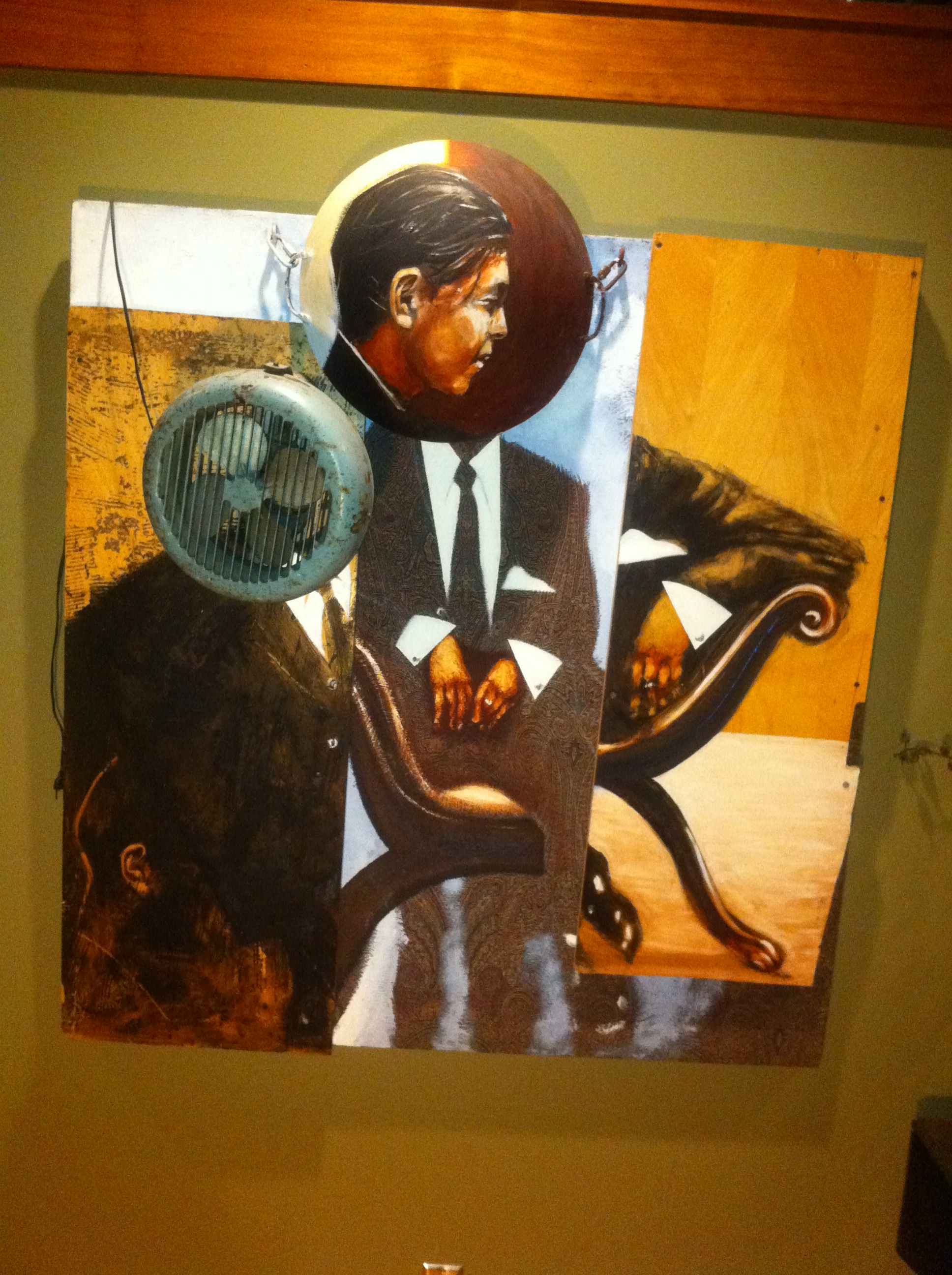
This piece of art hangs in my friend Steve’s living room on the Illinois prairie. I’ve always thought it was a little weird.  Actually, more than a little. Here’s Steve’s interpretation. I never would have guessed. He calls it

“The Trinity”

It is a triptych, three panels joined together.

There are three hands, three feet, three heads (see the profile– lower left).  White triangles are found everywhere.

The fan (pneuma) is, of course, the Holy Spirit.

The prayer- hearing ear of the unseeable God is just barely discernible in faint profile.

The painted wok, an ethnic face, a real human naturally is Jesus Christ. Christians remember him with food…  The brand of found fan is “Tripl-aire.”

Dave Ellis, a big city, secular painter, is the grandson and the son of a pastor.

Steve Shoemaker, Urbana, Illinois, is host of  “Keepin the Faith…” @ http://www.will.illinois.edu/keepinthefaith. This Sunday (May 20), his guest is Pulitzer Prize-winning author and Professor Garry Wills of Northwestern University on “Ambrose, Augustine and the Mystery of Baptism”


The Missing Shoes

Gordon C. Stewart – copyright – a memoir

Five years before my father’s death in July of 1999, the first of many false alarms had called me home to Pennsylvania.  I had brought some reading material for the flight from Minneapolis to Harrisburg – James Carse’s Breakfast at the Victory, an autobiographical reflection on the mysticism of ordinary experience.

I sat down for the flight, strapped myself in for take-off, opened to the Preface, and soon found my eyes flooded with tears.  Dad had developed Parkinson’s and had been hospitalized following a fall and several transient ischemic attacks, i.e., small strokes that had left my mother in a constant state of worry.  I could see him wasting away, yet his spirit was strong and he continued to insist that my brother Bob sneak him over to the golf course for nine holes.  “Dad, I’d love to, but you can barely stand up without a walker.  How you gonna play golf?”  “I can do it!  I can still swing a golf club.  Come on, just drive me over.”  “I think Mom might have some thoughts about that!”  “Come on.  Just you and me – Mom doesn’t ever have to know.”

So there I sat, strapped in, reading the Preface, the story of James Carse’s visit to this friend Charles who was dying of cancer.  Carse had gone to visit Charles before walking an old pilgrimage route in Spain that leads from the French border to Santiago de Compostela in northwest Spain.

“Maybe you’ll find my boots in Spain,” said Charles.  “They just gave out.  So I put them on a stone wall by the road and limped on my bare feet.”

As Carse made his solitary pilgrimage across Spain, slogging through the mud and cow dung produced by heavy rain and snow, he came upon “the outline of a familiar object crushed in the mire.”  He tugged at the old boot until it came loose from its moorings in the mud to find the sole gone but its essential structure in tact.  Could it be Charles’s boot?  He took a picture which he presented to Charles when he next visited him.

My face was flooded with tears.  I choked back the sobs.

Charles’s boots had been the essential equipment of a pilgrim, yet in the end they had not served him well.  He had had to make the journey in his bare feet.  So would Dad.  My father’s boots were the role of ordained Minister of Word and Sacrament.  One is ordained for life, he would remind me, not just for a particular job.  Yet I always wanted him to take off his boots, expose his naked self, experience the squish between his toes in the primordial muck that is more real than social roles and expectations, the more ordinary sacred ground that required Moses to take off his shoes.

Thirty-thousand feet in the air, I took out a pen and scribbled in the margin of Breakfast at the Victory:

“Dad and his boots – his soles worn out, only his bare feet for the rest of the journey.  At some point your boots wear out and it’s just you and your bare feet and the mud – the self shorn of the ego.”

I sobbed for Dad.  I sobbed for myself, fearing that he and I would both die with our boots on.  I cried for losing him.  I cried for him to be free.  I cried for barefoot authenticity.

Five years later – it was July – I again flew to Harrisburg.  Expecting my father’s death, I had worn a suit and my black Johnston & Murphy shoes, highly polished by the best shine man in the Minneapolis-St Paul International Airport, as a tribute to Dad – his shoes were always polished – but also because I have inherited Dad’s appreciation of good grooming, especially a pair of good shoes, shined to the max as a sign of dignity and self-respect.

When I arrived at my folks’ apartment at the retirement complex, I took off my shoes and placed them carefully next to the grandfather clock in the living room.  My mother had continued to live in the independent living apartment they had shared until seven months earlier  when Dad’s deteriorating health had required moving him to the dreaded “Care Center.”  The Parkinson’s had left my father weak and wobbly to the point where my mother could no longer manage his needs, and, with great distress, the move had been made that separated them after 62 years of marriage.

My trip to Cornwall Manor, however, had been planned three months before.  I had promised to drive my mother to a Titus family reunion in South Paris, Maine, our version of “A Trip to Bountiful,” a return to my mother’s roots.  When we had laid those plans in April, the doctor had told us that my father had two weeks at most to live.  Believing the end was near and knowing that my mother’s health had declined under the stress of watching Dad slowly fade away, I had made the plane and car reservations in the expectation that the July Titus family reunion would be several months after Dad’s death.

To everyone’s surprise, when it came time for the Maine reunion, my father continued to survive against all odds.  He had broken the doctor’s crystal ball.  Although he appeared to be near the end – his ability to swallow was all but gone – it had been so for some time, and both Dad’s doctor and my parents’  pastor urged us to make the trip for the sake of my mother’s health.  I explained to Dad that I was taking Mom home to South Paris for a few days for the family reunion.  He smiled and nodded his consent, giving approval to meeting her need, knowing, perhaps, that it was the best thing for them both that he slip away without her having to watch and knowing that both he and she would be surrounded by family when he went.

The call came three days later at two-thirty in the morning.  “Mr. Stewart, I’m sorry to tell you….”  “My father’s dead,” I said, less perhaps to make her job easier than to get a grip on death myself.  “We’re so sorry,” she said.  “The girls went to turn him at one-thirty.  He seemed fine.  He was comfortable.  When we went back in at two o’clock, he was gone.  Although we’ve been expecting it for a long time, we were surprised.  I’m very sorry.”

I was two years old again. My mother and I were back on the train following my father’s departure for the South Pacific in World War II.  Only this time he wasn’t coming back.  We wept.  We talked.  We engaged the guilt of having left him alone at the end.  Yet I also believed that it was as it was supposed to be.  My father had gone quietly into the night, knowing that he could go without taking care of my mother or my mother having to take care of him.  It was for her that he had stayed alive; he had received permission to go.  He knew she would not be alone when he went.

While my mother and I prepared to return to Harrisburg, it fell to my brother Bob and sister-in-law Janice, who lived nearby, to gather the belongings from the room at the Care Center and deliver to the funeral director the clothes my mother had carefully laid out on the bed for Dad’s burial – his favorite blue suit, a silk tie, and my father’s favorite blue shirt.

The morning of the funeral, I showered and pulled from the closet the white shirt and tie I had worn on the plane for just this occasion.  All was well.  With the sole exception of Bob and Janice who were to meet us at the funeral home, the family had gathered in the living room and was ready to go.  We were running on schedule when I returned to the grandfather clock to put on my shoes.  No shoes!  My shoes were missing.  I scoured the apartment without success, rifling through the closets of stuff Bob and Janice had brought home from the Care Center..  I was grumping about, cursing my brother for packing up my only good shoes, and in a terrible state of mind when I found the black cap-toed Johnston & Murphy’s.  I breathed a sigh of relief and put them on.  My feet were swimming in them – then it dawned on me: “These are Dad’s!  My shoes are on Dad!!!”

Johnston and Murphy shoes

Johnston and Murphy shoes

Dad was wearing my shoes.  I was wearing his.  Laughter shook the rafters of that living room, relieving the tension of whatever dread was there.  My cousin Gina and her husband Norman from Massachusetts; my brother Don and sister-in-law Bonnie from Kentucky; my son Douglas, who had come in from New York City; Kay, and my mother – all were convulsed with laugher and a lightness of being.  “They’re on Dad.  Dad’s wearing my shoes!”A jovial, somewhat irreverent debate such as only families can have followed.  “I love it,” I said.  “Dad always loved shined shoes and he’s wearing the very best.  He’d like this.”  “No, why don’t you call the funeral director,” Mom said, “You should have your own shoes.  Those shoes may feel okay now, but they’re going to kill your feet by the end of the day.  You need your own shoes.  Besides, I don’t think they bury them with their shoes on.”

“Well, I wonder,” I said.  “How in the world would they be able to get those on him – they’re two sizes too small.  His feet must be killing him!”

At the funeral home we made the switch, giving the director Dad’s shoes, just in case those who major in illusions are right and shoes are part of the pilgrimage to the other side.  Which, of course, they aren’t.  We all go out with bare feet.

Over the five years between the first summons to Harrisburg and my father’s final breath, Dad and I had each discovered his bare feet.  Each of us had begun to learn not to try to fill shoes that aren’t ours.  For Dad it was the shoes of Harold, his older brother and a family icon.  For me, it meant exchanging my father’s and my uncle’s imagos for their humanity.  Physical weakness has a way of compelling onlookers to see reality.  Any illusions about enduring greatness are dashed by the ticking of time in the human body.

Yet if I had made some progress toward releasing myself from the icon of my father’s goodness, I have also learned that the recovery is never quite complete.  Expectations lurk in the night, waiting to cast their shadows.

Sometimes a shadow crosses over us and we don’t even know it.  One crossed over me during the funeral service, although I did not recognize it until two weeks later, when the presiding pastor, Richard Cassel, a wonderful friend to my parents who had urged the trip to Maine, started his homily with the question “Should I eulogize Ken, or preach the gospel?”

He went on to say that everyone there would want him to say something personal about what a gift from God Ken Stewart’s life was for us all.  He extolled his selfless, joyful giving of himself for others.  He did not say, nor perhaps did he know, that it was hard to tell how much of my father’s generosity and “selflessness” arose from his need to win others’ approval, how much of it arose from the stolen self-esteem that lived in Harold’s lengthy shadow, how much of it arose from the unconscious suppression of his own needs, and how much arose from the call to follow his Lord.

Yet for all of that, the pastor’s words rang true: “He had all the dignity of his calling without one bit of the pomposity that sometimes afflicts lesser clergy-folk; all the confidence in the truth of the gospel without one  wit of judgment or condemnation for those who believe differently.  Ken was a proud man – proud of his family first of all – his beloved wife, Muriel, who was his devoted, loving, caring partner in all the ups and downs of life – proud of his three sons, all of them giving their lives to helping, healing, encouraging others, and of their families – proud of his Scottish ancestry (even his golf game!) – of his profession – proud, but without one molecule of arrogance.  He was a compassionate pastor and friend whose life was given away to be sure you were certain that you mattered – to him, to God, and that he would do whatever he could to make your life better, happier, more whole.”

All of that was true.  Memory took me back to age 13 when I had brought home a seventh grade report card filled with Fs.  My mother had wept and responded the only way she knew how: “Wait ‘til your father comes home!”  I went upstairs to my room to await his arrival.  The wood stairs in that 125-year old manse creaked with every ascending footstep, but the steps were slow and soft, not fast and hard.  What Dad saw when he entered the room was an ashamed first-born son sitting on the edge of the bed with his head down.  Without a word, he sat down next to me, put his arm around my shoulder and said, “Hi Skip.  It must be pretty bad.  Tell me how it is.”  Compassion was his middle name.  It all rang true.

The preacher returned to his original question, “Should I eulogize Ken or preach the gospel?” and proceeded to bring my father’s answer into that chapel loud and clear.  “Richard, a funeral is an occasion for the praise of God, not the deceased – and I certainly want God, not me, to be praised at my memorial service.  So…preach the gospel, Richard.”

At those words, my body convulsed.  My hand involuntarily squeezed Kay’s and my Mom’s, a vein of grief tapped deep in my soul.  It was as though my father were saying to me, “Gordon, preach the gospel” – the same charge he had delivered to me at my ordination 32 years before, a charge which I had failed.

Again, the preacher’s voice: “I can hear Ken say that to me.  But then it occurred to me,” he said, “that I must not choose between eulogizing and preaching the gospel.  Ken’s life among us was the gospel.”

I wanted to scream:“No! My father’s life was not the gospel.  It bore witness to the gospel, but his life was not the gospel.   My father was not Jesus Christ.  He was just another child of God who struggled to get it.  He was a child of God and of John Thomas and Sophia Campbell Stewart of Prince Edward Island and east Boston, brother of Mary, Harold and Olive, husband of Muriel, father of Gordon, Donald and Robert, who, for a time, bore the privilege of ordained pastoral ministry, his humanity as broken and scarred, as imperfect and flawed and complicated and messy as the worst rogue that ever occupied a pew.”  The preacher had elevated my father to sainthood, to an icon, an image that bears little resemblance to the human reality.

In his best moments my father understood that the gospel is not about our achievements.  In his worst moments of living in the shadow of Harold’s image, he believed it was.  His whole life was a fight against that perversion, that belittlement.  He preached because he needed to be convinced again day by day that there was a greater light than Harold’s shadow.  He preached it, as in an anthem he had written, sung by the Choir of St. Andrews Presbyterian Church at his funeral, “from mountaintops filled with promise” but also “from valleys of deep despair”.  He was a stranger to neither.

Two weeks after the funeral service grief had overtaken me.  I couldn’t sleep.  After several days of waking at three in the morning, I went to a friend to talk it out.  When I told him about the funeral, I became momentarily speechless when I recalled the preacher’s line, “Preach the gospel, Richard.”

I was back in the pew convulsing with unspeakable guilt and sorrow. I could never make it right.

Then I remembered the shoes and recalled my father’s unconditional support during the most traumatic time of my life that had led me to ministry outside the church at the Legal Rights Center. It was right that I have a pair of shoes that fit my own feet.

Dad no longer needed to fill Harold’s shoes.  I no longer needed to fill my father’s shoes.  When the end comes, it is altogether clear.  Our boots wear out.  Bare feet are all we have – just us, our bare feet, and mud, the self shorn of all ego.

Love Will Win

President Obama’s support for gay marriage made headlines yesterday. In Minnesota the issue will come before the voters in November: Should the Minnesota State Constitution be amended to define “marriage” as between a man and a woman? One of my colleagues weighed in on the question from the pulpit of the Oak Grove Presbyterian Church. I post it here because it says more clearly than I what I believe.

“Standing on the Side of Love”
Oak Grove Presbyterian Church
Galatians 3:26-28
Bill Chadwick
Sunday,April 29, 2012

Today I invite us to think together about the amendment that is before the voters of Minnesota this fall that would place into the state constitution the requirement that marriage is reserved for one man and one woman.

I have a pastor friend, now retired, who loved to rile people up.  If I might play amateur psychologist, my theory is that as the child of an alcoholic he was uncomfortable when things were calm.  Well, my parents were teetotalers.  As am I.  I love calm.  I hate conflict.  I would much rather not talk about the amendment.  I do so only because of the ordination vows I took almost 35 years ago.  I am preaching today about the Marriage Amendment only because I am attempting to follow faithfully my Lord and Savior, Jesus Christ.  I might be mistaken.  I once again remind you, that in the Presbyterian way of doing things, “Just because the preacher says it, doesn’t mean you have to buy it.”

I believe that to be faithful the Church always needs to take a stand, just like it did against slavery, just like it did in favor of human rights for women, for people of color.  The Church ALWAYS needs to take a stand on behalf of human rights for all of God’s children.  And especially so when it comes to fair treatment of LGBT folk, since the church has consistently led the way in their persecution.

When my grandchildren ask, “What did you do when the issue of human rights for gay people was still being debated?” I don’t want to have to say to them, “Well, as you know, Grandpa doesn’t like conflict, and I didn’t want to offend people, and I was afraid it might affect contributions, so I kept my mouth shut.”  I especially don’t want to say that if the questioning grandchild happened to have been born gay.

There is so much to say that I couldn’t do it in one sermon, so I put a bunch of stuff in the bulletin handout.  What I would like to do primarily in the sermon is to tell stories, most of them personal.

My story.  It has been a long journey for me to get to where I am today.  The Presbyterian Church was just starting to talk about the ordination of gay people when I graduated from seminary 35 years ago.  The following year was the first vote at General Assembly, when the proposal was roundly defeated.  In the lead-up to that vote I preached a sermon using Acts 10 and 11 as my basis.  That is the story of Peter praying at midday on the rooftop in the city of Joppa.  He has a vision in which a sheet comes down from heaven laden with all kinds of animals, clean and unclean (according to Jewish dietary laws), and Peter hears a voice saying, “Rise, Peter, kill and eat.” And Peter protests, “Surely not, Lord.  Nothing impure or unclean has ever entered my mouth.”  The voice spoke from heaven a second time, “Do not call anything impure that God has made clean.”  This happened three times.  Immediately following, he encounters Cornelius, a Roman centurion who has had his own vision.  Long story short, Peter realizes what the vision was trying to tell him:  It’s time to change his mind!  The gospel is not just for Jews, God’s love is for uncircumcised Gentiles as well.  That is absolutely mind-blowing for Peter!  It’s against the scriptures.  It’s against tradition.  But God was doing a new thing and commanding Peter to get on board.

So the gist of my 1978 sermon was this:  I am still not quite ready to ordain homosexual individuals, but I am open to the possibility that the Spirit might someday change my mind.

Over the next few years I continued reading the latest Biblical scholarship and scientific research.  I met and became friends with several very committed Christian people who happened to be gay.  They had undergone extensive therapy and prayer for years and still couldn’t change who they were.  I finally came to the conclusion that people simply are born who they are; gay people clearly have God-given gifts for ministry and that we should welcome all God’s children to use their gifts in ministry in ordained positions.

And we should encourage people to form committed relationships.  I was happy to bless civil unions.

But marriage?…  It somehow didn’t seem right to me to call a same-sex commitment “marriage.”  Why?  Just pure emotion, tradition, inertia.

Nothing logical about it.  I am embarrassed to say that it was only a few years ago that I moved to the point of fully supporting marriage equality.

Another story.  My younger brother, John, and I were extremely close growing up.  I was so excited when he and his wife started having children.  I didn’t have any of my own yet.  I loved being an uncle.  Many of you had the joy of watching Claire and Jim grow up here at Oak Grove.  A couple of GREAT kids!  Claire grew up, fell in love with a wonderful man, and married him two years ago.  Jim grew up, but when he falls in love he will not be able to marry the one he loves.  By the time Jim was three or four years old, I was very sure that he was gay.  Jim didn’t choose to be gay.  Why shouldn’t Jim be able to share the same right to marriage as his sister does?  Jim has told me that a lot of his relatives got married at Oak Grove and it would mean a lot to him to someday be married here.

One comic has said, “Let gays marry.  Why shouldn’t they be as miserable as the rest of us?”  That may be kind of a funny line.  But I’m not miserable.  My marriage means the world to me.  On Tuesday Kris and I celebrated our 24th wedding anniversary.  My marriage is a place of safety, welcome, commitment, companionship, intimacy, trust.  That can all happen without marriage.  But our relationship is acknowledged, encouraged and celebrated by the world and by the church.  Why should Jim be excluded from that acknowledgement, encouragement and celebration because of an accident of birth?

Marriage says “We are family” in a way that no other word does.

About two months ago while flipping through the TV channels one evening I came across a presentation of the Broadway play, Memphis, which won the Tony Award for best musical in 2010Have any of you seen it?  I wasn’t familiar with it, but the TV program was just starting.  I was quickly captivated and I watched the entire thing.  And then a few weeks ago a touring production came to the Ordway in St. Paul and Kris and I went to it and thoroughly enjoyed it.  (Unlike most straight men I love musical theater.)  The play is set in the 1950s and is loosely based on the career of a Memphis radio disc jockey.  In the musical the lead character is called Huey Calhoun and through the course of the play Huey meets a wonderful singer named Felicia, and eventually they fall in love.   Huey asks her to marry him and she says, “Yes.   Yes, I love you with all of my heart and I would marry you, Huey, …if I could.”  She means, if it were legal.  But he is white, and she is black.  In Memphis in the 1950s it was against the law  for a white person and a black person to marry.

Doesn’t that just make you shake your head in sadness?  In amazement?  I am utterly confident that fifty years from now—or probably less, maybe half that—almost everyone will be shaking their heads about the current ban on gay marriage in the same way that almost everyone shakes their heads at the ban on interracial marriage of a half-century ago.

Even if this amendment passes, it is just a temporary bump in the road on the way to the inevitable.  According to the Gallup Poll (May, 2011) 70% of young people in America favor gay marriage.  When the loudest voices opposing gay marriage come from the Church, it’s one more nail in the coffin…of the Church.  The Church is brushed aside by the younger generation as being narrow-minded, judgmental and irrelevant.

You sometimes hear the statement, “Gay marriage is a threat to heterosexual marriage.”  How so?   Two of our very good friends, Suzanne and Diane, were legally married in Massachusetts eight years ago.  My wife, Kris, flew out to be in the wedding.  We see them socially on a regular basis.  Eight years.  Their marriage has not affected my marriage one bit.  Any more than your marriage (pointing to congregation) or your marriage affects my marriage.  Whom you choose to love does not affect whom I choose to love.

Another story.  About a woman named Ruth.  (I’m indebted to St. Paul theologian David Weiss for this insight.)  You (probably) know Ruth’s words, even if you don’t know her story: “Wherever you go, I will go; wherever you live, I will live. Your people will be my people, and your God will be my God.”   (Where do we so often hear these words?)  This is one of the most often quoted texts at straight marriages.  But these words were spoken by Ruth to her mother-in-law, Naomi.  These words were spoken by a woman whose people, the Moabites, were condemned in the Bible – forever.  She has no business pledging – and fulfilling – a vow of faithfulness like God’s own promised faithfulness. But while her love for Naomi was ethnically and culturally odd and her (later) marriage to Boaz (a Hebrew) was religiously dubious, thanks to her odd love and dubious marriage she became the great-grandmother of King David. Her off-limits love became a blessing. 

I could give other germane Biblical stories:  The stories of Rahab, Hosea, the parable of the Good Samaritan, several women in Jesus’ life, and others.  As Weiss notes, “The Bible is full of stories about a God who welcomes surprising people into God’s family. Stories about heroes and heroines whose praise-worthiness lies in their promised faithfulness to another person.”   (See Weiss’s book, To the Tune of a Welcoming God: Lyrical reflections on Sexuality, Spirituality and the Wideness of God’s Welcome (2008, Langdon Street Press).

If you support marriage equality, what can you do?  Outfront Minnesota is an organization working to defeat the Amendment.  The Outfront folks expect that there will be an onslaught of misleading advertising this summer financed by the Mormon Church and others.  An Outfront trainer noted, “We believe that the way forward is not to be found in loud and angry debate with the opposition.  We think this only entrenches people.  Rather, our research finds that the single most effective way to advance our position is through one to one conversations. So, our strategy over the next months is to facilitate a million conversations. And, we have scheduled numerous trainings to help people plan those conversations, and feel comfortable having them.”  You can find information on the Outfront website.  Please hold gentle conversations with your friends and neighbors.

Final story.  Tuesday afternoon I was toiling away in my study when our receptionist came and knocked on my door to inform me that there was a man here who has just moved from another town and he is looking for a new church and wanted to know about Oak Grove.  I’m always eager to tell folks about Oak Grove so I bounded out to greet him.  We introduced one another and then walked out into the hall where I started to give him a little tour and tell him about the church.  But he stopped just outside the office and interrupted me, “You have a flag out front,” referring to the rainbow flag.

“Yes,” I said.  And I was thinking “Hmm. This could go either way.”  (I remind you that in 2008 a man came into a church in Tennessee with anger in his heart at what he called “liberal gay-lovers” and he opened fire, wounding seven and killing two.)  This was not in the back of my mind; this was in the front of my mind.  Was this man in front of me happy that we had the flag or was he here to set me straight, so to speak?

He continued.  “Does the flag mean you welcome everyone?”

“Yes, that’s what it means.”

A big grin spread across his face and he pumped my hand again.  “That’s what I’m looking for!”  And for the next twenty minutes he told me about his spiritual journey and how he had been hurt by some of his previous church experiences. He said he was looking for a church that would preach positive messages and where everyone was welcome.  At the conclusion of our conversation he shook my hand again and said, “I’ll see you Sunday at 8:15.”  (And he was here.  And he received a very warm welcome from you Oak Grovers.)

We are in the season of Eastertide.  The essence of Easter is the message that Love wins. Why take the temporary detour of this amendment?

 Love will win.

Follow the Money

money - follow the money

money – follow the money

Eight years as Executive Director of the Legal Rights Center, Inc. in Minneapolis confirmed this perspective by Fareed Zakaria.

Money spent on Prisons is rising 6 times the rate spent on higher education  By Fareed Zakaria,  March 25, 2012.

“Televangelist Pat Robertson recently made a gaffe. A gaffe, as journalist Michael Kinsley defined it, occurs when a political figure accidentally tells the truth.

“Robertson’s truth is that America’s drug war has failed and that the country should legalize legalize marijuana. This view goes against the  deepest political, moral and religious positions Robertson has held for decades, so imagine the blinding evidence that he has had to confront-and  that has been mounting for years-on this topic.

“Robertson drew attention to one of the great scandals of American life.
“Mass incarceration on a scale almost unexampled in human history is a
fundamental fact of our country today,” writes the New Yorker’s Adam Gopnik.
“Over all, there are now more people under ‘correctional supervision’ in
America-more than 6 million-than were in the Gulag Archipelago under Stalin
at its height.”

“Is this hyperbole? Here are the facts. The U.S. has 760 prisoners per
100,000 citizens. That’s not just many more than in most other developed
countries but seven to 10 times as many. Japan has 63 per 100,000, Germany
has 90, France has 96, South Korea has 97, and Britian – with a rate among
the-highest – has 153. Even developing countries that are well known for
their crime problems have a third of U.S. numbers. Mexico has 208 prisoners
per 100,000 citizens, and Brazil has 242. As Robertson pointed out on his TV
show, The 700 Club, “We here in America make up 5% of the world’s population
but we make up 25% of the [world’s] jailed prisoners.”

“There is a temptation to look at this staggering difference in numbers and
chalk it up to one more aspect of American exceptionalism. America is
different, so the view goes, and it has always had a Wild West culture and a
tough legal system. But the facts don’t support the conventional wisdom.
This wide gap between the U.S. and the rest of the world is relatively
recent. In 1980 the U.S.’s prison population was about 150 per 100,000
adults. It has more than quadrupled since then. So something has happened in
the past 30 years to push millions of Americans into prison.

“That something, of course, is the war on drugs. Drug convictions went from
15 inmates per 100,000 adults in 1980 to 148 in 1996, an almost tenfold
increase. More than half of America’s federal inmates today are in prison on
drug convictions. In 2009 alone, 1.66 million Americans were arrested on
drug charges, more than were arrested on assault or larceny charges. And 4
of 5 of those arrests were simply for possession.

“Over the past four decades, the U.S. has spent more than $1 trillion
fighting the war on drugs. The results? In 2011 a global commission on drug
policy issued a report signed by George Shultz, Secretary of State under
Ronald Reagan; the – archconservative Peruvian writer-politician Mario Vargas
Llosa; former Fed Chairman Paul Volcker; and former Presidents of Brazil and
Mexico Fernando Henrique Cardoso and Ernesto Zedillo. It begins, “The global
war on drugs has failed … Vast expenditures on criminalization and
repressive measures directed at producers, traffickers and consumers of
illegal drugs have clearly failed to effectively curtail supply or
consumption.” Its main recommendation is to “encourage experimentation by
governments with models of legal regulation of drugs to undermine the power
of organized crime and safeguard the health and security of their citizens.”

“Bipartisan forces have created the trend that we see. Conservatives and
liberals love to sound tough on crime, and both sides agreed in the 1990s to
a wide range of new federal infractions, many of them carrying mandatory
sentences for time in state or federal prison. And as always in American
politics, there is the money trail. Many state prisons are now run by
private companies that have powerful lobbyists in state capitals. These
firms can create jobs in places where steady work is rare; in many states,
they have also helped create a conveyor belt of cash for prisons from
treasuries to outlying counties.

“Partly as a result, the money that states spend on prisons has risen at six
times the rate of spending on higher education in the past 20 years. In
2011, California spent $9.6 billion on prisons vs. $5.7 billion on the UC
system and state colleges. Since 1980, California has built one college
campus and 21 prisons. A college student costs the state $8,667 per year; a
prisoner costs it $45,006 a year.

“The results are gruesome at every level. We are creating a vast prisoner
under-class in this country at huge expense, increasingly unable to function
in normal society, all in the name of a war we have already lost. If Pat
Robertson can admit he was wrong, surely it is not too much to ask the same
of America’s political leaders.”

– appeared on-line, IllinoisDemNews@yahoogroups.com

Sermon: The Estate Sale and a Thousand Years

Click 

This sermon, inspired by a visit to an estate sale and Via Lucis’ photographs of Gothic and Romanesque architecture, was preached at Shepherd of the Hill Presbyterian Church in Chaska, MN.

Ora Labora

Katie delighting in Sebastian

Katie delighting in Sebastian

Today is the second anniversary of Katie’s death after a valiant battle with leiomysosarcoma, a rare terminal cancer.In today’s earlier reposting of Kay’s reflection on her blog, www.rawgrief.com, I quoted the last line of a great hymn.

The composer, T. Tertius Noble, spent his summers in the big house at the top of the wall of Old Garden Beach in Rockport, MA, one block from my grandparents’ home.  Only later in life did I learn that this favorite hymn was composed by the man in the house above the wall at the beach.

Here are the lyrics and an organ rendition of the hymn that flooded my mind this morning, as I gave thanks for Katie and thought of Kay’s reflection.

Come, labor on.  Away with gloomy doubts and faithless fears!

No arm so weak but may do service here; By feeblest agents

may our God fulfill His righteous will.

Come, labor on. No time for rest, till grows the western sky,

Till the long shadows o’er our pathway lie,

And a glad sound comes with the setting sun,

“Well done, well done!”

4:30 am Reflection (during my first few months of grieving)

4:30 am Reflection (during my first few months of grieving).

Kay and her brood -Katie, Andrew, and Kristin

Kay and her brood -Katie, Andrew, and Kristin

Two years ago today we said goodbye to 33-year-old Katherine (“Katie”), RIP. Today her mother Kay posted this amazing reflection. Click the link above the photograph for Kay’s recollection and reflection.

Below is a photograph of Katherine (she preferred her formal name in her adult years) and Christopher (“Chris”), her husband and best friend, during a family trip to Costa Rica in 2009. Chris, you were the best of the best. Payers for Chris Katie’s father, Steve, sister Kristin, brother Andrew, and Kay.  “And a glad sound comes with the setting sun: ‘Well done! Well done!'” – final stanza, hymn “Come, Labor On.”

Katie and Chris on Arenal Volcano, Costa Rica

Katie and Chris on Arenal Volcano, Costa Rica

Stuff

We have so many things

we cannot count them all.

(We’ve added virtual

to piles of actual…)

We’ve had to rent more space–

or buy another house

just to store all our things.

And then we find, of course,

our houses are too small;

we tear them down so all

our stuff, our toys, the things

we bought to sooth our soul

will not have to be thrown

away.  (Because our own

city, village, or town

is surrounded by things

in stinking, seeping hills

of trash, garbage, the frills

we thought were essentials.)

Our hell is filled with things.

– Steve Shoemaker, Urbana, IL, May 9, 2012

“Man and nature belong together in their created glory – in their tragedy and in their salvation.” – Paul Tillich quote on monument in Tillich Park, New Harmony, Indiana.

Paul JohannesTillich's gravestone in the Paul TillichPark, New Harmony, Indiana

Paul JohannesTillich’s gravestone in the Paul TillichPark, New Harmony, Indiana

Inscription on Paul Tillich’s gravestone reads:

 “He shall be like a tree planted by the rivers of water that bringeth forth his fruit in due season. His leaf also shall not wither; and whatsoever he doeth shall prosper.”

– Psalm 1: 3

God above God

A visit to Tillich Park in New Harmony, Indiana, inspired these lyrics. Unfortunately, the blog editing continues to erase the stanza divisions. Each stanza is four lines.

God above God, Source of all Be-ing,

You Whose Name is above all our names:

Help us to kneel; Break down our fences;

Shine through the dark clouds religion has made.

Source of all life, Ground of all Be-ing,

God of the a-corn, the seed and the rain –

Send now your grace, seasons and har-vest,

Circle of life that our hearts have disdained.

Mother of nat-ions, Father of pe-oples,

Known as Allah, Adonai, El-o-him ~

Known, yet not known, Be-yond all perception

But for your grace in all cultures revealed

God of the cross, Life to the pla-net,

You Whom we cross with our gods and our ways –

Raise us to life, breathe now Your Spirit,

Restore us to life as the kin to all Life.

God above God, Source of all Be-ing,

You Whose Name is above all our names:

Help us to kneel; Break down our fences;

Dispel the dark clouds our religions have made.

– Gordon C. Stewart, November 4, 2005

Sung to tune “Dexter”  4.5.7 D with Refrain

http://www.youtube.com/watch?v=aYmXDCTbdak

“God above God” is the language of Paul Tillich for whom God is not a being among others – an object of finitude – but the Ground of Being Itself, the Ground that remains when all of our concepts and idea collapse.

The source of this affirmation of meaning within meaninglessness, of certitude within doubt, is not the God of traditional theism but the “God above God,” the power of being, which works through those who have no name for it, not even the name God.

PAUL TILLICH, SYSTEMATIC THEOLOGY, VOL. 2, P.12

“Man and nature belong together in their created glory – in their tragedy and in their salvation.” – Paul Tillich monument, Tillich Park, New Harmony, Indiana.