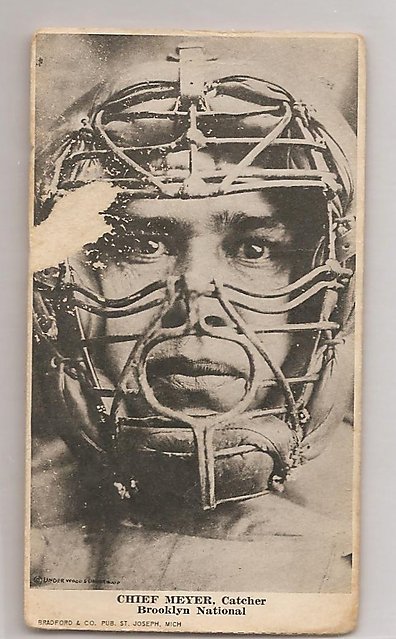
“Chief” Myers

“Chief” Myers
This sermon was preached at Shepherd of the Hill Presbyterian Church in Chaska May 12, 2013 following a trip to Cambria, CA that began with Kay breaking her ankle on the way down the stairs as we were leaving for the airport. The rest is story of William Randolph Hearst desire for a bungalow that ended up as a castle, and an encounter with Mr. Excellent. The fawn story never made it into the sermon because of a forgetful preacher.
The story of the fawn is this. The morning Kay and I were preparing to leave Cambria for the trip home, I noticed a deer in the backyard pacing. There was a fawn lying on the lawn. Examining the fawn, it appeared to be alive, but was not moving, injured perhaps. The next time I looked, its eyes were closed. After examining it, I called the owner of the home we had rented to suggest that she call animal rescue. I thought there was a dead fawn in her back yard.
When we arrived home in Minnesota there was a voicemail that Animal Rescue had come and taken away the fawn only to realize that it was very much alive. It had just been born that morning. Point of the story for a Mother’s Day sermon: God is like that mother, staying nearby waiting for her newborn baby to get up.
A sermon three years after Deep Water Horizon on love, freedom, and caring for each other, the oysters and the crabs in the Gulf of Mexico.
 My younger son is gay. For 12 years he’s been in a committed relationship in New York.
His response to the news that Minnesota will now become a marriage equality state was:
“Great. One more state in which I get to choose not to get married!”
He doesn’t want to get married. He just wants for anyone who chooses the covenant of marriage to have that choice. He just wants to live his life.
In 1978 students at The College of Wooster began “coming out” to me in the safe space of my office at The Church House”, the campus ministry center that housed the offices of the College Church, Westminster Presbyterian Church. I served the dual role of Pastor of the church and Pastor to the College of Wooster.
Dr. Violet Startzman, the physician at the College’s Health Center, came home with the results of a three-year study on homosexuality commissioned by the General Assembly of the Presbyterian Church (USA). Westminster sponsored public forums, adult studies, and less formal conversations about the core finding of the study: same-gender orientation is not a choice; it’s part of the natural spectrum of human sexual attraction and love.
It was in that context that previously fearful or confused students shared in the privacy of the pastor’s office and found affirmation. They were active in the college church. They were ordained (student) elders on the church board.
My story since then is complicated, more so than I would like it to have been, in retrospect. Pastors are teachers and educators as well as advocates. Those of us who seek to minister to a congregation wear the mantle of conflicting responsibilities of conscience, patience, unity, and advocacy. We are first and foremost rabbis (teachers). Teaching is different from preaching, although the good preacher is also a teacher. And teachers begin by respecting their students, no matter what their views are on a given subject. Each of us perceives the world through eyes that see what experience has taught us to see.
When my son came out to us, we were grateful. Grateful for his self-knowledge. Grateful for his trust. Grateful that a (not-so-secret) secret was no longer a secret. So very grateful and proud of who he was as a young man and all that he had done and stood for.
Now, today, I am in Minnesota. He is in New York. I, like him, am grateful that there is one more state in which he can choose whether or not to be married.
“If you believe in GOD’s powers and you ask for help and he doesn’t help you right away, it means he believes in you!
It only takes 20 seconds of insane courage to do the impossible.”
– Ruth J., 9 yrs. old.
After worship at Shepherd of the Hill in Chaska, Ruth and Lily hand me their reflections on the sermon – either in words or in drawings and symbols printed on the backs of yellow visitor/prayer request cards. Their insights blow me away. I look at their cards and ask myself, “Why didn’t I think of that?”
Ruth is a young Paul Tillich:
“Faith is the courage to be. Courage can show us what being is, and being can show us what courage is.” – Terry Lectures delivered at Yale University, The Courage To Be, Yale University Press, 1952.

Missing Something
Stone cold bronze age
Man sits stone cold still
In clothes no ape would wear
Living inside his business suit
Even when alone.
His faceless head retains
the slivered brain of stone-cold
Men who wage the wars
And capitalize on capital
And Capitols.
There is no logic, no capacity
For reason or self-assessment,
Where air blows through the
Empty space a left brain
Might fill.
What’s left is all right and
would still feel and leap
For joy or bow with sadness
Had it not been turned to
Bronze or gold.
His fingers touch left to
Right and right to left
In prayerful hope for the
Missing mind and face, and
Heart of flesh.
– Gordon C. Stewart, May 10, 2013, Chaska, MN
“I will give you a new heart and put a new spirit in you; I will remove from you your heart of stone and give you a heart of flesh.” – The promise for the bones in the Valley of the Bones (Ezekiel 36:26).

Katie and Chris at Arenal Volcano, Costa Rica
It takes awhile sometimes. The stages of grief don’t come in standard sequence like the innings of a baseball game.
In “The Final Time” in Max Coots’ collection of poetic prose, Seasons of the Self (Abington Press, 1971), he wrote:
It takes a little while to know how much of life is death and not to dread it so.
To sense the equilibrium of the earth,
To be at home in time, and take the limits of both life and love.
…
A person’s death is a private thing, like grief, like prayer, like birth.
I know nothing of that final time, except what I know of life,
But I know I live and in my life I have so many opportunities to die,
For death is many things and times,
Before the days are gone,
But I have, yet, a while, and things to be, and much to do.
Max Coots is a poet and Minister Emeritus of the Canton Unitarian-Universalist Church in Canton, NY. His words still echo today as the family gathers to lay Katie’s ashes to rest. Special prayers today for Katherine’s husband Chris, her mother Kay, her father Steve, and her siblings Kristin and Andrew.
It’s the little deaths before the final time I fear.
The blasé shrug that quietly replaces excited curiosity,
The cynic-sneer that takes the place of innocence,
The soft sweet odor of success that overcomes the sense of sympathy,
The self-betrayals that rob us of our will to trust,
The ridicule of vision, the barren blindness to what was once our sense of beauty –
These are deaths that come on so quietly we do not know when it was we died.
Precious Lord, deliver us from these, and grant us peace within the limits of life and love.

Hearst Castle, San Simeon, CA
The Hearst Castle began with Hearst’s desire for “a bungalow” retreat on the site where a tent had always been his preference on vacations there.
William Randolph Hearst (1863-1951) was interesting in so many ways. He attended an exclusive boarding school in New Hampshire and was expelled from Harvard for mischievous behavior, like sponsoring spontaneous beer blasts on Harvard Yard and having potty chambers containing the photographs of professors he didn’t like delivered to their homes and offices.
After Harvard the young Mr. Hearst was given a job by his father, George, in the Hearst family newspaper business. He rescued the San Francisco Examiner from near failure by hiring some of the very best journalists of his time. He purchased other large city newspapers in Chicago, Atlanta, Boston, and New York. He built the Hearst family business into a newspaper, radio, and television news and entertainment empire.
The young Hearst was a maverick and political progressive. He appears to have been a man of conscience. He worked for the end of child labor, championed the causes of organized labor, allied himself with progressives, and, as shown in a film viewed at the end of Hearst Castle tour, called for the redistribution of wealth in America.
“The distribution of wealth is just as important as its creation. Any man who has the brains to think and the nerve to act for the benefit of the people of the country is considered a radical by those who are content with stagnation and willing to endure disaster. If you ask, “Am I my brother’s keeper?” The answer is, “You are.”
Twice elected to the United States House of Representatives (1903 and 1907) as a Democrat, Hearst sought his party’s nomination for President in 1904 but was sorely disappointed that his hero, Williams Jennings Bryant, would not support his nomination. He was narrowly defeated in candidacies for Mayor of New York City (1905 and 1909) and as candidate for Governor of New York (1906). In his second bid for Mayor, he ran as candidate of a short-lived a third party of his own creation, the Municipal Ownership League, formed to defeat Tammany Hall’s stranglehold on the NYC Democratic Party.
By the time of his last run at political office – his bid to become the Democratic Party candidate for the U.S. Senate seat in New York in 1922, backed by Tammany Hall – he had become know for “yellow journalism” whose chief journalistic opponent was Joseph Pulitzer.
“In 1934 after checking with Jewish leaders to make sure the visit would prove of benefit to Jews, Hearst visited Berlin to interview Adolf Hitler. Hitler asked why he was so misunderstood by the American press. ‘Because Americans believe in democracy,’ Hearst answered bluntly, ‘and are averse to dictatorship.’ Hearst’s Sunday papers ran columns without rebuttal by Hermann Göring and Dr. Alfred Rosenberg.” (Brechin, “Imperial San Francisco”, 1999, University of California Press, cited on Wikipedia)
In 1935, John Spivak described Hearst’s “current efforts to scare up the ‘Red’ bogey as one of the first steps in preparing the country for Fascism. Hearst, with his chain of newspapers reaches millions of readers. Just before he started his anti-Red drive he returned from a visit to Germany where he had conferred with Hitler and other Nazi leaders. Shortly after his arrival home he stated in a front page editorial that this country need not fear Fascism, that Fascism can come only when a country is menaced by Communism.” (Source: John Spivak, New Masses, Feb. 5, 1935. Hitler asked Hearst ”
Throughout it all, Hasrst found respite in the lovely hills that quickly rise 1600 feet above the Pacific Ocean shoreline up a winding road in San Simeon, California. As a boy and young man it was his favorite place, a place of extraordinary natural beauty where he was alone.
In 1919, Hearst decided to forgo the camping that had been his practice. He hired Los Angeles architect Julia Morgan to design a modest bungalow.
How, then, did a bungalow turn into a 90,000+ square foot castle that was still expanding when Hearst died in 1951? How did the bungalow retreat become the lavish quarters that hosted George Bernard Shaw, Winston Churchill, Franklin Delano Roosevelt, and Calvin Coolidge, not to mention the host of other high-profile guests from the entertainment industry, newspaper, magazine, radio/television magnates like himself?
Perhaps the better question is why? How is easy. He had the money. He paid for it.
Why is harder and deeper than how. Why would a man who loved to camp under the stars in the clouds overlooking the Pacific Ocean and his own land for as far as his eye could see give up the relative simplicity of a bungalow?
What happens inside a man or woman is always a mystery beyond human understanding at its fullest. We rarely understand our own selves, let along understand what goes on inside the hearts and minds of others. One can only guess at why, but the journey from the bungalow to a castle – or the dream of it – is not far from any of us, if truth be told.
Certainly a bungalow would do. And not just any “bungalow” but one designed by a brilliant female architect from LA (250 miles south of San Simeon). Even William’s bungalow would have been a castle for most Americans. His bungalow would have born little resemblance to the working-class bungalows of Queens, New York or Little Italy in Chicago. It would be a Hearst bungalow. But it would not be a castle.
Touring the Hearst Castle this week helped shed light on why the bungalow mushroomed into a castle.
Ours was a special two-hour handicapped-accessible evening tour. There were four of us with a docent to ourselves. My wife, Kay, qualified for the handicapped tour because she had broken her leg and needed a wheel chair. The other couple was paired, although neither of them was disabled. Long before they climbed aboard the bus, we had been fascinated with the man who seemed agitated that the ticket agents weren’t showing him special deference. Ticket agents are like that. They don’t care who you are. If you’re not next in line, you’re not next and that’s just the way it is, even a the Hearst Castle.
The couple climbed aboard our bus just as we were about to leave. The man, dressed in a black suit with black shirt and black shoes, continued to shake his head. His wife managed a smile our way.
On the tour, the man showed no interest in conversation, but asked lots of questions about Mr. Hearst’s rise to prominence and the fortune represented by the castle itself. He was intensely interested to learn how William Randolph Hearst ended up with a castle.
At the end of the tour, he handed me his business card. “I’m Mr. Excellence. and within five years my real estate company will be bigger than Century 21.”
The business card had two pictures – Mr. Excellent dressed in black, looking very serious; and a black silhouette of Super Man with an E on his chest complete with a cape.
“So where are staying?” I asked. “We’re not staying. We’re driving home tonight. (It’s 9:00 P.M.) “You live nearby?” “No, it’s about an hour south of LA, a five hour drive. We’ll switch off. No problem. We’ll sleep in late in the morning.”
So the man who now boasts of the fastest growing real estate company in all of California drives five hours at 9:00 P.M. instead of springing for a room on the plains below the Hearst Castle in Cambria or San Simeon? It seemed an incongruity, apparent to the inquirer, yet unapparent to the speaker.
More interesting was the question why. Why did Mr. Excellent feel the need to give us his business card and tell us how successful – how important – he was or would become? Why did the young conscientious William Randolph Hearst, the advocate for the redistribution of wealth, forsake his bungalow for a castle?
Pete Seeger is an American legend. But it wasn’t always so. Pete just turned 94.
Spadecaller posted the video on YouTube. He also wrote the following history behind “Where have all the flowers gone?”
On July 26, 1956, the House of Representatives voted 373 to 9 to cite Pete Seeger and seven others (including playwright Arthur Miller) for contempt, as they failed to cooperate with House Un-American Activities Committee (HUAC) in their attempts to investigate alleged subversives and communists. Pete Seeger testified before the HUAC in 1955.
In one of Pete’s darkest moments, when his personal freedom, his career, and his safety were in jeopardy, a flash of inspiration ignited this song. The song was stirred by a passage from Mikhail Sholokhov’s novel “And Quie Flows the Don”. Around the world the song traveled and in 1962 at a UNICEF concert in Germany, Marlene Dietrich, Academy Award-nominated German-born American actress, first performed the song in French, as “Qui peut dire ou vont les fleurs?” Shortly after she sang it in German. The song’s impact in Germany just after WWII was shattering. It’s universal message, “let there be peace in the world” did not get lost in its translation. To the contrary, the combination of the language, the setting, and the great lyrics has had a profound effect on people all around the world. May it have the same effect today and bring renewed awareness to all that hear it.
Click HERE for the transcript of Pete’s testimony before a sub-committee of the House Un-American Activities Committee.
Pete is an American patriot. He stands for the very best of the American character. He has never been intimidated by the likes of Senator Joseph McCarthy whose accusations turn people of courage into quivering jelly. He wrote and sang the songs that still stand up to the bullies who assassinate the character of others by means of innuendo and association. His joyful resilience exposes the demonic (the twisting of the good) character of public manipulation, mass hysteria, scapegoating, and the misplaced patriotism that marches to the drumbeats if war.
Happy birthday, good Sir! Your voice still echoes around the world.
“The Donkey” has been waiting for the right occasion. Dennis Aubrey’s photographs and commentary “The Ineffable” on Via Lucis Photography linking suffering and beauty led me fetch “The Donkey” from the “draft” file today for reasons hard to explain.
What I love about Dennis’s commentaries is that he refuses to engage in simplicities that reduce ambiguity to something manageable.
It led me this morning to The Passion (“suffering”) of Jesus, which begins Palm Sunday with a mistaken public perception: the Redeemer is a King who will vanquish the Roman “King” and who, perhaps, by his “Triumphal” Entry, will triumph over suffering.
The wish to escape suffering is, in some way, the kiss of death. There are Christian theologians today who argue that we should remove the cross as the central Christian faith symbol because it glorifies suffering, shifts the focus away from Jesus’ life, and contributes to the perpetuation of violence. But to do so would be to run and hide from the peculiar mystery of the human condition described by Dennis Aubrey’s piece – the ineffable and the beautiful in the face of suffering. The truth is in the paradox and the contradiction.
Steve’s poem brings all of that to mind. Jesus sets his face toward Jerusalem to free it from its military-economic occupiers and from its own violent self. The Passion continues to arrest our deepest soul in the mystery of life in the face of suffering and the abyss of nothingness. As Dom Sebastian Moore observed, “the crucified Jesus is no stranger” – we put him there…and we are he.
A Poem for Palm Sunday: “The Donkey: a Kid’s Verse…”
The coats the folks are throwing down
sure make it hard for me to walk
especially carrying this clown
whose feet are almost to the ground.
“Hosannah King!” is all the talk,
but this guy seems to be as poor
as I am–no one could mistake
him for a Royal–he’s just a fake!
They wave palm branches, and they roar,
but my long ears can hear the real
parade across the city square:
the General, the Priests, the score
of war horses–the whole grand deal.
This pitiful parade will fail
to save a soul, and soon the yell
will change from “Hail!” to…”Kill!”
– Verse by Steve Shoemaker, Urbana, IL, March 28, 2012
 Views from the Edge