I've always liked quiet. And, like most people, I've experienced the world's madness. "Be Still! Departure from Collective Madness" (Wipf and Stock Publishers, Jan. 2017) distills 47 years of experiencing stillness and madness as a campus minister and Presbyterian pastor (IL, WI, NY, OH, and MN), poverty criminal law firm executive director, and social commentator. Our cat Lady Barclay reminds me to calm down and be much more still than I would be without her.
Going through airport security recently, I thanked the TSA employees for working. Other passengers did the same. It’s an odd thing to do. We expect employees to show up for work. We also expect their employers to pay them for their work. No one can expect employees to work without compensation.
New flag of the TSA unveiled at the TSA’s 2018 commemoration of the 9/11 attacks.
These TSA workers have families. Their needs are not shut down. Only the paychecks that pay the rent and utility bills, the public transportation to and from work, groceries, insurance, prescriptions, and day care for their families are shut down.
Denver Airport security
“Thank you for working,” said the passengers going through the security procedures put in place to prevent another high-jacking like those on 9/11. Their work is essential to national security. Looking back on it, I’m ashamed of myself. You don’t thank hostages for being hostages. You free them from their hostage-taker . . . without paying the $5.1 Billion ransom to make America safe again.
— Gordon C. Stewart, Chaska, Minnesota, January 20, 2019
Readers who aren’t geezers didn’t watch the Howdy Doody Show Monday through Friday from their TV dinner trays.
I was never a big fan of Uncle Bob, the emcee, or the mindless Peanut Gallery that broke into frenzies of foolish applause, but I always chuckled when Mr. Bluster appeared.
In this episode Mr. Bluster insists on the impossible — a ROUND mailing envelope to contestants in the “Bluster Contest.”
All these years later, I wonder whether another Howdy Doody fan in Queens sat like the rest of my generation in front of his television, eating a Swanson’s TV dinner on a TV dinner tray.
“Invisibly, almost without notice, we are losing ourselves” (see yesterday’s post) brought to mind the following piece written in 2007.
Do you ever feel invisible? Ever wonder whether you’re really there? I do. People walk by on the street or in the mall…it’s like I’m not there. People walk by like ghosts talking to ghosts. They don’t see me. They’re somewhere else, not really there. They walk like people; they talk like people; they look like people. But their eyes and ears are somewhere else . . . in some far off place. Their heads down, reading or writing a text or staring into space, babbling to someone who’s not there. I’ve become invisible.
I have the same experience driving to and from work. Drivers cut in front of me or run up behind me. They laugh and smile and wildly gesture, but there’s no one else in the car! When their driving puts me in jeopardy, I honk. They just keep talking. They don’t look and they don’t hear anything but the voice on the other end of the cell phone. Even my Toyota’s invisible; it’s become a non-material world.
Sign along Bellaire Boulevard in Southside Place, Texas
It’s nothing new really. Western spirituality has always been dualistic. It says that we have a body and we have a soul – the physical and the spiritual. We have these bodies for a while, and then we die, but we don’t really die; we just escape these bodies, like birds set free from our cages. This dualistic understanding of life made its way from classical Greek philosophy into the writings of St. Paul as the war between “the flesh” and the spirit. “I’ll fly away,” often sung at funerals, expresses the underlying philosophy. “When the shadows of this life have gone, I’ll fly away Like a bird from these prison walls I’ll fly. I’ll fly away.” The rudeness on the highways, in the malls, coffee shops and restaurants — and even in our homes — is the latest expression of this deprecation of bodily existence.
We don’t see each other anymore. The voice on the other end of the phone is more important than the person in front of me, and the ones I cannot see or hear or receive a text from are unreal…in Iraq, Afghanistan, and anywhere else I decide to hang up and nuke their worlds into the permanent invisibility of nonexistence or the fires of hell.
I sit quietly at the airport gate, waiting for my flight. Used to be people would at least acknowledge one another’s existence – the bare fact that you were really there and not somewhere else or nowhere – but now they’re on their phones, babbling away as though the room were empty except for them. Because, I suppose, we’re ancient Greeks with head sets, cell phones, and iPads, seduced by the old idea that we are meant for non-embodied existence. It’s just me and my invisible world, and you with yours, a rude collection of loud mouths with headsets, alone in the crowd, bereft of the silent pauses between the noises that make us anxious.
Barclay and Kristin pausing on the walking path.
Touch is a basic need. My dog knows it. I know it. Hearing and speaking are important. But the most important communication comes by touch. An animal that goes untouched becomes mad as a March hare. So do we.
In this world of disembodied spirits, we crave the gift of touch. But to touch and be touched is a vulnerable thing. It reminds us of our embodied selves, our mortal selves, our dependent and interdependent selves. The non-material world is safer. Unlike the body, the worlds in our head are invulnerable.
Building of the Tower of Babel – Master of the Duke of Bedford
In my faith tradition, the Feast of Pentecost celebrates the day the babbling stopped, the day the Spirit shifted the crowd’s eyes and ears out of the lonely silos of self-absorption and self-deception — away from their iPhones, iPads, and headsets.
The sound of a mighty wind was so profound, so inescapable and unmistakable, that the company of lonely strangers stopped babbling around the phone tower and noticed the other people around them.
— Gordon C. Stewart, Chaska, Minnesota, Jan. 9, 2019
“Invisibly, almost without notice, we are losing ourselves,” says the quote at the end of this thoughtful reflection. I think of Kosuke Koyama’s metaphor of the three-mile-an-hour God. Why three-miles-per-hour? Because that’s the natural pace of a human being walking.
Physicist, novelist, and essayist Alan Lightman has added his own manifesto, In Praise of Wasting Time. Of course, the title is ironic, because Lightman argues that by putting down our devices and spending time on quiet reflection, we regain some of our lost humanity, peace of mind, and capacity for creativity—not a waste of time, after all, despite the prevailing mentality that we should spend every moment actually doing something. The problem is not only our devices, the internet, and social media. Lightman argues that the world has become much more noisy, fast-paced, and distracting. Partly, he writes, this is because the advances that have enabled the much greater transfer of data, and therefore productivity, have created an environment in which seemingly inexorable market forces push for more time working and less leisure time.
Lightman starts his book with an anecdote from his recent time in a rural…
The Minnesota Scholar, the bi-annual journal of the Minnesota Independent Scholars’ Forum, published this review of Be Still! Departure from Collective Madness in its December 2018 issue.
Psalm 46 tells us, “Be still, and know that I am God.” Gordon C. Stewart, in his collection of essays entitled Be Still! Departure from Collective Madness, meditates on what this means. Is this quietism and withdrawal from the world? Possibly sometimes. But if Jesus bestirred Himself to drive moneylenders from the Temple, how still was He? What consequences would have been inflicted on the sneering Goldman Sachs representatives testifying about their role in the Great Recession described in “American Oligarchy – 4/29/10”? Are stillness and engagement mutually exclusive?
Reverend Stewart did summer internships as a street outreach worker in Philadelphia, worked with a poverty law firm in Minneapolis, and has served in seven congregations and ecumenical campus ministries. Anyone who contributes to Sojourners’ “God’s Politics: Blogging with Jim Wallis and Friends” fits the category of liberal Christian. He recognizes the common ground in the gun debate of fear of the threats of chaos and insecurity and that guns are different realities for rural and urban populations, “The Common Ground Beneath the Gun Debate” and “Reframing the Gun Debate.” However, a description of a call for support from the National Rifle Association indicates he sees the threat from guns, not gun control, “Religion and Politics: Cain and Abel.”
Essays reflect views to be expected from someone with Stewart’s background. He celebrates nature and deplores those who threaten the environment, “Stillness at Blue Spring”, “The World in an Oyster,” and “Climate Change and the Nations.” He deplores a criminal justice system and attitudes which send minorities to prison and death row and makes existing while black perilous, “The Execution of Troy Davis,” “Hands Up! Don’t Carve!” and “Homeland Militarization.” Islamic and other fundamentalisms are seen as evil but the bombings and other military action in retaliation are condemned as, well, “Being Human”, “Creating Hell in the Name of Heaven,” and “Losing Our Heads.” The many sins of capitalism are seen in the context of its victims and protesters, “The Wall Street Tattler”, “American Oligarchy—4/29/”.
The best essays highlight voices of stillness and moments of reflection. Friend Dr. Kosuke Koyama, to whom the book is dedicated, speaks at commemoration of Hiroshima about how the sin of exceptionalism led Japan to self-destruction and threatens the world today, “Only One Sin: Exceptionalism.” Sitting in an Amish rocking chair, Stewart reflects on the forgiveness and kindness extended to the family of a man who murdered Amish school children, “Jacob Miller’s Amish Rocking Chair.” He faces the death of a friend and asks Muslims for prayers and sees that death can be a mercy, “The Waiting Room” and “When Breath Flies Away.” An Airbnb rental in Paris is the apartment of a late Tunisian Sufi poet and novelist whose rooms are filled with books, “The Anguished Heart of God.” He imagines Jesus healing a madman in a Capernaum synagogue in a time too early to have heard the advice that “worshippers should wear crash helmets,” “The Man Who Knew.”
Multiple essays reflect on Stewart’s heritage, especially the coffin makers and others of South Paris, Maine, a town where one is known in relation to the relatives who remain. He sees the tension in St. Augustine, Florida between the local civil rights activists and the celebrities like Martin Luther King and the Southern Christian Leadership Committee (SCLC) who drew more attention. Is it possible to have two Freedom Trails? And is the Civil Rights struggle something historical which happened in the distant past and no longer relevant to later generations?
The essays are preceded by quotes and poems illustrating the theme of the entry. Some of the quoted are well known like Henry David Thoreau, Arnold Toynbee, Wendell Berry, Emily Dickinson, Martin Luther King, Jr., Albert Camus, and Matthew Arnold. Others are welcome discoveries such as Willem Zuurdeeg, a Dutch writer whose parents fought in the Resistance trying to make sense of the fact that civilized Germany could have produced the Nazis,and Stewart’s friend, Steve Shoemaker. The quoteshelp frame efforts to make sense of the world and extract truth from the chaotic events of life.
A collection of essays will, by its nature, be episodic and even disjointed. It is a series of snapshots not a continuous film. Otherwise, it would be a treatise on philosophy or theology. It would be less like life. Although reasoned, the vignettes appeal to emotion which is our ultimate decision-maker. It is a worthwhile work. One may quibble here and there as one will in a conversation, but there are profound truths throughout the work.
As a Baha’i who believes in the oneness of religion, I was hooked at the first essay, “Tide Pools and the Ocean.” Like the proverbial blind men and the elephant, it is easy to mistake one’s tide pool for the ocean, fail to celebrate each tide pool’s unique features, and not see what each really has in common. A good collection of meditations will have something for everyone.
~Steven Miller, President of Minnesota Independent Scholars Forum and participant in a, perhaps, unhealthy number of discussion groups, is a sole practitioner attorney practicing labor and employment for management. He has a B.A. and M.A. from George Peabody College (now part of Vanderbilt University) and a J.D. from Duke University School of Law.
The Minnesota Scholar, Volume 13, Number 2, Dec. 2018.
“All authors want their names to go down in history; I want to keep the smoke coming out of the chimney.” — Mickey Spillane.
Thanks to Steven Miller and Minnesota Scholar editor Evelyn Klein for the smoke from the chimney two years after Be Still!’s publication.
Yesterday President Donald Trump said the government shut-down could go on for months or even years. There will be no end to the Mexican standoff until Congress agrees to fund his campaign promise to build a wall on our southern border.
That’s not what he promised. The campaign promise had two parts. 1) A wall would be built on the Mexican border, and 2) Mexico would pay for it. It wouldn’t cost American taxpayers a dime. If it didn’t happen, he would issue an apology to the electorate.
Mexico refused to pay for the wall. There’s been no apology. What the nation gets instead is a tantrum.
Later in the day, the president pulled out a trump card from his sleeve. He could invoke the National Emergencies Act to declare a national emergency. “I can do it if I want to,” he said at today’s press conference.
The border wall built by Mexico was always a hoax. Now, it’s also a distraction. The wall that’s needed is not made of steel or concrete. It’s built of an informed electorate, on the one hand, and an invisible cyber wall that protects the integrity of the American electoral system and the security of at-risk power grids, nuclear silos, and communication and command networks.
The government shutdown is based on a Big Lie. Or two. Or three.
The Big Truth
There is a real national emergency. It occupies the Oval Office, stands before microphones, and sends out daily tweets to garner attention and continue the hoax. It sits in the offices of the president’s cabinet members who have not the courage to invoke the 25th Amendment that would remove the threat from the Oval Office. It sits in a Congress that has failed to exercise its constitutional duty to oversee the integrity of the government institutions. It comes in threats to Robert Mueller’s investigation into foreign interference in the 2016 American election process.
Joseph Goebbels, Chancellor of Nazi Germany, wrote of the Big Lie as a propaganda technique in reference to the English in “Aus Churchills Lügenfabrik” (English: “From Churchill’s Lie Factory”) dated January 12, 1941: “The essential English leadership secret does not depend on particular intelligence. Rather, it depends on a remarkably stupid thick-headedness. The English follow the principle that when one lies, one should lie big, and stick to it. They keep up their lies, even at the risk of looking ridiculous.” – Aus Churchills Lügenfabrik (“From Churchill’s Lie Factory”), January 12, 1941.
Seventy-eight years after Goebbel’s publication on the lie factory, and 75 years after Joseph McCarthy used the Big Lie here in America, the Big Lie again stares us in the face. So does The Big Truth, as American poet James Russell Lowell expressed it during the American Civil War in his poem “The Present Crisis.” I was raised on the hymn “Once to Every Man and Nation” with the lyrics from Lowell’s poem. It etched in my heart and mind that the decisions we take make a difference to this world.
“Once to every nation Comes the moment to decide In the strife of truth with falsehood. . . .Though the cause of evil prosper, Yet ’tis truth alone is strong. . . . ” — James Russell Lowell (1819-1895), “The Present Crisis.”
What goes around comes around. And some things going around now will come around sooner or later. No one knows when or how. We live between what is coming around and what is now going around.
I’ve been reading a gift from son-in-law Christopher that leads me to break the recent silence on Views from the Edge. It’s the result of investigative journalism that zooms in on one of the most prominent figures of American life.
What’s My Line?
Logo of What’s My Line
Years ago What’s My Line?, featuring celebrity guests like Groucho Marx and a brilliant panel, took over my family’s living room. Moderated by John Charles Daly, members of the panel, which always included Dorothy Kilgallen, Arlene Francis, and Bennett Cerf, were blind-folded before the mystery guest came on stage to answer the panel members’ questions. The mystery guests disguised their voices, and provided the blind-folded panel a tidbit of information as a clue to their identities.
All these years later, What’s My Line? is gone. Now I listen to Wait Wait . . . Don’t Tell Me!Wh
His purpose is power and his strategy to “keep his name in the papers at all costs.”
Patient research into the techniques of his campaigns results in the conclusion that his one all-dominating consideration has been to win at any cost.
To achieve his ends he has failed to repudiate support from . . . some of the most disreputable, hate-mongering, fascist-minded groups in the nation on the far right.
Our danger is that ____ism will gradually grow into a homespun variety of totalitarianism, and will destroy our liberties as surely as Communism would. The antics of ____ism are made to order for the propaganda purposes of international Communism. I am sure that ——ists are not intentionally aiding the international conspiracy of … Communism, but if they were Communist agents they could not be doing a more useful job, from Russia’s viewpoint. The wider ____ism grows, the weaker they leave America, and the stronger the possibility of international Communism.
The Senators unanimously concluded that the ____ election “brought into sharp focus certain campaign tactics and practices that can best be described as. . . destructive of fundamental American principles.”
It was, the report continued, a “despicable back street type of campaign which usually, if exposed in time, backfires.”
Removing the blind-folds
Blind-folded Panel of What’s My Line?
Now we remove the blind-folds. Each of the above clues is a quotation cited in the 92 page 45th Anniversary edition of The Progressive, April 1954 on Senator Joseph McCarthy and McCarthyism. “McCarthyism: A Documentary Record” concludes with these words of counsel:
We of The Progressive are convinced that our best chance to keep the lamps of hope and liberty burning brightly in a world hungry for light and leadership is to deal head-on with the conditions which create the doubts and fears on which McCarthy and Malenkov thrive. The first great step down that road of hope must be to replace “The Big Lie” of Communism and McCarthyism with “The Big Truth” of a working democracy.
What goes around comes around. The Big Lie and the Big Truth come and go with the tides of history.
Live & Learn’s post “Miracle. All of It. (This Year on Earth” brings together changes to Earth in 2018 with the ancient wonder of Ptolemy and Albert Einstein.
Earth picked up about 40,000 metric tons of interplanetary material, mostly dust, much of it from comets.
Earth lost around 96,250 metric tons of hydrogen and helium, the lightest elements, which escaped to outer space.
Roughly 505,000 cubic kilometers of water fell on Earth’s surface as rain, snow, or other types of precipitation.
Bristlecone pines, which can live for millennia, each gained perhaps a hundredth of an inch in diameter.
Countless mayflies came and went.
More than one hundred thirty-six million people were born in 2018, and more than fifty-seven million died.
Tidal interactions are very slowly increasing the distance between Earth and the moon, which ended 2018 about 3.8 centimeters further apart than they were at the beginning. As a consequence, Earth is now rotating slightly more slowly; the day is a tiny fraction of a second longer.
He slinks down Pennsylvania Avenue, head down in a hoodie at 3:00 A.M., disguised as a homeless man, escaping the watchful eye of the Secret Service and the television cameras, returning to the dilapidated tenement in the poorest part of the city.
FBI Unabomber sketch
The tenement dweller who owns nothing has been waiting for him since their last visit. The apartment door is ajar, as it always is, in anticipatory welcome of all the homeless.
“Welcome, Donald. I wondered when we’d have another visit.” As he had during the first visit, he lifts the heavy coat from the visitor’s slumping shoulders, and points to the furniture he’d rescued from a dumpster — an old folding chair missing a slat, and the torn red-leather wingback, facing each other each as they had before. The night visitor pauses and chooses the high wingback.
The scene is the same as previously. The room is dimly lit by a small table lamp, the kind of late night or early morning light that creates an ambiance of calm and invites intimate conversation. The tenement dweller takes his seat in the folding chair. The visitor sits in silence, his hoodie still covering his head, not wanting to be seen, but wanting to be seen. The room is silent.
“I’ve been very concerned, friend. I see you’ve been tweeting a lot again. It must be lonely inside the wall. But it doesn’t show outside your wall. Others can’t see it. The you who’s visible to those outside the wall is cruel, vengeful, because in the world outside your wall And you’ve shut down the government over the wall. What’s that about? Tell me about that.”
“I can’t sleep. The family’s gone to Florida. I’m alone here with no one but the maids, the cooks and the butlers. My mind won’t stop. I watch television to settle down but now it only makes things worse. Even my favorite network may be turning on me.”
“What brings you here? It’s 3:30 A.M.
“I don’t know.” The table lamp flickers.
“Feels pretty dark, doesn’t it?”
“Very dark. Very dark! The darkest ever!”
“Why is that?”
The visitor lowers his head, like a child confessing to his parents. “I have all the power in the world but I’m helpless to help myself. I can’t stop tweeting. It’s like it’s not real. I could destroy the world with the push of a button. I’ve shut down the government. The power scares me. And there are all these investigations. My mind never stops. I can’t sleep.”
The tenement dweller in the small folding wood chair sits quietly in the hush that comes when truth has been spoken. His eyes are full of compassion for the homeless man who had opted for the big red leather wingback. The visitor has regressed since their last conversation. His need for self-assurance has grown worse. The walls have gone up.
“Remember our last visit, Donald? Your disguise is not a disguise. You’re hiding something. Do you ever watch ‘Ray Donovan‘?
Ray Donovan
“No. Why? Who’s Ray Donovan?”
“Ray’s’a fixer’, like Michael, but that’s not why I asked. Ray’s a lot like you, Donald. Ray’s running from what was done to him in childhood. He was molested by the man he trusted. His parish priest. He’s not been the same since. Ray built a wall around his heart. He’s cruel. He’s heartless. But inside the wall? He’s very tender, Donald. He’s homeless within his own wall. You can’t live inside the wall.”
From his small, wood chair, the tenement dweller reaches out his hand. They share a long silence before the host put Donald’s heavy coat back on his shoulders. In the pre-dawn darkness, the disguised night visitor returns to his homeless place on Pennsylvania Avenue. He hears singing from the street below.
“Softly and tenderly Jesus is calling— Calling for you and for me; Patiently Jesus is waiting and watching— Watching for you and for me!
“Come home! come home! Ye who are weary, come home! Earnestly, tenderly, Jesus is calling, Calling, O sinner, come home!” — Will Lamartine Thompson (1847-1909)
The tenement dweller smiles at the sound, but h knows it won’t be long before he comes back.
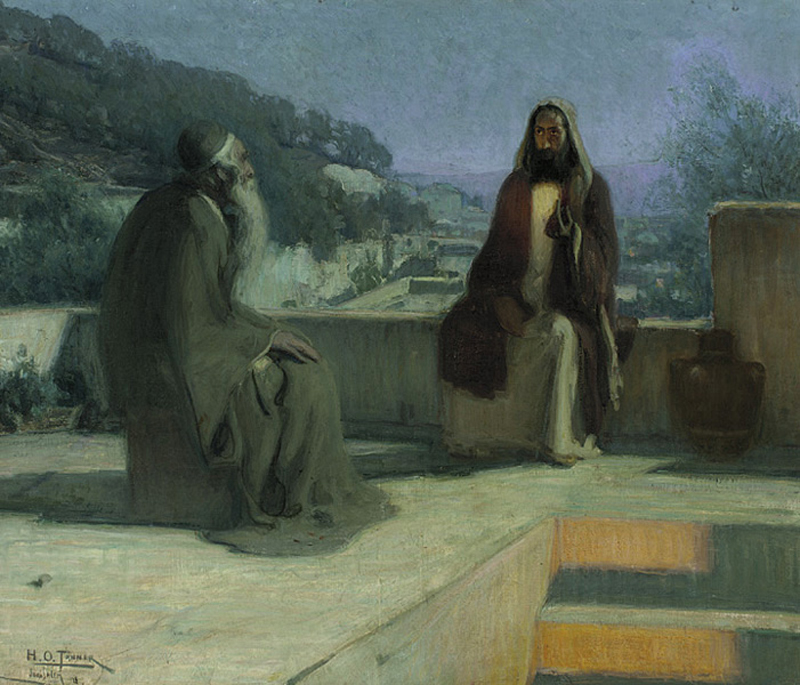
Nicodemus and Jesus on a rooftop, Henry Ossawa Tanner (1859-1937)















 Views from the Edge