Unknown's avatar

About Gordon C. Stewart

I've always liked quiet. And, like most people, I've experienced the world's madness. "Be Still! Departure from Collective Madness" (Wipf and Stock Publishers, Jan. 2017) distills 47 years of experiencing stillness and madness as a campus minister and Presbyterian pastor (IL, WI, NY, OH, and MN), poverty criminal law firm executive director, and social commentator. Our cat Lady Barclay reminds me to calm down and be much more still than I would be without her.

Rubbing My Eyes: How Long, Lord? How Long?

“Watching Dorian’s devastation of the Bahamas while being hit by an avalanche of tweets that treat tragedy as a television opportunity has left me speechless. Nothing from the White House connects the dots — the growing frequency of 100 year storms, floods, and fires (weather) — with an urgent call to act now on climate change. The planet’s lungs are on fire in the Amazon while the man who promises to make american great again shreds established regulations put in place to protect water, air, our forests, and soil. Meanwhile $3.1 B are stripped from FEMA and national security to pay for the wall for which we were promised the Mexican government would pay. I feel like the psalmist. ‘How long, Lord? How long?'”

Those words went up on FB yesterday, breaking a long silence on FB and here on Views from the Edge. That was before reading Katha Pollitt’s piece in The Nation. “Almost Everything Bad that Trump Did This Summer” details some of the Trump Administration behavior between June 3 and September 1, 2019.

  • Gordon C. Stewart, Chaska, MN, September 6, 2019

Elijah on The Three Little Wolves and the Big Bad Pig

ELIJAH WATCHING THE BIG BAD PIG ON MOM’s iPAK

Photo of Elijah in bed watching the story of The Three Little Wolves and the Big Bad Pig on an iPad.
Two year old Elijah learns of The Three Little Wolves and the Big Bad Pig

CONVERSATION OF ELIJAH AND BUMPA (GRAMPA) ABOUT THE BIG BAD PIG

Good morning, Elijah! You look happy this morning. Whatcha doin’?

Watchin’ a story on Mom’s iPak. I love Mom’s iPak. This one’s REALLY good, Bumpa!

You mean ‘iPad’. What’s it about?

Three liddle wolves and the big bad pig. You know the story!

Hmmm. Well, I do know a story, but I think you have the characters backwards. It’s three little PIGS and a big bad WOLF!

Uhuh! I’m watching it right now, Bumpa. It’s real! The Big Bad Pig destroys the three houses of the three liddle wolves.

There’s a story Bumpa and Gamma grew up with, but it’s the Big Bad Wolf who’s bad. The Big Bad Wolf huffs and he puffs and he blows down two of the three little pigs’ houses but can’t blow down the third little pig’s house because the third little pig build his house of brick. The Big Bad Wolf couldn’t blow it down.

Nope! Different story! This is about the Big Bad Pig. Pigs are greedy, Bumpa. Pigs are nasty! The Big Bad Pig blows up all the houses, even the one made with brick and the one made of concrete. But then the three liddle wolves give up on security. They build a house made of flowers!

So they’re hippies!

What?

Hippies. Hippies were the “flower children.” People who wanted to make America better by ending the Big Bad Pig’s war in Vietnam. Hippies wanted peace.

That’s over my head, Bumpa! I don’t know about Vietnam! Gamma doesn’t talk like that. She knows I’m just liddle. She still changes my diapers. You never ever change my diapers! I like Gamma better!

I’m so sorry, Elijah. Gamma is a much better person than Bumpa.

But here’s the thing. The Big Bad Pig is at the G-7 meeting insulting America’s friends, and we’ll be stuck with his mess!

READ ALONG WITH ELIJAH ON MOM’S IPAK.

Gordon C. Stewart (Bumpa), Chaska, MN, August 24, 2019

In Search of Rest

“To rest is to give up on the already exhausted will as the prime motivator of endeavor, with its endless outward need to reward itself with established goals. … To rest is to give up on worrying and fretting and the sense that there is something wrong with the world unless we are there top put it right.” - David Whyte, Consolations: the Solace, Nourishment, and Underlying Meaning of Everyday Words.
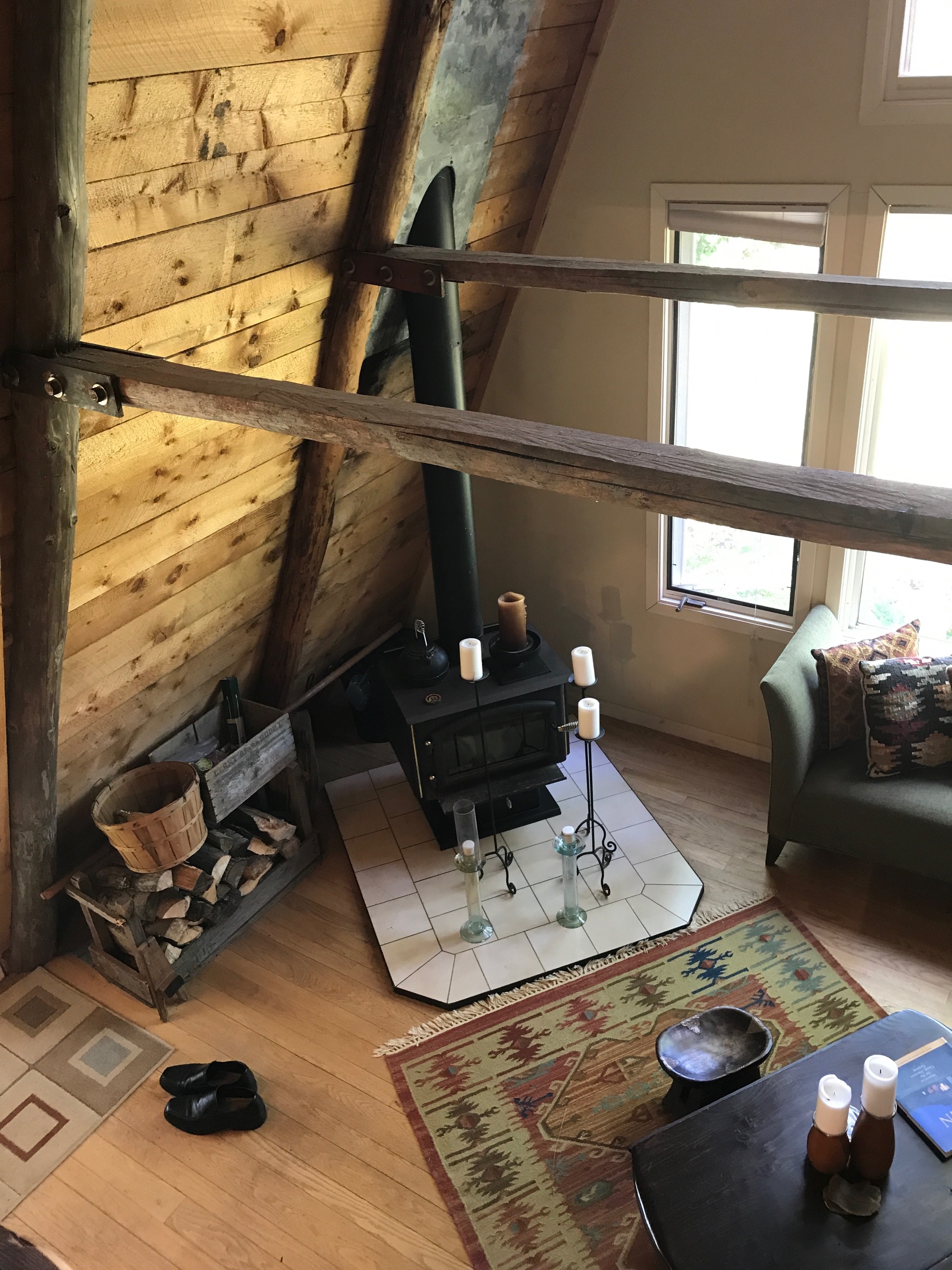
photograph of cabin by the wetland showing orange wall with morning light.

In search of rest, I retreat from the world of 2019 and my “already exhausted will”. The walls inside the cabin by the wilderness are rough-cut pine, the natural color of the president’s orange hair. Alas! The world comes with me, even by the wetland: I cannot rest from comparisons and disdaining thoughts of orange hair and Greenland.

I’m worrying and fretting, wanting to put the world right: rescue the English language from the words that paint the world orange: words like ‘bad’…’good’ … ’nasty’ … ‘nice’ …’not nice’ … ‘loyal’ … ‘disloyal’, that divide, blame, simplify, stereotype, scapegoat, and choke the best in us. Words do matter. The unexamined underlying meaning of words matters most.

First thing in the morning, while Barclay is still asleep in his kennel, I do what I once disdained as flight from action. The word ‘devotional’ has a different meaning now. A ‘devotional’ is not an escape from responsibility. The half-hour devotional is what it says: to devote attention to the Source of consolation and solace in the world that makes my head hurt. Here at the cabin, I devote my attention to the Psalm before checking the mouse trap.

Sometimes the Psalm consoles; other days it does not. When something in the Psalm whets my appetite for the underlying meaning of the words, I turn to the Paraphrases of the Church of Scotland. The Paraphrases, like scripture itself, take me to an earlier time that knew nothing of the United States, Greenland, Denmark, or Mexico, orange hair, or the “summer camps” for migrant children along the border.  I read the Paraphrase of Psalm 146:

The stranger’s shield, the widow’s stay,
     the orphan’s help is he:
  But yet by him the wicked’s way
     turned upside down shall be. 
  — Psalm 146:9, Paraphrases

Consoled and nearly comforted by David Whyte and the old Scot paraphrase of the ancient Psalm, I put down the Paraphrases to fill Barclay’s bowl with fresh dog food before freeing him from his kennel, remembering the One,

Who righteous judgment executes
   for those oppress’d that be,
 Who the hungry giveth food;
   God sets the pris’ners free.
-- Ps. 146:7

But first I free from the trap the orange mouse my dog shall never see.

– Gordon C. Stewart, by the Minnesota wetland, August 22, 2019.

Who owns Greenland?

The Song in My Head

Have you ever found yourself humming a tune when you wake up in the morning? Sometimes the tune reaches back to childhood. My small church in the small town west of Philadelphia sang hymns that became childhood favorites. As I grew into adulthood, some of them drop away as childish.

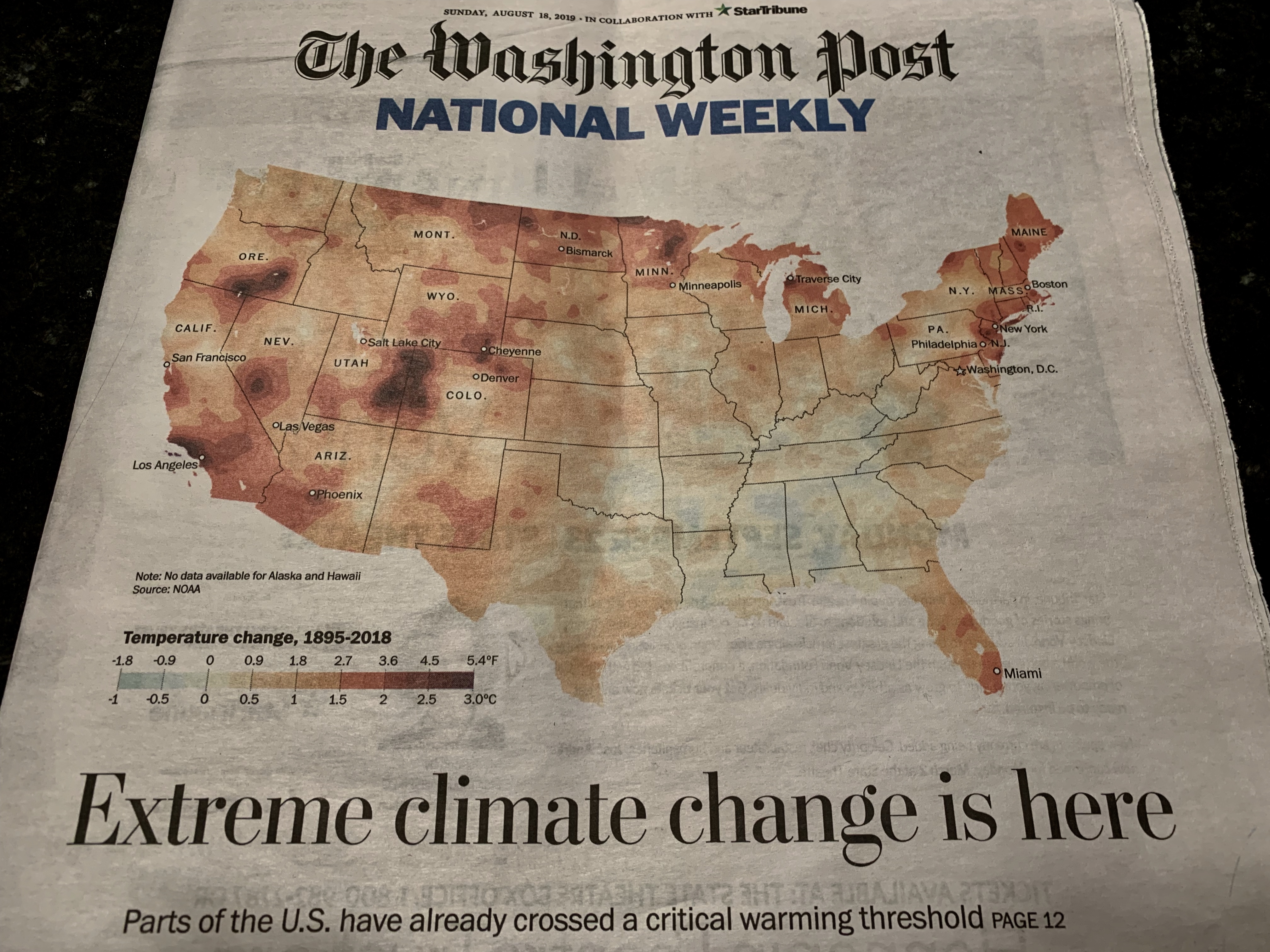
One answer to why I would hum “This Is my Father’s world” all these years later suggested itself over coffee. The featured story of The Washington Post’s National Weekly: “Extreme climate change is here” accompanied by a map of rising temperatures across the United States.

front page, Washington Post National Weekly in collaboration with Star Tribune, 8/18/19

Climate Change and the Illusion of Property

While the planet’s oceans warm, the glaciers of Glacier National Park, polar ice caps melt beyond the tipping point, fires ravage the redwood forests, hundred year floods have become frequent, and the pale blue dot turns brown, “our listening ears” hear talk of buying Greenland. The Greenlanders and the Danes are too occupied with the melting ice and rising sea levels to be distracted by a foolish real estate offer.

The simple childhood hymn no longer sounds childish. It feels more child-like, full of the wonder that is the antidote to adult presumptions of property ownership. “This is my Father’s world, and to my listening ears all nature rings the music of the spheres. This is my Father’s world: I rest me in the thought of rocks and trees, of skies and seas, his hand the wonders wrought.”

Faith, Nature, and God

Climate change is the challenge of our time. Not just one of many challenges. It is both the most urgent, i.e., it cries out for action NOW, and the most important to the future of all that lives on this planet hanging among the spheres. Believing that Earth is a divine gift placed in our hands as stewards of nature, and wanting to remember the words of “This is my Father’s world,” I took out the Presbyterian hymnal of my childhood and the 1982 hymnal of the Episcopal Church.

From Wonder to Responsible Action

The last stanza in both hymnals ends with our responsibility, as though a century ago Maltbie Babcock (1858-1901), the lyric’s author, had anticipated the island of trash the size of Texas floating in the Pacific Ocean. This hymn on which my childhood friends and I were raised moves from wonder (awe) through recognition that “the wrong is great and strong” toward responsibility for the planet. “This is my Father’s world, oh let us not forget that though the wrong is great and strong, God is our Father yet. He trusts us with his world, to keep it clean and fair, all earth and trees, all skies and seas, all creatures everywhere.”

It is likely that Maltbie Babcock did not think what he wrote overlooking Niagara Falls was worthy of dissemination. It remained private until published by his wife after his death. Maltbie Babcock seems to have viewed “This is my Father’s world” as a personal expression of wonder beneath the literary standards of good poetry. But ”This is my Father’s world” strikes a chord at the tipping point of climate departure.

photo of Niagara Falls

It is likely that Maltbie Babcock did not think what he wrote overlooking Niagara Falls was worthy of dissemination. It remained private until his wife published it after his death. Maltbie Babcock seems to have viewed “This is my Father’s world” as a personal expression of wonder beneath the literary standards of good poetry. But ”This is my Father’s world” strikes a child-like chord standing at the tipping point of climate departure in 2019.

No one owns Niagara Falls. No one owns Greenland. No one owns the world.

— Gordon C. Stewart, heading north to the wilderness retreat, August 19, 2019.

Something about long, lazy days and whirring air conditioners

Consider the contrast between Live and Learn‘s appreciation for Earth’s seasons and Franklin Graham’s focus on heaven in a recent Fox radio interview chastising public figures who openly reject or express doubts about their Christian faith.

“I’m going to keep telling people how they can have a relationship with God how they can have their sins forgiven and how it can make and have that hope of heaven one day by putting their faith and trust in Jesus Christ.”

Franklin Graham, Fox radio interview with Todd Starnes Click THIS LINK for more.

Although the Live and Learn quote from Sarah Dessen’s That Summer is not specifically theological, it captures the contrast between two kinds of religion. One celebrates life (“So much in one summer, stirring up like the storms that crest at the end of each day, blowing out all the heat and dirt to leave everything gasping and cool”) and seeks to live responsibly on the planet.

The other kind of religion sees faith as the ticket to heaven (a paradisal life after life), instead of eternal punishment in you know what, while the sweet smell of honeysuckle is overcome by the smell of sizzling asphalt and the porpoises wash ashore because of plastic.

Click HERE for he post “Something about long, lazy days and whirring air conditioners” on Live and Learn.

The Hoodie in the Hood

The Hoodie at Four A.M. – Washington D.C.

It’s four o’clock in the morning. He’s wide awake, his mind swirling. He puts on the hoodie disguise to walk from his white house to the tenement in the ‘hood’ he’s visited before. He avoids the Secret Service and television cameras. He enters the building, takes a deep breath, and lowers himself to climb the rusting metal stairs to the fifth floor walk-up apartment in hopes no one will recognize him.

The tenement-dweller has been waiting for him since their last visit months before. The door is ajar. The tenement-dweller never locks the door. No one needs to knock. The homeless, “women of the night”, pimps, people on the other side of the law, and cops who enforce it, alcoholics and drug addicts, the opioid and heroin dealers, and people in high white places are always welcome here.

The Tenement-Dweller: the Man in the Hood

“Welcome, friend,” says the tenement-dweller. “I’ve wondered when you might come for another visit.” He points to the dumpster chairs — the folding wood chair with the missing slat and the torn red leather wingback to the left and right of the small cardboard box end table. The night visitor chooses the high wingback.

“Can I get you something to drink?” asks the tenement dweller. “I have a nice variety of perfectly good teas. Not to worry; they’re from the dumpster, but they’re still in their wrappers,” he says with a smile. “Camomile is good for a restless night.” The night visitor nods his assent and watches his counselor walk past the rat traps to the Coleman stove and return with the kettle, an assortment of tea bags, two chipped cups, and a small plate of ginger snaps he’d put together for whatever guest might come that morning.

“There’s not much room on this table,” says the tenement dweller, pointing to the cardboard box with the small lamp between the chairs. “Would you mind removing that book to make room for the tray?” The tenement dweller pours the hot water into the cups, and, with a warm smile, gestures toward the tea bags and ginger snaps.

A Privileged Conversation

“Things haven’t gone so well for you since our last visit. You’re still wearing that hoodie! I like that! So … what brings you this morning?”

The night visitor removes his hood.

“I’m a stranger in my own house. I’m more alone than ever. My beautiful wife and beautiful daughter are upset about the thing at the border, and now the Epstein thing. And . . . yesterday the Scaramucci thing. And who knows what’s going to come out of Michael’s big mouth! I can’t even trust FOX any more.”

There is a silence before the tenement-dweller responds.

“Well, that’s a lot to carry.”

“It is. I’m weary and heavy-laden.That’s why I’m here. I’m taking you at your word.”

“I see. I’m glad you remembered, and I’m glad you came back to lay your burden down. But first, I need to clear the air a bit. You hurt my feelings when you attacked Elijah Cummings with those tweets about his district and his character. You called his district a rat and rodent-infested mess. Take a look around, Donald. What do you see? That’s where you are. Take a look at me. What color do you think I am?

“And all those people in concentration camps at the border, the wink-winks toward the gun lobby after all these mass shootings, and the cruelty of calling poor people fleeing for their lives ‘invaders.’ You know as well as I do that there is no invasion at the border. The people in those camps and the people in my neighborhood are as dear to me as you are. And now this thing with Israel and two Muslim congresswomen. It’s off the rails, Donald. If I didn’t know your need, I would have assumed you’d never put on the hoodie again.

The Book on the Box

“That book from the table, the one on your lap, I got just for you, Donald. I want you to take it home and read it.”

“I don’t read much. I’m a slow reader.”

“I know, and you hide it. You’re embarrassed by it. But it’s just the two of us here.  So, let’s do this. You don’t have to read the whole book. Just turn to the bookmarked page and read the highlighted sections I marked for you after our last visit. Read it out loud while we’re still together.”

Donald opens the book and reads aloud:

“The more insecure, doubtful, and lonely we are, the greater our need for popularity and praise. Sadly … the more praise we receive, the more we desire. The hunger for human acceptance is like a bottomless barrel….The search for spectacular glitter is an expression of doubt in God’s complete and unconditional acceptance of us. It is, indeed, putting God to the test. It is saying, ‘I am not sure that you really care, that you really love me, that you really consider me worthwhile. I will give you a chance to show it by soothing my fears with human praise and by alleviating my sense of worthlessness by human applause….’ The….experience of God’s acceptance frees us from our needy self and thus creates new space where we can pay selfless attention to others. This new freedom in Christ allows us to move in the world uninhibited by our compulsions….”

Henri Nouwen, The Selfless Way of Christ: Downward Mobility and the Spiritual Life

“You got this thinking of me? You think I’m insecure? You think I’m moving in the world compulsively? I don’t need praise, but look at the applause! They love me. They support me. I could shoot somebody in broad daylight standing in the middle of Pennsylvania Avenue, and they’d still love me. I can do whatever I want.”

“Take the book with you, Donald. What I know that you don’t yet know is in the other sections I highlighted just for you. Applause is not love. If applause were love, you wouldn’t have disguised yourself. You wouldn’t have risked coming here. Love is something else. In the end, love is all there is. Think about that on your walk back, and read those pages over and over. Read them every morning before you think about tweeting. Only then will you not feel homeless.”

— Gordon C. Stewart, by the wetland, MN, August 16, 2019.

The River of Consciousness

How and why the mind works the way it does came to mind these past few days. My mind has been like a river pouring over rapids and waterfalls, splitting into two or three paths around the islets that still rise from the riverbed, and then returning from two or three to one river with a single flow.

Niagara Falls

Integrating one’s plunges over the falls, side trips around the islets, and tumbling over rapids is what the mind does as it looks back upstream from down river. More often than not, one’s life is a blur. We move with the flow downstream. But once in while, what happened upstream invites or demands reflection.

No moment in the river’s journey is superfluous. Daily routines in periods of calm dull our awareness of the river itself and lay aside questions of its whence and whither until another event, or a memory, moves us to clear the blur. One event or memory leads to others we thought we had forgotten, pushed aside, or left behind.

The path of descent is the path of transformation. Darkness, failure, relapse, death, and woundedness are our primary teachers, rather than ideas or doctrines.

Richard Rohr, Yes

Think a moment of all the events and encounters that have shaped you most deeply and lastingly. How many did you see coming? How many did you engineer, manufacture, chase down? How many were interruptions? . . . The span between life as we intend it and life as we receive it is vast. Our true purpose is worked out in that gap. It is fashioned in the crucible of interruptions.

Mark Buchanan, The Rest of God: Restoring Your Soul by Restoring Sabbath.
Aerial view: confluence of the Yukon River (lighter color) and the Koyukuk River (darker), Alaska

All moments are part of the river of whence that flows over rocks and waterfalls, splits, and returns to one on its way to a whither beyond our knowing.

Gordon C. Stewart, by the wetland, Minnesota, August 12, 2019.

‘Trouble’ is God’s middle name

Robert McAfee Brown is not a household name for most folks, but it is for a dwindling multitude shaped by his life and teaching. Few of us sat in his classes at Macalester College, Union Theological Seminary in New York, or at Stanford, and few of us marched with him for civil rights or an end to the Vietnam War. Although we never met him, he seemed to know who were, and spoke of God in ways that struck a chord with adolescent ears itching to change the world.

One of the people who did know him personally was Jo Bede. Jo knew him up close as his student assistant at Macalester College, typing the manuscripts for the books he published. All these years later, Jo is in a Memory Care Center here in Minnesota. Like many other members of the multitude, she no longer remembers his name or the name of her alma mater.

Unlike many members of the Robert McAfee Brown multitude, Jo remembered everything until Alzheimer’s stole’s her powers of recognition. Many other members remain unaware of their membership, though they read (or didn’t read) Brown’s book used in Presbyterian confirmation classes all across the United States. Like most kids that age, we didn’t pay attention to the author. We didn’t want to be ‘churchy’. But if The Bible Speaks to You sounds ‘churchy’ to you today, it’s likely because ‘church’, as Robert McAfee Brown understood it, bore no resemblance to the churches that decades later would replace intelligent faith with platitudes in the era of Donald Trump.

Some things are stranger than strange. In 2019 few things feel as strange as the likelihood that a young Donald Trump had become part of the multitude as a member of the confirmation class at First Presbyterian Church of Jamaica Heights, NYC. He was just another kid who didn’t give a thought to Robert McAfee Brown or crack the book we were supposed to read.

“We can be sure that ‘Trouble’ is God’s middle name,” he wrote, “and that such a God will be alongside us in the midst of trouble rather than off in a remote heaven practicing neutrality. And if we begin to make that most difficult switch of all — away from the gods of middle-class values and upward mobility, and gilt-edged retirement plans — and if we can explore, even tentatively and gingerly, what it would be like to think and act for those who are the victims, we just might uncover ‘the most unexpected news’ of all: that God got there before we did.”

All these years later, I imagine Bob Brown inviting all of us to his home in Palo Alto for a reunion of the crowd we didn’t know. Jo, Donald, and I are in the Browns’ living room. He begins the welcome by turning to Jo, whose head is down and who appears to be asleep. “Jo, it’s so good to see you after all these years! Do you still have that typewriter?” Jo lifts her head and smiles at the sound of her old teacher’s voice. “And, Donald and Gordon, Carolyn, Woody, Ted, Bob, Dottie, and David, I can’t wait to hear what you’ve done with your lives.” We go around the circle, introducing ourselves to each other from across the country. After the last of introduction, there is a silence while all eyes return to our host.

“So . . .,” he begins with a kindly smile, “how are all of you doing with the God whose middle name is ‘Trouble?'” All eyes lower into a deafening silence. Before any of us speak, he asks the second question for which he has brought us together:

“‘How are you doing with the switch?”

  • Gordon C. Stewart, from the wilderness, August 10, 2019.

Toni Morrison to Dayton: “Just turn your backs!”

Toni Morrison, the 1993 Nobel laureate and beloved national treasure Americans mourn today, wrote and spoke words fit for the crowd of people who will stand before the president today in Dayton, OH.

“Anger … it’s a paralyzing emotion … you can’t get anything done. People sort of think it’s an interesting, passionate, and igniting feeling — I don’t think it’s any of that — it’s helpless … it’s absence of control — and I need all of my skills, all of the control, all of my powers … and anger doesn’t provide any of that — I have no use for it whatsoever.”

[Interview with CBS radio host Don Swaim, September 15, 1987.]”
― Toni Morrison

anybody white could take your whole self for anything that came to mind…. Not just work, kill, or maim you, but dirty you. Dirty you so bad you couldn’t like yourself anymore. Dirty you so bad you forgot who you were and couldn’t think it up

Toni Morrison

Remember that Narcissus depends on applause and cameras. “Don’t get mad. Don’t yell and scream and lose control. STAND TALL and speak with single voice. JUST TURN YOUR BACKS when he speak!

— Gordon C. Stewart, Chaska, MN, August 7, 2019.

The “invaders” — a psalmic reflection

The Power of Language for good and for evil

According to the New York Times, the Trump 2020 re-election campaign has run 2,000+ Facebook ads framing the national conversation by calling the migration at our southern border “an invasion”.

Introducing an exercise

It gets harder every day. The carnage is in full sight. So are the tweets. It’s depressing. In times like this a Psalm sometimes comes along that expresses the emotions. They laments. The anger at cruelty. Hope for something better beyond what we can see as possible.

Psalm 79: How Long, O Lord?

 O God, the nations have come into Your inheritance;
    they have defiled your holy temple;
    they have laid Jerusalem in ruins.

America today is not the sweet land of liberty of whom we sing. We grieve amid the latest ruins in El Paso and Dayton. We lament the human sacrifice that defile the good green Earth,Your holy temple, the inheritance of global grace.

  They have given the bodies of your servants
    to the birds of the heavens for food,
    the flesh of your faithful to the beasts of the earth.

They trade doves for vultures, and olive branches for military materiele on the streets of Baghdad and Kabul, El Paso, and Dayton, Virginia Beach, Aurora, Thousand Oaks, Pittsburgh, Annapolis, Santa Fe, Parkland, Sutherland Springs, Las Vegas, Orlando, Fort Lauderdale, Burlington, Orlando, San Bernardino, Roseburg, Chattanooga, Charleston, Sandy Hook . . . . Mankato and Wounded Knee.

They have poured out their blood like water
    all around Jerusalem,
    and there was no one to bury them.

  We have become a taunt to our neighbors,
    mocked and derided by those around us.

The invaders call the tired and the poor, yearning to breathe free; the homeless, and tempest-tossed “invaders” — caravans of an invasion crossing the southern border. The vultures prey on fathers and daughters drowned and lying face-down on the Texas bank of the Rio Grande. In the name of national security they take nursing children far from their mothers’ breasts, separate families, and forget where they have placed the invaders’ children, while the authorities retreat to golf courses and sent their children to fancy summer camps.

Let the groans of the prisoners come before You;
    according to Your great power, preserve those doomed to die!

May the groans that hurt Your ears rouse the nation’s conscience to close the prisons and preserve all those White Nationalism dooms to die.

“National extremists are idealists. Racial and religious extremists are idealists. ISIL is idealist. American exceptionalism is idealist. . . . Idealistic terrorism lives to rid the world of evil as its adherents understand it, projecting evil as ‘the other’ while flying ‘the sore point’ in ourselves that we conscious animals seek to avoid.”

“Idealism and Terror,” Be Still! Departure from Collective Madness (2017 Wipf and Stock), p. 33-39

Return sevenfold into the lap of [their captors]
    the taunts with which they have taunted You, O Lord!
But we Your people, the sheep of your pasture,
    will give thanks to You forever;
    from generation to generation we will recount Your praise.

“I’m ninety-six,” wrote Benedictine monk Sebastian Moore of Downside Abbey, introducing his last book, “and for most of my life I’ve been a monk. My life as a monk has been, for the most part, a search for God as real.”

Dom Sebastian Moore, OSB, Remembered Bliss (2014, Lapwing Publications)
  • Gordon C. Stewart, Chaska, MN, August 6, 2019