Unknown's avatar

About Gordon C. Stewart

I've always liked quiet. And, like most people, I've experienced the world's madness. "Be Still! Departure from Collective Madness" (Wipf and Stock Publishers, Jan. 2017) distills 47 years of experiencing stillness and madness as a campus minister and Presbyterian pastor (IL, WI, NY, OH, and MN), poverty criminal law firm executive director, and social commentator. Our cat Lady Barclay reminds me to calm down and be much more still than I would be without her.

The Art of the Deal with the Devil

The Faustian Bargain

The daily White House updates on the coronavirus pandemic bring to mind the Medieval folklore of Faust’s bargain with Mephistopheles (the devil). Faust surrenders his soul for the diabolical blessings of wealth, power, and fame.

Dr. Fauci, Dr. Trump, and Dr. Birx
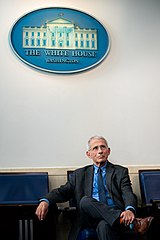
We see and hear POTUS Donald Trump; then we see and hear Dr. Fauci, and Dr. Birx. Two of three have M.D. degrees required to diagnose and dispense medication. The other has no degree and no license to practice medicine but repeatedly ignores and contradicts Dr. Birx and Dr. Fauci.

Yesterday’s White House update (April 23) offers the latest conflict between knowledge and what seems like insanity. The president referred to “emerging” research showing that the increased sunlight and higher humidity of spring and summer kill the virus. Past studies have not found good evidence to support the theory. But that’s not the worst of it.

Noting unidentified research into the effects of disinfectants on killing the virus, the president went further off the rails by wondering aloud whether a disinfectant could be injected into people because the virus “does a tremendous number on the lungs, so it would be interesting to check that.” Where is Sigmund Freud when we need him?

Sigmund Freud’s Case Study in Demonic Neurosis

We are children of the Enlightenment. Few of us believe in real life Faustian bargains with the Devil. But Sigmund Freud became intrigued by Johann Christoph Haizmann (1651-1700), a Bavarian-born Austrian painter, after reading Haizmann’s newly recovered narrative description (L) and triptych painting (below) of his Faustian bargain.

Haizmann’s personal description of his experience became the occasion for Sigmund Freud’s and Gaston Vandendriessche’s research on “the Haizmann case” became a part of the study of psychology and psychiatry.
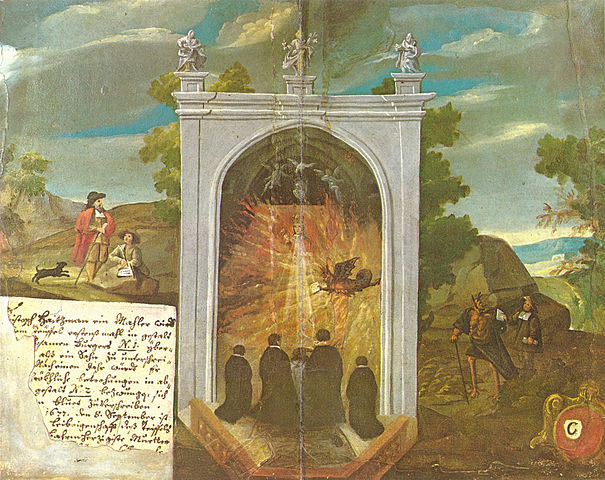
photograph of triptych by Johann Christoph Haizmann
Votive triptych by Johann Christoph Haizmann’s (1651/52 – 14 March 1700). Left: Satan is depicted as a fine burgher, while Haizmann signs a pact with ink. Right: The Devil reappears a year later and forces Haizmann to sign another pact with his own blood. Middle: The Virgin Mary makes the Devil return the second pact during an exorcism.

The Burgher and the Deal with the Devil

Of interest to us here is Haizmann’s depiction of the Devil as “a fine burgher” in the left panel of Haizmann’s triptych. ‘Burgher’ was a title of the medieval a privileged social class. Public officials were drawn from among the burgher class of medieval towns and cities. Haizmann’s choice of a burgher as the Devil in disguise is its own repudiation of wealth, privilege, and power. Only the Virgin Mary could free him from the pact with the Devil.

Freud de-mythologized the religious language and metaphors by which Haizmann had understood himself and his world. In 2020 only a quack would speak of demonic possession! Yet the biblical pictures of demonic possession still have a way of reaching parts of us we cannot explain or escape. Every one of us is a little insane at night, or locked in during the coronavirus pandemic. Few of us keep our twitter feeds on the pillow to push away the darkness. Few of us belong go the burgher class, yet there is something about Donald Trump that was with us before is election and will remain with us after he is gone: the age-old demonic dreams of wealth, privilege, and power.

We speak of neuroses and psychoses instead of demons or the devil the way Haizmann did. But still, there is the haunting memory of King Saul dropping into the abyss of insanity, throwing his spear at David, and the man who had been possessed by the Legion of demons before Jesus asked his name and sent them into the herd of swine. What is happening to us in America defies rational explanation. How does it happen that we allow a soul-less burgher who imagines injecting Lysol into our veins to take the world stage with Dr. Birx and Dr. Fauci?

The Art of the Deal and the Deal with the Devil

The Art of the Deal put Donald Trump on the world stage. Art of the Deal is an autobiography. But it’s not. According to the publisher and the book’s ghost writer, Tony Schwartz, Mr. Trump never wrote a line, but continues to say he was he author. Now that the coronavirus has shut down the economy he tricks himself into being a doctor who always knows best.

By way of contrast, Johan Christoph Haizmann, relieved from the frantic need for the burghers’ recognition. He joined the Brothers Hospitallers of Saint John of God, aka, the Brothers of Mercy to spend the rest of his life serving the poor, and the sick of body and mind.
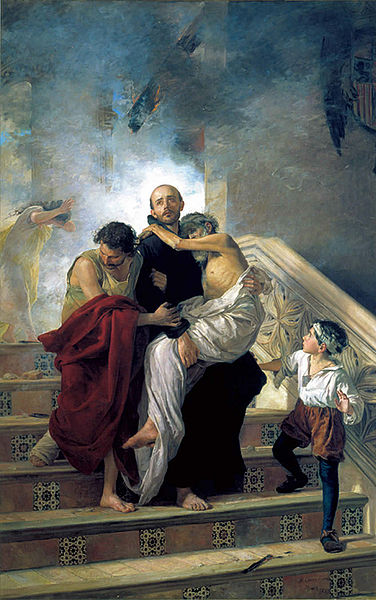
Manuel Gómez-Moreno González: San Juan de Dios salvando a los enfermos de incendio del Hospital Real (English: Saint John of God saving the sick from fire at the Royal Hospital)

Gordon C. Stewart, public theologian, host of Views from the Edge: to See More Clearly, author of Be Still! Departure from Collective Madness (2017, Wipf and Stock, Eugene, OR), Chaska, MN, April 24, 2020.
Water is wider than blood

Blood, as all men know, than water’s thicker
But water’s wider, thank the Lord, than blood.

Aldous Huxley, Ninth Philosopher’s Song, 1920

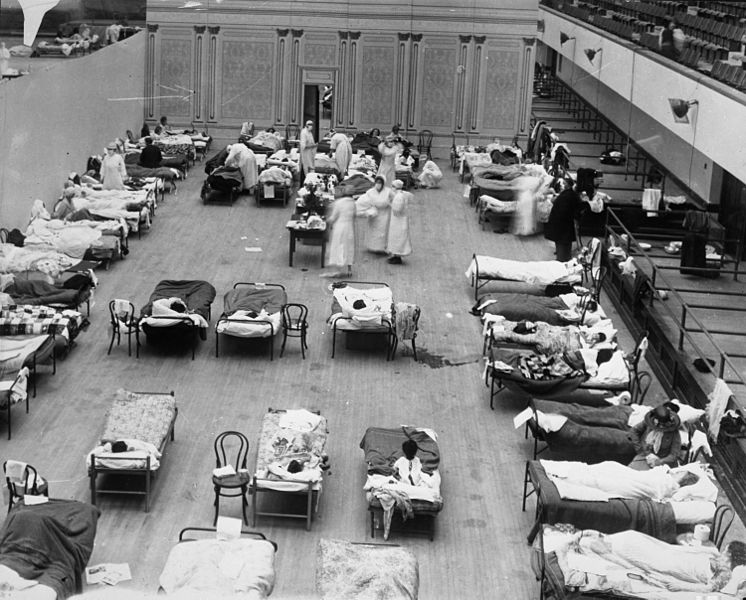
When Aldous Huxley turned the adage “blood is thicker than water” on its head there was no Earth Day. No COVID-19. No economy stuck in idle at the brink of the cliff. No orders or guidelines to stay home and wash your hands. But he had been the flu pandemic of 1918.

Makeshift hospital for flu patients, Oakland, CA, 1918.
Makeshift hospital for “Spanish” flu patients, 1918

Blood Brothers — Teddy Bonsall and I

“Blood is thicker than water” is about family ties, or becoming ‘blood-brothers’ the way Teddy Bonsall and I did when we drew blood with our pen-knives, and put our cut fingers together to mix our five year old blood. Maybe something in our little minds knew that ‘blood’ described the bond between soldiers in battle. Blood-brothers — soldiers who risked their lives, as our fathers had in World War II — were closer than brothers and sisters born of the same womb. The world was a war zone. Teddy and I would go down together, whatever new war might come along. We were blood brothers.

A virus doesn’t know about ‘blood-brothers’

The day after Earth Day 2020 tests the way we frame who and what we humans are and will, or will not, be on a planet on its way to boiling both blood and water. We are not blood brothers or blood sisters. We can no longer frame ourselves as warriors in wars between our nation and their nation(s) without committing species suicide. No more blaming the Spanish for the 1918 flu pandemic or China for the new coronavirus. There will be no great America without a green planet. Everyone is a child of water — the amniotic fluid of every mother’s womb, and the water that is wider than blood (the oceans, rivers, and water tables) that keep the ‘pale blue dot’ blue and green.

The Daily Briefings

Most afternoons I tune in to the president’s coronavirus pandemic team’s daily updates, but I can’t do it anymore. I’ve run out of Maalox, and I refuse to fill a glass or two from the liquor cabinet. This is no time to self-medicate. I’ve watched the climate-change-denying president and his ‘oleaginous’ vice president and administration re-frame COVID-19 as a foreign invasion — the ‘Chinese’ flu — to be ‘defeated’ by an army of American blood brothers. The updates are not COVID-19 updates. They are 2020 presidential campaign rallies with Dr. Fauci and Dr. Birx thrown in to provide cover for the medical disinformation no doctor or scientist can support. Day by day, the conflict between the president and the medical professionals becomes increasingly apparent in the faces of Dr. Fauci and Dr. Birx barely able to conceal their professional and moral in the face of a kind of medical malpractice they once could not imagine.

While the members of the coronavirus team stand shoulder to shoulder without masks, members of the White House press corps practice the social distancing guidelines the people with the microphone do not. Spaced six feet apart, the correspondents ask the questions that publicly trap the president in his own lies and contradictions. The medical professionals become more outspoken, less likely to say what the president expects them to say.

The White House press corps occasionally rises to the expectations of the First Amendment, offering slivers of hope that Rush Limbaugh and Sean Hannity will go away before the Earth is left to the viruses.

The Voice that cannot be silenced

photo of Aldous Huxley

I imagine Aldous Huxley in the last row of the White House correspondents section. He’s the only one in the room who brings wisdom from the “Spanish Flu” pandemic a hundred years ago.

He’s had his hand up for 20 minutes. No one will call on him.

Finally, in exasperation, he whispers in hopes someone watching might remember the greater threat to Earth itself:

“Blood, as all men know, than water’s thicker
But water’s wider, thank the Lord, than blood!”

Gordon C. Stewart, Be Still! Departure from Collective Madness (2017, Wipf and Stock), Chaska, MN, April 23, the day after Earth Day 2020.

The School of Misery

Home-schooled in misery — Oh, for the wisdom of Aeschylus

Photo of Roman bust of Aeschylus after Greek bronze hermaphroditism (340-320 BCE).

I, schooled in misery, know many purifying rites, and I know where speech is proper and where silence.”

Aeschylus, Greek playwright known as the Father of Tragedy (c. 525/524 – c. 456/455 BCE)

In the school of misery, we know to wash our hands. Knowing when and where to speak one’s minds or hold one’s tongue is harder. In Aeschylus’ time, it required the wisdom of the gods or the wisdom of Solomon.

The Intelligence Test

“COVID-9 is not just a disease. It’s an intelligence test,” wrote sportswriter Jim Souhan in response to Major League Baseball’s idea of bringing all 32 MLB teams to Phoenix where they could play out the 2020 season. The teams would be quarantined at night in area hotels; the stadium seats would be empty to keep the players safe. “COVID-19 is not just a disease. It’s an intelligence test.”

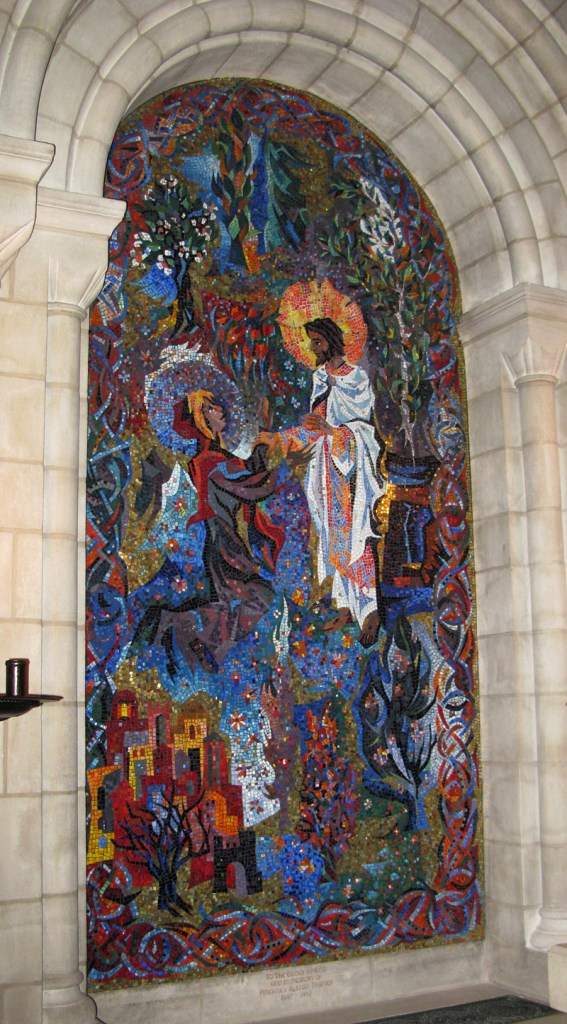
Easy speech is not only pointless in 2020. It is dangerous. But so is silence. In the school of misery more than one kind of intelligence is required. Maintaining emotional balance in a time of plague is a test of courage and compassion. Albert Camus’s The Plague, whose heroic character is not the priest, but the doctor serving among the sick and the dying, comes quickly to mind. So does the crucified-resurrected Jesus’s strange encounter with Thomas.

The Courage of Compassion Test

The Incredulity of Thomas — Caravaggio, Michelangelo Merisi da, 1573-1610

Caravaggio paints what readers unschooled in misery are not likely to see in the text –the continuing presence and voice of the crucified-risen Christ in the Gospel of John 20:27: “Thereafter he is saying to Thomas . . . .”

Known for his gritty realism, Caravaggio has Jesus grasping the hand of the apostle Thomas and thrusting it deep within the wound at his side, powerfully aligning Jesus’ and St. Thomas’ hands to form a lance. St. Thomas’ face expresses profound surprise as his finger thrusts deep into Jesus’ wound. Perhaps, the surprise has to do with his unbelief. It could also be surprise at the realization that he, too, is pierced. Indeed, St. Thomas appears to clutch his side as if he becomes aware of a wound at his side as well. And we who wince at this gritty depiction feel a wound at our side as well.” — Edwin David Aponte, Handbook of Latina/o Theologies, Chalice Press, 2007.

“I will meet you there — wherever the wounds are.” “My Lord, and my God!”

Gordon C. Stewart, author of Be Still! Departure from Collective Madness (2017, Wipf and Stock), Chaska, MN, April 21, 2020.

Getting through the tight squeeze

The kidney stone

This is not your usual Views from the Edge commentary. I’ve found myself unable to write anything that might be worth passing on to others. But inspiration arrives from the most unlikely sources, like last Sunday’s painful visit to the Emergency Room. The CT scan revealed the kidney stone that became the inspiration for this quirkier-than-usual Views from the Edge piece. The doctor assured me the stone was small. It would pass with time. The nurse gave me a little bottle to save the stone when it passes.

Who cares if you pass a kidney stone?

Let’s say you’re a writer. Okay, a blogger. You’ve struggled for weeks to write a piece on the daily assault of propaganda coming into our living rooms every weekday afternoon, but it hasn’t come. It just sits there, like a kidney stone that doesn’t pass. You’re sure it will never get out, and that, even if it does, no one will care. Why should they? What you want to say is not unique. A kidney stone’s a kidney stone. You’re also bored.

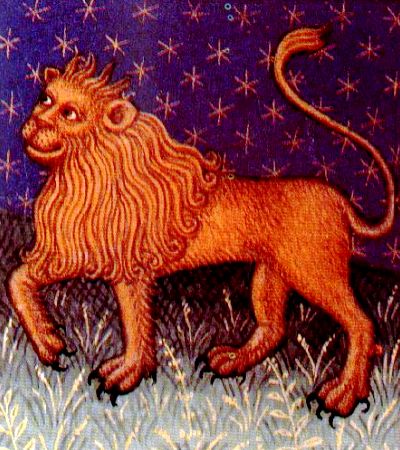
You don’t believe in horoscopes, but they’re a way to pass the time. You’re a Leo.

It’s like you’re trying to move a couch into a room with a small door. Once inside, everything will work out nicely. But getting through this tight squeeze will take some doing. What needs to be released in order to move forward?

Horoscope by Holiday Mathis, StarTribune, April 17, 2020.

You’re excited! Permission has to write has been granted. What needs to be released is your fear. Squeeze your ego through that small door! Just take it outside. Forget who cares. Just do it! Put it out there! You sit down to write. Returning to the newspaper for the exact quote, you realize you had read the wrong horoscope, the one for a Libra. Your reading disability has tricked you again. You saw the ‘L’ and assumed it was for you. It wasn’t. it was for a Libra.

You go back to the paper to read the right horoscope — the one for you, the Leo.

“There was a time when you didn’t believe you could actually change your circumstances by merely observing them differently. Now you believe it, and you do it on a daily basis. Today brings proof.”

You wonder whether the people who write this stuff know something you don’t. Don’t they know that not even a Leo can change some circumstances by observing them differently?

When you pass a kidney stone, you put it in a little bottle and take it to your doctor who sends it to the lab. You never see your kidney stone again. But there are exceptions. Some folks keep their kidney stones next to the computer keyboard. What’s the use of passing a kidney stone if you can’t be proud of passing it or experience the joy of sharing it virtually?

You’re curious what else is in the Horoscope section. If you’re a Taurus, “you are mysterious, and all the more attractive for your secrets.” You like that. But by the end, you wonder whether you’re really a Pisces.

OriginalPisces illustration -- Symbole du signe astrologique des poissons.

https://creativecommons.org/licenses/by-sa/4.0/deed.en

Just because something goes unspoken doesn’t mean it’s unspeakable . . . .

Who knows? The piece you can’t pass today may pass tomorrow. If it turns out to be unspeakable, put it in the bottle, send it to the lab, or throw it away. If what has gone unspoken seems speakable, ask yourself, “Who else cares if you pass a kidney stone?”

Gordon C. Stewart, Chaska, MN, April 17, 2020.

P.S. Last night the stone did pass.

Easter Morning

The painter’s brush, the poet’s pen, and the musician’s composing take the heart and mind into the space of wonder and joy that is Easter.

Easter Morning verse

EASTER MORNING
a double acrostic 


Either Jesus really did rise or
All his followers made up the worst
Series of lies in history... Poor
Thomas certainly was right to doubt
Even after hearing tales: what four
Reached the tomb (or five?) Who saw him first

Matthew says two women; Mark says three
Or was it just one, as said by John?
Reports of what eye-witnesses can see
Or was it just one, as said by John?
Never can be trusted. Luke said one
In the road joined two who could not see --
Not until he broke the bread...No one 
Got the story straight! Conspiracy?

Even grade school kids could do as well.
And Luke throws in Peter saw him too --
Somewhere unreported... Who could tell
That this jumble of accounts could do
Enough to give faith and hope to all.
Resurrection? Who could think it true?

Maybe just the simple: those whose eyes
Open to the light through grief, through tears…
Reminded of love, of truth, of grace…
Needing to be fed, hands out for bread ...
Inspired by the scriptures, in whose head
Grow visions: life can come from the dead.

- Steve Shoemaker, Urbana, IL, 2012 

Text set to music by Palestrina (1591)

“The strife is o’er, the battle won; the victory of life is won . . . . The powers of death have done their worst, but Christ their legions hath dispersed: let loud shouts of holy joy outburst.

[“The Strife is o’er” is often sung to the tune Victory, adapted from a 1591 setting of the Gloria Patri by Giovanni Pierluigi da Palestrina from a Magnificat tertii toni. An additional Alleluya refrain was set to music by William Henry Monk.”

Grace and Peace to you this Easter in the midst of the COVID-19 pandemic. “Life can come from the dead!”

  • Gordon C. Stewart, Chaska, MN, April 11, 2020, Easter morning.

Black Saturday, Blackmail, and Andrew Cuomo

Black Saturday — a deafening Silence

Black Saturday isn’t part of everyone’s experience; even many Christians don’t know it by that name. They know it as Holy Saturday, the day of dreadful silence that follows Good Friday. Jesus is dead. “It is finished.” It’s dark. There is not yet a resurrection. Jesus’s words of horror hurt our ears. Not the consoling words: “Father, forgive them, for they don’t know what they’re doing.” Nor his reply to the penitent hanging to his right, “Today, you will be with me in paradise.” Nor his care for his mother: “Woman, behold your son.” and to the un-named apostle, “Behold your mother.”

On Black Saturday we remember what we easily forget on other days: Jesus’s wrenching cry of god-forsakenness. Eloi, Eloi! Lema sebachtani? “My God, my God, why have you forsaken me?”; the thrust of the centurion’s spear opening a gash his side. “It is finished.”

Black Saturday and Shouts of Blackmail

Black Saturday feels darker this year by the ascendancy of the scapegoat mechanism at work in the trial and execution of Jesus, i.e. the consolidation of power by creating the scapegoat which must be sacrificed/killed to save the nation. But as the Alleluias will remind us tomorrow, you cannot kill love. You cannot kill goodness. You cannot kill the truth. Today’s White House “Resolute Reads” repeats the scapegoating with this quote from The New York Post:

“These left-leaning outlets don’t even care that their covering for Dems is so blatant. The Times took heat just this month for changing a headline, “Democrats Block Action” on the $2.2 trillion rescue plan, to “Partisan Divide Threatens Deal.” Yet that didn’t stop Thursday’s changeroo.

“No wonder Dems are so willing to resort to blackmail: They can count on their puppets in the press to never report it that way.”

New York Post April 9 editorial quoted in the White House daily update.

Black Saturday and Easter Sunday — Ego cannot defeat Soul

Into this Black Saturday reflection a stranger’s post arrives with a positive note that strikes a chord with me. Perhaps it will with you.

Andrew Cuomo’s Faith for All

Andrew Cuomo today is a phenomenon. He speaks every day about the coronavirus and his press conferences have become must-see tv. Why? Many reasons, but at heart he speaks to spiritual yearning in all people, a yearning that focuses not on religion and/or God, but on the truth and depth of our common humanity.

The Governor of New York State has become the voice of leadership and compassion during the coronavirus pandemic. His daily talks have become a time to hear the facts, face the reality, and listen to a calm voice of reason, hope and challenge. Beyond the arena of New York politics, about which most Americans know nothing, he has been received by the nation as a man to whom we can relate. He helps us transcend political divisiveness and helps us realize that we are all human beings.

He is a Roman Catholic, but one that many in his church would choose to excommunicate. Under his guidance, New York recognizes gay marriage and has the most humane abortion law to be found in America. It is clear from his presence that he is a man of deep faith, but also one whose faith is not determined by institutional religious authority. One might argue that his ability to speak to everyone is a result of decades of honing his political acumen, but that would be a shallow understanding. At least in these press conferences, Cuomo strikes a deep spiritual chord that resonates with most people.

To begin with, he respects everyone, whatever their religion or lack thereof, whether they celebrate Passover, Easter, Christmas, Ramadan or Kwanza, and you cannot help but feel that his respect is genuine. For public safety, however, public gatherings are prohibited. There is no exception for religious services, weddings or funerals. The kind of flagrant violation of stay-at-home policy exhibited by arrogant ministers in other states is strictly forbidden by Cuomo in NY.

Along with his acceptance of respectful others is a self-confidence that enables honest straight talk, incorporating a stature that can empathize with those who are hurting, both emotionally and physically. Essential to this data-driven attitude is a refusal to speculate, whether about the future of the pandemic or indeed about anything that might be called mysterious or mystical. His boldest statement about mystery asserted that although we are socially distanced we are spiritually connected, but he didn’t know how.

The only use of the word “God” is in the context of describing someone who risks their life for others. “God bless them”. God is also intimated in the phrase “keeping them in our thoughts and prayers”. But in both instances, the phrase seems to be more a term of popular culture than an actual assertion of faith. The closest Cuomo gets to a confession of faith is in his assertion that love wins. Love wins out over fear and anger. It also wins out over economic considerations. And to the calls by right wing voices to let the old and infirm die because they contribute nothing to society anyway, Cuomo responds with scorn and utter disbelief. No one is expendable. Loving and caring for one another is the essence of our humanity. Life is not reducible to numbers. This holds true not only for the elderly and infirm, but also for the outcast of society, the poor and the weak, those who labor for naught and strive in vain. If there is any refrain in his speaking, it is Cuomo’s prophetic insistence that no one will be left behind, that love reaches out to all and compels us to create a just society.
This is a moment, he says, for the world, for our country and state, for us as individuals. “Moment” is a word that he uses often, referring to a time in our lives when great change becomes possible. Stripped of diversions and escapes, we are free to explore our inner angels, to learn, to read, to listen in silence to the silence. The great danger, Cuomo believes, is giving in to the fear of the unknown that awaits us vis a vis both the virus as well as our own future. Too easily reason succumbs to fear and is overtaken by irrationality and panic. It is at this point that he says that this not the NY way, by which he means that this is not the human way, the way of strength, smartness, unity, and…love.

This is a message that reverberates across the country and probably around the world. It does not say, hey look at me and my needs. It says we are all in this together. And it does not say: learn how to do yoga, or meditate, or pray, or become a mystic. It simply says, appreciate the moment, accept the pain, do good, look ahead and celebrate the time when you can be together again with friends and loved ones, and, most importantly, share your love with all.

Many Americans, it seems, hear and understand. 

Carl E. Krieg, Ph.D, University of Chicago is a retired United Church of Christ pastor and professor with living in Ridgway, CO; author of The Void and the Vision: The New Matrix (2007, Wipf and Stock) and host of Carl E. Krieg’s Blog: Just Wondering.

Easter Sunday Worship Recommendations

If you’d welcome a live-streamed Easter celebration, click HERE for the 10:30 a.m. CT service of Westminster Presbyterian Church in downtown Minneapolis, or HERE for The House of Hope Presbyterian Church in Saint Paul, MN.

  • Gordon C. Stewart, Chaska, MN, Black Saturday, April 11, 7:30 p.m. CST.


Reflections for Good Friday

The sounds from the cross are too hard to hear. They still echo down the years to this moment when COVID-19 has locked us in our homes . . . if we have a home. Poetry not only echoes the sounds we do not wish to hear; it helps us to hear a Deeper Voice, the divine whisper beneath the clamor. What follows are the Stations of the Cross, courtesy of poet Malcolm Guite.

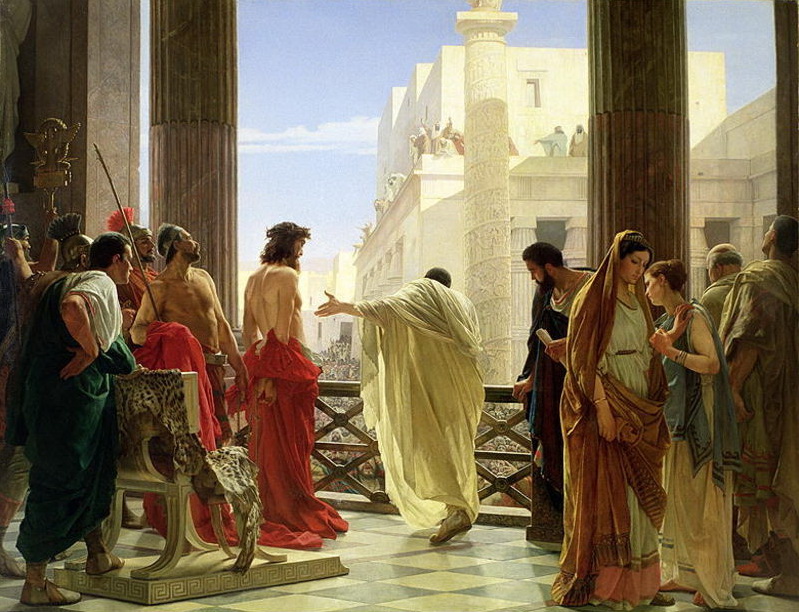
!I. Jesus is condemned to death

The very air that Pilate breathes, the voice
With which he speaks in judgment, all his powers
Of perception and discrimination, choice,
Decision, all his years, his days and hours,
His consciousness of self, his every sense,
Are given by this prisoner, freely given.
The man who stands there making no defence,
Is God. His hands are tied, His heart is open.
And he bears Pilate’s heart in his and feels
That crushing weight of wasted life. He lifts
It up in silent love. He lifts and heals.
He gives himself again with all his gifts
Into our hands. As Pilate turns away
A door swings open. This is judgment day.
Painting of Pontius Pilate with his Prisoner by Antonio Ciseri (1760-1828)
Pontius Pilate with his Prisoner – Antonio Ciseri (1760-1828)

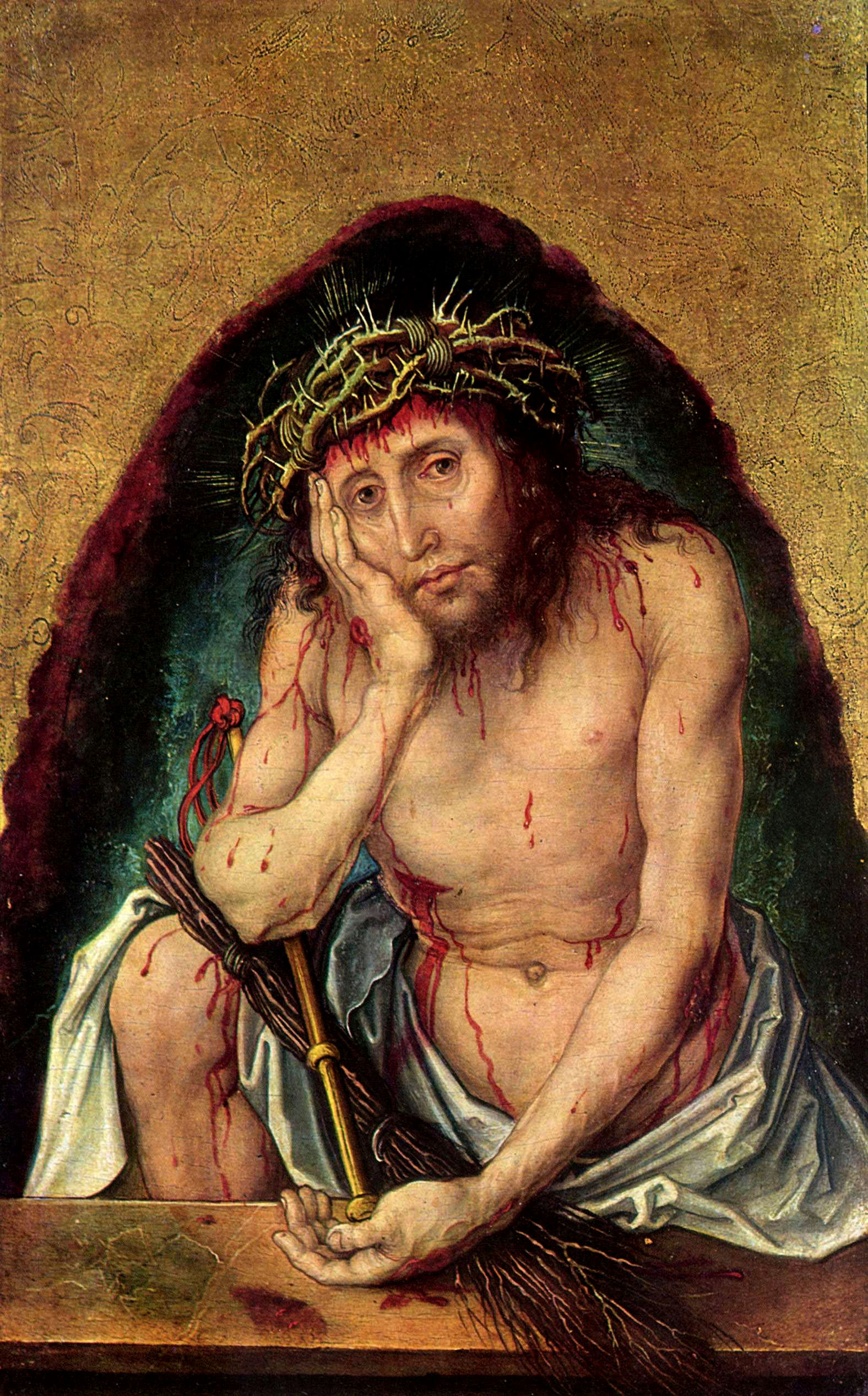
II. Jesus is given his cross

He gives himself again with all his gifts
And now we give him something in return.
He gave the earth that bears, the air that lifts,
Water to cleanse and cool, fire to burn,
And from these elements he forged the iron,
From strands of life he wove the growing wood,
He made the stones that pave the roads of Zion
He saw it all and saw that it is good.
We took his iron to edge an axe's blade,
We took the axe and laid it to the tree,
We made a cross of all that he has made,
And laid it on the one who made us free.
Now he receives again and lifts on high
The gifts he gave and we have turned awry.
Ecce Homo - "Here is the Man" Albrecht Durer
“Ecce Homo” Albrecht Durer

Click HERE for the rest of Malcolm Guite’s Stations of the Cross, or HERE for Malcolm’s book Sounding the Seasons.

  • Gordon C. Stewart, Chaska, MN, April 10, 2020 — Good Friday.

My Yoke Is Easy and My Burden Is Light

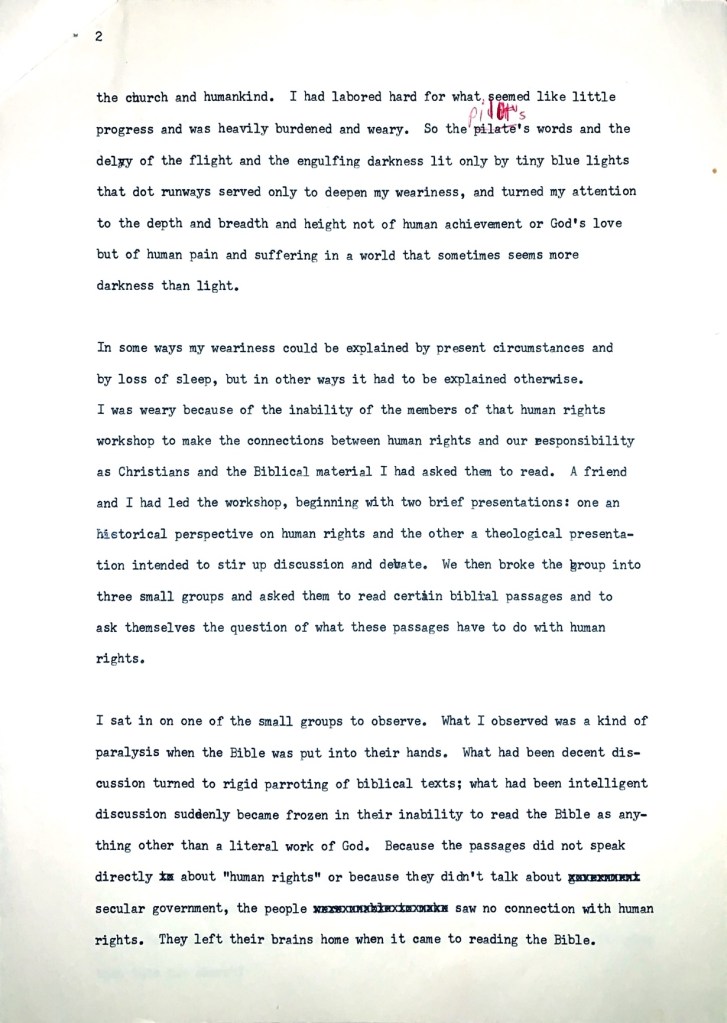
“They tell us,” said the pilot, “there’s a good bit of weather between here and Akron-Canton and the air traffic control people don’t want us to go until the weather moves out of the area. So it may be a while before we take off. Loosen your seat belts, have a drink and relax. It may be a while.”

Forty years later, we’re all strapped in at home, waiting for COVID-19 to move out. The Center for Disease Control says it’ll be a while.

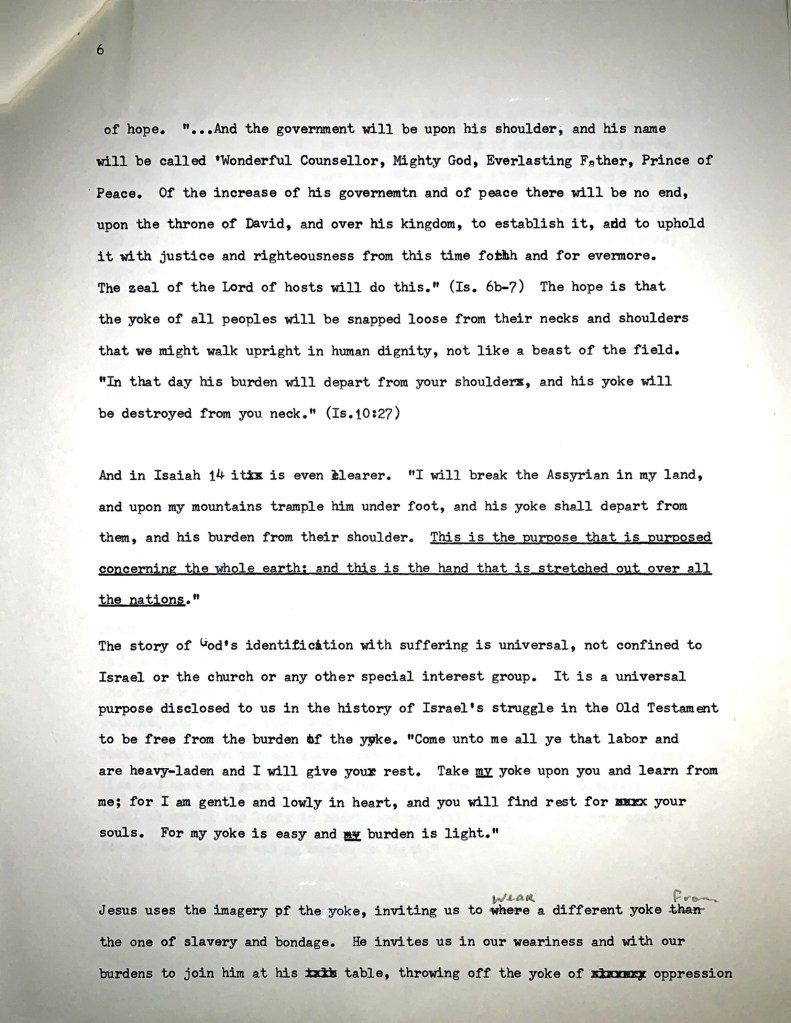
Sermon at McGaw Chapel, The College of Wooster — original manuscript

Sermon page 1
Sermon page 2
Sermon page 3
Sermon page 4
Sermon page 5
Sermon page 6
Sermon page 7
Sermon 1980, Rev. Gordon C. Stewart, McGaw Chapel, The College of Wooster
  • Gordon C. Stewart, Chaska, MN, April 9, 2020, Maundy Thursday

Letters from an American

The news I might not hear

Heather Cox Richardson’s Letters from an American: the History Behind the Politics is waiting for me every morning. It brings me up-to-date on news-worthy events that often fly under the radar — like today’s report about the late-night firing of the Intelligence Community Inspector General — another end-run around Congress and further violation of law.

Letters from an American latest newsletter

April 3, 2020
Heather Cox Richardson
8 hr

Quite the Friday night news dump today. At about ten o’clock tonight, Trump notified Congress he has fired the Intelligence Community Inspector General Michael Atkinson.
 
In September 2019, Atkinson made sure Congress knew that then-acting Director of National Intelligence Joseph Maguire was illegally withholding from the congressional intelligence committees a whistleblower complaint. Atkinson had examined the complaint, as required by law, and had determined it was “credible” and “urgent” and so sent it on to the acting DNI, who was supposed to send it to Congress. Instead, Maguire took it to the Department of Justice, where Attorney General Barr stopped the transmission by arguing that since it was a complaint about the president, and since the president was not a member of the intelligence community, the complaint shouldn’t go forward. And we know where it went from there.
 
Now Trump has fired Atkinson.... 

Click Letters from an American to read the rest of the story and to subscribe to Letters from an American. Ignore the video at the top of the screen to reading her column. Heather Cox Richardson is Professor of History at Boston College.

Thanks for coming by,

Gordon C. Stewart, Chaska, MN, April 4, 2020

Trump ghost writer Tony Schwartz tells his story on YouTube

Video

Tony Schwartz knows Donald Trump in a way no one else does. Ten (10) days before the 2016 election, he shared his experience at an Oxford University public forum preserved on YouTube.

Click HERE to listen in on what you knew and didn’t know before listening to the ghost writer of The Art of the Deal, the book that put a 38 year-old real estate developer on the NYT Best Sellers list and onto the world stage.

Gordon C. Stewart, author of Be Still! Departure from Collective Madness (49 two to four page social commentaries on faith and the news), Chaska, MN, April 4, 2020.