This sermon connects the interruption of Paul’s journey to Syria with the recent U.S. threat to bomb Syria to destroy evil in the name of goodness.
On the Road to Damascus
Reply


This sermon connects the interruption of Paul’s journey to Syria with the recent U.S. threat to bomb Syria to destroy evil in the name of goodness.
the teachers now are all younger
they have read more than i ever
will their devices seem part of
their hands but words and books they love
still as well as screens and apple
will my swiss cheese mind prove ample
-Steve Shoemaker, Urbana, IL, September 19, 2013

Swiss Chees Brain
Steve is bringing his Swiss cheese mind to Tuesday Dialogues at Shepherd of the Hill Presbyterian Church in Chaska, MN on Tuesday, October 1.
While driving home last night, I saw
a full moon in the eastern sky.
There were no clouds wandering by
(I’m sorry, Wordsworth…), but I saw
a line, a dark smudge–vertical–
move from the upper right and fall
quite slowly (like a tentacle)
down to the lower left.
I called
my spouse at home using my cell
(risking the lives of all around),
but she saw nothing. Could it be
a floater in my eye? Windshield
bugs, butterflies? Or could it be,
as some have thought, that I’m crazy.
-Steve Shoemaker, Urbana, IL, September 19, 2013

Howling at the Moon
Anticipating Shepherd of the Hill Dialogues’ “Voices of the Slaves” program celebrating the 150th Anniversary of the Emancipation Proclamation, we offer Sojourner Truth’s speech here on Views from the Edge. The Tuesday Dialogue on Oct. 15 (7:00 P.M.) will feature dramatic readings like this one and the music that originated in the cotton fields.
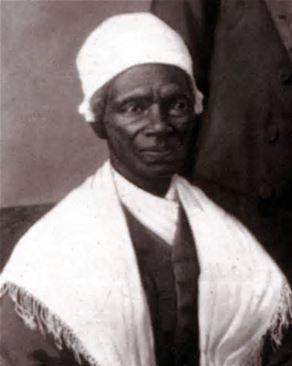
Sojourner Truth
This NPR piece Attenborough’s muddled thinking can’t stop human evolution came to our attention this morning by way of David Earle from New Zealand.
David’s blog is In the Company of Hysterical Women.
His comment on yesterday’s Views from the Edge post The American Religion reads, in part:
Fortunately Sir David is totally wrong on all counts. It is only a small fraction of humanity that benefit for these improvements and even then, it has little to no measurable impact apparently on generic change across population. …
But he is tapping into a wider sentiment that some day we might be so in control of our own destiny that we are no longer subject to this nasty, animal based thing called evolution.
Isn’t that when we force our way back to the garden and eat from the second tree?
Editor’s note: David is referring to the Genesis story (Gen. 2 and 3) where what David calls “the “first tree” is the tree of the knowledge of good and evil (the tree of control/mastery by which they will “be like God”). “The second tree” is the tree of life (by which the characters in the story would become eternal.)
The Garden story is not history; it’s anthropology and theology. It never happened; it’s always happening.
Your thoughts on the matter are welcome. Leave a comment to promote the discussion.
“A religion is a unified system of beliefs and practices relative to sacred things, that is to say, things set apart and forbidden, beliefs and practices which unite into one single moral community…all those who adhere to them.” – Emile Durkheim, The Elementary Forms of Religious Life, p. 17.
Emile Durkheim is one of the fathers of the social sciences and the father of sociology. When he first studied the aboriginal people of Australia, he carried with him a bias against all religion.
“During Durkheim’s life, his thinking about religion changed in important ways. Early in his life, as in Division, he argued that human societies could exist on a secular basis without religion. But later in his life he saw religion as a more and more fundamental element of social life. By the time he wrote Forms, Durkheim saw religion as a part of the human condition, and while the content of religion might be different from society to society over time, religion will, in some form or another, always be a part of social life. Durkheim also argues that religion is the most fundamental social institution, with almost all other social institutions, at some point in human history, being born from it. For these reasons he gave special analysis to this phenomenon, providing a philosophy of religion that is perhaps as provocative as it is rich with insights.
“According to Durkheim, religion is the product of human activity, not divine intervention. He thus treats religion as a sui generis social fact and analyzes it sociologically. Durkheim elaborates his theory of religion at length in his most important work, Forms. In this book Durkheim, uses the ethnographic data that was available at the time to focus his analysis on the most primitive religion that, at the time, was known, the totemic religion of Australian aborigines. This was done for methodological purposes, since Durkheim wished to study the simplest form of religion possible, in which the essential elements of religious life would be easier to ascertain. In a certain sense, then, Durkheim is investigating the old question, albeit in a new way, of the origin of religion. It is important to note, however, that Durkheim is not searching for an absolute origin, or the radical instant where religion first came into being. Such an investigation would be impossible and prone to speculation. In this metaphysical sense of origin, religion, like every social institution, begins nowhere. Rather, as Durkheim says, he is investigating the social forces and causes that are always already present in a social milieu and that lead to the emergence of religious life and thought at different points in time, under different conditions.”
– Paul Carl’s entry on Emile Durkheim published June 3, 2012 in Internet Encyclopedia of Philosophy: a Peer-Reviewed Academic Resource.
QUESTION
Later sociologists like Robert Bellah look today at American society and ask what “sacred things” are enshrined in American culture and practices.
What are the equivalent beliefs and practices, “sacred things” set apart or forbidden, that give coherence to a fast-changing American society?
A Sermon at Shepherd of the Hill Presbyterian Church in Chaska, Minnesota.
EXCERPTS
“I have always been bemused by time and place. I am a toddler on a train listening in the night to the eerie sound of the train whistle and the constant click-clacking of the wheels. Where were we? Where are we going – and why, just my mother and I?”
“We are all in transit. But from where to where and from when to when have become less and less my questions.”
After posting a heavy piece on the President’s speech on Syria, 15-week-old Barclay took me aside and suggested I lighten up. “Dad, you have to stop being so serious. Besides, Dad,” he said, “I like President Obama. I thought you did, too. You need to chill out. You need to watch Mom’s video from last night and show it to the world. You humans are just too mean. All this Syria stuff is just a big soccer game.”
“Okay,” I said, “I’ll put your video up on the blog to bring some laughter and lighten up the superior species. Good dog!”
“Our ideals and principles, as well as our national security, are at stake in Syria, along with our leadership of a world where we seek to ensure that the worst weapons will never be used. America is not the world’s policeman. Terrible things happen across the globe, and it is beyond our means to right every wrong. But when, with modest effort and risk, we can stop children from being gassed to death and thereby make our own children safer over the long run, I believe we should act. That’s what makes America different. That’s what makes us exceptional.”
– Conclusion of President Obama’s Sept. 10 national address on Syria.

Kosuke Koyama
By the end of his life in 2009, Kosuke Koyama had concluded that there is only one sin: exceptionalism.
I wish President Obama had been able to consult with Kosuke Koyama (1929 – 2009) before delivering this speech. He might have chosen his words more carefully. Koyama was a world-renowned Japanese Christian theologian and leader in inter-religious dialogue, author of Waterbuffalo Theology, Mount Fuji and Mount Sinai: a Critique of Idols, among other books.
Koyama first heard the claim of national exceptionalism in the Japan of his childhood. Japan was exceptional. The best. Number one. The Empire of the Rising Sun. The Emperor, supported by the religion of the imperial cult, could do no wrong. He was divine. So was Japan.
Dr. Koyama and his wife Lois moved to Minneapolis following his retirement. He shared with his friends his deep sadness that the old Japanese imperial claim had become the American claim.
America’s “leadership of a world where we seek to ensure that the worst weapons will never be used” is at stake.
Fact: the worse weapons ever used (nuclear and chemical) have already been used. We used them. We are the only nation on the planet to have dropped the atomic bomb. We dropped on Hiroshima and Nagasaki, Japan. We used chemical weapons in Vietnam. Agent Orange is a chemical weapon. Napalm is a chemical weapon.
America is not the world’s policeman. Terrible things happen across the globe, and it is beyond our means to right every wrong.
We have thought of ourselves as the world’s policeman and we still do. A policeman insures that the law of the land is enforced. The law that causes such resentment in the Middle East is the law of American exceptionalism and prerogatives. For the Arab world, this is what makes America different: the presumption of American exceptionalism expressed by re-arranging the economic-political-cultural landscape to advance Western interests, as in the case of Saudi Arabia, or by imposing and disposing, as in the CIA assassination of the legitimate President of Iran and the installation of the Shah, or our support for Saddam Hussein and Iraq in the Iraq-Iran War.
Very clearly, the U.S. has not sought to right every wrong. Nor should we. But our language is hollow at best and jingoistic at worst when one surveys the history of American intervention into the internal affairs of other sovereign states as the heir of British colonialism. The arrangements in the Middle East have their genesis in deals made by wealthy British and American elites with elite Arab Sheiks and strong men like Hosni Mubarak and Muammar Gaddafi until they no longer were useful.
“But when, with modest effort and risk, we can stop children from being gassed to death and thereby make our own children safer over the long run, I believe we should act.”
International scenes of human suffering and terror abound. In some cases we have chosen to act. In others, like Darfur, we chose not to act based largely on the principle of American self-interest. If American national interests were not threatened or affected, we did not act militarily. We acted humanely with humanitarian aid, but we did not act militarily to stop the horror of genocide in Darfur.
The principle of American national security and self-interest is clear in the President’s speech where he ties together the long-term safety of American children here at home with the short-term safety of children being gassed in Syria. That is, arguably, the way it should be. The use of chemical weapons and the threat of them in the hands of those who hate us is an ominous prospect.
Whether we should act is not, however, the question. The question is how America should act? Furthermore, how we decide to act should be informed and guided by the lessons of our own historic use of weapons of mass destruction and our own involvement in the supply of chemical weapons to Saddam Hussein, used in the Iraq-Iran War and allegedly used against his own people in Iraq.
It is an essentially moral position to condemn the use of weapons of mass destruction (chemical, nuclear, or biological. It is immoral to use them –an offense against humanity, and offense against all nature, and, for religious people, an offense against God.
Unfortunately there is not an equivalent of confession for nation states when they themselves have acted against their own declared moral principles. President Obama did not drop the bombs on Japan. Nor did he or his Administration supply the chemical weapons that did in Iraq what has happened to the mothers and children in Damascus. He might wish he could wash the blood from America’s hands or erase these chapters of American history, but he cannot. He cannot because the facts are facts, and the rest of the world remembers.
<
em>“That’s what makes America different. That’s what makes us exceptional.”
“There is only one sin,” said Kosuke Koyama,.“Exceptionalism.”
The myth of American exceptionalism dates back to a great hope as the new nation was about to be born. It was spoken in a sermon by Puritan John Winthrop on the Arbella sailing the high seas from the Old World of England to the New World of America. The biblical text of John Winthrop’s sermon was the Sermon on the Mount in the Gospel of Matthew applied to the adventure of establishing an exceptional nation, “the city set upon a hill” (Matthew 5:14) to give light to the world.
Although the word ‘exceptionalism’ is foreign to most Americans except those in academia or those who are especially attuned to American politics, it is the controlling myth of American life and the ground to which succeeding American Administrations and Congresses have turned to justify American ventures – economic, spiritual, political, cultural, and military.
In some way or another it falls to each Administration to uphold the myth, even and perhaps especially, when the myth appears to be false. The aspiration of a city set upon a hill was etched in mind of the Church, not a nation-state. It was and is a call to a different way, and its original spokesman saw that city quite differently from the American military-industrial-technological-corporate complex. This Jesus, a Jewish rabbi living under the Roman occupation of the First Century C.E., was not a warrior or a policeman. He saw to the heart of the human condition and the tragedy of high moral claims that justify all forms of violence.
“Why do you see the speck in your neighbor’s eye, but do not notice the log in your own eye? Or how can you say to your neighbor, ‘Let me take the speck out of your eye’, while the log is in your own eye? You hypocrite, first take the log out of your own eye, and then you will see clearly to take the speck out of your neighbor’s eye” (Gospel of Matthew 7:3-5, NRSV).
There is only one sin.
Koyama’s last work was Theology and Violence: Towards a Theology of Nonviolent Love, published in Japanese in 2009 in Tokyo. There is, as yet, no American translation.
Gravel and motorcycles don’t mix.
Even though the 73 year old Dean
(Emeritus) was only going 5 mph
on the last gravel mile to his
daughter’s lake house, when he looked
at the passing motorboat,
the big quiet bike slowly slid sideways
and down on his left leg.
A passing lake visitor helped lift
the bike off his bruised, he thought,
limb, and he limped the half-mile
to his daughter’s place carrying
his helmet–the same red as his bike.
After resting, she drove him back
to the unharmed motorcycle,
which he rode the 30 miles home.
He drove his pick-up truck to the
Walk-in Clinic to check the leg
that kept hurting as he walked.
After the X-Rays showed two
breaks, waiting for surgery,
his daughter said, “I’ll bet you
are smiling because your bike
wasn’t even scratched!”
– Steve Shoemaker, Urbana, IL, September 10, 2013

