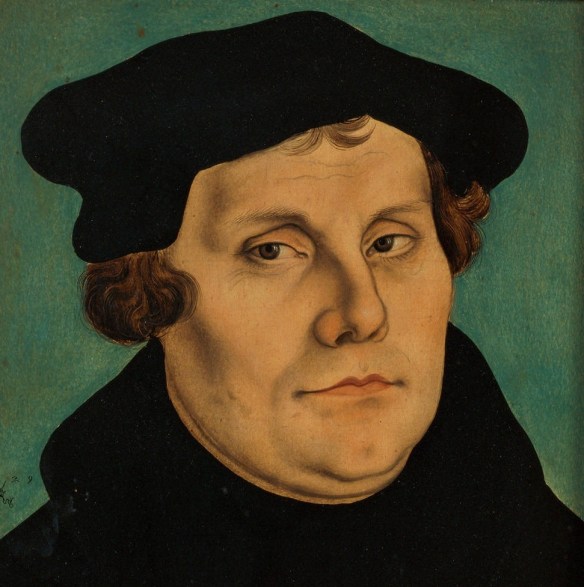
Sermon: You shall see My back

A sermon on The Book of Exodus 33:12-23 for Reformation Day celebrating the 500th Anniversary of the 16th Century Reformation, preached at Central Presbyterian Church, St. Paul, Minnesota.

With all that’s happening in the world these days, many thoughtful people wonder about the nature of God, or conclude there is no God, that the whole thing is a made-up story to serve our own purposes rather than seeing something real that cannot be seen.

“See, there is a place by Me” [says God to Moses in the wilderness] “where you shall stand on the rock; and while My glory passes by I will put you in a cleft of the rock, and I will cover you with My hand until I have passed by; then I will take away My hand, and you shall see My back; but My face shall not be seen” (Ex. 33:22-23).

This strange reading from the Book of Exodus which puts a face on God —  God has no face, no hands, no feet — may just be the text to help us get reality straighter than we had before the crisis that imperils the human species itself: the onset of climate departure. Not just climate change, but climate departure, the point of no return to nature as we have known it. Maybe God has put us again in the cleft of the rock and is passing by. We only get to see God’s back.

While our hearts and minds are reeling on the edge of the abyss of despair over the rise of the KKK and the alt-right in Charlottesville, the hurricanes, floods, fires, and earthquakes in Houston, Puerto Rico, northern California, and Mexico City to say nothing of the inexplicable massacre of more than 500 concert-goers in Las Vegas while two little boys with matches in Washington and Phnom-pen play chicken with nuclear toys, we are like Moses in the wilderness pleading to see God’s glory. We are teetering on the edge of an abyss into which we dare not look.

“To clasp the hands in prayer is the beginning of an uprising against the disorder of the world,” wrote Karl Barth. Elsewhere he insisted that the God we know in Jesus Christ is essentially unknowable. So today we clasp our hands again asking about God, asking about what, if anything, is ultimately and finally Real. We only see God from the back, clasping our hands in prayer — the beginning of an uprising against the present disorder of the world.

Like Moses in the cleft of the rock — between a rock and a hard place — in the wilderness where nothing is certain — we have forgotten, to paraphrase our Lord, that “Humankind does not live by tweets alone…but by every word that comes forth from the mouth of God.”

In the Hebrew mind, to see someone’s face is to know them. But God says to Moses, “You cannot see My face and live. I will put you in the cleft of the rock, cover you with My hand and passed by. Only after I have passed by can you see My back.”

Why the back? Why not the face?

We are mortals who don’t want to be mortal, mammals who don’t want to be mammals. We are part of nature, not the masters of nature, not the exception to it. “You are dust,” says the Creator in Genesis, “and to dust you shall return.” Mammals are not meant to wake up with morning tweets from a mortal who can’t sleep and needs to hear Echo’s voice before breakfast and coffee.

We are living in the period of Narcissus of the Greek myth who dies because he cannot take his eyes off his reflection in the pond — his own face, his own image, his own glory.  A mere a mortal who must eat and drink to survive, Narcissus dies because to drink would have disturbed the pond in which he sees only himself. And, when he dies, a flower blooms on that very spot.

On this Reformation Sunday and the 500th Anniversary of the Reformation, we do well to pay heed to a declaration that may strike us as curious: “Human nature is, so to speak, a perpetual factory of idols.”

Wait! Wait! Don’t tell me!     Who said that:

Bill Maher, Christopher Hitchens, or someone else?

Would you believe it was John Calvin, the much misunderstood 16th century reformer whose work was turned into stone by the Calvinists who mistook his face for God’s, turning his work into an idol?

The issue for Calvin and the Reformed theological tradition which is Central’s tradition, was not atheism. It wasn’t unbelief. It was idolatry. It was misplaced worship of the products, phantasms and fantasies produced by the human heart and mind, the substitutes for ultimate reality that command our worship.

Wait! Wait! Don’t tell me! Who said:

“The human mind, stuffed as it is with presumptuous rashness, dares to imagine a god suited to its own capacity; as it labors under dullness, nay, is sunk in the grossest ignorance, it substitutes vanity and an empty phantom in the place of God. To these evils another is added. The god whom man has thus conceived inwardly he attempts to embody outwardly. The mind, in this way, conceives the idol, and the hand gives it birth” —

Bill Maher, Christopher Hitchens, William Barber II, Cornel West, Elizabeth Warren, or John Calvin?

“I will cover you with My hand while I pass by. You can see me from the back.”

There is in the Hebrew Bible, and in the writings of Holocaust survivor Eli Wiesel, a profound sense of God’s absence as well as presence. By the time Moses gets to see God from the back, God has already passed by.

In the Lutheran and Reformed tradition from Luther to Calvin to Bonhoeffer to Bill McKibben, there is a long-standing recognition of God’s absence or hiddenness.  Listen to Dietrich Bonhoeffer:

The God who is with us is the God who forsakes us. The God who makes us live in this world without using God as a working hypothesis is the god before whom we are standing. Before God and with God we live without God. God allows Himself to be edged out of the world and on to the cross. God is weak and powerless in the world, and that is exactly the way, the only way, in which God can be with us and help us. …

 Man’s religiosity makes him look in his distress to the power of God in the world; he uses God as a deus ex machina. The Bible, however, directs us to the powerlessness and suffering of God; only a suffering God can help. To this extent we may say that the process we have described by which the world came of age was an abandonment of the false conception of God, and a clearing of the decks for the God of the Bible, who conquers power and space in the world by his weakness. . .

 Humans are challenged to participate in the sufferings of God at the hands of a godless world. One must therefore plunge oneself into the life of a godless world, without attempting to gloss over its ungodliness with a veneer of religion or trying to transform it. . . To be a Christian does not mean to be religious in a particular way, to cultivate some particular form of asceticism. . . but to be a human being. It is not some religious act which makes a Christian what he is, but participation in the suffering of God in the life of the world.. . .

One must abandon every attempt to make something of oneself, whether it be a saint, a converted sinner, a churchman . . . This is what I mean by worldliness—taking life in stride, with all its duties and problems, its successes and failures, its experiences and helplessness. It is in such a life that we throw ourselves utterly in the arms of God and participate in his sufferings in the world and watch with Christ in Gethsemane. That is faith, and that is what makes a human and a Christian. —Dietrich Bonhoeffer, Letters and Papers from Prison.

 The world may be God-less, but it is not without gods. The idols are everywhere. And the chief idol of our time is the prosperity gospel: the gospel of greed that escapes all suffering.

These small gods our hearts have manufactured are not real but they are no less powerful. When they are unmasked, we see their ashen faces – the faces we have created because we refuse to live as mortals who cannot see God’s face, discontent to spend time in the cleft of the rock in order to see God from the back, the scarred back of God, whipped and lashed by the hands of Narcissus’s god-filled world.

Presbyterians and others of the Reformed theological tradition often ask why our membership is declining. Are we dying?

On this Reformation Sunday in the year of the 500 Anniversary of the Reformation, could it be not because we haven’t kept up with the latest cultural trends and fads but because we’ve forgotten our identity? Could it be, in part, not because other churches have bands and are better at entertainment, and make God more accessible to a tweeting culture, but because we have surrendered the one thing that makes us Reformed Christians: humility before God — a profound sense of awe before the holiness of God whose face we cannot see?

Could it be that we have mis-translated the rallying call of the Reformed tradition to mean that the church must always be changing itself, that we are the agents of our own change. Ecclesia reformata, semper reformanda! is properly translated “The church reformed and always being reformed!” Which is to say, under the judgment and guidance of the Holy Spirit of the Living God, not changing our image in Narcissus’s reflecting pond. It is a theological-ethical perspective which, as McCormick Theological Seminary’s Anna Case-Winter wrote in Presbyterians Today (May, 2017), “neither blesses preservation for preservation’s sake nor change for change’s sake.”

Ecclesia reformata, semper reformanda . . . calls us to something more radical than we have imagined. It challenges both liberal and conservative impulses and the habits and agendas we have lately fallen into. It brings a prophetic critique to our cultural accommodation—either to the past or to the present—and calls us to communal and institutional repentance. It invites us, as people who worship and serve a living God, to be open to being “re-formed” according to the Word of God and the call of the Spirit.”

“Holy, holy, holy! Lord God Almighty! All the saints adore Thee, Casting down their golden crowns around the glassy sea; Holy, holy, holy!  Though the darkness hide Thee; Though the eye of sinfulness Thy glory cannot see, Holy, holy, holy! All Thy works shall praise Thy Name in earth and sky and sea!”

We don’t get to see God’s face. We cannot see God’s full glory.  But, as the disciples of Jesus Christ, we do see God’s back! And for mortals, that’s plenty good enough! And from the darkness of this cleft in the rock, we join with Luther in trembling before the Holy One, and join Barth and Bonhoeffer by clasping our hands together in the dark as the beginning of an uprising against the disorder of the world.

And though this world, with devils filled,

Should threaten to undo us,

We will not fear, for God hath willed

His truth to triumph through us:

The Prince of Darkness grim,

We tremble not for him;

His rage we can endure,

For lo! his doom is sure,

One little word shall fell him.


That word above all earthly powers,

No thanks to them, abideth;

The Spirit and the gifts are ours

Through Him who with us sideth:

Let goods and kindred go,

This mortal life also;

The body they may kill:

God’s truth abideth still,

His Kingdom is for ever.

  • Gordon C. Stewart, Chaska, MN, October 29, 201

Only the Splendor of Light

What we now see through the Hubble telescope is poetry written on a grand scale much larger than our mortal minds can fathom.

A deep infrared view of the Orion Nebula from HAWK-ILong before the Hubble and long before the onset of climate departure that rocks our illusion of the human species’ exception to nature, Walter Chalmers Smith‘s poetry gave voice to the sense the Hubble elicits, the sense of mortal awe looking at what we cannot fathom.

How do you express the inexpressible mystery of the Creator whose name was unutterable in Hebrew Scriptures, save the self-described “I AM”? How do you put into words what cannot be known? How do you sing about the One who is ineffable — beyond all words? —  Professor C. Michael Hawn, Perkins School of Theology, “History: ‘Immortal, Invisible, God Only Wise’.”

Poetry is the language of faith. Perhaps it is also the language of God, the Ineffable.

To all, life Thou givest, to both great and small,
in all life Thou livest, the true life of all;
we blossom and flourish as leaves on the tree,
and wither and perish, but naught changeth Thee.

Great Father of glory, pure Father of light,
Thine angels adore Thee, all veiling their sight;
all praise we would render, O help us to see
’tis only the splendor of light hideth Thee!

— Walter Chambers Smith (1824-1908), “Immortal, Invisible God Only Wise” (1867), stanzas three and four.

  • Gordon C. Stewart, Chaska, MN, October 30, 2017.

H.L. Mencken — American prophet

H.L. Mencken wrote it in The Baltimore Evening Sun, Sunday, July 26, 1920:
“As democracy is perfected, the office of the President represents, more and more closely, the inner soul of the people. On some great and glorious day, the plain folks of the land will reach their heart’s desire at last and the White House will be occupied by a downright fool and complete narcissistic moron.”
23353-004-D77B30AD Mencken

Henry Louis Mencken @The Baltimore Evening Sun

Mencken was known as “the Sage of Baltimore.” These days, I listen to Bill Moyers, Christopher Hedges, and watch the PBS News Hour Friday nights with Mark Shields and David Brooks.
David Brooks’ “The Week Trump Won” (Oct. 26 NYT) confirms — in chilling detail  — H.L. Mencken’s status as a prophet. Yet it ends with the faint hope that the better angels of the American character still lie buried in the people’s DNA, waiting for a spokesperson, a leader, to give voice to sanity and vision.
– Gordon C. Stewart, Chaska, MN, Oct. 28, 2017.

2017 in the Cleft of the Rock

This 500th Anniversary of the 16th Century Reformation is also the onset of climate departure. Not just climate change, but climate departure, the tipping point beyond which there is no way back.

1529MartinLuther

Martin Luther (1483-1546)

Preparing to preach on Reformation Sunday at Central Presbyterian Church in St. Paul leads to reflection on a strange text and several great hymns.

The text (Exodus 33:12-23) pictures Moses in the cleft of the rock with God’s hand covering him while God passes by with the reminder that no mortal can see the face of God and live. The hymns that come to mind are “A Mighty Fortress Is Our God” and “Immortal, Invisible, God Only Wise.”

Perhaps, like Moses in the wilderness, we are in the cleft of the rock — between a rock and a hard place — and more than a little humbled as the Creator of all that is, Being-Itself, passes by while we are in the dark.

This moment of climate departure demands a new reformation, beginning with the recognition that we, homo sapiens, are mammals with the horses, cows, dogs, lions, cheetahs, and elephants — and that our future is imperiled by the gods of greed and prosperity our hearts have manufactured.

“Human nature is, so to speak, a perpetual factory of idols,” wrote the 16th Century Reformer John Calvin.

cd6353be60481a08737fdf1555f0973e--john-calvin-reformed-theology

2017 is a far cry from 1517, but it is, in this respect, the same.

A difference this year is that Martin Luther’s Ein feste Burg — “A Mighty Fortress” — will be sung in Catholic masses as well as protestant celebrations, bearing witness to the reconciling love of God over centuries of time.

Meanwhile the prosperity gospel — based on the idol of property — will go unchallenged in many churches, a departure from the truth that can only be found between a rock and a hard place: this cleft of the rock in 2017 while God passes by.

  • Gordon C. Stewart, Chaska, MN, October 27, 2017.


Elijah: Grandpa, what’s surreal mean?

The_Elephant_Celebes

The Elephant Celebes by Max Ernst. Oil on canvas. 125.4 x 107.9 cm. Tate Gallery, London.

Grandpa, what’s surreal?

Where’d you get that word? You’re only five months old!

I heard it on the news. Some flake from Arizona said it.

1200px-Jeff_Flake_official_Senate_photo_(cropped)

Senator Jeff Flake (R-AZ)

Well, it wasn’t “some flake,” Elijah! It was Senator Jeff Flake, and he’s not a flake. Flakes are like snowflakes. You haven’t seen snowflakes yet but it’s supposed to snow tomorrow. You’ll see. Snowflakes fall from the sky, turn everything white, and then they disappear.

Did Jeff Flake disappear? He’s white. Is he surreal?

No, Elijah, he hasn’t disappeared and he’s not about to disappear.

So…what are you talking about? You’re not making sense, Grandpa!

Well, Jeff Flake was saying what thinking people know: what’s happening in the world right now is surreal.

That’s what I asked you!!! What’s ‘surreal’?

Life is, Elijah! You’re only five months old.  You’ve never known anything but the surreal world. It’s the world that has “the disorienting, hallucinatory quality of dream; unreal; fantastic” (Dictionary.com). Life itself has become surreal.

Grandpa, are elephants real?

Yes, why?

‘Cause Marissa doesn’t’ like elephants. She says they’re mean and out of touch with reality. Are elephants like snowflakes?

No, Elijah. Elephants are real. But some elephants, like the one Marissa is talking about, are . . .  well . . .  surreal and deranged. They want the whole world to be white. They’re snowflakes.

Yeah, but not like Jeff Flake. Jeff Flake’s no flake!

Right, Elijah. He’s like Max Ernst and the Surrealists who exposed the underlying insanity by painting it. Jeff Flake painted it with words.

IMG_1779 E 5 monthsThanks, Grandpa. This whole conversation has been surreal. I love words!

  • Grandpa Gordon, Chaska, MN, Oct. 26, 2017.


Elijah and his sitter’s text

Grandpa, my babysitter was crying today.

IMG_1779 E 5 months

Elijah (five months old)

I’m sorry, Elijah. Why was she crying?

Marissa’s cousin in Puerto Rico sent a text five days ago but Marissa didn’t get it until this morning. She was crying hard, Grandpa! It was really sad.

What did the text say, Elijah?

I thought you’d ask, so I asked Marissa to print it out ’cause you’re old. You don’t text so good.

‘Well’, Elijah, I want you to learn to speak proper English. You should say, “You don’t text so well” — not “you don’t text so good.”

Yeah, well, you say ‘well’ a lot. That’s not good. Well, here’s what Marissa’s text from Puerto Rico said. It’s not good.

Month 2. Day 1.

No power

We have running water

Telecommunications are fair on the best of days. I consider it successful if I can consistently get 2mb down. Today it’s about 0.13mb.

Traffic is insane

Fuel lines are better

Shopping takes hours

We are the lucky ones, the privileged ones. It’s not better, progress is slow, medical care is impossible for many.

We are here. We need your help. Keep pressure on news organizations, on elected officials, and aid organizations. Use your voice for people who have been silenced.

Grandpa! We’re gonna help, right? Are we ‘privileged’?

  • Grandpa Gordon, Chaska, MN, October 24, 2017

“A Soulless Coward”

The President’s lies about former presidents Obama and Bush in reaction to criticism that he had not made presidential calls to the families of four soldiers killed in Niger struck me as just one more example of his unfitness for office.

Then The Nation exclusive interview — “‘A Soulless Coward’: Coach Gregg Popovich Responds to Trump” — popped into my inbox. “[T]o lie about how previous presidents responded to the deaths of soldiers—is as low as it gets. We have a pathological liar in the White House.”

Gregg Popovich, the United States Air Force Academy alumnus and head coach of the San Antonio Spurs, is affectionately called “Pop” but one has to wonder how long the affection will last after calling the president a soulless coward.

The interviewer, Dave Zirin, The Nation‘s sports writer, concludes the article: “Should be one hell of an NBA season.”

  • Gordon C. Stewart, Chaska, MN, October 17, 2017.


Open Letter to NFL Owners

To: Mark and Zygi Wilf, owners, Minnesota Vikings
Cc: NFL Commissioner Roger Goodell

October 17, 2017

Today’s NFL owners meeting is a watershed moment. The agenda item  that would change the NFL’s rules limiting player behavior during the national anthem requires a courage stance informed by history.

As the sons of parents who were survivors of the Holocaust in Nazi occupied Poland, you are in a unique position to lead this discussion as owners of the Minnesota Vikings.

I applaud your initial response to the issue of taking a knee during the national anthem. By linking arms with Vikings management and players, and by your official statement on the matter, you supported players’ First Amendment right to free speech. You refused to buckle to the White House demagoguery that confuses taking a knee on behalf of racial justice with disrespect for the country.

I was pleased that you and the NFL stood up for a bedrock American principle. Principle trumped profits . . . momentarily. Now filling pockets threatens to empty the initial commitment to the U.S. Constitution.

If the NFL owners today accede to the president’s bullying, I, for one, will take a knee. I will turn off the television Sundays, Mondays, and Thursdays . . . as a matter of principle . . . and will invite everyone I know to do the same. Some things are more important than football. They learned that in Germany. I thought we had, too.

Perish the thought, but . . . if the national anthem pre-game ritual requires the equivalent of a “Sieg Heil!” salute that abrogates the right to free speech, maybe it’s time to end the pre-game ritual and just play football.

I hope and pray this morning that our Jewish friends lead the way today to honor the dead from the history we dare not forget and to stand up for the principle of First Amendment rights to freedom of speech.

And, while you have the floor, I hope you will bring to the league’s attention the duplicity of having defended the league against the president’s criticism of taking the knee while, at the same time, the owners appear to collude to exclude the original kneeler, Colin Kaeppernick, from taking the practice field.

Sincerely,

Gordon C. Stewart
Chaska, Minnesota

Neighborly Economics

Mindfulness —the latest topic around the water coolers — helps in times like these. While some use Yoga or some other eastern meditation to become more mindful, my practice is to contemplate the poetry of the Book of Psalms. I open Psalm 146 in hopes of putting my anxious soul at ease from this moment of history.

Praise the LORD, O my soul,
I will praise the LORD as long as I live;
I will sing praises to my God as long as I have my being.

Put not your trust in rulers, nor in any child of earth,
for there is no help in them.

When they breathe their last, they return to the earth,
and in that day their thoughts perish. (Ps. 146:1-3)

The psalmist assures me that this moment will not last forever. The elevation of the rich and the assault on the poor, the game of matches lit near the fuses of nuclear devices on two sides of a vast ocean, the name calling between the two narcissists whose Echoes sound the same despite the differences in language, the scenes from Puerto Rico in the aftermath of Maria, the burned-out forests, homes, and vineyards in northern California, the undermining of the hope for universal health care, and the disregard for the Paris Accord addressing climate change have ground me down. There is no help in the White House or Capitol Hill. But, their time, the psalmist declares, is but a breath, a moment. Their thoughts will perish.

IMG_8484

cabin by the wetland

In the solace of the cabin by the wetland far from the news, I am breathing easier. Away from the rulers in whom the psalm urges me to place no trust, my mind is calmer. I am in need of no great thing.

But, after lighting the fire in the wood stove, it dawns on me that we’ve forgotten some supplies for the weekend. We have no bread. Or ice cream!

I remember a sign for “DON & DAVE’S: Groceries and Gas — 4 Miles.”

IMG_8514Don & Dave’s is a throw-back to the day Don founded it 70 years ago. From the looks of the exterior, although it is well-kept, I imagine little except for the “ATM Inside” sign has changed since 1947.

“You must be Don or Dave,” I say to the man inside. “I’m Dave,” he says with a smile. I’m Don’s son.” Dave is in his late ‘60s. Don was his father, killed in a car accident years ago. Dave joined his father in the business in 1977. I introduce myself as the owner of the A-frame by the wetland, but he already knows from Shirley, our only neighbor within a quarter of a mile of the cabin.

I take a look around the store, pick up a $1.59 loaf of locally made wheat bread, notice the ice cream freezer, pick up a large tub of Neopolitan ice cream, notice a Hershey milk chocolate with almonds bar, and take them to the check-out counter where Don meets me.

I take out my credit card. “We don’t take plastic,” says Don. “Just cash or check.” I tell him I don’t have either. “Well, we have an ATM,” he says. “I don’t do ATM’s,” I say. You need a PIN for that. I have no idea what the PIN is; Kay does that. I don’t have a clue.” He laughs and invites me to take the bread, ice cream, and Hershey bar without paying. “No problem. Please take it. You can pay me when you come back.”

He takes out a slip of scrap paper, writes down my name, the amount I owe, and the date, and wishes me a good weekend.

Four hours later I return with the cash just before 6:00 P.M., hoping Don and Dave’s is still open on a Saturday night. Turns out they open at 8:00 A.M. and closes at 10:00 P.M. seven day a week! I learn from the young woman who greets me that Don has left for the day, and explain that I’m here to pay my bill. She asks my name, and fetches the piece of paper from a shelf below the cash register. “What should I do with this? Tear it up?”

“No,” I say, “I want Don to know I came back and I want to say thanks. Just write ‘paid’ with today’s date and let me add a word of thanks.”

I had learned earlier from Don that there are four Walmarts with a 60 mile radius of Don & Dave’s. I wonder when the last time was Walmart sent an empty-handed customer away with so much as a loaf of bread, a tub of ice cream, and a candy bar.

I’m very mindful. In the moment. 1947 never looked better!

Values Worth Fighting For

John Buchanan’s “Values Worth Fighting For” articulates clearly so much of what my seminary classmates and I are thinking and feeling as we prepare for the 500th Anniversary of the Reformation in the midst of the era of Donald Trump.

Family of John M. Buchanan's avatarHold to the Good

Churches across the globe, Protestant but also Roman Catholic, will mark the 500th anniversary of the Reformation later this month. On October 31, 1517, Martin Luther, an Augustinian monk and theology professor, nailed 95 Theses to the door of the Castle Church in Wittenberg, Germany. The church door served as the community bulletin board and Luther’s Theses – or propositions- were in the form of an invitation to debate. There has always been some uncertainty about whether Luther actually nailed the document to the church door. What is not uncertain is the effect they had. The 95 Theses had to do with traditional church doctrine and practice that, in Luther’s mind, needed to be reexamined and reformed. The result was the Reformation, in Marilynne Robinson’s words, “a movement that touched or transformed thought and culture across the breadth of empire.” (The Givenness of Things, p.17). Before it was over…

View original post 1,036 more words