Verse: “Christian blood is semen”

Verse:  “Christian blood is semen.”- Tertullian (180-225 A.D.)

Tertullian

Steve Shoemaker, Urbana, IL, July 29, 2012

Terrible-tempered ,

Ever-

Ready

To

Use his

Lively

Legal mind

In defense of

Attacks on the faith,

Nasty

To all,

Even friends,

Respected

Though for

Urging the

Lord’s followers to

Live faithfully

In spite of the

Authorities’

Never-ending executions.

Tertullian was an “Early Church Father” whose works are required reading in most seminary or graduate school courses in Patristics. Click HERE for more information from The Tertullian Project, or get a chuckle from this post-card produced by The Disseminary: Wisdom wants to be free, re-posted here with permission:

“…That side was made for you and me”

This morning my friend Steve asked if I remembered the last line of Woody Guthrie’s folk song “This Land Is Your Land”? Here’s the last stanza. Scroll down to hear it.

There was a great high wall there

That tried to stop me;

A great big sign there

Said private property;

But on the other side

It didn’t say nothin’.

That side was made for you and me!

Behind the high wall of the U.S. Supreme Court’s “Citizens United” decision, join Pete Seeger and Bruce Springsteen singing Woody Guthrie’s song on the way to “the other side.” And remember to celebrate hope Organize. Organize. And keep on singing.

The Non-Exchange at the “The Corn Exchange”

“The Corn Exchange” is not like the Grain Exchange or Wall Street; it’s a French restaurant with a New York chef…in downtown Rapid City, South Dakota. It’s a classy place.

We’ve come here for dinner on recommendation of Carol and Kenn, the innkeepers of Hisega Lodge in the Black Hills. The food is fine; the people watching is equally good or better.

You’re not supposed to stare at people, especially in a restaurant. But sometimes you can’t help it. Like when a beautiful 30-something Asian woman dressed to the nines and a 30-something guy wearing  a t-shirt, jeans, and jogging shoes are seated at a table in full view for people-watching.

The couple at The Corn Exchange


They seem to be on a first date, a bit nervous with each other, maybe matched by a dating service or something, awkward with each other. The first indication is the woman talking on her cell phone. Her date seems a bit irked, or so I think, until he pulls out his iPad, puts it in front of him on the white linen tablecloth, and begins to do whatever he is doing – perhaps showing his date that he, too, has nothing at stake, is cool, detached, not vulnerable, killing time in the awkward silence.

The woman has finished her three phone conversations.  Her mind is back where her body is, at the table with the guy in the t-shirt, jeans, and jogging shoes. But he’s not there. He has his iPhone in one hand and his iPad on the table. Maybe he’s texting himself back and forth. Whatever he’s doing, he seems oblivious to the beautiful, well-dressed Asian woman who has come with him to the fancy Corn Exchange…for a date…and is ready now for him to play the game of hot pursuit. He doesn’t notice. She’s tapping her foot. She’s staring out the window in disgust, her chin resting in her left hand, as if to say,  “B o r i n g!”  

The rest of the meal is like pushing a replay button. The exchanges at the corner table at The Corn Exchange are predictable. He’s preoccupied; she taps her foot. She’s looking out the window when he’s ready to engage; he’s wiggling his leg. She looks at him; he turns his body to the side and looks away. He looks at her; she looks down and takes a bite.

Desserts arrive. The pain endurance contest is almost over. He smiles and begins to pay attention. She smiles back and pays attention. Then the rude people-watchers see an exchange they’ve missed along the way of trying not to be so rude. You can’t stare all the time. The two cell phones – his and her’s – and the iPad are now in his custody, on the windowsill beside their table. We’re’ confused.

Only then do we see the ring on her finger.

The Prenuptial Dinner

Prologue

Describing  the prenuptial dinner in Bend, Oregon calls to mind my niece’s twinkle-in-the-eye declaration after her first experience with Japanese Sushi (raw fish): “It was,” you might say, “an experience!” The memorable “experience” was the company more than the food.

Scene 1

The room in the back of the Middle Eastern restaurant in cosmopolitan downtown Bend, Oregon was hard to find, but well-prepared for the 16 family members.

We introduce ourselves to Bonnie, the bride’s mother, and Mike, the bride’s second step-father. The next 25 minutes is a tag-team Bonnie and Mike monologue. We learn all the places they have lived, why they are now moving from Maryland – on the Chesapeake Bay – to Texas, Bonnie’s ancestral home. They have put their house on the market…and their boat with a listing price higher than the market value of our house in Minnesota. Third marriage for both Mike and Bonnie. No interest in knowing anything about us. Monologue. Texas monologue. The first taste of what is to come.

Scene 2 

The bride’s 65 year-old gregarious Uncle Billy Bob (“Uncle Bill”) – married to the bride’s Aunt Frances – makes his grand entrance. Uncle Bill is very large – 6’4” 280 lbs. of massive  proportions wearing a khaki work shirt tucked into suspendered khaki work pants hiked up high above his waistline and a tractor hat.

Uncle Bill’s voice is as loud as his body is big. He is a commanding presence. We’d met the night before when the families were gathering from Oregon, New York, Texas, and Minnesota. He’s been told I’m a minister.

“Have s seat,” he says, glad to see me, pulling a chair from the long table and slapping it with his hand like a command from a drill sergeant. “So you’re a minister. What kind?”

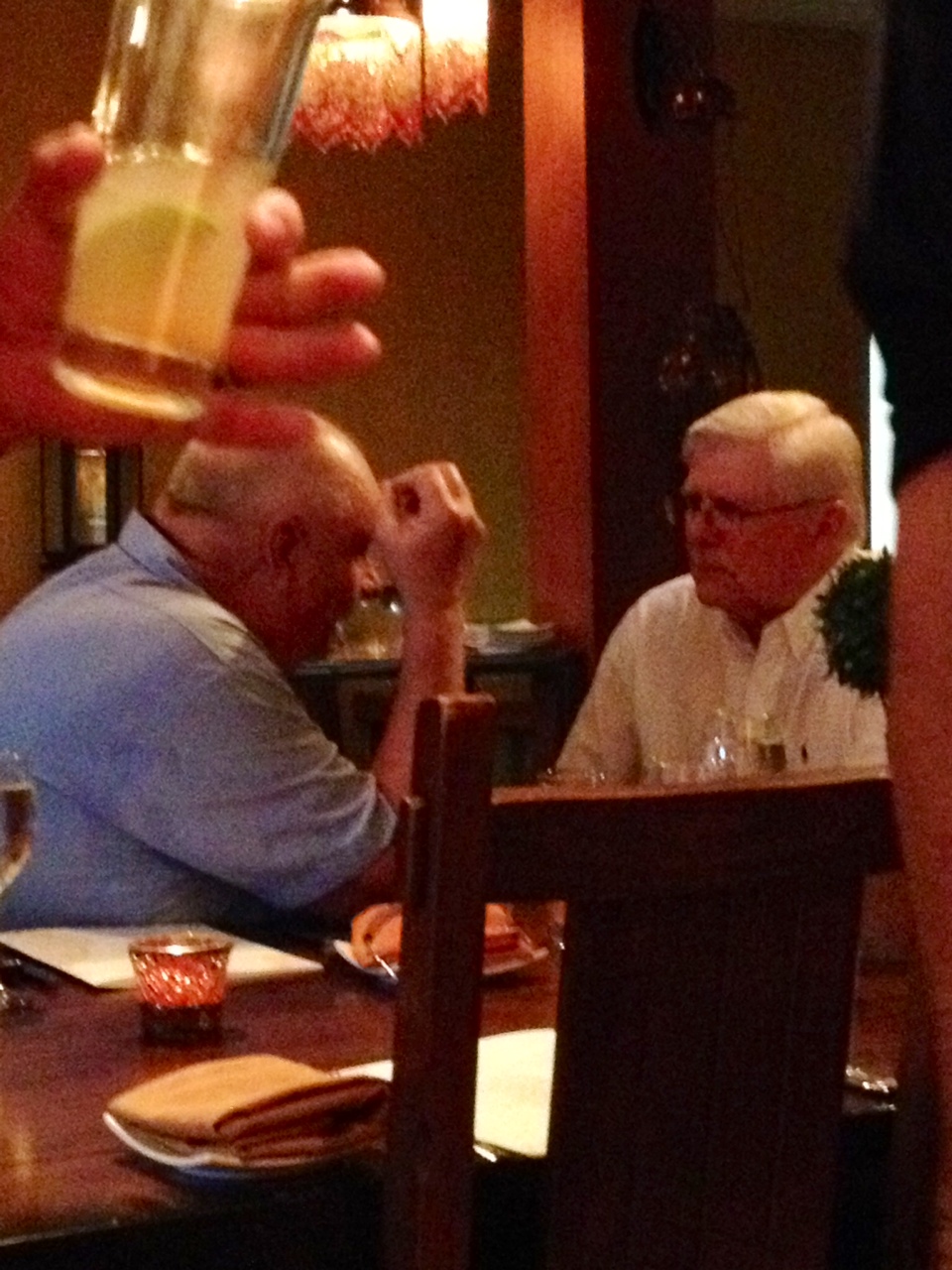
Uncle Bill and Gordon

“Yes sir. Presbyterian,” I say, wondering where this is leading.

“Well, lemme tell ya a story,” says Uncle Bill. “Ma Granddaddy was a Hah Babtist. He married my Grandmomma who was a Hah Church of Chrast.”

“What’s ‘high’ mean?” I ask.

Uncle Bill’s face tells me he’s astonished by my ignorance, a man of the cloth and all that. “Well, sir, there are Hah Babtists and Low Babtists; Hah Church of Chrast and Low Church of Chrast. ‘Hah’ means ‘mine is the only way.’ So my Grandaddy and Grandmomma’s son, ma Daddy, was a heathen. He married a Hah Babtist.

“I was raised Hah Baptist, like ma Momma. Now here’s where the story begins…….”

The waiter interrupts by putting a large platter of hummus and Lebanese pita bread in the middle of the wide table. Billy Bob looks at it. He’s hungry. He’s never seen anything like this. He’s wondering what it is and what to do with it. “Frances!” he calls out to the other side of the room. Frances, who’s recovering from hip surgery, walks to where we’re sitting. “What’s this?” “I don’t know,” says Frances, “I’ll ask Bonnie, maybe she’ll know,” and walks across the room to Bonnie and Mike.

“Now, as I was startin’ to say…you take Frances and me. I was a Hah Babtist; Frances was a Hah Church o’ Chrast.  Now I’m a Low Babtist and she’s a Low Church o’ Chrast.”

Frances returns from the other side of the room.  “It’s chick peas,” says Frances. “Well, I’ll be,” says Uncle Bill, pulling the whole platter in front of him from the middle of the table where others could share it. “Now, what do I do with it?” Before Frances can answer, the large serving spoon is filled with hummus in Uncle Bill’s mouth. “You take the bread and dip it in the chick peas,” says Frances. “Where’s the bread?” “It’s right there,” says Francis, “it’s Middle Eastern.”

“Now the story gets really interesting,” he says. “This is where it begins.”

I’m thinking to myself it’s been 20 minutes and all I’ve said was “What’s high mean?” Uncle Bill doesn’t seem to notice or care. He’s reeled in a minister. Ministers are supposed to be nice people who listen. They just smile, nod, and show interest. This is a monologue by a Texas story-teller with a captive audience.

“I go to my Babtist church and Frances goes to her Church o’ Chrast church. Been doing it for 35 years. Now my minister went off to the Holy Land, I guess they call it and went to the seminar. And you know what the other students told him about why they was at the seminar? Money! They was there for the money. What kinda minister’d you say you was?”

“Presbyterian,” I repeat, “and we’re required to go to seminary in order to be ordained. For us it’s not about money. No one gets more money by going to seminary. Every candidate for ministry goes to seminary because we want our ministers to learn the original biblical languages – Hebrew and Greek – and spend three years in graduate school before serving a congregation.”

“How big was your church?” asks Bill. What was the biggest?”

“3,000.”

“See that’s what I mean? Now we’re just a little church o’ 35 people. We pay our minister $1500 a month which seems pretty dang good to me.”

Apparently Bill has concluded that his audience is a money-grubber, although he never says so. He’s Low Babtist; I’m Presbyterian. I’m sipping a vodka martini; he’s drinking lemonade-iced-tea. He’s livin’ the low life; I’m living the hah life.

Scene 3

I’m thinking to myself,

“Funny how Hah (the only way OR the superior way, religion, culture, accent) manages to find an open door even when we think we’ve locked it behind us. High just re-defines itself according to whatever ways my life seems superior to Billy Bob’s or Billy Bob’s seems to him to be superior to mine.”

I poke fun at Billy Bob’sTexas drawl and monologue and laugh at his call across the room to Frances to rescue him in a Middle Eastern restaurant which is stranger to him than the money-grubbing Presbyterian “seminar” graduate from Minnesota. Each of us has managed to place himself on the perch of Hah looking down at the Low.

But there’s something about the two of us sitting there sipping our different drinks, eating the hummus and pita bread, that unifies us. We kind of like each other…maybe the way opposites are attracted to each other, if for no other reason than that they’re interesting.

“Now lemme tell ya another story… As I was startin’ to say…”

“Bill, I’m sorry, I need to catch up with my wife. It’s been a pleasure.”

“You bet. We got a w h o l e evening to get acquainted. We’ve got plenty o’ time.”

Scene 4

As we sit down for the meal, I sit at one end of the long table of 16 people with Kay on the left and Frances to my right. Uncle Bill sits to France’s right.

At the opposite end of the table sits my son Doug with his partner and two of the bride’s relatives, all now living in New York City. They’re on their second bottle of wine, having a great time, as the waiter brings the entrees to our end of the table. Doug flashes a wave to his Dad.

Uncle Bill turns to the head of our table and asks the money-grubbing Presbyterian minister from the seminar, “Would you say the blessing’ for our end of the table?” I offer the blessing on behalf of all the hah and low Baptists, Church of Christ, and Presbyterian people at our end of the table – thankful for new food and friends, for family, and for grace bigger than any of our highs – thankful, you might say, for “the experience.”


I Live with doubt

I live with doubt

A hymn by Steve Shoemaker, Urbana, IL, In honor of John Newton (1725-1807), author of “Amazing Grace.”

I live with doubt:  my faith is weak,
Dark clouds are what I see.
A God of love is all I seek,
Can such a good God be?

The world is full of greed and lies,
Of war and talk of war.
Can any savior hear my cries
And hope and peace restore?

When Jesus met the man born blind,
He touched his eyes with clay.
He bid him wash and he did find
His sight and a new day,

The sun breaks through, I see ahead
My task to feed the poor.
I still have doubts, but grace instead
Of fear I feel much more!

My thoughts and feelings come and go
Like sun dissolves the snow;
But God is firm, and now I see,
That God has faith in me.
Garrison Keillor’s “The Writer’s Almanac”posting on the anniversary of the birthday of John Newton, converted slave ship captain, prompted Steve to write these stanzas in honor of the author of “Amazing Grace.”  Steve’s hymn can be sung to the same tune. The meter is the same.

Verse – We never saw the stars

In memory of Rev. Milton Carothers

As two Protestant pastors, we had no
desire to become eremites, but went
to the monastery  to try to slow
our hectic campus lives in a retreat.
The Benedictine Retreat Master split
us quickly.  I was sent to spend the week
with an old monk–a former architect–
who now designed the gardens for his work
(all of the men must sweat as well as pray.)
We carried rocks; he talked incessantly.
Inside the borders made of stone, each day
we’d pull the sinweeds (never silently.)
At all the common  meals there was no talk
allowed–and in our cells, we were alone,
of course.  At 3 a.m. the bells would wake
us for a walk inside the walls (of stone
also) to sing, to pray the Psalms each night.
We saw no sky:  stained glass kept out starlight.

– Steve Shoemaker, Urbana IL

Editor’s note: I know Milton only through Steve’s tribute to him, but those who have served as campus ministers intuitively understand each other in ways that are unique t those who minister within the walls of the ivory tower. Milton, Steve and I share that history. Milton served in North Carolina, Steve in North Carolina and Champaign-Urbana, IL, and I in Wisconsin, New York, and Ohio. Like Milton and Steve, I have known the need to retreat to the Benedictine retreat center to restore my soul in the solitude and rhythms of Benedictine community.

Although I’ve never risen to pray the Psalms within the walls of stone at 3:00 a.m., I’ve often found myself awake within the starless walls of stone my hardened heart has built. Sometimes at 3:00 a.m. I’m lost among the sinweeds. A Psalm rises up within me to melt the stone, release me from the inner prison, remove the starless plastered ceiling. “When I consider the works of your hands, the moon and the stars which Your fingers have made, what is man that You think of him… and yet” and yet.

“I forgive you”

Another contribution by Views from the Edge  poet laureate Steve Shoemaker.

I forgive you.
Never say that.  This makes you the good
one–superior, in fine control—
condescending to the one that’s bad.
Say nothing, but take the active role:
think, imagine what the other one
likes–what would make them feel happy, whole..
Act in loving ways; make a day fun
for your partner, lover, or your spouse.
Live  forgiveness:  be an act of grace.
Editor’s note: Steve knows about these things. He and Nadja have been sweethearts since high school and have been married forever and a day. To Nadja and his friends…Steve himself is an act if grace.

The Sea Anemones

July 17, 2012

In the early morning fog blue-green – are they fluorescent? – circles cluster in colonies in the tide pools at the base of the Pacific “stacks” at Coquille Point near the human cluster called “Bandon” (Oregon).

Anemones with star fish in Coquille Point tide pool

Every day the sea anemones are here…low tide…mid-tide…high tide…always there, opening to feed, closing to nap or sleep…with the daily rhythm of the tides. They make no protest. They entertain no illusions…of becoming whales, dolphins, seals or sea lions. They make no noise. They do not imagine themselves becoming one of those who prey on them at low tide – a seagull, cormorant or beach-comber.

They just are what they are…creatures…vulnerable…in colonies of mutual petition and intercession in the low tide broad daylight, under clouds, in morning mist, at red-sun dusk, and in the depths of high-tide darkness alike. They bear a silent blue-green fluorescent cluster testimony to the magnificence of this one moment of time next to the tall stacks… small, finite, humble…but here and beautiful…in the vastness of eternity.

Sea stacks, Coquille Point, Bandon, OR

The Penny Roasters

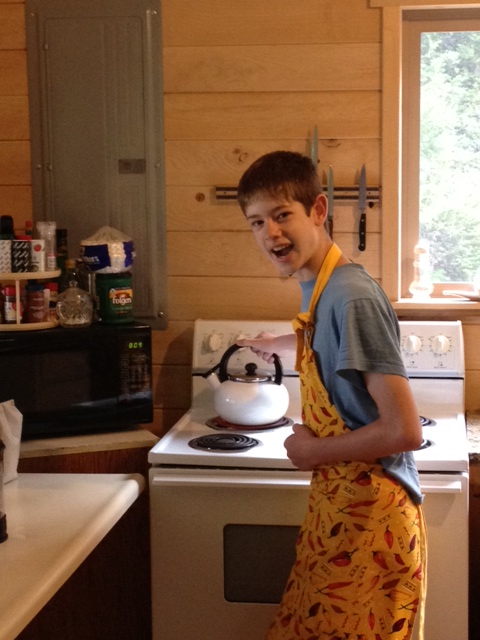
Grandson Jack, proprietor, The Penny Roaster, Bend, OR

The Penny Roasters opens early for breakfast. Jackson Stewart, its proprietor, serves custom coffee, blended to the special tastes of each customer. Jack loves to please – tall, elegant, aproned for cooking, and fully attentive to his customer’s every need.

Amelia, the Penny Roasters’ cheerful hostess, welcomes you to the establishment and shows you to your table. Some people all Amelia “Mimi” but only her closest relatives get to call her that. “Good morning,” she says with a great smile and big eyes with the longest eyelashes you’ll ever see, “welcome to the Penny Roasters.”

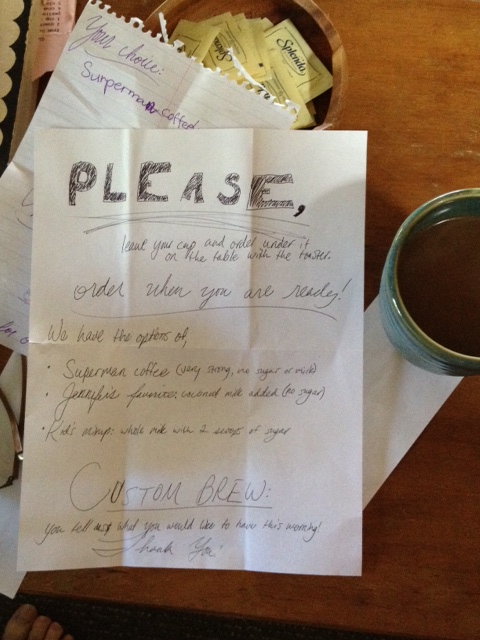
Penny Roasters' menu

The Penny Roasters menu

The table is set with hand-written menus and a coffee cup. The menu includes three regular options: SUPERMAN coffee (very strong, no sugar or milk); Jennifer’s favorite, coconut milk (no sugar); Kid’s mixup: whole milk with 2 scoops of sugar.

The fourth choice is CUSTOM BREW: you tell us what you  would like to have this morning!

Thank you!

You use the pencil to mark the menu.

Verse – “Of the Dead”

Steve hits a home run with this piece. OUCH – and a good laugh.

Verse – “Of the Dead”

De mortuis nihil nisi bonum.

Of the dead speak nothing but good.

As the family gathered

after my mother’s death,

of course we told stories.

My three younger brothers

did not seem to recall

what most disgusted me

about Mom in our youth.

On the phone, she would smile

and say in a sweet voice,

“Good-bye then…see you in church,”

hang-up, and then yell at me,

“Shut-up, when I’m on the phone!

Stop fighting!  You boys drive me crazy!”

Then, RING, and “Hello, there…”

in the sweetest low voice/ imaginable.

…..     …     …     …     …

I had been wanting to play

a CD of clever church songs

for my two unchurched grand-kids,

and as I dropped their father off

to  get his repaired car,

I hit the PLAY button, stepped around

to the driver’s seat, heard them yelling

at each other, smashed the OFF button,

and heard myself out-yell them,

“Shut up!  Stop fighting!

You kids are driving me crazy!”

– Steve Shoemaker, Urbana, Illinois, July 7, 2012