Capture the Flag

Children playing Capture the Flag

Long before I got hooked on Facebook, my childhood friends and I used to play outside until it got dark.  Capture the Flag was our favorite game.If you had the flag, your job was to keep it; if you didn’t, your job was to capture it.  Only one person had the flag; the rest of us worked together until one of us got it.  And when one of us did, the game started over again.

Even if you hadn’t captured the flag that night, you went home knowing that tomorrow you had another chance.  Nothing was forever in the game of Capture the Flag.

We were learning how the game of democracy is played. We were learning how to win and how to lose.  We were learning the importance of continuing to play the game because no one knew how things would turn out the next night before our Moms called us home at bedtime.

All these years later, we’re playing Capture the Flag on Facebook.  Some of us are Democrats.  Some are Republicans.  Some are Libertarians.  Some are Socialists.  Some of us are Cynics who’ve decided that the game is stacked and that no matter how hard they try to capture the flag for what they believe in, the same bullies always win.

When we played the game as kids, there was a nearly level playing field.  The slowest of us had less of a chance than the fastest, but even the slowest and the smallest had a shot, if we worked together to capture the flag.

It’s not that different now, except that the bullies have money the rest of us don’t have. They’ve also learned how to divert our attention. Well-funded mind-bending scare tactics seek to convince voters that the flag has actually been in our pocket and that we, not they, are losing control of our country if health care reform, action on climate change, and reigning in Wall Street are the results of the November election.

Protest sign: U.S. Chamber of Commerce

It’s time to go out to the backyard and play the game again. Time to stand up together to reign in Wall Street and the U.S. Chamber of Commerce and to tell our friends in the Tea Party that  deregulated, laissez-faire capitalism will serve only the fittest, not the many. Time to snatch the Stars and Stripes out of the deep pocket of the bullies who paint themselves as America’s last, best hope. No one gets to keep the flag in the United States of America.

The Copper Collar

Its my 70th birthday. I get to say whatever I want…flat out. I’m too old a dog to worry. 🙂

America is on the leash…in the collar of Big Money.

Free speech is a basic right in America. But some of us are freer than others. Because the Supreme Court has ruled that money is speech. Some of us have lots of it. Most of us have a buck or two to support candidates for public office.

Montanans once referred to “the copper collar” worn by elected officials (federal, state and local), policy-makers, newspaper publishers and editors, journalists, business people, asnd relgious leaders. The copper collar kept them on the leash of the state’s largest employer and wealthiest campaign contributor, Anaconda Copper Mining Company. Montana was one big company town.

Photo of book “Forging the Copper Collar”

Step in a direction Anaconda didn’t like, and you’d feel a quick tug on the leash – a phone call, a note,  a pink slip, or worse. Want to run for office? Here’s the money. Money for things the average Montanan cannot buy, money for the “free” speech few can afford. Money for professional pollsters to learn voter attitudes and what scares them. Money for advertizing agencies that turn the polling data into ads that flood the airwaves, the internet, roadside billboards, and the print media.Money puts candidates and political parties in the collar. On the leash. Candidates who start to sniff to the side of the path on their morning walks feel a yank on the collar, a reminder that the dog isn’t walking on its own. It’s walking on a leash.  The “free” speech of candidates who stray or bite the hand that feeds them soon disappear. It was paid for by the owner.

The American colonies revolted against the ideas of a king and colonial rule. The political idea of royalty appalls us. We think of ourselves as the home of the brave and the land of the free. But aversion to kings and queens doesn’t mean we can’t be fooled into hoping that any one of us can climb to the top. We gripe about the wealth yet we aspire to it, and we think in personal terms we can understand more easily than the complicated matters of economics and arrangements between private and public institutions. The royalty and colonial privilege we love to hate find a way to disguise themselves as just another citizen with freedom of speech.

The Supreme Court’s Citizens United ruling that corporations are “persons” with the same rights as a voter with “free speech” campaign contributions has put the collar on every candidate for public office. When candidates wear a collar, freedom of speech is a fiction, and the country we love becomes one big corporate town, the colonial town of the new kings and queens.

America is fast becoming a corporate town. We can bark. We can whine. We can vote. But the speech that matters isn’t free. It’s paid for. Democracy and freedom are on the leash…wearing the copper collar.

For a closer work at how it works, click “Goodbye to All That: Reflections of a GOP Operative Who Left the Cult,” an insider’s look at what’s happening to America. Or click  “Confronting Ethical Emptiness of Wall Street” for a powerful piece, including the picture below of the raging bull.

The Wall Street Bull – symbol of ethical emptiness on Wall Street

Every day four or five emails arrive asking for a campaign contribution to fight Big Money. Just a $3 or $5 contribution will make a hug difference, say the appeals. But I know that once I give $3, the next one will be for $50 and then $100, and then…. Makes me feel real small…facing the bull.

But…if I don’t give….

The next time I watch a campaign ad, I’m going to read the small print to see who’s holding the leash to the collar.

You’ll make an old dog happy on his birthday by leaving a comment to promote some discussion.

Escaping the Inner Prison

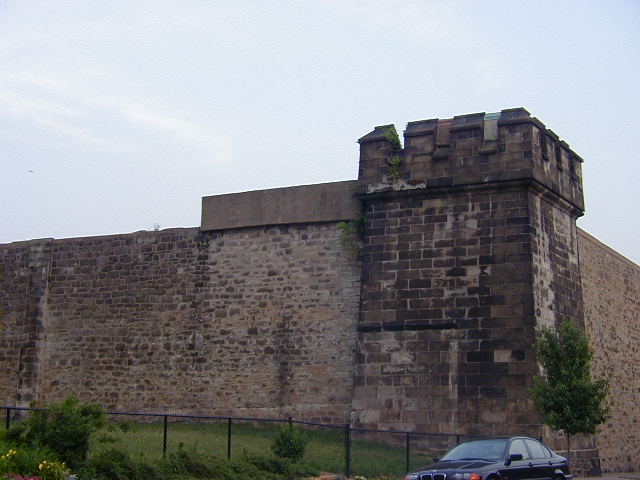
Corinthian Avenue Penitentiary, Philadelphia, PA

I once worked outside this prison as a street worker in North Philadelphia. Young gang members and I played “stickball” on the lawn outside the prison wall. I thought then that the prisoners were inside, and that the gang members were headed for the inside. The rest of us were free…on the outside. Now I see it differently.

We’re all in prison. Yet we’re free. We’re in the prison of deregulated corporate capitalism.We’re back in the Roman Empire, where Paul and Silas were thrown in prison because they dared to interfere with the free market. They freed a young slave-girl who had been put on the street corner as a fortune-teller. She lived on Main Street; all the money from her fortune-telling went to her slave owners on Wall Street.

By rescuing the slave-girl, Paul and Silas were challenging the morality of the prevailing economic system. So the folks from Wall Street seized them, dragged them “into the market place” before those in power and the judges — who were in the hip pocket of those who owned the marketplace and the market — beat them and threw them in prison for advocating “customs and practices” that were unlawful, according to law of the Roman empire. It’s all there in the New Testament Book of Acts. It was unlawful to be moral, unlawful to mess with the economy of a free market.

After beating them to a pulp, the judicial system ordered the jailer to lock them up in the most secure part of the prison — “the inner prison.” It’s always “the inner prison” — the one in our own hearts and heads — whose walls are the thickest. The people who challenge prison security are put in the “inner prison” — solitary confinement.
As Paul and Silas sang and prayed “at midnight” from their inner prisons and all the others were listening, there was a kind of earthquake that shook the foundations of the prison. All the prison doors swung open and everybody’s chains fell off! Everybody’s! And when the jailer woke up to what was happening and drew his sword to commit suicide, Paul and Silas declared that he, too, had been set free from the prison he had guarded.
In September-October 2008 an earthquake rocked the foundations of deregulated corporate capitalism. The earthquake, of their own making, shook the prison walls owned by the big investment brokerage houses and the big banks and AIG, and the inner cell doors had begun to swing open in the hearts and minds of the American people.
But instead of leaving the prison, we stayed in the “inner prison.” We rebuilt the prison, gave the keys back to Wall Street, and chose three square meals a day, a roof over our heads, some chump change for candy and cigarettes, numbed ourselves TV entertainment, and gave the slave-girl back to her owners so we could all dream about a different future. We rebuilt the Wall Street Prison.
What to do? For me, this is a matter of faith. I’m still an inmate of the Wall Street Prison, but my “inner prison” is free. I’m going to keep singing out loud at midnight about human freedom from the prison economy of a deregulated corporate free market that is anything but free. I’m going to walk out of that inner prison by taking my chump change out of the big banks that give $1,000,000 bonuses to the very people who foreclosed on the family of that slave-girl, and I’m transferring all it to the local credit union which belongs to the people. Then I’m going to invite everyone else to do the same.
I’m going to join Paul and Silas and song-writer Timothy Frantzich until everybody’s chains fall off and all the prison doors swing open.
Questions for comment and discussion:
  1. What is “the inner prison”?
  2. How does “the inner prison” work?
  3. Do you agree, in part or in whole, with the commentary?
  4. Where do you agree and disagree?

I’d love to hear from you. Others would, too. Thanks for coming by.

Cuban Altar Boys, the Pope, and Occupy

Pope Benedict has called for political reform in Cuba. The Cuban government has refused the request.  It continues to insist on one party rule.

Ninety miles away, here in the U.S., we have Occupy because an oligarchy has stolen the rule of the people. (“They may squirm in hearings, but Wall Street oligarchs know who has the power“.) The Supreme Court’s ruling has given the green light for some of the people (i.e. corporations) to rule the airwaves with the unlimited spending that buys elections “of the people, by the people, and for the people.” Which people? Follow the money and you will see the illusion that America is a democracy. We have hoods over our heads.

We’re an oligarchic society. For all intents and purposes we live under the rule of the few, for the sake of the few. Fewer and fewer of the crumbs in Jesus’ parable of the poor man Lazarus are falling from the rich man’s table.

Why would Raul and Fidel Castro, two former altar boys, and the Cuban Communist Party refuse to open up the Cuban political system?

One need only review the history of Cuba prior to the revolution for their reasoning. I’ve had this conversation. I had it in 1979 in Cuba, and I had it in 1966 in Czechoslovakia behind the Iron Curtain. See yesterday’s post (The Wafer and th Loaf: the Pope and Raul Castro)

The Iron Curtain was altogether different from the Cuban embargo. The Iron Curtain was raised from the other side of the fence. It was put up by what we then called the Eastern Bloc, not by us in the West, while the Cuban embargo, the Iron Curtain meant to strangle the success of the socialist experiment, was built by the U.S.  Against all odds, Cuba has survived without access to the world’s largest market 90 miles to the north.  Somehow or other, against all odds, Cuba defended itself successfully against the giant to the north’s invasion at Playa Giron, “the Bay of Pigs”. It has lived ever since in fear of its northern neighbor, especially its ex-patriot Cuban business class in Florida that led the Bay of Pigs Invasion. Now Pope Benedict is urging the Cuban government to open up the political process, to expand political freedom.

Partly it’s a matter of perception.

Here in the West we decried the Iron Curtain as the means of dictatorial regimes to keep people in East Germany from fleeing to West Germany. To us the Berlin Wall was a prison wall intended to keep people from fleeing to freedom.  As seen by the Czechoslovakian family with whom I lived during the summer of 1966 and by the students at the university in Bratislava, the Iron Curtain served an altogether different purpose. It wasn’t to keep them in. It was to keep us out. They believed in the egalitarian society they were hoping to create. The Wall had been raised to wall out the corrosive influences of Western materialism, the power of money that is capitalism, the culture of greed, the survival of the fittest, the culture of selfishness.

Today Cuba is poor. Or is it? How do we measure poverty…or wealth?

Prior to the Cuban revolution led by Fidel Castro and Che Guevara, two former altar boys, Cuba was the U.S.’s source of sugar. The sugar came from sugar plantations owned by American Sugarwhose American elites and their Cuban partners gathered for lavish vacations on the white sands of Varadero Beach.  The American one-percent was reaping the profits and lying on the beach with their Cuban corporate friends at Varadero. It made no difference to them that the literacy rate of the Cuban people was among the lowest in the world.  The vast majority of the people could neither read nor write. It didn’t seem to matter to the elites or to Batista, the Cuban dictator whose government they had bought and paid for.  The vast majority of Cubans – those who spent their days cutting sugar cane on the large plantations, peasants who scratched out a living with a few chickens and pigs, and those who worked in the tourist industry in Havana and at Varadero Beach – had no health care, no dental care, and no safety net other than the Church’s charity. It was an island of economic injustice relieved by episodic acts of religious charity.

In short, Cuba was an oligarchy.

If Cuba “opens up” the way the Pope and most Americans believe they should, Cuba will very quickly become again the place it was before the former altar boys came down from the mountains to ousted Batista and American Sugar.

Is Cuba poor? Is America poor?  Cuba has had universal health care for longer than the US. Has had the Civil Rights Act. No one goes without seeing a doctor.  Its literacy rate is one of the highest in the world because of its government’s commitment to education and literacy for all its citizens.  Here at home a conservative U.S. Supreme Court is weighing arguments that could turn back America’s closest thing to universal health care, and the literacy rate is dropping, the prison population is mushrooming with school dropouts who can’t read or write. Those who can afford it, move their children out of the public schools into private schools.  The gap between the haves and have-nots widens every day. And the people on Wall Street who keep the rest of us living in the illusion that our future security rests with the interests of the oligarchy is as tall and thick as it ever was.

During his trip to Cuba Pope Benedict not only called for reforms in Cuba. His words also pointed north to the U.S. and the system that enshrines private capital and greed rather than God as the central principle around which Western societies are organized.  Pope Benedict denounced the ills of capitalism, as he has done repeatedly.

Benedict bemoaned a ‘profound spiritual and moral crisis which has left humanity devoid of values and defenseless before the ambition and selfishness of certain powers which take little account of the true good of individuals and families.’” (Nicole Winfield and Andrea Rodriguez, Huffington Post, 3/27/12).

The calls to open up the political system, on the one hand, and to end the ills of capitalism, on the other, are twin calls that echo 90 miles to the north as well as across Cuba.  We live in a closed system where the ills of capitalism turn the Constitutional rights and freedoms of a representative people’s democracy into a money game, a single-party oligarchy in which the one-percenters put hoods over our heads while they look forward to the installation of another Batista, the day when the can join their friends again on the white sands of Varadero Beach.

The Wall Street Tattler

Gordon C. Stewart               March 15, 2012

How could he do this? Is Greg Smith a tattler? Or, perhaps, Judas?

How could one of Wall Street’s own go to the New York Times (“Why I am leaving Goldman Sachs”) to publicly denounce the company’s culture?  “He just took a howitzer and blew the entire firm away,” said Larry Doyle of Greenwich Investment Management.“ (“Wall Street Exec Quits with Public Broadside).

According to the LA Times article, Goldman Sachs’ CEO Lloyd Blankfein suggests that Mr. Smith – Golman’s executive director and head of the firm’s United States equity derivatives business in Europe, the Middle East and Africa.- is a “disgruntled employee.” William Cohan, author of Money and Power: How Goldman Sachs Came to Rule the World, says that “there are lots of disgruntled people who leave Wall Street, and they don’t do this” (i.e. open their mouths.) “What I’m hearing (on Wall Street),” said Cohan, “is sour grapes. You just pigged out at the trough for 12 years and you don’t have enough sense to keep your mouth shut.” (underlining mine)

Keeping one’s mouth shut is the name of the game on Wall Street.

Conscience may have its place so long as you keep it to yourself. You can have a conscience on Wall Street, just don’t exercise it. You’re part of an elite gang. Whether on the Street corners of impoverished neighborhoods like Watts in LA and Bedford-Styvesant in NYC, or in the center of crony capitalism that is Wall Street, gang members don’t rat on other gang members. If you don’t like it, swallow hard and keep your mouth shut.

Goldman’s rebuttal to Mr. Smith’s statement -“It makes me ill how callously people talk about ripping off their clients,” referring to their own clients as Muppets – hardly has the ring of strong denial. “We disagree with the views expressed, which we don’t think reflect the way we run our business.”

Hmmm. “…don’t think…”? Why not “don’t”?

It’s a rare thing for a spokesperson for a corporation with the best legal counsel in the world to say anything than a flat-out denial. “We don’t think” sets up the issue as a matter of perception, not fact. It’s Goldman’s perceptions of itself versus Mr. Smith’s disgruntled perception.

Mr. Smith’s refusal to live by the Wall Street gang code of conduct will lead to a barrage of attacks on his character calculated to divert the public’s attention from an institution that eats people’s investments and life savings to the Judas who is without integrity.

Goldman understands that for most of us the world is personal, not institutional. We don’t like tattlers and turn-coats, disgruntled employees who never learned the lesson of kindergarten that you never tattle on your friends. You don’t go running home to tell momma. Part of the code of the playground is not to tell.

What’s even more unusual in this case is that Greg Smith dealt in derivatives. Remember them? Derivatives – a complicated form of financial market gambling so convoluted that even the people who manage them can’t explain how they work – were at the center of the Wall Street meltdown in 2008. They were legal then. They are legal now. Goldman Sachs and the rest of the Wall Street gang of crony capitalism are still calling the shots with the highest paid Washington lobbyists money can buy.

Greg Smith is a Wall Street Judas who betrayed his gang not with a kiss but with a howitzer.

How could he do this? Why didn’t the guy who ate at the pig trough for 12 years just kiss and say good-bye? Why did he make his money and then break the code?  Unless…unless…unlike so many of those who were taught not to tattle, Greg Smith couldn’t live with himself and decided not to run home to tell momma but to run to the New York Times. He’ll never again be allowed on the playground.

The American Dream on the Ropes

Gordon C. Stewart | MinnPost.com, Wednesday, March 16, 2011

“Sometimes I feel like a motherless child.” The homeland I mourn is the world I once thought I knew. It was far from a perfect world, by any measure, but its ideals seemed intact. There was set of shared expectations of fairness, some measure of equality, the vision of a more just and peaceful world freed from poverty, oppression and war.

Today that world is as much of a memory as my boyhood home. Something has died. The American dream is rising in Egypt, in Tunisia, and across the Arab world, but it is on the ropes here in America. The cry for democracy, basic human rights, and an end to Mubarak’s self-serving economy has its echo in Madison, Wis., where workers have stood tall for the right of collective bargaining. But not tall enough to stop the turning back of the clock. Nor are they bold enough to strike, as unions would have in my youth.

All across America the hard-earned gains of the labor movement are being painted as evil, yet not a single person on Wall Street has gone to jail for the fraudulent, greedy schemes that brought the American economy to its knees in September-October, 2008. Not one. The idea of democratic rule — the rule of ordinary, hard-working people — has been high-jacked by a ruling class that has no shame while it takes home most of the cookies. It pays little or no taxes, cries foul about spending, raids the Social Security Trust Fund to pay for its wars, blames the deficit on liberal social programs, and leaves the crumbs from its budget-cutting for the rest of us to fight over.

The Soviet Union was feared

My generation’s formative years during the Truman and Eisenhower administrations had us ducking under our school desks in preparation for a nuclear bomb that was sure to drop on my little town outside of Philadelphia. The U.S.S.R. was the enemy and was out to get us. “Getting us” would mean, we thought, an end to democracy, an end to freedom.

Never did it occur to us that the end of democracy and freedom would come from what President Dwight Eisenhower later warned of: the American military-industrial complex that would usurp the people’s right to rule themselves. Never would it have occurred to us that a U.S. Supreme Court would rule that corporations are “persons” when it comes to the electoral process — people just like us free to spend the money none of the rest of us “persons” has to buy an election.

Sunday mornings after church I remember turning on the religious show that featured Oral Roberts ranting and raving and waving and “healing” his bizarre church in Oklahoma City — thinking that this must be some kind of joke. What was bizarre then has become mainstream today. Michele Bachmann, whose law degree comes from Oral Roberts University Bible-based O.W. Coburn School of Law (now defunct) and Sarah Palin, whose church makes Oral Roberts look temperate, would have been laughed off the stage when I was a kid. Today they own the stage, and their Annie Oakley, winner-take-all politics and economics set the agenda — not only in Minnesota and Alaska, but in Wisconsin and in Washington, D.C. Patriotism has become a white fundamentalist Christian packing a semi-automatic on the lookout for the same people Sen. Joseph McCarthy hunted down in the early ’50s.

I remember Joe McCarthy. I didn’t like him then. I don’t like him now. And I don’t like those who imitate him wearing lipstick on their beauty-queen faces and have the gall to call the president of the United States “un-American.”  We no longer need a House Un-American Activities Committee to conduct our witch hunts. The verdicts are rendered ad hoc by demagogic politicians with law degrees from a law school founded by Oral Roberts that lasted only seven years before closing its doors.

Americans want ‘real’ people as leaders

Who needs Harvard, Yale, Princeton, the University of Minnesota, the University of Wisconsin, the University of Michigan or Notre Dame?  We want our elected leaders to be “real” people untainted by elitist educations. And we want them to tell us that “taxes” — the word that once upon a time stood for my share of personal responsibility for America’s infrastructures, values, financial security and national defense — are greedy government conspiracies to rob our us of what is rightfully ours.

“Sometimes I feel like a motherless child a long way from home,” sang the African-American slaves picking cotton out in the fields. Some who sang the songs were children who had been separated from their mothers and families as prize chattel on the slave blocks. Others sang it mourning their African homeland. Sometimes “home” stood for heavenly release from the terror of the plantation. The mournful tones from the cotton fields echoed off the walls of the plantation owners’ mansions. The owners considered their work force part of their plantation American Way of Life, while the enslaved workers sang of a different homeland right under their masters’ noses.

I have not been stolen away. But the sense of grief, anger and sadness could not be more real. My mother has died. My country has been stolen. “Come, my brother, come my sister, a long way from home.”

The American Oligarchy

By the Rev. Gordon C. Stewart | Thursday, April 29, 2010

We do not live in a democracy; we live in an oligarchy, “government by the few, especially despotic power exercised by a small and privileged group for corrupt or selfish purposes” (Encyclopaedia Britannica). I’ve been waiting for people in high places to say it.

Goldman Sachs executives’ testimony Tuesday before the Senate Permanent Subcommittee on Investigations brought the elephant into the living room, but the name of this species of government remains unspoken for understandable reasons.
A democratic republic is a constitutional form of government where the people rule through their elected representatives gathered in deliberative bodies. The faces and voices of Goldman Sachs’ executives demonstrated the intransigent arrogance of the private institutional concentration of wealth and power of deregulated capitalism.