
Verse – And now they both have Ph.Ds

Well, everyone liked him, but she
had only been 16, (“Almost
was 17!” she still would say),
when he met both her parents first
and said, “Yes, I am 25,
but can I take your daughter out?”

They made him wait six months, and have
what then was called a double date,
and bring her back by ten. But when
she was in college and told them
it’s his ring on her finger, then
they almost made her stay at home.

He promised she would graduate,
and so they set their wedding date.
In spite of strong parental fears,
they have been married for ten years.

[For M and K, whose life has been
only somewhat like this.]

– Steve Shoemaker, Urbana, IL, April 23, 2015
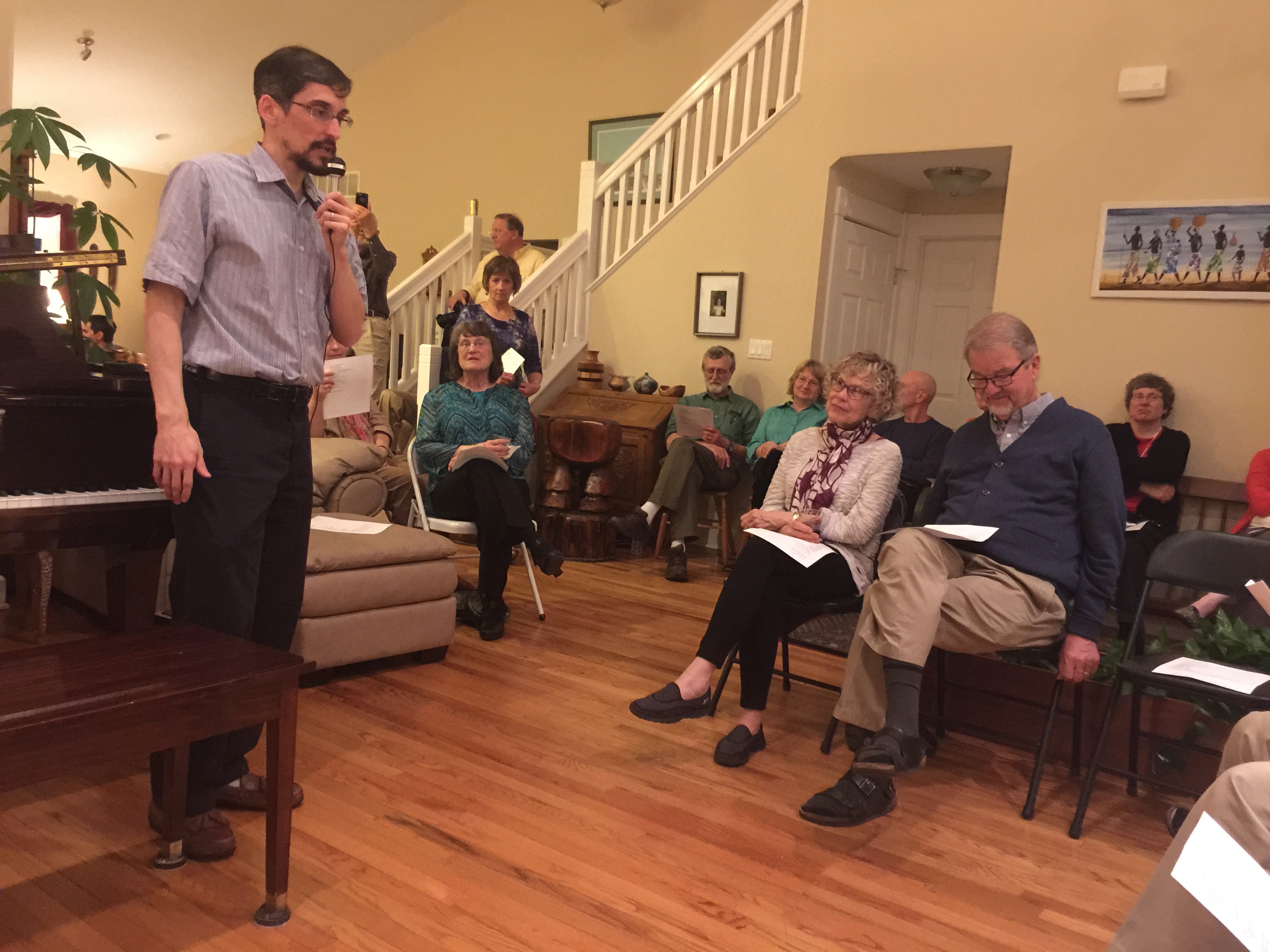
Verse – House Concert

House concert(April 17, Michael Hammer
piano)

so many keys played carefully
one at a time or recklessly
in clumps in chords in runs in scales
hands bouncing fingers waggling trills
yet knowing each composer’s need
for a performer’s sloth or speed
for piano or fortissimo
to Hammer or to gently go

– Steve Shoemaker, Urbana, IL, April 18, 2015

Liberation Limerick

It’s sexist, demeaning, though hard to explain
That a positive adjective can be a pain:
The papers we scan
Don’t say Jane’s handsome man,
It’s always Joe Blow and his lovely wife, Jane.

– Steve Shoemaker, Urbana, IL, April 16, 2015

Verse – Annals of Aging, No. 14

On Snoring

I wake and my lips are all chapped,
My sinuses completely stopped.
Breath through my nose is what’s missing.
My biggest regret: no kissing.

– Steve Shoemaker, Urbana, IL, April 15, 2015

Verse – A Cliche Expanded

What I believe
and state firmly
does not matter
nearly as much
as my actions
in revealing my
character.

Who I am
can be seen:
much more clearly
by observers
than learned by
hearers or readers
of my words,
so carefully chosen.

– Steve Shoemaker, Urbana, IL, April 12, 2015

Verse – Buzzkill

Buzzkill

Five in a line in our family
(all of them females, of course),
have the name Bee in the middle
(between their last and their first.)

Half of the bees in our country
died over winter last year.
One out of three of our foodstuffs
need bees or will disappear.

Einstein may not be who said it
(no one has proved it was he),
that we will die, yes, each family
within two years of the bee.

We need more prairies and fruit trees,
(that are not sprayed from above.)
Honey from new hives can happen:
we need to give bees our love.

[written in 9 minutes early this morning after hearing a PechaKucha 20-slides-each-20 seconds talk last night by Urbana, Illinois, beekeeper Maggie Wachter at a Sola Gratia Farm dinner.]

– Steve Shoemaker, Urbana, IL, April 12, 2015

Verse – Rising Early

Our April morning
sky, ribbed in violet,
now becomes

magenta fading into
dusty blue without
a single white cloud

to distract our horizon gaze
waiting for our spinning
globe to show the sun.

– Steve Shoemaker, Urbana, IL, April 12, 2015

A Verse for Easter

Readers unfamiliar with Christian scripture will find it helpful to learn that the original Gospel of Mark ended abruptly and curiously, not the way one would expect good news to end. Upon discovering the stone rolled away from the tomb and the tomb empty, Mark ends not with triumphal joy but with fear. “So they went out and fled from the tomb, for fear and amazement had seized them, and they said nothing to anyone, for they were afraid.” Here’s Steve’s verse for Easter:

The Short Ending of Mark

Most scholars think that first came Mark,
then Matthew, or perhaps St. Luke,
but Mark is shortest of the three
and it takes work for brevity.

The empty tomb is found in Mark,
but in the first draft of the book
no resurrected Christ appears–
his followers are left in fear.

The Gospels four all tell the tale
of thousands fed by miracle,
but only Mark will tell it twice–
this Jesus is the Bread of Life.

Young Mark assumes from Chapter One
that Jesus is the Son of God
the Christ-Messiah, Holy One.
His faith was fed by wine and bread.

Mark must believe that doubts and fears
can turn to trust when he appears.

[Mark 16:1-8]

– Steve Shoemaker, Urbana, IL, April 5, 2015

Do unto others…

It’s not often we follow up of Steve’s poems. But today’s post (“Verse – Indiana”) on Indiana’s Religious Freedom Restoration Act (RFRA) merits further comment on Holy Saturday.

some so-called Christians change the
Golden Rule:
Do unto others what hate did to you.

Steve and I are both Presbyterian ministers. We’re Protestants. We’re not proud of it; it’s just who we are. At this point in his life, Steve restricts his social commentary to poems and verses.

Here are the earlier stanzas of of “Indiana” that succinctly set the Indiana religious Freedom Restoration Act in its ironic historical context:

To America came the Protestants.
In England they could not live
as they would.
They were despised by ruling residents
and fled to freely worship their own God.

Conservatives want to preserve the past,
forgetting which side they were on…
They now
discriminate against those who resist
and say, “To your beliefs we will not bow.”

Tomorrow Steve will celebrate Easter in Illinois. I will celebrate Easter in Minnesota. The symbol of the stone rolled away will be front and center. There can be no hate at the empty tomb. Governor Pence and legislators, pay close attention. “Father, forgive them, for they know not what they do.” It’s hard to believe they didn’t know what they were doing, but in the sense in which the prayer from the cross was uttered, they really didn’t know`1.


Verse – Indiana

To America came the Protestants.
In England they could not live
as they would.
They were despised by ruling residents
and fled to freely worship their own God.

Conservatives want to preserve the past,
forgetting which side they were on…
They now
discriminate against those who resist
and say, “To your beliefs we will not bow.”

Instead of helping people to be free
to live and love as God made them to be,
some so-called Christians change the
Golden Rule:
“Do unto others what hate did to you.”

– Steve Shoemaker, Urbana, IL, April 4, 2015