iPhones and Baseball

It’s baseball season in the era of the iPhone.

There’s silence in the Minnesota Twins clubhouse, wrote StarTribune sports writer Jim Souhan last week while covering the Twins preparing for the new season during spring training.
The players sit quietly in front of their lockers before and after games glued to their iPhones. Right next to each other… on a TEAM. The clubhouse that once rocked with laughter, card games, and the loud voices of Twins leaders Kirby Puckett and Kent Hrbek on their way to a World Series is now like a morgue.

Teams that win have chemistry. You don’t build chemistry on iPhones. You don’t win a World Series playing with phantoms or staring into the pool for your own reflection – reading what the sports writers are saying about your individual performance. You win by bonding with the people around you. Men who play 162 games over a season find ways to keep the clubhouse loose. Boyish pranks like filling David Ortiz’s undershorts with ice so he wouldn’t notice that you had smeared his trousers with peanut butter. Stunts like reserve catcher Mike Redmond strutting naked through a tense clubhouse bellowing out a solo that cracks open the ice after a bad game. A baseball season is a long time, a long grind with losing streaks and winning streaks and long road trips where your only friends are your teammates.

Baseball teams that make it to the World Series are not quiet. They have some fun. They play. Not just on the field but on the buses, the planes, and in the restaurants and hotels where the team stays for a week or more far from home.

Twins fans can hope that when the new generation of Twins players sit by their lockers with their iPhones, they will come across Jim Souhan’s advice in this morning’s StarTRibune.

“Show us something this year.
“Heck, show us anything.
“Show us some fire, some grit; some passion, some promise.
“Show us that three years of unprofessional play was a detour, not a destination.

“Show us that you care about something other than paychecks and per diems.

Joe Mauer is the best player on the Twins, a future Hall of Famer. But he’s as emotionally flat as flatbread or a flat tire. He’s predictable. No strolls through the clubhouse singing an aria to break open the silence, no shaving cream pies, no jokes, no ice in another players under shorts or peanut butter, just a peanut butter and jelly sandwich on white bread eaten along in front of his locker, waiting to take hie new position at first base. If there’s passion in Joe, it doesn’t show.

Give us some passion. Bring on Kirk Gibson coming to the plate in the World Series on knees so bad he could barely walk, throwing his fire into a swing that pushed the ball over the fence with nothing but the pure grit from the fire in his belly, hobbling around the bases like a man recovering from hip surgery. Give me Kirk, Joe.

New rule: No iPhones, iPads, or any other such distractive devices in the clubhouse. Put ’em down. Get to know each other before you take the field. I’d wager that the first team to institute that rule would go the World Series not because they’re the most talented but because they care about each other and they care about playing as a team.

God the Stranger

I “know” less and less of what I thought I knew. The world has driven me into the unknowing silence out of which James A. Whyte spoke at the funeral in Lockerbie, Scotland in 1989.

During his term as Moderator of the Church of Scotland, The Right Rev. Dr. Professor James A. Whyte , still grieving the death of his wife, was called upon to lead the memorial service after Pan Am Flight 103 was blown out of the sky over Lockerbie. Among the most quoted parts of the sermon is this excerpt:

“That such carnage of the young and of the innocent should have been willed by men in cold and calculated evil, is horror upon horror. What is our response to that?

The desire, the determination, that those who did this should be detected and, if possible, brought to justice, is natural and is right. The uncovering of the truth will not be easy, and evidence that would stand up in a court of law may be hard to obtain.

Justice is one thing. But already one hears in the media the word ‘retaliation’. As far as I know, no responsible politician has used that word, and I hope none ever will, except to disown it. For that way lies the endless cycle of violence upon violence, horror upon horror. And we may be tempted, indeed urged by some, to flex our muscles in response, to show that we are men. To show that we are what? To show that we are prepared to let more young and more innocent die, to let more rescue workers labour in more wreckage to find the grisly proof, not of our virility, but of our inhumanity. That is what retaliation means.”

For James Whyte God is often silent. We are called to enter the space of God’s silence, the silence of the cross, the confusion and horror of the suffering of God at the hands of a world filled with man-made gods: security, freedom, nationalism, religion, muscle, revenge and self-righteousness, cultural supremacy. In the Jesus of the cross, Whyte’s eyes saw not only a naked man but God’s nakedness – a naked God stripped of all power, his arms roped to a cross-beam paradoxically spread wide to embrace the whole world of human suffering and folly.

James Whyte took time out of his busy life in 1991 to act as a conversation partner and mentor for an American pastor whose congregation had granted its pastor a sabbatical leave in St. Andrews. They met twice weekly for two months in his flat over tea and scones, the young American absorbed in the vexations of Christian claims to Christ’s uniqueness and universality, on the one hand, and religious pluralism, on the other, the good Right Rev. Dr. Professor listening attentively, maintaining a poignant silence that respected his mentee’s process. When the pastor left Scotland, he asked his mentor for a copy of prayers James Whyte had offered during worship at the Hope Park Church in St. Andrews. Each of the prayers was as thing of beauty. Each began with a quotation from the Book of Psalms.

James Whyte’s spirituality echoes that of an old Hasidic Rabbi (Barukh of Medzebozh [1757-1811]) reflecting on Psalm 119.

“I live as an alien in the land;
do not hide your commandments from me”
– Psalm 119:19

Rabbi Barukh of Medzebozh said of this psalm:

“The one who life drives into exile and who comes to an alien land has nothing in common with the people there and has no one to talk to. But if a second stranger appears, even though that person may come from quite a different place, the two can confide in each other. And had they not both been strangers, they would never have known such a close relationship. That is what the psalmist means: ‘You, even as I, are a sojourner on earth and have no abiding place for your glory. So do not withdraw from me, but reveal your commandments, that I may become your friend.”
– Martin Buber, <a href="http://www.amazon.com/Tales-Hasidim-Early-Masters-Later/dp/0805209956(

” title=”Link to information on Tales of the Hassidim”>Tales of Hassidim – the Early Masters.

Thanks you, James Whyte, good and faithful servant and friend of God the Stranger. RIP.

Sermon: The Man of Silence

A sermon for Palm Sunday/ Passion Sunday at Shepherd of the Hill Presbyterian Church in Chaska, MN, reflecting on the passion of Jesus in light of the writings of Dietrich Bonhoeffer.

The Gift of Green Again

Spencer Swanson

Spencer Swanson, a 16 year-old student at the Integrated Arts Academy in Chaska,  died tragically on October 15 when an errant arrow from his good friend’s bow ricocheted and hit Spencer

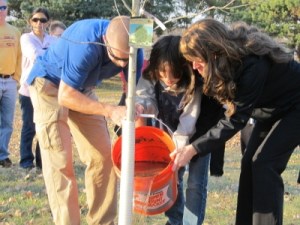
At 3:00 p.m. yesterday, November 20, Spencer’s schoolmates who study visual arts, cultinary arts and horticulture, gathered with Spencer’s family to dedicate a new 10′ tall red oak tree in his memory.

I never met Spencer, his friend, or their families. I attended yesterday’s dedication at the invitation of John Hopkins, a member of Shepherd of the Hill who teaches horticulture at the school. “The kids have put this program together,” said John. “If you’re not doing anything at 3:00, swing by.”

Spencer’s death had hit everyone at the school hard. I went to show support from the wider Chaska community for the students who had put this program together, as the program said,

“To comfort and help restore the hearts affected by the hurt of Spencer’s death.”

The printed program featured not only a carefully selected poem of Pakistani poet Faiz Ahmed Faiz, “When Autumn Came”  but art created from closer to home by the students of the Arts Academy.

Brieann’s drawing depicts her fallen schoolmate as a tree growing taller with the caption “Grow till Tall”; Dominika, another of Spencer’s schoolmates, wrote and read aloud her poem “I can see a lot of life in you”:

Hold on to the memories of

the ones we love and lost.

Take time to say what’s right.

Take time to forgive and not

fight. Each day’s a gift and

not a given right. You have to

wonder and find out what’s

your light.  Is it the One to

come?

Each day is new and full of life.

Listen through the whistling wind.

Your time is here

be content don’t linger.”

There were words there on the hill… but not many. There was quiet…. No cell phones ringing. No one texting. No one looking around in boredom. Just all of us, young and old, at home, for a moment, in the sacred silence of the community standing together to celebrate life in Spencer’s honor.

tree dedication

“To plant a tree is to give body and life to one’s dreams of a better world,” wrote Russell Page.

The red oak will grow over the years to great height and girth, spreading its branches for the birds and the squirrels, reminding each of us to honor the gift of life and the gift of the community of thoughtful speech and silence.

This is the way that autumn came to the trees:

it stripped them down to the skin,

left their ebony bodies naked.

It shook out their hearts, the yellow leaves,

scattered them over the ground.

Anyone could trample them out of shape

undisturbed by a single moan of protest.

The birds that herald dreams

were exiled from their song,

each voice torn out of its throat.

They dropped into the dust

even before the hunter strung his bow.

Oh, God of May have mercy.

Bless these withered bodies

with the passion of your resurrection;

make their dead veins flow with blood again.

Give some tree the gift of green again.

Let one bird sing.

Faiz Ahmed Faiz

Basho and Election Day on Views from the Edge

Old pond,

frog jumps in –

splash.

Views from the Edge jumped OUT of the blog pond two days ago. Then… yesterday… it made a big splash. The daily number of visits soared to 1,466 yesterday, 14 times larger than average. Why would the visits go up … at all … after announcing silence? Was it applause? Three cheers for one less noisy gong?

Answer? An earlier post, “The Germans at the Service Club Meeting,” had suddenly gone viral with 1296 visits – on Election Day.

Why or how it happened is a head-scratcher. Maybe yesterday’s inexplicable splash is a tribute to the efficacy of silence, our preference for the Older Pond over the new one, and reason for a humble re-write of Basho’s (1644-1694) old haiku:

New Pond,

frog jumps out –

splash.

This old frog is smiling the day after Election Day. Big money can’t buy the Old Pond…or the country. 🙂

Exhaustion

I’m exhausted…spiritually exhaused. They’re exhausting me…all the emails…and the voice mails telling me that if I don’t give one more dime one more time…my candidate is going to lose…and the world will come to an end…and it’s going to be… my fault.

Anyone else feeling that way?

I’m also torn up inside. I’m trying to be civil…trying to understand why this election is even close…and trying not to be haughty and naughty.

I’m missing my afternoon nap. I love my afternoon nap with Maggie and Sebastian, my buddies here at home. They still sleep like logs…the way I used to…before the Presidential debates and emails that clog my inbox and the phone calls from chummy best friends I’ve never met who want just one more donation of “just $5” so so-and-so knows s/he can count on me.

It’s an illusion. Anyone else feeling that way?

Meantwhile…between the emails and the phone calls…I visit the dying…in hospice care…who live on the edge of existence itself…who sip comfort from the deeper wells. My spirit is strangely quieted. Strangely calmed.  We sit in silence. I read a psalm or two. We…the dying…and I are refreshed. Ready for a nap.

I go home and stumble upon a prayer by Wendell Berry “To the Holy Spirit”:

O Thou, far off and here, whole and broken,

Who in necessity and in bounty wait,

Whose truth is light and dark, mute though spoken,

By Thy wide grace show me Thy narrow gate.”


Wendell Berry, Collected Poems, North Point Press, 1964.

Seeing with the Ears

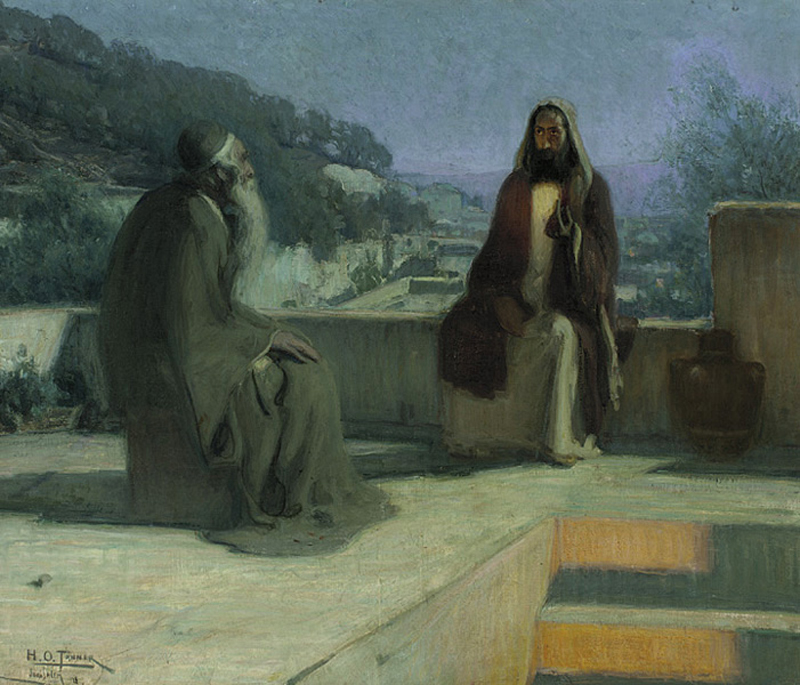
Nicodemus and Jesus on a rooftop, Tanner, Henry Ossawa, 1859-1937

Nicodemus and Jesus on a rooftop

He comes by night. He slips along the buildings of the city streets in hopes that no one will notice. He is a man of position and authority, a learned teacher with a Ph.D. in religion on his way to the kindergarten teacher. “Everything I need to know in life I learned in Kindergarten,” wrote Robert Fulghum. Nicodemus has a sense that he has lost a thing or two along the way, that he needs to start over again.

He’s sent a private message asking for a confidential meeting. The arrangements have been made for the time and place…under the cover of darkness… at Nicodemus’ request.

Dressed in a hooded sweatshirt pulled up around his face and wearing an old trench coat to blend in with displaced people who spend the night on the street, Nicodemus changes his normally stately gait on the way to his secret meeting.

Arriving at the appointed address at the appointed time, he ducks quickly to his left into the alley and darts up the stairs to the flat roof where the kindergarten teacher is waiting.

“Shalom!”

“Shalom aleikem!”

They kiss each other on the cheeks, the left and then the right, as is the custom among their people.

The teacher motions to the wood stool his hands have made for  occasions like this. The stool is well-worn by others who have come it at night, some by advance arrangement, others on the spur of the moment, when the darkness outside or within themselves has overwhelmed them and a hot cup of chamomile tea or warm milk won’t help them get back to sleep.

Nicodemus sits on the stool. But there is no second stool or chair. The teacher takes his customary place on the wall at the roof’s edge, his body and face partially lit by a full-moon, the city landscape and the whole world over the teacher’s shoulder, a strange kind of classroom. Nicodemus can see him – sitting calmly, erect, at full attention, his eyes fixed on his eyes, steady and searching and seeing, it seems, what even Nicodemus does not yet know about himself and the real reason he has come.

The man on the wall sits and waits for Nicodemus to break the silence. The wordlessness does not trouble him. He is at home with silence.

“You are a teacher who has come from God because no one can do what you do apart from the presence of God,” declares Nicodemus.

Nicodemus awaits a response to his declaration of honor, but there comes no response except for the eyes beholding him.

Nicodemus fidgets, uncomfortable with the silence. He repeats his declaration, increasing the decibels in case the teacher is hard of hearing, but not so loud as to wake the neighbors, the street people, or the police:

“You are a teacher who has come from God because no one can do what you do apart from the presence of God.”

Jesus gives a slight nod and looks at him from the wall.

“No one can see the kingdom of God unless he is born anew,” he says.

“So it’s about seeing?”

“Yes. It’s about seeing.”

Turning and pointing to the world over his shoulder, he asks Nicodemus, “Do you see this magnificent landscape behind me?… Look at it… Really look… What do you see?”

“I see a mess.”

“Ah, but look again, Nicodemus. You’re looking with the wrong eyes. It is a mess. Anyone can see the mess. If you look, you can see a different outline through the darkness. Maybe you need glasses. Maybe your ears will help you see.”

They fall again into the silence, but the words – “Maybe your ears will help you see” – speak to an inner darkness. Nicodemus looks with his ears at the night landscape and the distant horizon and the stars over the teacher’s shoulder, listening to the faintest sound of a familiar tune they both had learned in kindergarten at the synagogue.

Jesus, is humming.  Softly. Without thinking, Nicodemus joins in humming the tune, and then begins to mouth the words, the familiar words spoken quietly by every faithful Jew living under Roman occupation and in the dark nights of the soul, the words sung or spoken in silence by every Jew on the way home from synagogue, a kind of lullaby of faith, a way of seeing with the ears:

“Peace unto you, ministering angels, messengers of the Most High, of the supreme King of kings, the Holy One, blessed be He.” (repeat twice)

“May your coming be in peace angels of peace, messengers of the Most High, of the supreme King of kings, the Holy one, blessed be He. (repeat twice)

“Bless me with peace, angels of peace, messengers of the Most High, of the supreme King of kings, the Holy one, blessed be He.” (repeat twice)

“May your departure be in peace, angels of peace, messengers of the Most High, of the supreme King of kings, the Holy one, blessed be He.” (repeat twice)

“For He will instruct His angels in your behalf, to guard you in all your ways. The Lord will guard your going out and your coming in from now and for evermore.”

The Surrogate Voice

Some moments last a lifetime.

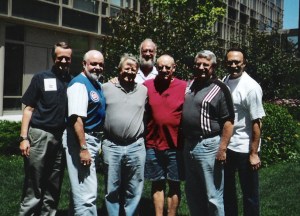
Chicago Seven - Dale Hartwig in red shirt

My friend Dale has Parkinson’s. He has boarded a train in Michigan (he’s now in a long-term care center there) to be with “The Chicago Seven” – the seven former classmates who gather annually at McCormick Theological Seminary. This year, Dale’s speech is hard to comprehend. He is reduced to listening. Death and dying are sitting at the table.At the morning reflection and round-table sharing, Dale is sitting to my right. When his turn comes, we look at Dale. There is an awkward silence. He hands me something. He wants me to read aloud what he’s written. I read his words aloud.

Gordon C. Stewart  – written in thanksgiving for the Chicago Gathering, 2004:

“THE SURROGATE VOICE”

The surrogate voice reads on,

the author sits and sobs

wrenching tears from primal depth:

from some abyss of joy or nothingness…or both.

The author’s sighs and piercing sobs

arrest routine,

invoke a hush,

dumb-found the wordy room.

He cannot speak,

his Parkinsons’ tongue tied,

his voice is mute, in solitude confined,

all but sobs too deep for words.

Another now becomes his  voice

offering aloud in a dummy’s voice

the muted contribution

in poetic verse the ventriloquist’s voice has penned.

The abyss of muted isolation ope’d,

his words, re-voiced aloud,

hush the seven to sacred silence,  all…

except from him, their author.

Whence comes this primal cry:

From depths of deep despair and death,

from loneliness, or depths of joy

We do not know.

The surrogate voice reads on

through author’s signs and sobs,

through his uncertain gasps for air

and our uncertain care.

The iron prison gates – the guards

of his despair – unlock and open out

to turn his tears from prison’s hole

to tears of comrade joy.

His word is spoken, his voice is heard,

a word expressed

in depth and Primal Blessing,

pardoned from the voiceless hell.

The stone rolls back,

rolls back, rolls back,

from the brother’s prison’s tomb,

the chains of sadness snap and break!

At one, at one, we Seven stand,

in Primal Silence before the open tomb,

as tears of loss, of gain, of tongues released

re-Voice unbroken chords of brotherhood.

 All moments are sacred. Some last a lifetime.

Silence and Cell Phones

This piece originally aired on “All Things Considered” (Minnesota Public Radio). Click here for an audio connection on the MPR site, or just read the piece.

Driving to work this morning, I suddenly started to pay attention to the drivers in my rear view mirror.  It all started when a large SUV nearly hit me from behind.  The driver was jabbering away on a cell phone.  I’m sure the conversation was important.  Why else would he jeopardize our safety?

For the next fifteen minutes on I35W I conducted my own scientific survey.  All of the drivers had cell phones glued to their ears.

Makes me wonder.  Are we that uncomfortable being alone?  Or do we think we’re so important that the rest of the world can’t get along without us?  Or perhaps we are afraid that the rest of the world WILL get along very well without us – so we need to keep reminding others that we exist because we’re not sure we really do unless someone else is filling the speechless void?  I wonder.

As concerned as we should be about the terrorism of distracted drivers on the highway, I’m more concerned about what our use of cell phones says about us as a people.  We are addicted to outside stimuli. Less and less comfortable with silence. Less and less attuned to wonder. More and more filled with chatter. More wordy – less thoughtful.

Sociologist Eugen Rosenstock-Huessey once observed – before the advent of the cell phone – that for many folks the drive to and from work was the only true “free zone” during their day.  It was time for solitude and reflection, a transitional pause to get your bearings, time to make the transition from home to work and from work to home. These were trips to be celebrated for what they were – opportunities to stand free from the herd – the herd mentality of religion, nationalism and ideology.  They were times to think.

Maybe I’m just getting older.  I am.  And that’s a good thing.  Because I’m getting tired of looking in my rear view mirror at someone with a cell phone stuck in his ear because he can’t stand the silence…or the sound of her own heartbeat.  Someday that beat will stop and there will only be the silence.  Maybe we ought to put down the phone and listen before there’s nothing to hear.