A sermon from Shepherd of the Hill in Chaska…with a humorous wrinkle.
Click “What is your name?” to sit on the re-telling of the New Testament story of the man who was “occupied” by the Legion, living among the tombs. “My name is ‘Legion’,” he said, “for we are many” (Gospel of Mark 5:1-20).
This “mind-numbing” sermon was inspired by the obituary of a young man named Josh who suffered “10 years of mind-numbing public schooling.” It was preached at Shepherd of the Hill Presbyterian Church in Chaska, Minnesota, “sharing the message of God’s unconditional love for everyone.”
Ever read an obituary that raised your eyebrows? Ever left a funeral thinking it was case of mistaken identity?
This week my old friend Bob Young shared this obituary with the annual gathering of seminary classmate. Bob has a wry sense of humor. We knew something was coming by the twinkle in Bob’s eye.
This obituary is the exception to phony. It appeared in the Ponca City News:
Joshua Micheal (nope, not a typo it’s really spelled that way) McMahan left this world April 18, 2012. He was loved, hated, praised, and cursed by relatives and friends alike. He ultimately passed as a result of being stubborn, refusing to follow doctors’ (or anyone else for that matters) orders, and raising hell for a little more than three decades. He lived life on his own terms.
Josh was born on Sept. 16, 1978, to Linda Burgert Waller. Josh was a beautiful, unique, kind, and loving spirit man. Joshie endured around ten mind-numbing years of public schooling. He had worked as a pizza delivery boy and call center representative before shockingly becoming independently “wealthy.”
He loved music, beer, movies, vodka, television, and women, but not necessarily in that order. He was also an awesome drummer!/vocalist? and was in several bands over the years. He lived in Ponca City his entire life except for the past year where he was forced to put up with his sister and brother-in-law out in the middle of nowhere — a little piece of terra firma aptly called Haskell.
He is survived by Rosie, his long-time canine companion; a sister, Melanie Waller Ochoa; a brother-in-law, DJ Ochoa; a best friend/brother, Cliff Crull; three nieces, Miranda, Emma, and Camille; and one nephew, Maxx. Josh had no children of his own (at least none that we know of). He was preceded in death by Mom Linda, Grandma Nina Burgert, and Grandpa Joe Burgert.
A remembrance service will be held at 2 p.m. April 25 in the chapel of Trout Funeral Home where you may re-tell the stories he can no longer share. Anyone dressed in a suit or Sunday’s best will be promptly escorted back to their vehicle. Just kidding … we’ll accept you as you are — just as Josh would have in life. Please be wary for any children’s sake, there may be profanity and/or alcohol involved. If you have a special memory or maybe just want to irritate Josh for all eternity, please bring a magnet or sticker to attach to his casket for evermore.
In lieu of flowers or memorial gifts, please give generously, in Josh’s honor, to rockstarmusiceducation.org.
JRock will be placed to rest in the St. Mary’s section of Odd Fellows (the irony) Cemetery in Ponca City and I’m sure he would invite you to come by later and have a laugh on him — literally.
As Bob read aloud Josh’s obituary in his droll manner, we had a great laugh, just as Josh would have wanted, and we felt accepted as we really are. Lord knows we’re all likely “to pass as a result of being stubborn.”
We had a round in Josh’s honor and prayed (not really) that, if someone decides to tell the truth in our obituaries, the writer will have a lively sense of humor…and a whole lot of grace.
Harry followed the obituary with the laughter with the story of a man named Alfred.
Alfred left Russia at the age of 18. After spending a year in Paris studying chemistry, he moved to the United States. After five years, he returned to Russia and began working in his father’s factory making military equipment for the Crimean War. In 1859, at the war’s end, the company went bankrupt. The family moved back to Sweden, and Alfred soon began experimenting with explosives. In 1864, when Alfred was 29, a huge explosion in the family’s Swedish factory killed five people, including Alfred’s younger brother Emil. Dramatically affected by the event, Alfred set out to develop a safer explosive. In 1867, he patented a mixture of nitroglycerin and an absorbent substance, producing what he named “Dynamite.”
In 1888, Alfred’s brother Ludvig died while in France. A French newspaper erroneously published Alfred’s obituary instead of Ludvig’s, noted that Alfred had died a very wealthy man as a result of inventing dynamite. Alfred was irked that the wrong obituary had been published. But he was more disturbed – deeply embarrassed, in fact – by a true obituary about his life. Disappointed with how he would be remembered, he decided to do something different with his life.
Alfred died of a stroke on December 10, 1896, in San Remo, Italy. After taxes and bequests to individuals, he left the majority of his estate to fund the Nobel Prizes. His name was Alfred Nobel.
—————————————–
Somewhere between Josh and Alfred there is you. Somewhere between the two there is I.
If you could write your own obituary, what would it say?
In her book Bird by Bird, Anne Lamott lays her life bare in print. Anne herself is a rare bird. She found her way to a church like Shepherd – small, humble, a bit odd, very loving and very joyful – in Marin City, California whose people accepted her as she was: depressed, addicted to alcohol and drugs, promiscuous, seriously depressed and feeling lost.
In Bird by Bird’s Acknowledgements, she wrote “I want to mention once again that I do not think I’d even be alive today if not for the people of St. Andrews Presbyterian Church, Marin City, California.
But this is the paragraph I want you to remember as you think about the rest of your life and how you will pull together the pieces. The words were written for aspiring writers. But, for our purposes this morning, I ask you to think of life as a kind of writing. It’s a paragraph in a chapter on Perfectionism.
“Your day’s work might turn out to have been a mess. So what? [Kurt] Vonnegut said, ‘When I write, I feel like an armless legless man with a crayon in his mouth.’ So go ahead and make big sprawls and mistakes. Use up lot of paper. Perfectionism is a mean, frozen form of idealism, while messes are the artist’s true friend. What people somehow…forgot to mention when we were children was that we need to make messes in order to find out who we are and why we are here – and, by extension, what we’re supposed to be writing.”
How would you want your obituary to read?
I’d be pleased if mine read something like the following, a mixture of Josh’s and Alfred’s, although it won’t be up to me. It will be written by Kay and family. I won’t get to read it or censor it.
Gordon Campbell Stewart died of a stroke. Actually he didn’t. He died because he wouldn’t listen to his wife, his friends or his doctors and because he had chosen to believe his dogs who thought his nightly bowls of ice cream and cashews would last forever, just like him.
He was a lot like his dog Maggie. Stubborn, occasionally amusing, playful, and very annoying when he didn’t get what he wanted. He was a preacher man, or so he thought, although those who slept through years of his mind-numbing sermons often brought pillows and blankets, and sometimes a flask to church. Fortunately for him, Gordon never noticed.
After many years of self-absorption, he discovered the joy of being mortal. He stopped worrying about tomorrow. He learned to appreciate the fullness of the moment. He learned to listen to the birds…well, actually…since he could no longer hear them, he learned to watch the birds and to imagine their songs after his hearing had gone. He watched the clouds and felt the wind, the snow, and the rain. He found solace in rainbows and rabbits, in squirrels, chip-monks, purple martins and woodpeckers.
He stopped trying to be perfect. He gave thanks for the messes as much as for the cleaning up. Because it was out of the messiness of his life that God shaped him into something more real. It was out of the death of pretense that the truth looked back at him in the mirror until he came to love himself. He gave up suits and expensive shoes. He wore the same pair of pants four days in a row…relaxed fit jeans…and extra large shirts to cover the paunch that eventually killed him.
In the silence of his shrinking world, he turned increasingly inward, sitting at the window at his computer, blogging hour by hour, and going deeper into the once bottomless pit of himself where he found not emptiness but fullness.
Out of the fullness, he has asked that the few people who gather around his ashes sing the strong traditional hymns that meant the world – literally “the world” to him – in hopes that the words and the music would lift you up. “O God our help in ages past, our hope for years to come, our shelter from the stormy blast, and our Eternal Home.” “All creatures of our God and King, Lift up your voice and with us sing, Alleluia! Alleluia! Thou burning sun with golden beam, Thou silver moon with softer beam, Alleluia! Alleluia! Alleluia! Alleluia! Alleluia!”
There were two – not one, but two – Jesuses, each known as “Barabbas” (“son of the father”) – who stood before Pilate. One was released into the crowd. The other was executed. Both are very much with us still. This sermon was preached at Shepherd of the Hill Presbyterian Church in Chaska, Minnesota, a place for the mind and heart sharing the message of God’s unconditional love for everyone.
This post is by historian and friend Gary Severson. I asked him to put his reflection in writing not because it says someting nice about you-know-who, but because I thought it should reach a larger audience. Views from the Edge added the photos of Atlas holding up the world to supplement Gary’s commentary.
Rockefeller Center Plaza with sculpture of Atlas
“When in NYC this past week I made my way to Rockefeller Center just to see a part of the city I had never seen. As it turns out my NYC experience in Rockefeller Center related to Gordon’s sermon this morning, “The Estate Sale & 1000 years”. His sermon related to the impermanence of many things in our society including its architecture. Gordon was surprised to see the estate sale he attended taking place at an “art deco’ style house that was totally out-of-place in a neighborhood of Tudor houses. This is a style that has disappeared compared to more traditional styles.
“As I arrived in Rockefeller Center Plaza I was taken by the immense architecture of places like NBC, News Corp., Time Life, Citibank etc. The tremendous sense of the power represented by these buildings was overwhelming in the sense that they represent a huge influence in terms of their ability to generate propaganda about America.”These buildings are generally of a sterile style described as spires of steel & glass. I stopped to talk to a security guard and by his demeanor it was clear he even took on the arrogance these buildings exuded. I walked into another RC building where I saw a $137,000 necklace in a window display & saw the clerk inside & thought that isn’t a place I would be welcome in either. As I turned around I noticed a sign that said “Onassis Museum”. I went in and could see it was free admission and contained 100 or so priceless sculptures, tiles, metal work etc. from Greece & Rome.
“As I listen to Gordon’s sermon I realize I’d been experiencing what he is describing in terms of permanence and impermanence. These skyscrapers in Rockefeller Center will be imploded while these ancient artworks represent eternal ideas right here in the midst of the impermanence of these modern buildings. In fact the exhibit in the Aristotle Onassis Museum was about the changes taking place in the artwork of the period in the transition from paganism to Christianity.
“When I left I saw across the street St. Patrick’s Cathedral, built during the Civil War. It rivals the cathedrals of Europe. It stands out in stark contrast to the surrounding modern glass structures with its spires pointing 300 ft. into the air. I went in and again saw the amazing sanctuary with its 250 ft. ceiling & spectacular stained glass windows.
Saint Patrick Cathedral
“Here we have a building that is already 160 yrs. old and will outlast the surrounding towers of crystalized guilt, a reference to the attempt by modern man to deny his mortality by replacing traditional religious worship with the worship of Earthly money and power. Today’s sermon was a wonderful example for me of the connections we can make between our seeming separate spiritual & everyday lives to create meanings that allow us to gain a deeper understanding of who we are.”
This morning Sojourners chose to publish last Sunday’s sermon (posted yesterday on “Views from the Edge”) on it blog, “God’s Politics: a Blog with Jim Wallis and Friends”. Click THE STONES ARE SINGING for the Sojourners post to read and hear it, “like” it (If you do :-)), post a comment,or send it to a friend by email.
Once again, special thanks to Dennis Aubrey and Via Lucis (click the link for today’s Good Friday photos) for permission to use his magnificent photographs and written description of his time in the Basilica of Mary Magdalene in Vezelay, France.
Reading Dennis’ words from the pulpit near the end of the sermon, I had to stop. It was as though years of trying to understand had come together into a single moment. When the Gospel writer has Jesus respond to his critics with “I tell you, if these keep silent, the very stones will cry out,” he is quoting from the Scriptures of his Jewish faith – Ode against the Chaldeans in the Book of Habakkuk “The stone shall cry out from the wall, and the beam out of the framework shall answer it. Woe to him that builds a town with blood, and establishes a city by iniquity.” (Hab. 2:11-12)
Sometimes things just seem to come together all of a sudden. This was one of those moments.
This sermon created itself when four texts converged. “But one of the soldiers pierced his side with a spear, and at once there came out blood and water” (Gospel of John 19:34). “She has done a beautiful thing to me. … Truly, I say to you, wherever this gospel is preached in the whole world, what she has done will be told in memory of her” (Gospel of Matthew 26:10, 13). “I tell you, if these were silent, the very stones would cry out” (Gospel of Luke 19:40). And, last but by no means least, the piece that pulled them all together: “Elle Chante, Pere” (Dennis Aubrey, Via Lucis Photography), used with permission of Dennis Aubrey. Yesterday, Good Friday, Via Lucis re-posted the sermon. CLICK HERE for Denniis’s comments and those of others on Via Lucis.
Albert Camus once said that your life is “the slow trek to recover the two or three simple images in whose presence [your] heart first moved.”
Sebastian Moore recovered one of those images after he had wandered into church at vespers on the Feast of the Sacred Heart.
In his book, The Inner Loneliness, he describes that moment of awakening. It came one evening after lots of pasta, a lot of spaghetti, and a lot of wine. “As I entered the church, I heard the familiar words [in Latin] ‘One of the soldiers opened his side with a spear, and immediately there came forth blood and water.’ And I had what can only describe as a sense of fullness of truth. Somehow, everything that was to be said about life and its renewing was in those words. Somehow my life, my destiny, was in those words.”
The image that moved his heart became one to which he returns daily, as do I. For the piercing of the side of the helpless man hanging on the cross happened not just then and there at Golgotha; it happens here and there and everywhere that torture own souls and the souls of others because we, or they, have failed to measure up to what we expected. Strangely, it is in the piercing that brings blood that we are cleansed by the living water that pours from his side.
Do you see your life in the words and in the image of the spearing of his side, in the blood, but also the water that heals, restores and renews, flowing from his pierced side?
A second image came to me this week on a photography blog of religious architecture by Dennis Aubrey.
“There are sights impossible to forget,” writes a blogger I’ve been following, a photographer. His name is Dennis Aubrey. He takes magnificent photographs of great church architecture and accompanies his images with equally spell-binding words describing his experience sitting in those sacred spaces.
Dennis Aubrey tells the story of walking into a basilica. It’s the Basilica of the Magdalene – dedicated to Mary Magdalene, who is thought to be the woman in the Gospel stories who poured out the expensive ointment on Jesus and then wiped his feet with her hair. The scene for the photograph and the writing that describes his experience is the Basilica of Mary Magdalene in Vézelay, France.
”There are sights impossible to forget,” he writes, “the first glimpse of your child, or the look on the face of a your beloved at a moment of perfect happiness. My first sight of Vézelay[i] was such a moment of perfection for me, a small medieval town clustered on a steep hill with a single narrow road winding its way to the top of the rise where stands the Basilica of Mary Magdalene.
“To appreciate Vézelay is to watch sunlight move like a living thing across walls of stone, then suddenly create a vision of indescribable, aching beauty. It is to watch shadows deepen around a priest sitting solitary in a side chapel waiting patiently for a penitent to come for confession. It is to hear the songs of nuns echo off the vaulted ceiling and ring like bells in the human soul. David sang in the Psalms, ‘You, O Lord, will be my light; by you, my God, the dark will be made bright for me,’ and in Vézelay this is palpable.
“So many days PJ and I have brought camera equipment into the church and have seen and captured images that make me wonder if it is even us taking the pictures. It is enough to sit and watch and wait, and suddenly the shot appears, as if summoned by the Magdalene herself. It has never failed to occur, and I don’t imagine that it ever will. In September 2008, at the end of two full days of shooting in the church, I sat on the stone wall leading down to the crypt where Mary’s relics have been kept for so long, venerated by so many. The originals were destroyed in the paroxysm of the French Revolution, but new ones have been placed in this crypt and are visited to this day. I was quiet and trying to remain inconspicuous because the priest was in the side chapel of Saint Teresa of Ávila hearing confession. Every once in a while, a young man or an elderly woman would come and sit next to him on a small wooden stool. With heads huddled together they would murmur quiet words of repentance and forgiveness. At the end, a sign of blessing and then footsteps echoed on the flagstones. It seemed to me, sitting near, the church was silent and reverent, fulfilling its very purpose even if it was only a single person seeking the expiation of sins.
“In this silence, a new thought entered my consciousness, something never expressed before. With this thought came a tumult of emotions, a release of waves of images and thoughts and feelings. I suddenly understood the need for God; even if I did not acknowledge that need for myself, I knew with certainty that it existed. It was a terrifying moment, unsettling and disturbing. I struggled to lock this transient understanding firmly in my mind so as not to forget, so that it did not turn into a mere anecdote. After some time a sound entered my consciousness, emanating from the pillars, the walls, arches, from the blocks
of granite themselves. I don’t know how long I sat there, rapt, listening, as the flow coursed through me in a flood that grew in intensity. And all the while, this faint sound of music.
“Eventually, I became aware of being watched, of not being alone in my thoughts. I turned to see a strong young priest standing next to me, with a small and knowing smile.
“’Elle chante, Pere,’ I said, ‘elle chante aujourd ’hui‘(‘She sings, Father, she sings today.’) His smile broadened, he nodded, and he went off down the aisle, leaving me with my thoughts. And on this day, Magdalene was singing, her very stones ringing with song.”
On this day – on the way to his death – when they told him to silence his disciples, Jesus replied, “I tell you, if these were silent, the very stones will sing out” – and they still do!
[i} After Note: A bit of history from Dennis Aubrey: “On Easter Sunday 1146, on the great open hillside to the north of the basilica, Saint Bernard of Clairvaux preached the Second Crusade to an enormous multitude gathered to hear him — King Louis VII, princes and peasants, clergy and laity. A few years later, two kings, Phillipe Augustus of France and Richard the Lion-hearted of England, assembled their forces here to begin the Third Crusade.
“Vézelay was also the site of a violent century-long social and political struggle among several parties — the monks and abbots of the abbey of Vézelay, the great abbots of Cluny, the Count of Nevers, and the merchants of Vézelay. The disputes over control of the fees and the rights of the various parties escalated to such heights that in 1106 the Abbot Artaud of Vézelay was murdered by townspeople. Three popes and two French kings tried to mediate a settlement, but the forces of history were in opposition, not just the rights of the nobility, the Church, or an emerging mercantile class.
“Eventually the power of the abbey waned, the legitimacy of the relics of Mary Magdalene was disputed by monks in Provence, and a pope eventually denied their authenticity. The pilgrims stopped visiting and the economy suffered. With the Renaissance, things human replaced things divine, and Vézelay sank into oblivion, a silent monument to the glories of the Romanesque revival in France.”
Re-posted by Sojourners’ blog, “God’s Politics with Jim Wallis” March 27, 2012.
Most every Sunday Ruth or Lily Janousek hands me a drawing on the way out the door. I have quite a collection. Lily and Ruth are budding theologians. They may not know that about themselves, but that’s what they are: budding theologians – they do theology, they do their best to speak of God.
They draw pictures of God and us. Like the one from last Sunday. The drawing of a bouquet with the words:
“God doesn’t loves us as a flower but as a bouquet”
Right then and there, standing at the door last Sunday, I knew I had the sermon for the next week in my hand.
Ruth’s drawing took me back some years ago when I had the great privilege of serving as the summer minister for Saint Timothy’s Memorail Chapel in Silver Cross, Montana, a ghost town with four residents where they would bring the world’s greatest preachers! One of the four residents of Silver Cross was the 92 year old Eliza who lived up the hill, perhaps the length of a football field, from Saint Timothy’s . Every Sunday morning Eliza would cut the wildflowers in her yard, arrange them into a beautiful bouquet and place them on the altar for worship. Now I get a drawing from eight year old Ruth, younger version of the 92 wilting theologian, Eliza.
“God doesn’t love us not as a flower but as a bouquet.”
I wonder who the flowers are in this bouquet, the Kingdom of Heaven, as Jesus speaks of it in the Beatitudes of the Sermon on the Mount (Matthew 5:1-14) or, the Body of Christ, as Paul speaks of it in First Corinthians.
As in Ruth’s drawing and Eliza’s Sunday morning arrangements, a bouquet is made up of a variety of flowers. Individual flowers come in a single size and shape, eac with its own color. In a bouquet, these different colors, shapes and sizes complement and contrast with one another to make something altogether beautiful in the hand of a skilled florist.
Ruth may be a rose and Lily a sunflower, Bob might be a purple Iris, and I might be…a Milkweed or a thistle or a twig of red oshier – but put us all together and we become something more than who we are.
God loves us as a bouquet. We are God’s bouquet. We are the flowers; God is the florist; we belong in God’s bouquet.
Could this be what Jesus is talking about in the Sermon on the Mount? Could the collection in Jesus’ Beatitudes be the bouquet, the Kingdom of Heaven?
Listen to the florist’s strange list of flowers in this bouquet:
Blessed are the poor in spirit;
Blessed are those who mourn;
Blessed are the meek,
Those who hung and thirst after righteousness,
The merciful, the pure in heart,
The peacemakers,
Those who are persecuted,
Those who are slandered against for doing what’s right.
“You are the city set on a hill that cannot be hid. the bouquet that cannot be ignored.”
Until this morning, I had always thought of these individual beatitudes as a description of the individual life of the disciple of Jesus. But to think of them that way is depressing because it’s unachievable.
In a former pastorate I used to visit four young men in psychiatric institutions whose demented states of mind I was sure were rooted in some way to their failure to measure up to this impossible spiritual standard. Each of them was a professor’s son. Each of them had been raised on a missionary style of Christianity. Each of them had been raised to feel sorry for the persecuted, the meek, the poor, the oppressed. And each of them, as we walked the grounds of the psychiatric hospital in Mansfield, would talk as though he should be able to save the world from its pain. Each of them seemed to believe that purity of heart meant being like Jesus – which meant to them incessant suffering, guilt, and sorrow.
Each of these brothers bore the marks of the Beatitudes. Each was poor in spirit. Each hungered and thirsted for justice. Each was merciful. Each was pure in heart. Each felt persecuted for pursuing what was right in a world that didn’t care or didn’t know. Each of them felt slandered for doing what their parents – and Jesus – had taught them to do.
But there was one quality that was missing: the quality of meekness…
So long as they lived in the illusion that they, as individuals. were responsible for the world as It was, or that each of them alone was responsible for ridding the world of its suffering, each of them was lost in the lonely world of a flower without a bouquet. So long as they embraced the twisted missionary moralism of their distorted Christian upbringings, they would suffer the horrors of shame and loneliness.
Now, I know, of course, that each of the four brothers I visited back then were mentally ill. They didn’t choose to be in the state psychiatric institution. But I also knew their parents. And I knew the church in which they had been raised. It came as no surprise to me that there seemed to be a profound connection between what I was hearing from the homes and the church of their upbringing and what I was hearing form their sons in the psychiatric hospital.
I have to admit to sharing in the twisted spirituality that saw the Beatitudes as a list of requirements for the Christian life. It’s made me sick along the way.
But this morning, in light of Ruth’s yellow card from last Sunday, I’m seeing them differently.
“God loves us not as a flower but as a bouquet.”
Not every flower in God’s bouquet is poor in spirit. Not every one of us is in mourning. Some of us got up this morning with smiles on our faces and a song in our heart. Not every one of is meek. Not everyone came here this morning hungering and thirsting for righteousness – some of us came out of habit; some of us came for comfort, some of us came to sing some hymns. Some of don’t know why we came. Not everyone is known by acts of mercy – we come with grudges and desires for retribution. Not everyone is pure in heart or a peacemaker. And almost of none of us is being persecuted as advocates for social justice.
But TOGETHER all of those blessed people are here in God’s Bouquet.
Makes me wonder whether Jesus had read the Bhagavad Gita, the Hindu scriptures of India written two to five centuries before he preached the Sermon on the Mount in Palestine. Listen to its familiar ring, and let the Florist place you in the vase of God’s remarkable Bouquet.
“I am the Self…seated in the heart of every creature. I am the origin, the middle, and the end that all must come to.
“All your thoughts, all your actions, all your fears and disappointments, offer them to me, clear-hearted; know them all as passing visions.
“Thus you free yourself from bondage, from both good and evil karma; through your non-attachment, you embody me, in utter freedom.
“I am justice; clear, impartial, favoring no one, hating no one. But in those who have cured themselves of selfishness, I shine with brilliance.
“Even murderers and rapists, tyrants, the cruelest fanatics, ultimately know redemption through my love, if they surrender
“To my harsh but healing graces. Passing through excruciating transformations, they find freedom and their hearts find peace within them.
“I am always with all beings; I abandon no one. And however great your inner darkness, you are never separate from me.
“Let your thoughts flow past you, calmly; Keep me near, at every moment; trust me with your life, because I am you, more than you yourself are.”
Seeing the crowds, Jesus went up on the mountain, and when he sat down, his disciples came to him. And he opened his mouth and taught them, saying:
“You – together – are the salt that preserves the earth from its own self-destruction.
“You – together – are the city set upon a hill that gives light to the world.”
We – together – each and all – are God’s bouquet. God loves us as a bouquet!
The post of my friend Steve Shoemaker’s poem “Murillo’s Christ after the Flagellation” and the comments that you posted prompted the sermon I delivered this morning at Shepherd of the Hill Presbterian Churchin Chaska, MN. The sermon never would have happened without your thoughtful, penetrating comments on the earlier post. THANK YOU. Here’s the sermon.
THE FLAGELLATION
“Now the men who were holding Jesus mocked him and beat him; they also blindfolded him and asked him ‘Prophesy! Who was it that struck you?’ And they spoke many other words against him and reviled him.” –Gospel of Luke 22:63
Two months ago I created a blog. One of my seminary classmates, Steve Shoemaker, wrote the other day to say that he was impressed by how prolific I was. I thought maybe he meant “wordy” until he said that my productivity embarrassed his laziness as a poet. So, he said, “Here’s the deal I’ve made with myself. For every piece you put up on your blog, I’ll write a poem.” Steve is 6’8 and a basketball player in college. Clearly, he hasn‘t lost his competitive spirit.
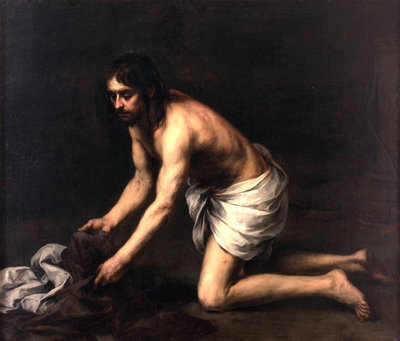
A poem arrived last Friday. It’s a reflection on a painting by sixteenth century Spanish artist Bartolomé Esteban Murillo. In the painting, Jesus is bent over on all fours after he being mocked and beaten.
Christ after the Flagellation
Steve’s poem, “Murillo’s Christ after the Flagellation” changed the direction of the sermon this morning. Here’s the poem.
The human had been tied to the whipping
post, a pillar that had been used many
times before by the Romans (and ages
earlier by the Greeks–but for a much
different purpose). Now, his pale skin looks
translucent (should it not have been darker,
with more blood?) His mother recalled his bris.
They had both cried then, too.
A strong young man, broad back, thick arms, now on
hands and knees, but head raised with eyes open:
seeing a cross that’s even worse ahead…
Still, unflinching, resigned–no, determined
to go on, face more pain, indignities,
shame, even death (there is no sign of God.)
Shortly there arrived a brief comment from a blogger who blogs about the daily struggle with mental illness.
“This poem brought tears to my eyes.”
Score one for my friend Steve.
Later in the day another comment arrived on the blog in response to Steve’s poetry. Like the first comment, this one also comes from someone with a history of some kind of long-term suffering. It reads as follows.
I have a response to the stories of Christ’s beating that often leaves others aghast. So brace yourselves:
He was beaten for several hours, or a day or two? Big deal. Those of us who have suffered years of abuse and terror know what real suffering is.
I don’t find focusing on Jesus’ suffering, or any of that 12 stages of the cross crap, to be helpful at all. I find it to be insulting. As if there is something noble and glorious about suffering. Nope, not a damn thing to recommend it. I know that Jesus voluntarily placed himself in the position for that to happen. So? Doesn’t help.
Please, fellow readers, don’t think that I am an isolated one, or few. There are lots and lots of us feeling this way.
The world is full – FULL – of people who have suffered much worse for decades or lifetimes. Think of people who live in North Korea. Or poor girls growing up in India. Or young girls in Fundamentalist Church of the Latter Day Saints settlements who get married off to much older men and are then raped daily for the rest of their lives. Jesus’ few days of humiliation are nothing in comparison.
The Lenten/Easter season is my favorite church season because I am reminded of how deeply I am loved and how quickly I am forgiven. Jesus’ brief beating plays no role in that….
The writer is hardly alone in his thinking about this. What do we say about those whose tenures of torture and suffering far exceed the relatively short period of Jesus’ suffering? Is focusing on Jesus’s suffering and the stations of the cross insulting to those who have suffered, and continue to suffer, for decades or for a lifetime?
How would you reply to the writer?
Here’s how I responded:
Your thoughtful response calls for an equally thoughtful reply. So I’ll try.
The cross, in my theology, in no way minimizes or disrespects the suffering of others. Nor does it say, as it is too often understood by sacrificial atonement theology, that suffering itself is noble or glorious. The cross was an instrument of Roman torture and execution. The Jesus who was tortured and executed, as were thousands of his Jewish contemporaries, is not somehow God masquerading in human flesh. That being said, moving the cross to the sidelines of Christian faith and reflection is, in my view, a mistake. Well meaning because it reacts against the twisted theology that understood it to be separate from, and above, all other human suffering, but mistaken nonetheless.
When I look at the cross, I see all these people. And I see myself there as both the crucified and the crucifier. What I see in the crucifix is total abandonment. “My God, my God, why have you forsaken me!” And in some way I hear not only the cry of Jesus but the cry of the God Dietrich Bonhoeffer described as the Divine Center we push to the edge of the world. I see in the Christ-event the tragedy and the hope of the divine-human encounter.
Sebastian Moore (The Crucified Jesus Is No Stranger and The Inner Loneliness) and Joseph Campbell awakened me to this richer Christology. Moore: “We have to think of God as closer to our evil than we ever dare to be. We have to think of God not as standing at the end of the way we take when we run away from our evil in the search for good, but as taking hold of us IN our evil, as the sore point which the whole idealistic thrust of man is concerned to avoid.
“Redemption through the blood of Christ is (wrongly!) interpreted as the bending of Reality itself to man’s great dream of himself. And it is exactly the reverse. It is the ending of the dream. It is the beautiful collapse of the whole enterprise. It is the invasion of man by himself, with God at the center as love.”(Bolding added for emphasis.)
Closer to home, another great theologian, my wife, Kay, reflected on the cross the other night at a Lenten series on “The Place of the Cross”:
“The Apostle Paul used to talk about all of his theology in terms of transformation at the foot of the cross. If a theological insight couldn’t go to the foot of the cross and be transformed there, then it wasn’t of God. This darkness is not for lightweight faith statements or testimonies. The annihilation of all goodness and all love which takes place in the action of one human being in violence to another human being—it cannot be redeemed by any other force but God’s pure love. That is a faith statement that lives inside a vacuum until manifested. There is no meeting of love and abandonment, they are mutually exclusive realities. We are lost. Period. And if God is to find us, then it is all about God’s initiative.”
From today’s perspective, Moore’s language is too gender- specific, not inclusive. But the substance of his Christology is totally inclusive. We’re all there. Anything short of that either drifts off into a new utopian project or into some new rendition of the power of positive thinking. The power of Christian theology is its gravitas: it doesn’t turn away.
I told the blogger, “Love to hear more…. Hope we can keep the conversation alive.”
Hours later, an email arrived from the second blogger who had watched “The Leper” on the blog saying s/he was moved and grateful for the sermon.
If I could sit down in a coffee shop or in a living room by the fire to continue the conversation, this is what I would say.
The cross of Jesus does not minimize other suffering. It casts a light backward and forward into all darkness for all time. From inside the light we see the darkness of all human violence and abuse, and at the foot of the cross, we look up to realize that the protest against the suffering we impose on others and our own self-imposed suffering – our own reviling of others and our reviling or ourselves — is not just ourprotest. It is God’s. It is the suffering of God at the hands of a godless world. And the word for “they reviled him” is the same as the word “blasphemed” him. Whenever we treat others cruelly, or treat ourselves cruelly, we blaspheme God. We are reviling and whipping the back of God.
From Jesus’s cry to God – “My God, my God, why have you abandoned me?” – there comes an echo from the heavens: “My children, my children, why have you abandoned me? My children, how could you forsake Me?”
The cross calls for an end to the reviling of others and our own sorry self-flagellation, as though those we revile, or we ourselves, would be or should be beyond love’s reach.
Who is the “the human tied to the whipping post”? Who puts her there?
Will you join the suffering of the God who wants it all to stop? Will you rejoice in the inevitable, eternal reach of God’s love and redeeming grace?
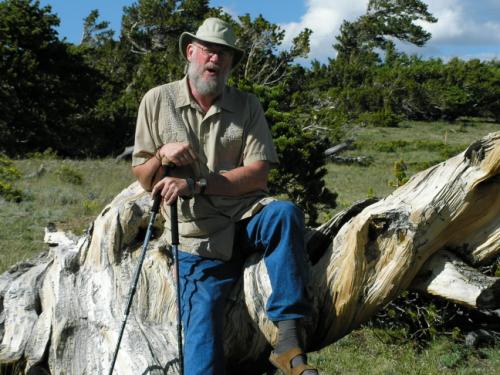
Footnote: Here is Steve, the poet, among the Bristle Cone Pines at 11,000 feet in Colorado:
..
A fellow student at McCormick Theological Seminary in Chicago, we’ve continued the friendship for 47 years. A published poet, Steve was the Senior Minister of the McKinley Presbyterian Church and Director of the McKinley Foundation (campus ministry) at the University of Illinois for many years. He hosts “Keepin’ the Faith” on WILL, Illinois Public Radio,. He and his wife, Nadja, a research biologist, live in a geo-thermally-heated house on the prairie outside Urbana, IL where his neighbors often spot Steve’s kites riding the winds of the prairie skies.




 Views from the Edge