The Web of Sanity and Fullness

Pond with morning mist evaporating

Pond with morning mist evaporating

A newspaper reporter asked me some questions. We were preparing for a First Tuesday Dialogues series on sustainability called “The Good Green Earth.”

The series would bring five speakers, including  spokespeople from the Gulf of Mexico deeply engaged in hazard assessment, technology, and recovery in the wake of Deepwater Horizon.

What’s your sense of the possibilities and trends for sustainability in your work now and what does it look like in the future?

I responded that one of my inspirations is Paul Tillich, according to whom:

Being religious means asking passionately the question of the meaning of our existence and being willing to receive answers, even if the answers hurt.

Faith consists in being vitally concerned with that ultimate reality to which I give the symbolical name ‘God’. Whoever reflects earnestly on the meaning of life is on the verge of an act of faith.

The Spider’s Web with Morning Dew

My calling as a pastor was to help us here at Shepherd of the Hill and here in Chaska literally “go out of our mind.”

Because the collective mind that has delivered us to this place is killing us and destroying the balance of nature.

My calling is to shake us loose from the mental and spiritual chains of species superiority, My calling is to shake us loose from the mental and spiritual chains of species superiority, the mistaken notion that we – humankind – are the exception to Nature.  It’s a call to help re-shape our understanding of ourselves as participants rather than owners, participants rather than conquerors or manipulators, members of a diverse natural order of interdependent life. The spiritual resources are there in Hebrew scripture, in the New Testament epistles to the Ephesians and the Colossians, and in the ancient respectful spirituality of some of America’s indigenous people. By “going out of our mind” we will come back into a the web of sanity and fullness.

What factors do you see pushing towards or against sustainability?

Historian of science and technology Lynn White said flat-out that the root problem of the sustainability crisis is religious or spiritual, and so is the solution.

So, number one, we have to address the old and emerging questions about what Tillich called “Ultimate Reality” and the meaning of our existence.  We have to go into labor to set the new theological and anthropological  paradigm free from of the old destructive thinking.  What we are beginning to find as we go into this spiritual labor is that this more respectful, more holistic way of thinking is not new at all – it’s the older paradigm that got side-tracked by greed and pride.
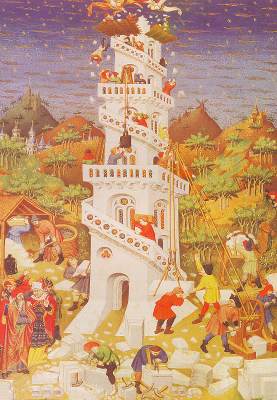
Building of the Tower of Babel – Master of the Duke of Bedford

God has “come down,” as it were, to frustrate our attempts at building the secure city called Babel; God is making us nomads again who recognize that we and the Earth are already full, not empty. Every settlement comes to nothing. Every tower built as a monument to pride falls. And number two, and I’m afraid there is no other way to say this – we will never make it without leaving behind the economic system of greed. Capitalism is killing us.

The consolidation of wealth and corporate power have a stranglehold on national, state, and local public policy. The members of the boards of the oil companies sit on the boards of General Motors and Ford.  So it’s no wonder that U.S. federal policies on transportation are car-friendly and suspicious of mass-transit, regardless of a car’s gas mileage. Osalescence is built in because you can’t sell something five years from now if the old model is still like new. Our health care and the FDA are in the palm of the insurance and drug company’s so that it’s illegal to go across the border to fill your prescription in Canada.

Finally, the sustainability of the human species itself is, I believe, imperiled by chemical alterations that are meant to do good but that, in the long run, make us biologically less resistant and resilient. Our natural immune systems are being weakened by pesticides in the food we eat and by the pharmaceuticals we ingest from the drug store.

Black tar heroin - U.S. Drug Enforcement Administration

Black tar heroin – U.S. Drug Enforcement Administration

We have become a nation of addicts.  Addicted to illusionary dreams of abundance.  Addicted to prescription drugs.  Addicted to fast food and faster short-term solutions. Even instant gratification is too slow. Controlled by advertizing that sells us prescription drugs that’ll give you an immediate erection but may send you to the emergency room if it last more than four hours,or drugs that may ruin your liver or land you in a casket, and the real pushers are not the petty drug peddlers on Minneapolis’s North Side. The real pushers are legal. They’re given license, while those who would shut them down are looked upon as crackpots and throw-backs who are opposed to progress.

So…what’s stopping real progress, a more Earth-friendly way of organizing human affairs that embraces reality itfself, “Being-Itself”?  The intransigent, legal, institutionalized arrangements of power and money, on the one hand, and our willing compliance with the de-democratization of America that salutes the system of greed. We have to learn again, and we are – very slowly –  pushing and screaming, that “the Earth is the Lord’s and the fullness thereof”. We have turned it over to the forces of greed and destruction.

The Good, Good Earth: Our Island Home

The Good, Good Earth: Our Island Home

We need to recover the gratitude and spiritual paradigm of a natural abundance in order to push against the false promises of those who would have us believe that our lives and the world would be empty without all the stuff that ends up in the landfills or washes ashore in the estuaries of the Gulf of Mexico.

So……Chime in, friends. How would you answer the reporter’s questions?

The Sin of “American Exceptionalism”

Last night I watched Mitt Romney at a campaign rally in my home town, Broomall, Pennsylvania. What I saw sent chills down my spine. Demagoguery was on display. The people from my home town applauded the scolding of American President for apologizing. No apology for the tragedy of an American soldier(s) walking into the homes of families in Afghanistan to kill. No apology for … well…for ANYTHING. America is the greatest country in the history of the world. We should make no apology, said Mr. Romney.

In light of that speech, I am reposting this piece first published in February. It’s Holy Saturday for me. The one who lay dead on this day was killed, without apology, by The Myth of Roman Exceptionalism. The Roman Empire is long gone. But the myth never goes away. Only the name of the nation changes. Here’s the piece:

Jacket of “My People Is the Enemy”

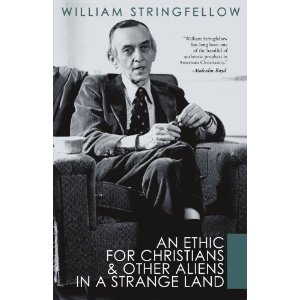
“The stairway smelled of piss….This [a tenement apartment in East Harlem] was to be my home.  I wondered, for a moment, why. Then I remembered that this is the sort of place in which most people live, in most of the world,  for most of the time. This or something worse. Then I was home.”  – William Stringfellow, My People Is the Enemy: An Autobiographical Polemic.

I’ve been holding my breath, wrestling with whether to speak aloud what I hear and see.

I’m a disciple of Jesus, a Christian, in the debt to the bold witness of the late William Stringfellow, lay theologian. I’m also a religious pluralist. I believe with Chief White Calf of the Blackfeet that there is not just one way, there are many sides to the mountain and many paths on which the Divine Mystery is experienced.

I have learned over the years to respect the multiplicity of ways different sides of the mountain experience the living God. I work hard to understand my Hindu, Buddhist, Muslim, and Jewish neighbors. I often experience these discussions as encounters with God whose vastness, like the ocean, is so much greater than any of the tea cups in which we hold a few drops of the sea.

I also know that some forms of religion are just plain nuts. The religion of Jim Jones whose followers drank the purple Kool Aid in shared suicide in the jungle of Guyana is only the most ludicrous example of why we need to join comedian Lewis Black’s raging objection to political distortions of the truth: “You can’t just make s—t up!” Religion represents the best and the worst of the human psyche (the Greek word for ‘soul’).

Joseph Campbell, among others, long ago opened the aperture on my theological camera. He helped me to see that what we are all dealing with, on all sides of the mountain, is myth, the human spirit’s uniquely creative meaning-making activity that expresses both the grandeur and the terror of finite experience. Myth is not the opposite of truth; it is the story that points us beyond ourselves to the transcendent and the eternal.

My way of looking at the world is shaped by a vast variety of voices. Among them are Fyodor Dostoevsky, Friedrich Nietzsche, Franz Kafka, Jean-Paul Sartre, Albert Camus and Dietrich Bonhoeffer, whose experiences of the horror of the absence of God caused them to poke their fingers in the eyes of prevailing religious traditions whose tidy moral worlds turn God into a cosmic sadist.

Any religion worth its salt in the 21st century has to pass through the existential protests of these thinkers and of the shrieks and cries that still echo across the world from Auschwitz and Buchenwald that poke holes in every theory of a morally ordered universe. The Garden of Eden was lost a long time ago and, in the wake of the closing of the gates to it, any religion has to take account of the human history that looks much more like the trail of tears paved by Cain’s slaying of Abel than like two innocent people in Paradise before the fall.

Yet there is a deep longing for something more tangible, more trustworthy than myth. Something one can touch, see, feel, smell – a story that is not a story but fact. The longing is strongest when we experience great uncertainty and insecurity.

With this perspective, I have been looking again at the fastest growing religion in America, Mormonism, and the Church of Jesus Christ of the Latter Day Saints (LDS).

My first experience with the Mormons came quite by accident thirty years ago. I was riding a bus in New York City on my way uptown to visit African-American theologian James Cone at Union Theological Seminary in Harlem when I noticed the sign “Mormon Visitation Center.”  Already stressed by an unfamiliar transit system and feeling quite alone, I decided to get off the bus and take the tour.

Unlike the streets outside that were filled with trash and lit by flashing neon signs, the Visitation Center was spick-and-span. Everything was in perfect order, complete with a hologram of a Mormon family in a tranquil woods sitting in a circle, listening to the white upper-middle-class family’s father sitting on a stump higher than the other members of the family, reading from the Book of Mormon to an enthralled wife and two perfect, obedient, happy children. The hologram elicited two responses. One was amazement. I had never seen or even heard of a hologram. The other was a sense of outrage at the perpetration of a promise that was, in short, nothing but a hologram, the illusionary projection of someone’s idea of Eden that would strike a chord with visitors who long for the lost woods of the Garden of Eden. It offered a world of perfection: orderly, tidy, white, rural – nothing like the urban world on the street outside – the antidote to the realities and complexities of life in New York City.

When I left the Mormon Visitation Center it never crossed my mind that the Mormon vision or mythology would become the fastest growing mythology in America in the 21st Century. I was relieved to get back on the bus on my way to Harlem.

I ask myself now why this is so. I look again at Mormon beliefs and practices to try to understand.

In Mormon teaching, the Garden of Eden was a historical place, and it was not in the Mesopotamian Valley by the Euphrates River, as in the original biblical myth of Genesis. It was in North America…in Missouri.

“According to Joseph Smith [Mormonism’s founder] the Garden of Eden was located in Jackson County, Missouri and following his expulsion from the Garden, Adam traveled northward to a place near modern-day Gallatin, Missouri. Mormon Apostle Orson Pratt stated that the name Adam-ondi-Ahman “is in the original language spoken by Adam, as revealed to the Prophet Joseph” (Journal of Discourses 18:343) – Bill McKeever, Mormon Research Ministry.

It is to this very spot of physical geography that Jesus will return at the Second Coming. None of this is in the realm of myth. It’s fact. You can go there to touch it and  walk on it, knowing that Adam was there long before you and that, after you have walked there, it will prove to be the epicenter of the universe, the very spot where Christ will return.

Why is the Mormon myth gaining such traction in America? And why would I break the code of silence, the well-advised reticence to those of us who share White Calf’s belief that the Divine Mystery is known differently on different sides of the mountain?

Some things are too important to leave unaddressed. The Mormon mythology is quintessentially American.

The myth that America is the center of transcendent goodness and power, the world’s epicenter, the original Garden of Eden and the place of Christ’s return, the people of “Manifest Destiny”, the one exception to the rising and falling of empires and nations, is losing its hold on us at home and abroad. We are losing our sense of innocence. Yet there lurks the nostalgia for the secure home provided by the illegitimate marriage of Jesus’ gospel of the Kingdom of God with America, “the City set upon a hill” of Jesus’ Sermon on the Mount and of John Winthrop’s sermon to English settlers on their voyage to the new world.

As Nietzsche knew, such gods don’t die easily, even when they’re already dead. When the town crier takes his lantern into the darkened town square at midnight crying “God is dead! God is dead!” in Nietzsche’s Thus Spake Zarathustra, the rest of the town regarded him as a madman. But it would be only a matter of time before the news would reach their ears.  It was the god of Western civilization that Nietzsche’s madman pronounced dead.

When something dear to us dies, especially when it is the prevailing religious myth of a nation about its own holiness and invulnerability, we become like starving people who continue to look in the same old bare cupboard for bread.

What better place to go than the reassurance that America is still the center – the ancestral home of a real man named Adam, who came complete with his own (now lost language, the special place to which Jesus (who visited the lost tribe of Israel in the Americas between his resurrection and bodily ascension into heaven) will return? When the Christian story the story is concretized to a finite, mortal place, it power as myth – pointing us beyond ourselves to the transcendent and the eternal – is not only lost but turned on its head.

There are many sides of the mountain, and it behooves all of us to approach people of different religious traditions with open ears and open minds. But approaching another’s religious beliefs respectfully does not require that we pretend not to see what we see or that we conclude that all religions are really the same or that one opinion is as good as another in the free market of religious truth claims. “You can’t just make stuff up!”

Let me say without hesitation that what I see in Mormonism is but the most exaggerated illustration of the idolization of the nation that includes so much of the American churches of whatever stripe where the nation is enshrined as God and where patriotism is the unspoken highest virtue with the cross wrapped in a flag.

The American wars of foreign intervention in Vietnam, Iraq, and Afghanistan could not have happened without this widespread faith in American goodness and exceptionalism. It is the cardinal sin that afflicts us across all denominational and religious lines. Whenever the Jesus executed by the Roman Empire becomes the Imperial King of a new empire, those who continue to hear the shrieks and cries of the world that suffers – and who continue to smell the piss on the stairway in the place we call “home”- are obliged to break the silence, violate the code, and get back on the bus to Harlem.

The Wafer and the Loaf: the Pope and Raul Castro

I woke up this morning to read “Pope calls for ‘justice, peace, freedom and reconciliation’ in Cuba. He was greeted by Cuban President Raul Castro, who promised religious freedom in his Communist nation.”  What follows is my reflection on this piece in light of three weeks in Cuba in 1979..

Curious. The headline and the story are curious.

Pope Benedict arrives in Santiago, Cuba. In Mexico he has just criticized Cuba’s Marxist model as obsolete and has called for a future of “justice, peace, freedom and reconciliation” in Cuba.

The President of Cuba, Raul Castro, welcomes the pontiff to Cuban soil.

The media focuses on the Pope’s call for change in Cuba, on the one hand, and Mr. Castro’s promise of  religious freedom in Cuba, as though the latter were a new development.

In 1979, on the heels of the Catholic Bishops Conference in Puebla, Mexico, I spent three weeks in Cuba, one of 75 churchmen and theologians invited by the Evangelical Theological Seminary of Matanzas, Cuba and the Presbyterian-Reformed Church of Cuba.

Most of the guests were from Central and South America. Others were from France, East and West Germany, Rumania, the Soviet Union, Mozambique, Angola, South Africa, Zimbabwe. There were four of us from the U.S: Professors Harvey Cox, , Robert McAfee Brown and a tag-along practicing pastor and college chaplain from Wooster, Ohio.

What do I remember most about that trip? Five memories:

________________________________

1) Approaching Cuba from the air, looking down at this island 90 miles from the coast of Florida, asking how this little David had managed to slay Goliath at the Bay of Pigs, and wondering what was so threatening to us that the U.S. government continued to punish it with an economic embargo. I felt like a bully. Guilty. Ashamed. Humble.

2) Getting sick on a collective farm, sitting under a tree after drinking a complementary glass of banana juice. I was quickly tended to by Cuba’s medical and pharmaceutical system. They continued to check on me until all was well. Everyone gets health care.

3) The Cuban pastors’ response to a long breast-beating speech by Robert McAfee Brown, one of the foremost theologians in the U.S.  Brown spent 45 minutes in a biblically based sermon apologizing to the Cubans, a kind of cathartic confession in full public view. I was with him all the way. The Cuban response? Stop that. You didn’t do this. The American people haven’t done this to us. Your government has. Wallowing in guilt won’t help you and it won’t help us. We all need to find ways to promote justice and peace in our own contexts. We are all here as friends, brothers and sisters in Christ.

4) Walking through the streets of Matanzas in the evening. Children playing freely in the streets. Windows and doors wide open. Neighbors talking and laughing with next-door neighbors. This could not be staged. This was the real Cuba.  As Harvey Cox, the charming professor from Harvard Divinity School who is fluent in Spanish, led the three of us through the streets, children followed him like the Pied Piper. Harvey would laugh with them and they with him. We would sing and walk. It was playful, like nothing that was happening back home.

5) A conversation with Communists on the veranda of the home of the President of the seminary. Raul Castro was among them. They were there to welcome us to Cuba. They also wanted to talk theology and society. They wanted to know what we really believed about God, about the Kingdom of God, and about social justice and economic equality. I don’t remember his name now, but I do remember the long one-on-one conversation during that cocktail hour with a member of the Communist Party. He had grown up Roman Catholic but was no longer a believer. The Church, he said, had kept the people in their place before the revolution. The Party had raised them up to believe in themselves. The Church had given them a wafer; the Party gave them bread, real food, real nutrition. The Church proclaimed the Kingdom of God after you die; the Party proclaimed a society of justice and peace that could be achieved in this world.

He asked what I thought. I told him that the version of Christian faith that he had described was not my faith. It was something else, but it was a very popular distortion of the life and teaching of Jesus. I told him that I shared his hope, that what he called “the classless society” I called the Kingdom of God, and that, to the extent that we were each working for the elimination of poverty, the end of starvation, and the health and joy of all God’s children, we were working toward the same goal under different names.  I rehearsed my history of Christian-Marxist dialogue dating back to seminary and the summer of 1966 living in Bratislava, Czechoslovakia as the Experiment in International Living Chicago Ambassador to Czechoslovakia. I told him of Josef Hromadka, the Czech theologian who had begun this dialogue because, said Hromadka, there was only one reason that the Bolshevik Revolution was atheistic: the sin of the Church. Its failure to align with the poor rather than the rich. The Church and the Czar had become of one cloth, just as he had been describing. The Church was giving people nothing but a wafer; the bread would come only after death. Lenin and Trotsky were insisting that to be genuinely human was to eliminate the economic structures that produce poverty and despair and that delay the distribution of real bread until an afterlife. Like Marx, they saw religion as the opiate of the people, the ideological blanket that blinded people to their earthly reality. But the biblical Kingdom is not about the Church, it’s about the new society in which the love of God reigns everywhere. It’s the NEW city, the new Jerusalem, and, in that new city, there is no longer any temple. There is no longer any need for the church because the Kingdom has come.”

The man from the Party’s eyes were wide.

I asked the man on the veranda where he thought his hope for such a society came from. “I don’t know,” he said, “I think it’s just part of being human.” “Yes,” I said, “but why? How’s that hope get there? Why should we hope unless there is something in being itself, something in the deepest part of us, that holds out the promise of its fulfillment, an inner sense that beckons us beyond the present conditions? The name for me is God.  None of us has ever seen God, yet I see God in Jesus of Nazareth, a worker, a carpenter, preacher of the Kingdom of God. I hear in your visions an echo of the Sermon on the Mount. I get the clearest sense of it when we share the meal at the Lord’s Table, the sign of the Kingdom.  The Kingdom will not come by Prometheus stealing fire from the gods. We have to work for it, but we also ‘wait for it with patience.’”

“Thank you, I’ll have to think more about that. You sound like Jose.” There’s a long pause. “Well…We’ll have to wait and see. I guess only time will tell who’s right,” he said. Like Harvey and the kids on the street that evening, we shared a good laugh, shook hands, and moved on to another conversation.

_____________________________

It’s now 33 years later and I’m reading about Raul Castro’s “promise” of religious freedom, the very same Raul Castro who was on the veranda at the seminary, who graciously welcomed the guy with the wafers to Cuban soil, except for kissing his ring. Priests and lay people from throughout Cuba throng to the site. None of them is hungry for bread.

Curious…for a country with no religious freedom. Don’t you think?

The Religious Parade: Unreal and Real

Click HERE to read and view the photos of religion on the campaign trail in Michael Gerson’s opinion piece in this morning’s Washington Post. Comment below to generate the discussion her.  But…before you do…ponder Steve Shoemaker‘s “The Donkey”  sent to me this morning in preparation for Palm/Passion Sunday.

THE DONKEY (A Children’s Verse)

The coats the folks are throwing down

sure make it hard for me to walk

especially carrying this clown

whose feet are almost to the ground.

“Hosannah King!” is all the talk,

but this guy seems to be as poor

as I am–no one could mistake

him for a Royal–he’s just a fake!

They wave palm branches, and they roar,

but my long ears can hear the real

parade across the city square:

the General, the Priests, the score

of war horses–the whole grand deal.

This pitiful parade will fail

to save a soul, and soon the yell

will change from “Hail!” to…”Kill!”

The Bouquet

Re-posted by Sojourners’ blog, “God’s Politics with Jim Wallis” March 27, 2012.

Most every Sunday Ruth or Lily Janousek hands me a drawing on the way out the door. I have quite a collection.  Lily and Ruth are budding theologians. They may not know that about themselves, but that’s what they are: budding theologians – they do theology, they do their best to speak of God.

They draw pictures of God and us. Like the one from last Sunday. The drawing of a bouquet with the words:

“God doesn’t loves us as a flower but as a bouquet”

Right then and there, standing at the door last Sunday, I knew I had the sermon for the next week in my hand.

Ruth’s drawing took me back some years ago when I had the great privilege of serving as the summer minister for Saint Timothy’s Memorail Chapel in Silver Cross, Montana, a ghost town with four residents where they would bring the world’s greatest preachers!  One of the four residents of Silver Cross was the 92 year old Eliza who lived up the hill, perhaps the length of a football field, from Saint Timothy’s . Every Sunday morning Eliza would cut the wildflowers in her yard, arrange them into a beautiful bouquet and place them on the altar for worship. Now I get a drawing from eight year old Ruth, younger version of the 92 wilting theologian, Eliza.

“God doesn’t love us not as a flower but as a bouquet.”

I wonder who the flowers are in this bouquet, the Kingdom of Heaven, as Jesus speaks of it in the Beatitudes of the Sermon on the Mount (Matthew 5:1-14) or, the Body of Christ, as Paul speaks of it in First Corinthians.

As in Ruth’s drawing and Eliza’s Sunday morning arrangements, a bouquet is made up of a variety of flowers. Individual flowers come in a single size and shape, eac with its own color. In a bouquet, these different colors, shapes and sizes complement and contrast with one another to make something altogether beautiful in the hand of a skilled florist.

Ruth may be a rose and Lily a sunflower, Bob might be a purple Iris, and I might be…a Milkweed or a thistle or a twig of red oshier – but put us all together and we become something more than who we are.

God loves us as a bouquet. We are God’s bouquet. We are the flowers; God is the florist; we belong in God’s bouquet.

Could this be what Jesus is talking about in the Sermon on the Mount?  Could the collection in Jesus’ Beatitudes be the bouquet, the Kingdom of Heaven?

Listen to the florist’s strange list of flowers in this bouquet:

Blessed are the poor in spirit;

Blessed are those who mourn;

Blessed are the meek,

Those who hung and thirst after righteousness,

The merciful, the pure in heart,

The peacemakers,

Those who are persecuted,

Those who are slandered against for doing what’s right.

“You are the city set on a hill that cannot be hid. the bouquet that cannot be ignored.”

Until this morning, I had always thought of these individual beatitudes as a description of the individual life of the disciple of Jesus. But to think of them that way is depressing because it’s unachievable.

In a former pastorate I used to visit four young men in psychiatric institutions whose demented states of mind I was sure were rooted in some way to their failure to measure up to this impossible spiritual standard. Each of them was a professor’s son. Each of them had been raised on a missionary style of Christianity. Each of them had been raised to feel sorry for the persecuted, the meek, the poor, the oppressed. And each of them, as we walked the grounds of the psychiatric hospital in Mansfield, would talk as though he should be able to save the world from its pain. Each of them seemed to believe that purity of heart meant being like Jesus – which meant to them incessant suffering, guilt, and sorrow.

Each of these brothers bore the marks of the Beatitudes. Each was poor in spirit. Each hungered and thirsted for justice. Each was merciful. Each was pure in heart. Each felt persecuted for pursuing what was right in a world that didn’t care or didn’t know. Each of them felt slandered for doing what their parents – and Jesus – had taught them to do.

But there was one quality that was missing: the quality of meekness…

So long as they lived in the illusion that they, as individuals. were responsible for the world as It was, or that each of them alone was responsible for ridding the world of its suffering, each of them was lost in the lonely world of a flower without a bouquet. So long as they embraced the twisted missionary moralism of their distorted Christian upbringings, they would suffer the horrors of shame and loneliness.

Now, I know, of course, that each of the four brothers I visited back then were mentally ill. They didn’t choose to be in the state psychiatric institution. But I also knew their parents. And I knew the church in which they had been raised. It came as no surprise to me that there seemed to be a profound connection between what I was hearing from the homes and the church of their upbringing and what I was hearing form their sons in the psychiatric hospital.

I have to admit to sharing in the twisted spirituality that saw the Beatitudes as a list of requirements for the Christian life. It’s made me sick along the way.

But this morning, in light of Ruth’s yellow card from last Sunday, I’m seeing them differently.

“God loves us not as a flower but as a bouquet.”

Not every flower in God’s bouquet is poor in spirit. Not every one of us is in mourning. Some of us got up this morning with smiles on our faces and a song in our heart. Not every one of is meek.  Not everyone came here this morning hungering and thirsting for righteousness – some of us came out of habit; some of us came for comfort, some of us came to sing some hymns. Some of don’t know why we came. Not everyone is known by acts of mercy – we come with grudges and desires for retribution. Not everyone is pure in heart or a peacemaker. And almost of none of us is being persecuted as advocates for social justice.

But TOGETHER all of those blessed people are here in God’s Bouquet.

Makes me wonder whether Jesus had read the Bhagavad Gita, the Hindu scriptures of India written two to five centuries before he preached the Sermon on the Mount in Palestine. Listen to its familiar ring, and let the Florist place you in the vase of God’s remarkable Bouquet.

“I am the Self…seated in the heart of every creature. I am the origin, the middle, and the end that all must come to.

“All your thoughts, all your actions, all your fears and disappointments, offer them to me, clear-hearted; know them all as passing visions.

“Thus you free yourself from bondage, from both good and evil karma; through your non-attachment, you embody me, in utter freedom.

“I am justice; clear, impartial, favoring no one, hating no one. But in those who have cured themselves of selfishness, I shine with brilliance.

“Even murderers and rapists, tyrants, the cruelest fanatics, ultimately know redemption through my love, if they surrender

“To my harsh but healing graces. Passing through excruciating transformations, they find freedom and their hearts find peace within them.

“I am always with all beings; I abandon no one. And however great your inner darkness, you are never separate from me.

“Let your thoughts flow past you, calmly; Keep me near, at every moment; trust me with your life, because I am you, more than you yourself are.”

Seeing the crowds, Jesus went up on the mountain, and when he sat down, his disciples came to him. And he opened his mouth and taught them, saying:

Youtogether – are the salt that preserves the earth from its own self-destruction.

“You – together – are the city set upon a hill that gives light to the world.”

We together – each and all – are God’s bouquet. God loves us as a bouquet!

What do YOU think?

Sit and reflect awhile

Amish Rocking chair

This post requests YOUR views on a hot topic.

“The GOOD Society: Religion and Politics” drew a crowd last night in Chaska.  The panel was a Quaker, a Christian, and a Baha’i. Those who came were Jewish, Protestant, Catholic, Unitarian-Universalist, Lutheran, Disciples of Christ, agnostic, atheist searching together. Add your voice to the discussion.

QUESTIONS FOR YOUR COMMENT:

What is your vision of the GOOD society, the kind of world you believe in?  Here are several answers from last night to whet your appetite.

The kingdom of God realized (Jesus’ prayer, “Thy kingdom come on earth…as it is in heaven”).

What would that look like? What would be different if it was realized?

What are the qualities of that society? A ‘kingdom’ is a society.

The kin-dom of God, the idea of the kingdom without the ‘g’ – the society of universal kinship. “There is only nation: the human family.”

Agree or disagree and why?

The Unites States is a secular republic, not a religious republic. The founders were clear that America was not to be a theocracy. The “wall of separation” between church and state guarantees the free expression of religion.  It also protects the state (government) against any one religion being on the throne, as in Iran, and as had once been the case in the Massachusetts Bay Colony.

What is the role of religion in the shaping of public life and in politics? By “politics” we do not mean “dirty politics” or “partisan politics’; we mean politics as the work of the polis (the people) in determining the values and laws that hold a religiously free society together. For example:

The Minnesota referendum on Marriage illustrates the problem.

What is “marriage”? Who defines it? Is it a religious concept or a civil concept?

Should a constitution be amended to define marriage?

Should the “wall of separation” leave the definition of and celebration of                  “marriage” (however defined) to the church, synagogue, mosque, etc., and instead provide for “civil unions” (legal contracts between two people irrespective of gender)?

All of us have religious/humanist and political traditions that informs us. One of those for me is the “Principles of Church Order” adopted in 1789 at the founding of the Presbyterian Church in the United States meeting in Philadelphia.  The Rev. John Witherspoon, one of the  signers of the Declaration of Independence and President of Princeton University, was also a key player in the Principles of Church Order intended to guide the church’s internal life and its relation to “the civil power”. Three of the eight principles, it seems to me, inform the current discussion.

On Church and State:

“God alone is Lord of the conscience…. Therefore we consider the rights of private judgment, in all matters that respect religion, as universal and unalienable. We do not even wish to see any religious constitution aided by the civil power, further than may be necessary for protection and security, and at the same time, be equal and common to all others.

In short, we live in a secular democratic republic in which “the civil power” does not aid any religion, but protects the free exercise of all religions equally, without privileging one over another.

On the shared search for truth and goodness: That truth is in order to goodness; and the great touchstone of truth, its tendency to promote holiness, according to our Savior’s rule, ‘By their fruits ye shall know them.’ And that no opinion can either be more pernicious or more absurd than that which brings truth and falsehood upon a level, and represents it of no consequence what a person’s opinions are.  On the contrary, we are persuaded that there is an inseparable connection between faith and practice, truth and duty.  Otherwise, it would be of no consequence either to discover truth or to embrace it.

In short: ideas do matter. The search for what I’m calling “the good society” is based on a shared commitment to the search for truth, not just opinion. Some degree of objectivity or what philosopher Gabriel Marcell called “inter-subjectivity”, not just my own subjectivity. My opinion might be that the moon is made of green cheese or that Earth, not the sun, is the center of our solar system. Ideas and opinions have social consequences.  And in all things, the truth exists for the sake of “goodness” – human and environmental wellbeing.

On the exercise of mutual forbearance: That, while under the conviction of the above principle we think it necessary to make effective provision that all who are admitted as teachers be sound in the faith, we also believe that there are truths and forms with respect to which people of good character and principles may differ.  And in all these we think it the duty both of private Christians and societies to exercise mutual forbearance toward each other.

In summary:  In a secular democratic republic, 1) no religion gets to “capture the flag” of the United States of America.  We honor individual conscience as the corrective light that reforms the prevailing ideas of truth and goodness. 2) We seek truth rather than sinking into the swamp of “I’m sorry, that’s the way I feel, and it’s none of your business, and yours is none of mine.” The acceptance of pluralism is not surrender to the swamp of anarchy or the refusal to look at the evidence of science or to engage in the common search for solutions to social problems.  3) Where we differ and disagree, however intensely, we will exercise mutual respect and patience while we work it out together.

Enough for this morning.  Chime in. Let others know what you’re thinking.

Thanks for visiting.

Elie Wiesel on Mormon Proxy Baptisms

Elie Wiesel, Nobel Prize and Pulitzer Prize winning author and survivor of the Holocaust, has called on Mitt Romney to join him in calling on the Church of Latter Day Saints (“Mormons”) to stop baptizing Jews who have died.  I wrote the following comment on the Huffington Post story:

We’re taught, and rightly so, to be respectful of religions and views different from our own. But that does not erase the responsibility to think critically about one’s beliefs and practices or those of others. I have the greatest respect for Elie Wiesel and am grateful to him for exposing a practice that insults every Jew, every Christian, every Muslim, every Buddhist, everyone who could not in good conscience embrace any religion at all, by imposing Mormon baptism. Nothing could be more arrogant. The proxy baptisms are not the only beliefs and practices that deserve thoughtful examination. More troublesome to me is the underlying Mormon assumptions that make the United States of America the very center of all human history – the alleged geography of a real Garden of Eden (in Missouri) and of the Second Coming of Christ (also in Missouri). As much as the proxy baptisms, those beliefs should send chills down the spines of everyone whose God belongs to no one nation, no one culture, no one religion – the God of the heavens and the Earth “Whose ways are not our ways and Whose thoughts are not our thoughts.”

An earlier commentary on the matter (posted earlier) addresses the matter moer fully. It’s a reflection that includes a visit to the Mormon Visitation Center in NYC. Let me know what you think.

The God of American Exceptionalism

Gordon C. Stewart          February 7, 2012

Jacket of My People Is the Enemy

“The stairway smelled of piss….

This [a tenement apartment in East Harlem] was to be my home.  I wondered, for a moment, why. Then I remembered that this is the sort of place in which most people live, in most of the world, for most of the time. This or something worse. Then I was home.”  – William Stringfellow, My People Is the Enemy: An Autobiographical Polemic.

I’ve been holding my breath, wrestling with whether to speak aloud what I hear and see.

I’m a disciple of Jesus, a Christian, in the debt to the bold witness of the late William Stringfellow, lay theologian. I’m also a religious pluralist. I believe with Chief White Calf of the Blackfeet that there is not just one way, there are many sides to the mountain and many paths on which the Divine Mystery is experienced.

I have learned over the years to respect the multiplicity of ways different sides of the mountain experience the living God. I work hard to understand my Hindu, Buddhist, Muslim, and Jewish neighbors. I often experience these discussions as encounters with God whose vastness, like the ocean, is so much greater than any of the tea cups in which we hold a few drops of the sea.

I also know that some forms of religion are just plain nuts. The religion of Jim Jones whose followers drank the purple Kool Aid in shared suicide in the jungle of Guyana is only the most ludicrous example of why we need to join comedian Lewis Black’s raging objection to political distortions of the truth: “You can’t just make s—t up!” Religion represents the best and the worst of the human psyche (the Greek word for ‘soul’).

Joseph Campbell, among others, long ago opened the aperture on my theological camera. He helped me to see that what we are all dealing with, on all sides of the mountain, is myth, the human spirit’s uniquely creative meaning-making activity that expresses both the grandeur and the terror of finite experience. Myth is not the opposite of truth; it is the story that points us beyond ourselves to the transcendent and the eternal.

My way of looking at the world is shaped by a vast variety of voices. Among them are Fyodor Dostoevsky, Friedrich Nietzsche, Franz Kafka, Jean-Paul Sartre, Albert Camus and Dietrich Bonhoeffer, whose experiences of the horror of the absence of God caused them to poke their fingers in the eyes of prevailing religious traditions whose tidy moral worlds turn God into a cosmic sadist.

Any religion worth its salt in the 21st century has to pass through the existential protests of these thinkers and of the shrieks and cries that still echo across the world from Auschwitz and Buchenwald that poke holes in every theory of a morally ordered universe. The Garden of Eden was lost a long time ago and, in the wake of the closing of the gates to it, any religion has to take account of the human history that looks much more like the trail of tears paved by Cain’s slaying of Abel than like two innocent people in Paradise before the fall.

Yet there is a deep longing for something more tangible, more trustworthy than myth. Something one can touch, see, feel, smell – a story that is not a story but fact. The longing is strongest when we experience great uncertainty and insecurity.

With this perspective, I have been looking again at the fastest growing religion in America, Mormonism, and the Church of Jesus Christ of the Latter Day Saints (LDS).

My first experience with the Mormons came quite by accident thirty years ago. I was riding a bus in New York City on my way uptown to visit African-American theologian James Cone at Union Theological Seminary in Harlem when I noticed the sign “Mormon Visitation Center.”  Already stressed by an unfamiliar transit system and feeling quite alone, I decided to get off the bus and take the tour.

Unlike the streets outside that were filled with trash and lit by flashing neon signs, the Visitation Center was spick-and-span. Everything was in perfect order, complete with a hologram of a Mormon family in a tranquil woods sitting in a circle, listening to the white upper-middle-class family’s father sitting on a stump higher than the other members of the family, reading from the Book of Mormon to an enthralled wife and two perfect, obedient, happy children. The hologram elicited two responses. One was amazement. I had never seen or even heard of a hologram. The other was a sense of outrage at the perpetration of a promise that was, in short, nothing but a hologram, the illusionary projection of someone’s idea of Eden that would strike a chord with visitors who long for the lost woods of the Garden of Eden. It offered a world of perfection: orderly, tidy, white, rural – nothing like the urban world on the street outside – the antidote to the realities and complexities of life in New York City.

When I left the Mormon Visitation Center it never crossed my mind that the Mormon vision or mythology would become the fastest growing mythology in America in the 21st Century. I was relieved to get back on the bus on my way to Harlem.

I ask myself now why this is so. I look again at Mormon beliefs and practices to try to understand.

In Mormon teaching, the Garden of Eden was a historical place, and it was not in the Mesopotamian Valley by the Euphrates River, as in the original biblical myth of Genesis. It was in North America…in Missouri .

“According to Joseph Smith [Mormonism’s founder] the Garden of Eden was located in Jackson County, Missouri and following his expulsion from the Garden, Adam traveled northward to a place near modern-day Gallatin, Missouri. Mormon Apostle Orson Pratt stated that the name Adam-ondi-Ahman “is in the original language spoken by Adam, as revealed to the Prophet Joseph” (Journal of Discourses 18:343) – Bill McKeever, Mormon Research Ministry.

It is to this very spot of physical geography that Jesus will return at the Second Coming. None of this is in the realm of myth. It’s fact. You can go there to touch it and  walk on it, knowing that Adam was there long before you and that, after you have walked there, it will prove to be the epicenter of the universe, the very spot where Christ will return.

Why is the Mormon myth gaining such traction in America? And why would I break the code of silence, the well-advised reticence to those of us who share White Calf’s belief that the Divine Mystery is known differently on different sides of the mountain?

Some things are too important to leave unaddressed. The Mormon mythology is quintessentially American.

The myth that America is the center of transcendent goodness and power, the world’s epicenter, the original Garden of Eden and the place of Christ’s return, the people of “Manifest Destiny”, the one exception to the rising and falling of empires and nations, is losing its hold on us at home and abroad. We are losing our sense of innocence. Yet there lurks the nostalgia for the secure home provided by the illegitimate marriage of Jesus’ gospel of the Kingdom of God with America, “the City set upon a hill” of Jesus’ Sermon on the Mount and of John Winthrop’s sermon to English settlers on their voyage to the new world.

As Nietzsche knew, such gods don’t die easily, even when they’re already dead. When the town crier takes his lantern into the darkened town square at midnight crying “God is dead! God is dead!” in Nietzsche’s Thus Spake Zarathustra, the rest of the town regarded him as a madman. But it would be only a matter of time before the news would reach their ears.  It was the god of Western civilization that Nietzsche’s madman pronounced dead.

When something dear to us dies, especially when it is the prevailing religious myth of a nation about its own holiness and invulnerability, we become like starving people who continue to look in the same old bare cupboard for bread.

What better place to go than the reassurance that America is still the center – the ancestral home of a real man named Adam, who came complete with his own (now lost language, the special place to which Jesus (who visited the lost tribe of Israel in the Americas between his resurrection and bodily ascension into heaven) will return? When the Christian story the story is concretized to a finite, mortal place, it power as myth – pointing us beyond ourselves to the transcendent and the eternal – is not only lost but turned on its head.

There are many sides of the mountain, and it behooves all of us to approach people of different religious traditions with open ears and open minds. But approaching another’s religious beliefs respectfully does not require that we pretend not to see what we see or that we conclude that all religions are really the same or that one opinion is as good as another in the free market of religious truth claims. “You can’t just make stuff up!”

Let me say without hesitation that what I see in Mormonism is but the most exaggerated illustration of the idolization of the nation that includes so much of the American churches of whatever stripe where the nation is enshrined as God and where patriotism is the unspoken highest virtue with the cross wrapped in a flag.

The American wars of foreign intervention in Vietnam, Iraq, and Afghanistan could not have happened without this widespread faith in American goodness and exceptionalism. It is the cardinal sin that afflicts us across all denominational and religious lines. Whenever the Jesus executed by the Roman Empire becomes the Imperial King of a new empire, those who continue to hear the shrieks and cries of the world that suffers – and who continue to smell the piss on the stairway in the place we call “home”- are obliged to break the silence, violate the code, and get back on the bus to Harlem.

Religion and Politics: Cain and Abel

The Ongoing Saga of Cain and Abel

Gordon C. Stewart | published by MinnPost.com

Religion and politics: oil and water? The problem is that each stakes a claim for the same turf. They both answer the question of how we live together. The fact that religious creeds and political creeds stake claims to leads some of us to separate them, not only as they are separated by the U.S. Constitution, but by carving out different spaces on the same turf: one private/personal sphere (religion), the other public/social sphere (politics). Religion says to politics: Keep your hands off my private beliefs! Politics says to religion: Keep your hands off public policy!

With the exception of adherents of the extreme right or left in religion or politics, most of us have had enough of religious or political fundamentalism. We’re tired of explosive tirades and single-issue politics whose test-tube is organized religion. We’re equally tired of political power plays that dress up a political party (take your choice) as the incarnation of righteousness.

The U.S. Constitution does a good thing when it insists that there be no established religion in this country. Looking back on the failed experiment of the Massachusetts Bay Colony’s blending of religious creed and political authority that resulted in the banishment of dissident Anne Hutchinson (1637), the execution of Quaker Mary Dyer, and the Salem witch trials, the framers of our Constitution had every reason to protect the body politic from the tyranny of any religious majority.

Faith, a vision of the peaceable society

But even as I celebrate the anti-establishment provision of the Constitution, there is no way to separate faith and politics. It’s impossible because faith is about more than the private/personal sphere — it’s a vision of the peaceable society. Faith and politics live in the same territory every time the vexing questions appear regarding the public/social/economic/military ideas and beliefs that create public policy for good or for ill.

The three Abrahamic religions — Judaism, Islam, and Christianity — answer Yes to the question “Am I my brother’s/sister’s keeper?” Our three traditions refuse to confine religion to the vertical and the private. Faith is a living relationship with the Divine that expresses itself, according to Amos, Jesus, and Muhammad, primarily in the daily practice of keeping or caring for the neighbor. Jewish, Christian and Islamic faiths are social as well as personal, public as well as private. While alms-giving and charitable giving are essential, they count for little without also addressing the public policies that set the fires that drive people into the arms of charity. The Cain and Abel story strikes me as a place to anchor the discussion. In the biblical story, Cain (‘kayin’ which means ‘Get’ in Hebrew) is humanity’s first child East of Eden. When Cain kills his young brother Abel (‘puff’ or ‘vapor’ in Hebrew), YHWH asks Cain where his brother is. Cain answers with a crafty question that still echoes down the centuries with war and bloodshed and religious hatred: “I don’t know. Am I my brother’s keeper?”

A call from the NRA

While concentrating on the Cain and Abel story last Monday, my phone rang. The little window on the phone said “NRA.” “Mr. Stewart?” “Yes.” “I’m calling for Ronald Schmeits, president of the National Rifle Association, to invite you participate in a survey with one simple question. It will take just a minute of your time. Mr. Schmeits has an important message. When the message is finished, Mr. Schmeits’ assistant will come on the line for the one-answer survey.”

The message went something like this: “Right now the United Nations is meeting behind closed doors planning to ban all guns everywhere in the world. Even as I speak, they’re planning behind closed doors to take away your freedom in this country. The United States is a sovereign country. We cannot allow a bunch of banana republic dictators to take away the American people’s freedom to bear arms. If we let them succeed, it will be the end of the Second Amendment and the end of freedom in our own country.” Mr. Schmeits’ assistant came on the line to pose the survey’s one “simple” question: “Mr. Stewart, do you think we should allow the United Nations and a bunch of banana republic dictators to take away our freedom? ”

“May I ask how you got my name?”

“Yes, sir, you’re in our data base either as an NRA member, contributor, or as someone who believes in the civil liberties.”

“Well …,” I said, “… I am an advocate for civil liberties.”

“So, Mr. Stewart, would you like to answer the question?”

“Are you serious?! You want me to answer a question that has only one answer, a question premised on demagoguery, fear and lies? Give me a break.”

“You’ve had your break! Have a nice day, Mr. Stewart!”

At that point I wished I’d had a gun. In the name of Abel and all things good, I was becoming Cain.

The work of all religion and politics

YHWH tells an angry Cain in the Genesis story that “sin is crouching at the door, and its urging is for you. But you must master it.” It is the human leaning toward violence that humanity must overcome.

The story of humankind is Cain’s story, the refusal of this mastery. The long sweep of human history is the story of slaying the brother because we have not mastered the beast that crouches inside ourselves. “I am not my brother’s/sister’s keeper.” The sin — i.e. the refusal to take responsibility, the rebellion of separation and of slaying that from which we cannot be separated — goes un-mastered and slays the brother. It comes hurling down the centuries of human development as a rock, a caveman’s club, a sling shot, a rifle, a handgun, a Bazooka, an M-15, an airplane turned into a missile, a drone that kills innocent civilians whose blood, as in the Genesis story, “is crying out to Me (YHWH) from the ground.” Abel’s blood is the ink in which our story is written. Cain’s story sets the stage for the work of all religion and politics worthy of their callings. It is the real story of the Fall from grace held in common by Christians, Jews, and Muslims. It also holds the key to re-writing the story, not by claiming innocence, but by taking responsibility for a violent world.

For faith and for politics alike there is one over-riding question: Am I my brother’s keeper? Or will I insist on the right to slay him? Am I willing to take responsibility for my neighbor, to master the urge to violence that crouches at my door? Do my religion and my politics slay or keep my brother/my sister from deadly harm?

Are we willing to re-claim the Earth as sacred turf — through responsible religion and responsible politics — so that the voice of Abel’s blood no longer cries out from the ground to a horrified God?

“The Leper” sermon video

Given today’s story about Lesbian Presbyterian Pastor Jane Spahr and Lisa Bove, and comments made on Huffington Post’s story,that impugn the authenticity of gay and lesbian clergy and others who read the Bible differently, last Sunday’s Sermon “The Leper” is posted here for all who would like a more generous way of living the faith.

A Journey of Faith into Economics

 – Gordon C. Stewart Feb. 12, 2012

North Philadelphia street scene

Where I grew up Karl Marx was the enemy of all that was good and true. The United States and the Soviet Union were in a dead heat in the Cold War between the Christian and capitalist West, and the atheistic, Communist East. In elementary school we dove under our desks during air raid drills to prepare us for the atomic bomb that would be dropped on Broomall, Pennsylvania, population 1,000. We began the school day reciting the Pledge of Allegiance – “one nation under God” – and a prayer that asked for God’s blessing. In World War II our fathers had beaten back the evil of Nazism. Now, evil was threatening once again from fascism’s opposite, godless Communism. It was either us or them.

It took a while before I asked about the coupling of Christian faith and capitalism or read Marx himself. To read him or to entertain the idea of a classless society was heretical treason, or treasonable heresy. Church and nation were two sides of the same thing. But the more I recited the Pledge of Allegiance, went to worship and youth group,  and became acquainted with the poverty of north Philadelphia, I began to realize that “freedom and justice for all” was, at best, an aspiration, not a fact.  At worst, it was a compelling myth that allowed us to think of ourselves as the chosen whose job was to eliminate evil from a fallen world.

Two summers working as a street worker for the Presbytery of Philadelphia in the poorest neighborhoods rattled my world and shook me to my knees. Every Monday through Friday during the summers of 1961 and ’62, I traveled an hour-and-a-half by bus and subway from my suburban home in Broomall to north Philadelphia and back trying to make some sense of these two very different worlds. How and why did they exist – one white; one black? One materially satisfied; one not? Martin Luther King, Jr. and the civil rights movement were answering that it was because of  the politics and economics of white privilege.

When I read the work of Willem Zuurdeeg, a Dutch philosopher of religion who grew up as part of the underground resistance during World War II, I found the philosophical mind that looked below the surface to the deeper convictions that hold our hearts and minds captive. The rest of the story is too long to tell.

Capitalism, like Communism, is an idol manufactured by the human heart, one of the convictions, often unexamined, that vie for our worship and allegiance. No economic system is now, or ever will be, perfect. Its efficacy and utility are to be judged by what it does to the people who live under its mindset and institutions.  Today, I hear strident voices that sound like the voice of the late Senator Joe McCarthy who turned over the tables looking for America’s internal enemies. I would like it to be said when I am gone that I honored the memories of Edward R. Murrow whose courageous reporting exposed McCarthyism, and of Joseph Walsh, the attorney for the Army who spoke aloud the words that brought an end to the power of the McCarthy Hearings to destroy decent, dissenting American citizens: “Have you no decency, Sir? Have you no decency left?”

Ours is a later time. The issues of our day are complex. But underneath the debates, the “us against them” mindset of World War II and the Cold War is no less alive than it was then. However and wherever McCarthy’s eyes flash while his finger points and his voice rises again, those of us who hear a Deeper Voice must not be silent. The Deeper Voice is the “still small Voice” of conscience and dissent.