America and “the Fall”

WikiLeaks’ Julian Assange addressed the United Nations General Assembly yesterday. His speech is reminiscent of American theologian William Stringfellow who declared in 1968 that we were already living under the rule of “extra-constitutional powers and authorities” that operate covertly in the shadows of democracy.

Watch WikiLeaks founder Julian Assange speaking by satellite from Ecuador where he lives in exile. Unedited Politics deserves credit for posting this.  Of particular interest are references to President Obama that hold his Administration accountable while seeming to grant some credit and holding out hope that he might change things.

Julian Assange Speech to UN General Assembly: “US Trying to Erect National Secrecy Regime” – 9/26/12.

William Stringfellow

William Stringfellow – author, lay theologian, lawyer among the poor and defense attorney for Bishop James Pike and the Berrigan Brothers (Frs. Phil and Dan) – wrote the following in 1973:

“In this world as it is, in the era of time, in common history – in the epoch of the Fall, as the Bible designates this scene every principality has the elemental significance of death, notwithstanding contrary appearances. This is eminently so with respect to nations, for nations are, as Revelation indicates, the archetypical principalities… All virtues which nations elevate and idolize – military prowess, material abundance, technological sophistication, imperial grandeur, high culture, racial pride, trade, prosperity, conquest, sport, language, or whatever – are

subservient to the moral presence of death in the nation. And it is the same with the surrogate nations – the other principalities like corporations and conglomerates, ideologies and bureaucracies, and authorities and institutions of every name and description…

“The Fall is where the nation is. The Fall is the locus of America… Since the climax of America’s glorification as a nation – in the ostensible American victory in World War II, most lucidly and aptly symbolized in Hiroshima – Americans have become so beleaguered by anxiety and fatigue, so bemused and intimidated, so beset by a sense of impotence and by intuitions of calamity, that they have, for

the most part, been consigned to despair… Racial conflict has been suppressed by an elaborate apartheid; products which supposedly mean abundance turn out to contaminate or jeopardize life; the environment itself is rendered hostile; there is a pervasive Babel; privacy is a memory because surveillance is ubiquitous; institutional coercion of human beings has proliferated relentlessly. Whatever must be said of earlier times, in the past quarter century, America has become a technological totalitarianism in which hope, in its ordinary connotations, is being annihilated.”

An Ethic for Christians and Other Aliens in a Strange Land, William Stringfellow, 1973. (Bolded print added by Views from the Edge)

Is religion fair game this campaign season?

Is religion fair game in the campaign for the White House and in American electoral politics generally?

The question put to John Fitzgerald Kennedy in 1960 about his Roman Catholic faith led to a long period when a line was drawn between religion and politics. Religion was a private matter; politics was a public matter. Aside from the  occasional story about church attendance and Jimmy Carter’s statement about lusting in his heart, religion in the White House and in American public life was considered off the table of public scrutiny.

Questions about candidate Barack Obama’s religion in the campaign leading to the 2008 election changed that. The attacks came from two sides. One attack alleged that Sen. Obama was a secret Muslim; the other doubted the genuineness of his Christian faith and insinuating that he was a secret Marxist. After the one-minute excerpt from one of Rev. Wright’s long sermons went viral on the internet and on the evening news, the question was whether Sen. Obama agreed with Mr. Wright that on 9/11 “the chickens had come home to roost.” Religion had suddenly re-appeared from the shadows of American public life. The Obama campaign stumbled at the development but quickly recovered when the candidate himself dissociated himself from Rev. Wright’s views and effectively articulated his own to the satisfaction of the American people, followed by a masterful speech in Philadelphia about race in America.

In the 2012 campaign for the White House, do we consider religion as fair game for the public’s right to know, or are we better advised to return to the 48 year hiatus between 1960 and 2008?

Mr. Romney is a Mormon, a leader in The Church of Jesus Christ of the Latter Day Saints (LDS). One can argue that his religion should not be a factor in voter decision-making. The distaste of the impugning of John Fitzgerald Kennedy’s fitness for office led, in part, to a hands-off position. Religion in American public life is regarded as a question of one’s preference of cuisine. It’s a matter of personal taste. Religion is about opinion, not truth or reality itself; one person’s opinion is as good as another. For some of us, all that matters is that a person be “religious,” while, for others, religious adherence represents a failure of intelligence. But for all of us in America, tolerance is the virtue that glues together a pluralistic democratic republic. We are not a theocracy. We are a pluralist society where personal freedom is honored, especially in religion.

Is there not, however, something missing in a complete divorce between religion and politics? More than that, the idea of the divorce is based on a shallow definition of religion as professed creed rather than beliefs one practices daily in personal and public life.

There is an underlying “civil religion,” as Robert Bellah described it, which binds Americans together. At the core of it is the conviction, spoken and unspoken, that the United States of America is the exception to the way of history: the rising and falling of nations. America is the exception. We are proud people. We love our country. Whether or not it is spoken aloud, the ideas of the chosen people and the city set on a hill –a peculiar nation with a manifest destiny to bring light to the rest of the world – is the central belief of American civil religion. It is a peculiar unexamined and mostly un-articulated rip off of the biblical call to Abraham. The allusions to it are mostly between the lines. Sometimes, as in electoral campaigns, it is actually said out loud, and in such times we get to ask whether that is what we Americans really believe…about ourselves, about other nations, and about God.

Listen to the speeches. The idea of American exceptionalism (the idea of singular “election”) runs like the mighty Mississippi through the justifications and rationales for American religious, economic, and military expansionism from the earliest days of westward expansion to the “pre-emptive war” in Iraq and the crusade to bring democracy to the Middle East. Anyone who disagrees is a pagan, part of an Axis of Evil.

The subtle and not so-subtle synthesis of religion and politics that comprises American civil religion has always been a fact of the American ethos. In that sense, religion is always at work in American public life. The only question is whether we are willing to re-examine what we believe as a people.

It is not just agnostics or atheists who take offense at this marriage between religion and politics, the divine and the human, the divine and the chosen people. For Jews, Christians, and Muslims the idea of national exceptionalism lifts the nation to the place of an idol of worship that usurps the mystery and majesty of God and the universality of the Creator’s love

Institutional religion and the American civil religion alike inform, shape, and sometimes determine how a candidate will exercise the duties of elected office.

Gov. Romney, a Mormon, and President Obama, a Christian, will represent their parties on the November ballot. The question for the American electorate is not whether the candidate is Mormon, Christian, Jewish, Muslim, or none of the above. The question is how the candidate’s religious beliefs inform how he will conduct domestic and foreign policy in a world increasingly suspicious of America’s belief in its unique divine call and destiny. The Oval office is where those dreaded decisions are often made.

On the road to the White House, President Obama has discussed publicly how his faith plays itself out in public policy. Governor Romney has yet to discuss with the American people how his deepest beliefs will inform the exercise of his duties of office, should he be elected President in November.

The closest one gets to hearing or seeing his core beliefs are the frequent moments when Governor Romney deflects a question by proclaiming how great a country this is and telling us how much he loves it. Which may be a clue to what he most deeply believes. We won’t know until we ask.

Nothing better fits the ideology of American exceptionalism than Mormonism, an American-centric religion that sees the Americas as the geographical center of history itself: the location of humanity’s origin in a real Garden of Eden alleged to have been in the State of Missouri and the place where Christ will come again at the Second Coming.  Human history – from the beginning to the end – is a peculiarly American story.  America is Alpha and Omega, holy ground in a profane world. Such a view explains, in part, why the Church of Jesus Christ of the Latter Day Saints is the fastest growing religion in the United States. It puts in the open the unspoken doctrine of America civil religion that sees America as God’s chosen people.

A great fear of people from other nations and cultures is whether the American people will elect whichever candidate for the U.S. Presidency shouts “Yes” the loudest. Galileo challenged the anthropocentric belief that the sun revolved around the Earth. The church found him guilty of heresy. The question now is whether we will continue to believe the myth that the world and the universe itself revolve around America. Every four years we Americans have the opportunity to reflect critically on what we do and do not want to say about ourselves, our neighbors, and the Divine.

A thoughtful, vigorous debate, led by a dogged free press, offers the best hope for an electorate prepared to meet the complex challenges of the world in the 21st Century. The world is watching, and the planet itself is waiting to see what we do.

Religion, in the broadest sense, is not only fair game. It is the game.

How to handle a heckler: Romney and Obama

Yesterday Unedited Politics re-posted this video of a would-be president.

It led me to this post of the President Obama handling a heckling reporter at the White House.

Now that you’ve seen them, notice the difference in the summary headings over the two videos. “Mitt Romney heckled by.…” focuses only the heckler, not on the candidate’s response. It evokes sympathy for Mr. Romney. “President scolds reporter….” elicits sympathy for the heckler. Language frames perception.

But the video-tapes tell a different story, no matter what the words say. The tapes tell the story of the character and style of Mr. Romney and the President and the way they handle a rude opponent.

How do you describe the difference? What qualities of character and style do you want in the Oval Office next January? Leave your comment here.

Campaign ads and the Snake

Karl Rove

Remember Karl Rove? He’s still around.

“American Crossroads” produced a campaign ad that speaks volumes about how far the Far Right will go to shape American voter opinion leading to the November election. Thanks to Unedited Politics for drawing attention to the ad.

Watch the ad, draw your own conclusions, read my comments below, and leave your comment. Or Re-Post this to further the discussion.

To waTch the add CLICK HERE.

When you put together the mind of Karl Rove and the money of the Koch Brothers, THIS is what you get: an ad that appeals to the basest fears and prejudiced of those in the general public who prefer willful ignorance and demagoguery to truth and civility. This is an exercise in the slanderous politics of character assassination that has produced such wide-spread cynicism in America.

Did you notice that the words PUBLIC EQUITY” are in RED?

“American Crossroads” is a Super PAC that cares nothing for public equity. It manipulates facts to give the impression that it cares about the 99%. It doesn’t. It cares nothing for “the little people.” It cares about power. It protects privilege.

This ad is what American Corssroads” is about – racist innuendos (the President’s head shucking and jiving like a rapper or a bobble head doll); twisting or making up facts (i.e. blaming the economic crisis on President Obama when, in fact, it landed on his doorstep as a result of the previous Administration’s failed oversight of financial institutions and financial markets; alleging that the auto  industry bailouts and stimulus package killed American jobs and sent them overseas, when, in fact, it saved and created American jobs).

But the question is not about the bailouts that are now widely unpopular. The question here is more basic than any policy: “Are we, the American electorate, wise enough to recognize the hiss of a snake when we hear it.” If not, the snake wins. If Yes, we win.

This afternoon, Views from the Edge will re-publish “The Language of Demagoguery” on the Gingrich memo that became the Machiavellian guide to public control.

President Obama Speech at National Holocaust Museum – 4/23/12

President Obama Speech at National Holocaust Museum – 4/23/12. to watch the speech.

UneditedPolitics.com publishes speeches by current and former Presidents, Senators, Congressinal Representatives, Governors in American public life. I have found it a great source of  information without comment. I hope you find it the same.

“Get off my corner!”

Sen Joe McCarthy purging America of disbelieversGordon C. Stewart (copyright)

I’m sitting calmly in my office when the phone rings. It’s a parishioner who lives near the downtown post office. “I don’t know what’s happening,” she says, “but there’s some kind of ruckus on the corner. There’s some kind of booth on the corner.”

I drive to the Post Office. I park the car half a block away and see a large booth on the street corner. The woman handing out literature is yelling at a man who’s crossing the street, and he’s yelling back. I can’t hear what they’re saying until I draw closer.  A man crossing the street to get away from the booth is shouting over his shoulder. “You’re not only anti-Semitic! You’re anti-American!”

The booth features an eight-foot tall photograph of the President of the United States. But this is no ordinary photograph. There’s a mustache imposed on President Obama’s picture, the mustache of Adolf Hitler and a call for his impeachment, “Du mp Obama!”

I approach the booth.  “Just another Jew,” says the woman.

“What’s happening?” I ask.

She slides a flyer toward me across the counter. “Read it,” she says. I put my finger on the mustache. “You don’t want to hear what we have to say. You’re a spy!” she says as she steps backward, tilts her head in the air, and bellows out “O beautiful for spacious skies, For amber waves of grain, For purple mountain majesty, Above the fruited plain. America!  America! God shed His grace on thee….” But before she sings the last line of the stanza – “and crown thy good with brotherhood… – she stops and orders me off her corner. “Get off my corner!”

She is carrying the message of Lyndon LaRouche, a perpetual candidate for President whose only consistency over a long checkered history of ideological swings on the political spectrum is the red-hot lava of righteous rage.

The behavior of the woman at the Post Office, like that of the Florida pastor whose threat to burn Qur’ans nearly set the world on fire several years ago, is bizarre. But the rage she expresses is not unique to her. Because it is so outrageous, it shines a light into the darkness of the widespread incivility of our time, an incivility that erupts from a core conviction hidden below the surface of our consciousness.

We’re street brawling over what kind of America we will be, and “Can’t we all just get along”- the plea of Rodney King as he witnessed the Los Angeles riots following the “innocent” verdict  exonerating the police officers whose beatings of him had been aired repeatedly on national television– is long forgotten. We’re dividing ourselves into true believers and heretics, patriots and traitors, suspicious of each other all the way to the White House.

This is not new. This volcano of anger erupted in the trial of Anne Hutchinson (1637), banished by the court of the Massachusetts Bay Colony as “a woman not fit for our society” who, when banished, went on to co-found the State of Rhode Island. It erupted in the execution of Mary Dyer, a Quaker hanged for heresy in 1670, and in the Salem Witch Trials. The horrors of powerful religious dogmatism led the Founders of the new American republic to write into the constitution that there would be no established religion. The American republic would a secular republic with freedom of religious expression. It would not be a theocracy.

As the new nation was being conceived, demagoguery often replaced politics, i.e. the art of compromise, as it often does now.  One does not compromise with the enemy. One eliminates him.   Rodney King’s plea is regarded as the way of the ill-informed, cowards, heretics, and Anti-Americans.

The lava of anger originates from a hidden, unexamined conviction that the United States is the chosen people, the messianic people whose job is to eliminate evil within and without in the war of good against evil. It is an idea born of the rape of the Judeo-Christian tradition by nationalism which installs America as the exception to history, the nation divinely ordained to banish Anne Hutchinson in 1637, hang Mary Dyer in 1670, and destroy the reputations of decent people as un-American in Senator Joseph McCarthy’s purge of secret communists in the early 1950s. It’s the belief that America is the exception…and that the real America is only some of us, the righteous believers.

In the unspoken consciousness of our collective memory, “You are the light of the world” becomes the declaration of fact spoken about America, not an itinerant preacher’s call to a small band of first-century disciples to persist in the hard politics of love and peace in a time of hate and violence. The ensuing lines from the primary text, The Sermon on the Mount – “You have heard that it was said, ‘You must love your neighbor as yourself,’ but I say to you, love your enemy and do good to those who persecute you” – are forgotten, ignored, torn out, blacked out or burned on the altar of messianic nationalism.

Even more ironic is that those who attack others, including a sitting president, as un-American – i.e. heretics  who do not bow to the idea of America as the collective messiah  of history– scream against government and taxes as enemies, socialist intrusions on their individual freedom to hoard what is theirs.  The biblical city is no longer a community of sharing of the wealth and care for the least; it becomes a sandbox of greed and competition where the highest value is my freedom to get and keep what is mine.

The irony is that in the minds and hearts of those who have been raped, “America the beautiful…God shed his grace on thee…” is not a statement of aspiration but of fact.  And the prayer “God mend thine every flaw” –  the flaws of selfishness and greed, our meanness to each other, our name calling and stereotyping, our entrenched partisanship, our collective global nationalist arrogance – become a distant memory of a censored sentiment. In times like these when ugliness replaces beauty, America
the Beautiful is, as it always has been, a courageous aspiration and prayer for sanity and the ancient wisdom of the Letter of James that calls us all to engage each other and the world of nations differently: “The fruit of righteousness is sown in peace by those who make peace.”

“I’m So Sorry”

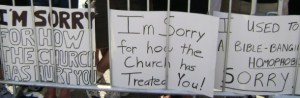
Marin Foundation photo of signs at Chicago Pride parade

I’m a pastor. But there are days when I wonder whether I belong in the Christian Church, whether I’m really a Christian. Ever wonder that about yourself? Or have you left the church as a matter of dissent, embarrassment, or protest?

Take the last two weeks. President Obama shares his faith at a National Prayer Breakfast. He declares that we are “our brother’s keeper”. I feel proud. The comments on CNN run heavily against him. Ayn Rand’s “the virtue of selfishness” – not the story of Cain and Abel or the teaching of Jesus – has won the hearts of the people. Rick Santorum tells an Ohio audience that Obama’s agenda is based on “some phony theology, not a theology based on the Bible.” I feel sad…and angry. I read the story about the church court case of the Rev. Jane Spahr, a lesbian Presbyterian minister rebuked for officiating at same-gender marriages, one of them the wedding of Lisa Bove. Lisa was an ordained student elder at the church I served at The College of Wooster. She went on to seminary and was ordained a Minister of Word and Sacrament. I feel proud of Janie and Lisa, their tenacity, their courage, their strong and gentle spirits, their deep faith. I feel sad that the church still doesn’t get it.

I’m embarrassed by how ridiculous the church debate is and how absurd this church family feud looks to the world. I want to withdraw, pull the covers over my head, go to sleep, take a sedative maybe. But I’m also angry. I want to fight. I want to weigh in on the debate. Yet to do so will only continue the polarization, the disrespect for others, the tendency on all sides of a church argument to proclaim with Little Jack Horner, “What a good boy am I!” If I stick my thumb in the pie, I’ll just continue the ludicrous display of Christian arrogance. What to do? To keep silence feels like abdication of conscience. To speak adds my voice to the appearance of the church’s absurdity. But I’m give fan of the Theater of the Absurd and Albert Camus, as well as Jesus.

I decide to stick my thumb in the story. My comment is the first thumb in a hot pie:

“I know Jane Spahr and Lisa Bove as colleagues and love them both. Lisa was a student leader at the Westminste­r Presbyteri­an Church at The College of Wooster where I served as Pastor. Jane is that rare minister of the gospel who has managed to remain gentle and bold, acting in conscience and ecclesiast­ical disobedien­ce without becoming hard or cynical. Lisa is the same. When you’ve been working for GLBT full inclusion as long as Jane and Lisa, that’s a testimony to their soulfulnes­s. For Jane, Lisa, and so many of us, the Bible calls disciples of Jesus to live in love and to be advocates for justice. The Presbyteri­an Church (USA) last year restored an older principle of church order that removes the restrictio­n against ordaining GLBT members. The issue of marriage remains contentiou­s in the church, as it is in the society as a whole. Some pastors have declared that until church and civil law permit them to officiate at same-sex marriages, they will not marry anyone as a witness to justice. Jane and Lisa are sweet, sweet spirits whose lives bear witness to justice, love and peace, working from that inner light of courage, conscience and consolation that keeps them sane and strong.”

Three replies come quickly:

1) “You are a faithful and honest servant of God.  It has taken a long time, but every year there are more like you” (i.e., “What a good boy am I Good boy!”); and

2) “Pastors should know and preach the truth of God’s word. Please read: 1 Tim: 3:1-7 and Titus 1: 5-9  When folks go against the truth of God’s word, then they are following deceit and you should know who the great deceiver is”  (“Bad boy! Bad boy!”)

3) “Let’s hope this church sees the light and retracts the rebuke.  And perhaps even apologizes­.”

Then this morning a classmate sends me this story about an apology: “Christian Group Shows Up to Chicago Gay Pride Holding Apologetic Signs“.

Marin Foundation photo of signs at Chicago Pride parade

I wish I’d been there to hold one of these signs.

I’ve experienced the forgiving hugs of gay and lesbian church members like the guy in the underwear. And when I write comment or a commentary like this one, I hear a little voice inside myself: “Good boy! Good boy!” Then, as soon as I feel the relief, I know I’ve fallen into the very self-righteousness I despise in others. “Bad boy! Bad boy!” and I’m back where I started: “God help us ALL!”

Read the story. Ponder it. Then stick your finger in the pie with a comment here on the blog.

Religion and the White House

Gordon C. Stewart          Feb. 14, 2012
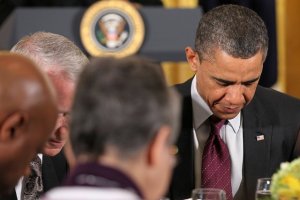
Is the religion of presidential candidates off limits?

President Obama’s remarks at the 2012 National Prayer Breakfast and Mitt Romney’s statement about the poor and the wealthy resurrect a question regarded since 1960 as off the table.

The religious issue in 1960 was the Roman Catholicism of John Fitzgerald Kennedy. No Roman Catholic had ever been elected President. The question was whether a faithful Catholic would be subservient to the Bishop of Rome, the Pope, in matters of state. Finally the question was put to Kennedy himself.

Since that time, with the exception of conservative fundamentalist Christians, American culture has increasingly accepted the separation of one’s religion from one’s politics. Religious faith is regarded as private; political beliefs are public.

The old adage that the way to best assure civil tranquility is to steer clear of religion, sex, and politics is good advice at family reunions and the like, but does it serve the public interests of an informed electorate in a democratic republic?

It should not go unnoticed that then-candidate Obama’s faith was brought into the national spotlight when his political opposition sought to paint Mr. Obama as un-American because of comments made by pastor Jeremiah Wright.

The unspoken journalistic rule that “religion is off-the-table” was set aside by ABC’s investigative reporting into 500 hours of sermon tapes by Mr. Obama’s pastor and its decision to air a one-minute excerpt from one of Mr. Wright’s sermons.

It made no difference that the sermon from which the excerpt came was biblically-based and in the bold African-American preaching tradition of Sojourner Truth, Dr. Martin Luther King, Jr., and Howard Thurman that thunders the Hebrew prophet’s voice in scripture as it apply to today’s news. Nor did it matter that the statement about the chicken’s coming home to roost on 9/11 came after a long recitation of the history of American violence at home and abroad. Mr. Obama’s religion was on the table.

The public wanted to know. Was the President a Christian? Or was he, as some of his opponents claimed or insinuated, a Marxist, a secret Muslim, or un-American?

Mr. Obama eventually denounced the excerpt from Rev. Wright’s sermon, resigned from the church, and used the controversy to spell out his own views in a brilliant speech in Philadelphia on race in America called “A More Perfect Union.”

So here we are in 2012.

Mitt Romney is a member of the Church of Jesus Christ of the Latter Day Saints (LDS), a Mormon. His statement about the very poor, the middle class, and the wealthy became the center of media controversy. “I’m in this race, he told CNN following his primary victory in Florida, “because I care about Americans. I’m not concerned about the very poor. We have a safety net there. If it needs repair, I’ll fix it. I’m not concerned about the very rich, they’re doing just fine. I’m concerned about the very heart of America, the  90-95 percent of Americans who right now are struggling.” To be fair, his statement, like the Rev. Wright’s ignoried his earlier remarks. Nevertheless, the statement deserved careful scrutiny.

At the same time, President Obama’s religion was in the news again because of heavy criticism for connecting his faith with his public policies at the 2012 National Prayer Breakfast  where he described his motivation as “living by the principle that we are our brother’s keeper. Caring for the poor and those in need.”  “These values,” he said, “they’re the ones that have defined my own faith journey.”

In doing so, Mr. Obama voiced a conviction central to the Judeo-Christian tradition. The belief goes to the heart of the Christian faith – the Golden Rule: “Do unto others as you would have them do unto you” and Jesus’ parable of the Last Judgment in which Jesus tells his listeners that, if they want to know where to find “the Son of Man,” they will find him among the poor and destitute (Matthew 25:31-4.).”Insofar as you have done it to one of the least of these, you have done it to me.”

Mr. Obama’s view came under attack from a number of quarters. One response came in the Washington Times with the headline “President Obama misrepresents the teachings of Jesus at National Prayer Breakfast,” arguing that “Jesus did not teach that wealthy people should give more money to the government or charity than others should.” And on CNN on-line, the public comments re: the President’s position ran heavily against his view.

At the same time, Mitt Romney’s stock was rising. So is his religion. Years ago Leo Tolstoy asked the American Ambassador to Russia about the new religion in America, the Ambassador pleaded ignorance, Tolstoy described Mormonism as “the quintessentially American religion” that would one day catch fire and be unstoppable.

Is religion on the table or off the table in 2012? If it’s on the table for discussion, as in Mr. Obama’s Prayer Breakfast statement, the question about the “quintessentially American religion” should also be on the table. How would Mr. Romney’s religious views affect his public policy decisions? What difference would it make to his conduct of foreign policy that his religion is American-centric, believing that “Christ  appeared in the western hemisphere between his resurrection and ascension to heaven; that the State of Missouri is the site of the Garden of Eden as well as the site where Jesus will return at the Second Coming? “For this and other reasons, including a belief by many Mormons in American exceptionalism, Molly Worthen speculates that this may be why Leo Tolstoy described Mormonism as the “quintessential ‘American religion'” (Wikipedia).

One does not need to be a partisan opponent or a despiser of religion to ask whether a candidate for the Presidency believes that America is sacred, God’s chosen people, and if so, what the implications are for how he would use American power and influence in a world that is always just one step away from nuclear holocaust.

It was the pernicious idea of American exemption from the way of the nations that got us into Iraq, and it is the rejection of that idea that has allowed us to begin to pull back into a more humble and realistic way of being America. The idea of American exceptionalism is widespread across party and religious lines in America, and, most sadly, an electorate that fears the future may fall for whichever candidate continues the illusion that America is God.

If I could ask one question to those who aspire to the White House, I would ask them to reflect, line by line, on the Clifford Bax’s hymn (1919):

Turn back, O man, forswear thy foolish ways.
Old now is earth, and none may count her days.
Yet thou, her child, whose head is crowned with flame,
Still wilt not hear thine inner God proclaim,
“Turn back, O man, forswear thy foolish ways.”

Earth might be fair, and all men glad and wise.
Age after age their tragic empires rise,
Built while they dream, and in that dreaming weep:
Would man but wake from out his haunted sleep,
Earth might be fair and all men glad and wise.

Earth shall be fair, and all her people one:
Nor till that hour shall God’s whole will be done.
Now, even now, once more from earth to sky,
Peals forth in joy man’s old undaunted cry—
“Earth shall be fair, and all her folk be one!”

Melody from The Genevan Psalter



“It’s not easy being real”

Last night I listened to President Obama’s speech on contraception and religion institutionso courtesy of Unedited Politics. I then looked to see if there were comments. There was only one:

“This has nothing to do with so called women’s health, it’s Marxism 101.”

With no elaboration as to how or why the President’s speech or position on women’s health care, on the one hand, and religious liberty, on the other, was Marxism 101, the comment accomplished what such comments nearly always do, until they are challenged. It called someone by a name. End of discussion. No need to explain how or why it’s Marxism. “Bad! Boogie Man! Evil in the White House!! The Marxists are out to get us!”? So I wrote my own comment:

Oh, my! Dear friend, whoever you are, you must never have taken Marxism 101. This isn’t Marxism. It’s the work of a democratic republic – messy, balancing values that sometimes conflict with each other, protecting the rights of the minority against the tyranny of the majority, and guaranteeing equal protection (in this case, health coverage) to all citizens. It’s comments like this – confusing a health care position with Marxism (i.e. communism?) – that divert the discussion and take us back to the darkest time of American history, the Senate Hearings of Sen. Joseph McCarthy that painted decent, patriotic Americans as evil. The President is NOT a Marxist, my friend. Time to rescind the comment for the sake of civil discussion that helps to solve real problems.

The reply came soon after:

Try reading his books and consider the fact that he attended a Marxist church for 20 years.

Again, I replied:

I’ve read Marx. I spent the summer of 1966 in Bratislava, Czechoslovakia as the Chicago Ambassador of the Experiment in International Living. I lived with the Schulz family, all members of the Communist Party. Marxism is more than a figment of my imagination. And the church Obama attended is a CHRISTIAN Church, United Church of Christ, one of America’s historic “mainline” denominations. ABC watched 500 sermon videos and chose to air a one-minute clip from a sermon on one of the Hebrew prophets that led viewers to conclude Jeremiah Wright was a communist. Radical? Yes. Off the wall? Sometimes. But Marxist (i.e. not Christian, not a disciple of the Jesus who turned over the money-changers tables)? No. And to talk about this President as a Marxist is…go back and watch Joe Welsh’s final rebuke to the character assassination campaign of Sen. Joe McCarthy: “Have you no decency, Sir. Have you no decency left?” Please think twice before raising McCarthy’s ghost. It’s ugly.

In 1966 I was certain that my finalist interview with the selection committee of the Chicago Chapter of the Experiment in International Living had disqualified me as a candidate as Chicago Ambassador to Czechoslovakia for the summer of ’66.

“You’re a Christian and a seminarian, asked Paul Harvey. “Why would you want to go to a communist country?”  I responded at some length that I didn’t trust the stereotypical representations of Eastern Bloc countries any more than I would trust their representations of the West. I felt there was propoganda on both sides of the Cold War. I wanted to see for myself.   I also told them that there was a theologian in Czechoslovakia named Josef Hromadka, the father of Christian-Marxist dialogue. I had been reading Hromadka and others and wanted to participate in this discussion. I believed that the Marxist classless society was a rendition of the central biblical message of the Kingdom of God. I came out of the interview and said to another candidate, “Well, I just eliminated myself. Hope you have a great summer.”

To my surprise, they selected me. The generosity of Pan Schultz and Pani Schultzova, their son Vlado and daughter Jana who welcomed me like a member of their own family, conversations with students about Franz Kafka and the existentialists at the university coffee shop, and the ugliness of fellow-American Ambassadors (there were 11 of us) who insisted on ice cubes in their drinks combined to further open the aperture of my camera lens as I look at the world.

I decided long ago not to keep silent when the labels like “Marxism 101” march across the field of my camera. My experience is only mine, but it’s the only experience I have, and God knows how limited it is. But, I decided to to heed Frederich Buechner  counsel – “Listen to your life”, he wrote – and to speak out loud what I see and hear, hoping and praying, as I do every Sunday morning before I dare to preach, that in some inscrutable way, “the words of my mouth and the meditations of all of our hearts will be pleasing in Thy sight, O Lord, our Rock and our Redeemer.”  I’d love to hear your meditations. Leave comment to share.

Deadly Political Rhetoric

When Political Rhetoric Brings Out the Worst in Us

by Gordon C. Stewart, March 29, 2010

Click the title for full commentary published by Minnesota Public Radio) Here are some Excerpts (Opening and closing paragraphs):

Our nation is being poisoned by inflammatory rhetoric from both sides of the political aisle. How else does one explain the sending of a used condom to a Minnesota congresswoman, or the phone message left on  Rep. Keith Ellison’s answering machine: “Timothy McVeigh said dead government workers are good government workers.  Goodbye, Sambo”? And that’s just here in Minnesota….


 Where are the likes of Edward R. Murrow and Joseph Welsh now? We need them again.