You should be ashamed of yourself!

Ever want to say OUT LOUD how you REALLY FEEL and why … without self-censorship?

Carolyn sent this to every Senator who voted against “gun safety” in the U.S. Senate.

Gun SAFETY

The Second Amendment to the Constitution was written by men whose notion of “gun” was a musket needing reloading after each shot.

With your recent votes on gun safety, you represented the interests of manufacturers of guns and ammunition, and voted against the safety of Americans, as well as against the expressed wish of 84% of us. You also spit on 26 graves in Newtown, CT, and on those of many, many thousands of other victims of gun violence.

You put forth high sounding phrases, and tell lies about the effects of the bills, but we know that your sole motivation was and is to keep collecting legalized but still immoral bribes from the gun manufacturers and to keep the votes of those few Americans who either think serious differences of opinions are best resolved by violence or threats of violence, or the subcategory who think they some day may need to solve differences of opinion with our democratically elected government by armed insurrection — that is, treason.

To be sure, very many (not all) Senators bury their dead consciences before taking the oath of office, and you are clearly one of the many who did. Therefore it behooves me to remind you that you should be heartily ashamed of yourself.

Carolyn and I went to Kindergarten together. Our families were closest of friends. She is now retired from the University of Pennsylvania Music Library, well-versed in the do’s and don’ts of ascribing motives. Carolyn is also VERY polite; her speech is routinely moderate and carefully considered, but she decided on this one to throw caution to the wind.

“I’m certain it changed no minds,” said Carolyn’s email to me, “but it was a relief to me somehow to ‘tell them off.’

“I sometimes quarrel with myself about things in it like ascribing motive — “…we know…”. But it certainly is how I feel. …[T]hen I reassure myself — there are many who make the same assumption. What’s more, I think it is a fair one.”

When you look at the fact that the 45 U.S. Senators who voted against “gun safety” received in excess of $8,000,000 in campaign contributions from the NRA and gun manufacturers, it’s hard not to go where Carolyn went. These Senators know that the Second Amendment would not have been breached by the bill sponsored by their two courageous Senate colleagues who chose to do the right thing despite their A ratings from the NRA.

Out of the Mouth of Woodbine Willie

“Woodbine Willie” is a strange name for an Anglican priest. The nickname was given to

G. A. Studdert Kennedy (18813 - 1929)

G. A. Studdert Kennedy (1883 – 1929)

G. A. Studdert Kennedy (1883-1929) by the battered troops of the British forces to whom he ministered in World War I.

The name came from the “Woodbine” cigarettes he gave to the troops. Woodbine Willie grew up among the desperately poor. He had two great passions: the church and social reform. He never winced and, oh, how he was loved by what were then known as “the common people.” He was a fighter for social justice and human rights, but he also advocated civil conversation, what he called “a plane” upon which people of differing views and good conscience would come together to resolve a problem.  Think about the current national debate in the wake of the tragedy at Newtown.

There is, and there must be, a plane upon which we can think and reason together upon questions arising out of our wider human relations, social questions, that is, apart from and above party prejudice and sectional interest. If it is not so, and there is no such plane, and we can not think of these big questions outside the prejudices and passions that arise in party strife, then it is safe to assert that there will never be any solution of the problems whatsoever. The idea that politics in the true sense – that is, the art of managing our human relationships on a large scale – must remain a separate department of life, distinct from morals and religion, is ultimately irrational and absurd, and is an idea with which no  responsible teacher ought to have anything to do. – Sermon, “The Church in Politics: a Defense”

Tomorrow night, Tuesday, Feb. 5, Shepherd of the Hill Presbyterian Church in Chaska will do its best to provide “a plane” for reasonable discussion of the epidemic of gun violence in America. 7:00 – 8:30 PM. Hope and pray that it be an evening where we step back to discuss “the big questions outside the prejudices and passions that arise in party strife.”

Critique of American Exceptionalism published today by MinnPost

MINNPOST published “In the 2012 race for the White House, Is religion fair game?” this morning. Click THIS LINK to read the piece on MinnPost.com.

The first commenter on MinnPost didn’t like it. Here’s the comment:

September 5, 2012 – 8:21am.

but you’ve overlooked the obvious.

This nation was founded on the principle of religious liberty.  The Declaration of Independence mentions God four times and describes the uniqueness of America in that, unlike Europe, where power flows from God to the Throne to the People, in America “we are endowed by our Creator” … power flows from God to the people and then to government.

The issue of religion in this campaign hasn’t been about whether the Mormon practice of tithing is one this society should consider adopting (“If 10% is good enough for God it should be good enough for government.”  –  Romney gave $4 million to the church last year) or whether Obama’s connection to black liberation theology and its demand for “social justice” is compatible with a free society.  No, it’s been more basic than that.

When Paul Ryan reminded us in his acceptance speech that “our rights come from God,” leftwing websites and TV talking heads took issue with that.  Some even expressed outrage as if they’ve never read the Declaration.  They insisted that our rights come not from God but from Government!

And as if to formalize their party’s transition to secular humanism this week, we’ve learned that the democrats have removed any mention of God from their party platform.

So the discussion of religion IS fair game in this election, but not in the minutiae that you suggest, but whether the majority of the citizenry even understands that our founding was based on religious liberty and inalienable rights and is codified in the Constitution that exists to protect them, because frankly, Reverand, I’m beginning to doubt it.

Leave your own comment on the MINNPOST site or here on Views from the Edge. See previously published commentaries on the intersection of religioin and politics, and American exceptionalism on Views from the Edge for more on the subject

Is religion fair game this campaign season?

Is religion fair game in the campaign for the White House and in American electoral politics generally?

The question put to John Fitzgerald Kennedy in 1960 about his Roman Catholic faith led to a long period when a line was drawn between religion and politics. Religion was a private matter; politics was a public matter. Aside from the  occasional story about church attendance and Jimmy Carter’s statement about lusting in his heart, religion in the White House and in American public life was considered off the table of public scrutiny.

Questions about candidate Barack Obama’s religion in the campaign leading to the 2008 election changed that. The attacks came from two sides. One attack alleged that Sen. Obama was a secret Muslim; the other doubted the genuineness of his Christian faith and insinuating that he was a secret Marxist. After the one-minute excerpt from one of Rev. Wright’s long sermons went viral on the internet and on the evening news, the question was whether Sen. Obama agreed with Mr. Wright that on 9/11 “the chickens had come home to roost.” Religion had suddenly re-appeared from the shadows of American public life. The Obama campaign stumbled at the development but quickly recovered when the candidate himself dissociated himself from Rev. Wright’s views and effectively articulated his own to the satisfaction of the American people, followed by a masterful speech in Philadelphia about race in America.

In the 2012 campaign for the White House, do we consider religion as fair game for the public’s right to know, or are we better advised to return to the 48 year hiatus between 1960 and 2008?

Mr. Romney is a Mormon, a leader in The Church of Jesus Christ of the Latter Day Saints (LDS). One can argue that his religion should not be a factor in voter decision-making. The distaste of the impugning of John Fitzgerald Kennedy’s fitness for office led, in part, to a hands-off position. Religion in American public life is regarded as a question of one’s preference of cuisine. It’s a matter of personal taste. Religion is about opinion, not truth or reality itself; one person’s opinion is as good as another. For some of us, all that matters is that a person be “religious,” while, for others, religious adherence represents a failure of intelligence. But for all of us in America, tolerance is the virtue that glues together a pluralistic democratic republic. We are not a theocracy. We are a pluralist society where personal freedom is honored, especially in religion.

Is there not, however, something missing in a complete divorce between religion and politics? More than that, the idea of the divorce is based on a shallow definition of religion as professed creed rather than beliefs one practices daily in personal and public life.

There is an underlying “civil religion,” as Robert Bellah described it, which binds Americans together. At the core of it is the conviction, spoken and unspoken, that the United States of America is the exception to the way of history: the rising and falling of nations. America is the exception. We are proud people. We love our country. Whether or not it is spoken aloud, the ideas of the chosen people and the city set on a hill –a peculiar nation with a manifest destiny to bring light to the rest of the world – is the central belief of American civil religion. It is a peculiar unexamined and mostly un-articulated rip off of the biblical call to Abraham. The allusions to it are mostly between the lines. Sometimes, as in electoral campaigns, it is actually said out loud, and in such times we get to ask whether that is what we Americans really believe…about ourselves, about other nations, and about God.

Listen to the speeches. The idea of American exceptionalism (the idea of singular “election”) runs like the mighty Mississippi through the justifications and rationales for American religious, economic, and military expansionism from the earliest days of westward expansion to the “pre-emptive war” in Iraq and the crusade to bring democracy to the Middle East. Anyone who disagrees is a pagan, part of an Axis of Evil.

The subtle and not so-subtle synthesis of religion and politics that comprises American civil religion has always been a fact of the American ethos. In that sense, religion is always at work in American public life. The only question is whether we are willing to re-examine what we believe as a people.

It is not just agnostics or atheists who take offense at this marriage between religion and politics, the divine and the human, the divine and the chosen people. For Jews, Christians, and Muslims the idea of national exceptionalism lifts the nation to the place of an idol of worship that usurps the mystery and majesty of God and the universality of the Creator’s love

Institutional religion and the American civil religion alike inform, shape, and sometimes determine how a candidate will exercise the duties of elected office.

Gov. Romney, a Mormon, and President Obama, a Christian, will represent their parties on the November ballot. The question for the American electorate is not whether the candidate is Mormon, Christian, Jewish, Muslim, or none of the above. The question is how the candidate’s religious beliefs inform how he will conduct domestic and foreign policy in a world increasingly suspicious of America’s belief in its unique divine call and destiny. The Oval office is where those dreaded decisions are often made.

On the road to the White House, President Obama has discussed publicly how his faith plays itself out in public policy. Governor Romney has yet to discuss with the American people how his deepest beliefs will inform the exercise of his duties of office, should he be elected President in November.

The closest one gets to hearing or seeing his core beliefs are the frequent moments when Governor Romney deflects a question by proclaiming how great a country this is and telling us how much he loves it. Which may be a clue to what he most deeply believes. We won’t know until we ask.

Nothing better fits the ideology of American exceptionalism than Mormonism, an American-centric religion that sees the Americas as the geographical center of history itself: the location of humanity’s origin in a real Garden of Eden alleged to have been in the State of Missouri and the place where Christ will come again at the Second Coming.  Human history – from the beginning to the end – is a peculiarly American story.  America is Alpha and Omega, holy ground in a profane world. Such a view explains, in part, why the Church of Jesus Christ of the Latter Day Saints is the fastest growing religion in the United States. It puts in the open the unspoken doctrine of America civil religion that sees America as God’s chosen people.

A great fear of people from other nations and cultures is whether the American people will elect whichever candidate for the U.S. Presidency shouts “Yes” the loudest. Galileo challenged the anthropocentric belief that the sun revolved around the Earth. The church found him guilty of heresy. The question now is whether we will continue to believe the myth that the world and the universe itself revolve around America. Every four years we Americans have the opportunity to reflect critically on what we do and do not want to say about ourselves, our neighbors, and the Divine.

A thoughtful, vigorous debate, led by a dogged free press, offers the best hope for an electorate prepared to meet the complex challenges of the world in the 21st Century. The world is watching, and the planet itself is waiting to see what we do.

Religion, in the broadest sense, is not only fair game. It is the game.

Campaign ads and the Snake

Karl Rove

Remember Karl Rove? He’s still around.

“American Crossroads” produced a campaign ad that speaks volumes about how far the Far Right will go to shape American voter opinion leading to the November election. Thanks to Unedited Politics for drawing attention to the ad.

Watch the ad, draw your own conclusions, read my comments below, and leave your comment. Or Re-Post this to further the discussion.

To waTch the add CLICK HERE.

When you put together the mind of Karl Rove and the money of the Koch Brothers, THIS is what you get: an ad that appeals to the basest fears and prejudiced of those in the general public who prefer willful ignorance and demagoguery to truth and civility. This is an exercise in the slanderous politics of character assassination that has produced such wide-spread cynicism in America.

Did you notice that the words PUBLIC EQUITY” are in RED?

“American Crossroads” is a Super PAC that cares nothing for public equity. It manipulates facts to give the impression that it cares about the 99%. It doesn’t. It cares nothing for “the little people.” It cares about power. It protects privilege.

This ad is what American Corssroads” is about – racist innuendos (the President’s head shucking and jiving like a rapper or a bobble head doll); twisting or making up facts (i.e. blaming the economic crisis on President Obama when, in fact, it landed on his doorstep as a result of the previous Administration’s failed oversight of financial institutions and financial markets; alleging that the auto  industry bailouts and stimulus package killed American jobs and sent them overseas, when, in fact, it saved and created American jobs).

But the question is not about the bailouts that are now widely unpopular. The question here is more basic than any policy: “Are we, the American electorate, wise enough to recognize the hiss of a snake when we hear it.” If not, the snake wins. If Yes, we win.

This afternoon, Views from the Edge will re-publish “The Language of Demagoguery” on the Gingrich memo that became the Machiavellian guide to public control.

Sojourners publishes again today

Sojourners today re-published “A Song for Each Kind of Day” on their blog – “God’s Politics: a blog with Jim Wallis and friends.” Click HERE to see it on their blog.

Yesterday they picked up “I Wish We Were All that Crazy.”  Click HERE to see it.

Thank you, Sojourners – and thank you Steve Shoemaker for the heart of the piece.

Minnesota Public Radio News Commentary Today

Minnesota Public Radio for publishing this today. Click on They say politics ain’t beanbag; Marlins manager finds out why | Commentary | Minnesota Public Radio News.

The Religious Parade: Unreal and Real

Click HERE to read and view the photos of religion on the campaign trail in Michael Gerson’s opinion piece in this morning’s Washington Post. Comment below to generate the discussion her.  But…before you do…ponder Steve Shoemaker‘s “The Donkey”  sent to me this morning in preparation for Palm/Passion Sunday.

THE DONKEY (A Children’s Verse)

The coats the folks are throwing down

sure make it hard for me to walk

especially carrying this clown

whose feet are almost to the ground.

“Hosannah King!” is all the talk,

but this guy seems to be as poor

as I am–no one could mistake

him for a Royal–he’s just a fake!

They wave palm branches, and they roar,

but my long ears can hear the real

parade across the city square:

the General, the Priests, the score

of war horses–the whole grand deal.

This pitiful parade will fail

to save a soul, and soon the yell

will change from “Hail!” to…”Kill!”

Throwing Up in the School Cafeteria

Gordon C. Stewart          Feb. 28, 2012

“It makes me want to throw up!”

Nothing causes indigestion more than a food fight over religion and politics. Just because there’s a food fight in the school cafeteria doesn’t mean we should join it.

The 2012 election is shaping up as a battle over religion and the state. But the battle is ill-framed, using a shotgun that sprays everywhere.

The failure to differentiate the issues is widespread in the thinking of the candidates, their supporters and detractors, and news media that are increasing driven by sensational sound-bites that increase viewership and profits than by professional journalistic standards that would help clarify the debate.

Take Mr. Santorum’s statement on ABC’s “This Week” when asked how his faith fits in with his ideas about governing. He referred to then-candidate John Fitzgerald Kennedy’s speech affirming the absolute separation of church and state. The speech, he said, makes him “want to throw up.”

“I don’t believe in an America where the separation of church and state is absolute,” he said. “The idea that the church can have no influence or no involvement in the operation of the state is absolutely antithetical to the objectives and vision of our country.”

There are three separate issues here: 1) the role of religion in shaping public policy; 2) the role of a candidate’s personal faith in the exercise of the duties of elected office in a democratic republic; and 3) the wall of separation between church (institutional religion) and the State.

The question was not about church (i.e. institutional religion) and state. It was issue #2: how the candidate’s faith/religious convictions would influence the way he would govern, if elected President of a pluralistic democratic republic.

“To say that people of faith have no role in the public square? You bet that makes you throw up. What kind of country do we live that says only people of non-faith can come into the public square and make their case?” Santorum asked.

In that respect, Mr. Santorum is correct. For the public or a candidate to assume that it would make no difference would assume that faith and religion are strictly private, personal matters, while politics is a public matter. But as theologians, ethicists and critics of religion like Bill Maher agree, that’s not how it works. What we believe privately informs and drives what we do publicly, whether our personal convictions are religious or some version of secular humanism.

The cross-over between these core convictions and public policy is too important to ignore. The “culture wars” are real. The definition of marriage, the rights of women v. the rights of the unborn, institutional principle/conscience (e.g. contraception) and health care, the value of public education, end-of-life decisions, war and peace, workers’ rights, America’s role in the world, the distribution and re-distribution of wealth, wealth and poverty, and capital punishment are public issues hotly debated by an electorate whose varying religious and secular convictions place them front and center on the national agenda.

The genius of the U.S. Constitution lay in its framers’ ability to differentiate  between individual faith and institutional religion when it comes to matters of State.  What was later described as the “wall of separation” between church and state was, in fact, a wall that prevents the establishment of any one religion as the religion of the State. That is to say, the United States of America was not and would never be a theocracy. It would bea secular democratic republic which respected the free exercise of religion, whatever its stripe.

The founders were also clear that the success of the experiment in representative democracy rested on its citizens being what John Adams called “a moral people and religious people”  instructed in civility and committed to the search for goodness and the common good. They drew the line between the State and institutional religion to protect the republic from the horrors they had witnessed when the two had merged in the attempted theocracy of the Massachusetts Bay Colony, and to protect the free exercise of religion from the restrictive powers of the State.

In that sense, all three questions are fair game. Given the current food fight, the question is not whether to keep all such discussions out of the school cafeteria. Only when we, the electorate, inform ourselves of the nuances of the debate, will the cafeteria be more civil and the candidates stop throwing up in public because they swallowed the wrong question.

Elie Wiesel on Mormon Proxy Baptisms

Elie Wiesel, Nobel Prize and Pulitzer Prize winning author and survivor of the Holocaust, has called on Mitt Romney to join him in calling on the Church of Latter Day Saints (“Mormons”) to stop baptizing Jews who have died.  I wrote the following comment on the Huffington Post story:

We’re taught, and rightly so, to be respectful of religions and views different from our own. But that does not erase the responsibility to think critically about one’s beliefs and practices or those of others. I have the greatest respect for Elie Wiesel and am grateful to him for exposing a practice that insults every Jew, every Christian, every Muslim, every Buddhist, everyone who could not in good conscience embrace any religion at all, by imposing Mormon baptism. Nothing could be more arrogant. The proxy baptisms are not the only beliefs and practices that deserve thoughtful examination. More troublesome to me is the underlying Mormon assumptions that make the United States of America the very center of all human history – the alleged geography of a real Garden of Eden (in Missouri) and of the Second Coming of Christ (also in Missouri). As much as the proxy baptisms, those beliefs should send chills down the spines of everyone whose God belongs to no one nation, no one culture, no one religion – the God of the heavens and the Earth “Whose ways are not our ways and Whose thoughts are not our thoughts.”

An earlier commentary on the matter (posted earlier) addresses the matter moer fully. It’s a reflection that includes a visit to the Mormon Visitation Center in NYC. Let me know what you think.

The God of American Exceptionalism

Gordon C. Stewart          February 7, 2012

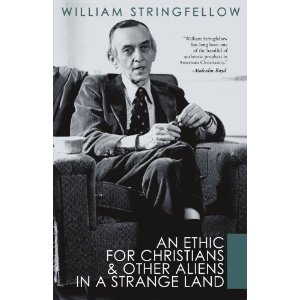
Jacket of My People Is the Enemy

“The stairway smelled of piss….

This [a tenement apartment in East Harlem] was to be my home.  I wondered, for a moment, why. Then I remembered that this is the sort of place in which most people live, in most of the world, for most of the time. This or something worse. Then I was home.”  – William Stringfellow, My People Is the Enemy: An Autobiographical Polemic.

I’ve been holding my breath, wrestling with whether to speak aloud what I hear and see.

I’m a disciple of Jesus, a Christian, in the debt to the bold witness of the late William Stringfellow, lay theologian. I’m also a religious pluralist. I believe with Chief White Calf of the Blackfeet that there is not just one way, there are many sides to the mountain and many paths on which the Divine Mystery is experienced.

I have learned over the years to respect the multiplicity of ways different sides of the mountain experience the living God. I work hard to understand my Hindu, Buddhist, Muslim, and Jewish neighbors. I often experience these discussions as encounters with God whose vastness, like the ocean, is so much greater than any of the tea cups in which we hold a few drops of the sea.

I also know that some forms of religion are just plain nuts. The religion of Jim Jones whose followers drank the purple Kool Aid in shared suicide in the jungle of Guyana is only the most ludicrous example of why we need to join comedian Lewis Black’s raging objection to political distortions of the truth: “You can’t just make s—t up!” Religion represents the best and the worst of the human psyche (the Greek word for ‘soul’).

Joseph Campbell, among others, long ago opened the aperture on my theological camera. He helped me to see that what we are all dealing with, on all sides of the mountain, is myth, the human spirit’s uniquely creative meaning-making activity that expresses both the grandeur and the terror of finite experience. Myth is not the opposite of truth; it is the story that points us beyond ourselves to the transcendent and the eternal.

My way of looking at the world is shaped by a vast variety of voices. Among them are Fyodor Dostoevsky, Friedrich Nietzsche, Franz Kafka, Jean-Paul Sartre, Albert Camus and Dietrich Bonhoeffer, whose experiences of the horror of the absence of God caused them to poke their fingers in the eyes of prevailing religious traditions whose tidy moral worlds turn God into a cosmic sadist.

Any religion worth its salt in the 21st century has to pass through the existential protests of these thinkers and of the shrieks and cries that still echo across the world from Auschwitz and Buchenwald that poke holes in every theory of a morally ordered universe. The Garden of Eden was lost a long time ago and, in the wake of the closing of the gates to it, any religion has to take account of the human history that looks much more like the trail of tears paved by Cain’s slaying of Abel than like two innocent people in Paradise before the fall.

Yet there is a deep longing for something more tangible, more trustworthy than myth. Something one can touch, see, feel, smell – a story that is not a story but fact. The longing is strongest when we experience great uncertainty and insecurity.

With this perspective, I have been looking again at the fastest growing religion in America, Mormonism, and the Church of Jesus Christ of the Latter Day Saints (LDS).

My first experience with the Mormons came quite by accident thirty years ago. I was riding a bus in New York City on my way uptown to visit African-American theologian James Cone at Union Theological Seminary in Harlem when I noticed the sign “Mormon Visitation Center.”  Already stressed by an unfamiliar transit system and feeling quite alone, I decided to get off the bus and take the tour.

Unlike the streets outside that were filled with trash and lit by flashing neon signs, the Visitation Center was spick-and-span. Everything was in perfect order, complete with a hologram of a Mormon family in a tranquil woods sitting in a circle, listening to the white upper-middle-class family’s father sitting on a stump higher than the other members of the family, reading from the Book of Mormon to an enthralled wife and two perfect, obedient, happy children. The hologram elicited two responses. One was amazement. I had never seen or even heard of a hologram. The other was a sense of outrage at the perpetration of a promise that was, in short, nothing but a hologram, the illusionary projection of someone’s idea of Eden that would strike a chord with visitors who long for the lost woods of the Garden of Eden. It offered a world of perfection: orderly, tidy, white, rural – nothing like the urban world on the street outside – the antidote to the realities and complexities of life in New York City.

When I left the Mormon Visitation Center it never crossed my mind that the Mormon vision or mythology would become the fastest growing mythology in America in the 21st Century. I was relieved to get back on the bus on my way to Harlem.

I ask myself now why this is so. I look again at Mormon beliefs and practices to try to understand.

In Mormon teaching, the Garden of Eden was a historical place, and it was not in the Mesopotamian Valley by the Euphrates River, as in the original biblical myth of Genesis. It was in North America…in Missouri .

“According to Joseph Smith [Mormonism’s founder] the Garden of Eden was located in Jackson County, Missouri and following his expulsion from the Garden, Adam traveled northward to a place near modern-day Gallatin, Missouri. Mormon Apostle Orson Pratt stated that the name Adam-ondi-Ahman “is in the original language spoken by Adam, as revealed to the Prophet Joseph” (Journal of Discourses 18:343) – Bill McKeever, Mormon Research Ministry.

It is to this very spot of physical geography that Jesus will return at the Second Coming. None of this is in the realm of myth. It’s fact. You can go there to touch it and  walk on it, knowing that Adam was there long before you and that, after you have walked there, it will prove to be the epicenter of the universe, the very spot where Christ will return.

Why is the Mormon myth gaining such traction in America? And why would I break the code of silence, the well-advised reticence to those of us who share White Calf’s belief that the Divine Mystery is known differently on different sides of the mountain?

Some things are too important to leave unaddressed. The Mormon mythology is quintessentially American.

The myth that America is the center of transcendent goodness and power, the world’s epicenter, the original Garden of Eden and the place of Christ’s return, the people of “Manifest Destiny”, the one exception to the rising and falling of empires and nations, is losing its hold on us at home and abroad. We are losing our sense of innocence. Yet there lurks the nostalgia for the secure home provided by the illegitimate marriage of Jesus’ gospel of the Kingdom of God with America, “the City set upon a hill” of Jesus’ Sermon on the Mount and of John Winthrop’s sermon to English settlers on their voyage to the new world.

As Nietzsche knew, such gods don’t die easily, even when they’re already dead. When the town crier takes his lantern into the darkened town square at midnight crying “God is dead! God is dead!” in Nietzsche’s Thus Spake Zarathustra, the rest of the town regarded him as a madman. But it would be only a matter of time before the news would reach their ears.  It was the god of Western civilization that Nietzsche’s madman pronounced dead.

When something dear to us dies, especially when it is the prevailing religious myth of a nation about its own holiness and invulnerability, we become like starving people who continue to look in the same old bare cupboard for bread.

What better place to go than the reassurance that America is still the center – the ancestral home of a real man named Adam, who came complete with his own (now lost language, the special place to which Jesus (who visited the lost tribe of Israel in the Americas between his resurrection and bodily ascension into heaven) will return? When the Christian story the story is concretized to a finite, mortal place, it power as myth – pointing us beyond ourselves to the transcendent and the eternal – is not only lost but turned on its head.

There are many sides of the mountain, and it behooves all of us to approach people of different religious traditions with open ears and open minds. But approaching another’s religious beliefs respectfully does not require that we pretend not to see what we see or that we conclude that all religions are really the same or that one opinion is as good as another in the free market of religious truth claims. “You can’t just make stuff up!”

Let me say without hesitation that what I see in Mormonism is but the most exaggerated illustration of the idolization of the nation that includes so much of the American churches of whatever stripe where the nation is enshrined as God and where patriotism is the unspoken highest virtue with the cross wrapped in a flag.

The American wars of foreign intervention in Vietnam, Iraq, and Afghanistan could not have happened without this widespread faith in American goodness and exceptionalism. It is the cardinal sin that afflicts us across all denominational and religious lines. Whenever the Jesus executed by the Roman Empire becomes the Imperial King of a new empire, those who continue to hear the shrieks and cries of the world that suffers – and who continue to smell the piss on the stairway in the place we call “home”- are obliged to break the silence, violate the code, and get back on the bus to Harlem.