When help doesn’t come

“If you believe in GOD’s powers and you ask for help and he doesn’t help you right away, it means he believes in you!

It only takes 20 seconds of insane courage to do the impossible.”

– Ruth J., 9 yrs. old.

After worship at Shepherd of the Hill in Chaska, Ruth and Lily hand me their reflections on the sermon – either in words or in drawings and symbols printed on the backs of yellow visitor/prayer request cards. Their insights blow me away. I look at their cards and ask myself, “Why didn’t I think of that?”

Ruth is a young Paul Tillich:

“Faith is the courage to be. Courage can show us what being is, and being can show us what courage is.” – Terry Lectures delivered at Yale University, The Courage To Be, Yale University Press, 1952.

Reflections along the way of a terminal illness

Katie and Maggie sharing a moment of sadness. Maggie knew!

Katie and Maggie sharing a moment of sadness. Maggie knew!

Today, three years to the day after Katherine’s (“Katie’s”) death (May 9, 2010), we inter her cremains.

IT’S RAINING, IT’S POURING” was written the day we learned that Katie’s incurable Leiomyosarcoma had taken a turn for the worse. In memory of Katherine (“Katie”) Elizabeth Slaikeu Nolan.

Gordon C. Stewart Feb. 11, 2009

It’s raining, it’s pouring
The old man is snoring
He went to bed and he bumped his head
And couldn’t get up in the morning

It’s a day like that. I bumped my head on the illness of a 33 year-old loved one. It’s raining sadness. I’m having trouble getting out of bed in the morning.

Terminal illness has a way of doing that unless you believe in miracles of divine intervention or you have extraordinary powers of denial.

My spirituality has become increasingly like that of Rebbe Barukh of Medzobaz, an old Hasidic master in Elie Wiesel’s tale of Four Hasidic Masters and Their Struggle Against Melancholy. When he prayed the customary Jewish prayer, “Thank you, Master of the Universe, for your generous gifts – those we have received and those we are yet to receive” – he would startle others with his weeping. ‘Why are you weeping?” one of them asked. “I weep,” he said, “in thanksgiving for the gifts already received, and I weep now for the gifts I have yet to receive in case I should not be able to give thanks for them when they come.”

For my family at this critical time, the real miracle has already occurred – the shared gift of love – and it will come again in ways I cannot now anticipate when the last page of the final chapter of our loved one’s life is over.

The miracles are more natural, nearer to hand. Although I don’t believe in selective divine intervention, I am on occasion a sucker for denial – except on days like this when it’s raining and gray and I’ve bumped my head on the hard fact that cancer is ransacking my loved one’s body. A certain amount of denial, too, is a blessing in disguise, one of God’s generous gifts to keep us sane when the rain pours down and clouds are dark.

Faith comes hard sometimes. In college mine was challenged and refined by Ernest Becker‘s insistence that the denial of death lies at the root of so many of our problems. My faith has been refined along the way by the courage of Albert Camus and Jean-Paul Sartre to face the meaninglessness of the plague, the faith and courage of Dietrich Bonhoeffer and Paul Tillich who stuck their fingers in the gears of Nazism, and the humble witness of Mother Teresa working in the slums of Calcutta with more questions than answers and some anger at God.

The job of faith, as I see it, is to live as free as possible from illusion with a trust in the final goodness of Reality itself, despite all appearances to the contrary. Faith is the courage and trust to look nothingness in the eye without blinking or breaking our belief in the goodness of mortal life.

When I look into my loved one’s eyes I see that courageous kind of faith that defies the cancer to define her, and a resilient spirit that makes me weep tears of joy over the gifts we’ve already received and the ones we have yet to come.

It’s still raining and it’s still pouring, but I refuse to snore my way through this. I’ve bumped my head on the news of a loved one’s terminal illness, but I’m getting up in the morning.

POSTSCRIPT March 21, 2012

Conversation yesterday about “The List” posted on Bluebird Boulevard:

Karen:

My mother died of cancer eight years ago. Her loss is still visceral. She is in every bird I see.

Me:

The morning of Katherine’s memorial service Kay, Katherine’s mother, was standing by the large picture window gazing out at the pond in our back yard. Out of nowhere, it seemed, two Great Blue Herons flew directly toward the window and swooped upward just before they got to the house. “She’s here. That’s Katie,” said Kay without a second’s hesitation. On her last day of hospice care, Kay and I each remarked that her face looked like a baby bird. I’m a skeptic about such things. I’ve always been, and always will be, a doubting Thomas. My assumptions and conclusions come the hard way. But on the day the herons flew directly at Kay from across the pond, I saw it with my own eyes…and HAD to wonder.

Within a minute a third Great Blue Heron perched on the log by the edge of the pond and stood alone for a LONG time. It reminded me of a gathering on the steps of the State Capitol in Saint Paul following the tragic deaths of school children at Red Lake, MN. The crowd stopped listening to the speaker. They were looking up. “What’s going on?” I asked Richard, the Red Lake American Indian advocate and my co-worker at the Legal Rights Center.org. “Eagles,” he said. “Where?” “WAY up. They’re circling.”

I learned later that the eagles were also circling at that same moment over the grieving families gathered at Red Lake. I asked American Indian colleague what he took it to mean. “We don’t ask. That’s the white man’s question,” he said. “We just accept it. We live in the mystery.”

The First Duty of Love

Paul Johannes Tillich

This morning’s crossword quote is from theologian Paul Tillich:

“The first duty of love is to listen.”

To learn more about Paul Tillich click THIS LINK.

Most weeks I return to the works of Tillich. Paul Tillich has rescued many a faith, including my own, when doubt had been mis-perceived to be faith’s enemy.

“Doubt is not the enemy of faith; it is one element of faith.”

– Paul Tillich, The Dynamics of Faith

Tillich’s statement about faith and doubt go hand-in-glove with listening as the first duty of love. If you missed “Staying Together” on Views from the Edge’s, scroll down.  Steve’s poem puts these two Tillich quotes into practice of listening. Here’s a sip:

“Listen, learn, respect, rephrase, repeat

before you even start to speak.”

Republican Convention Religious Crusade

The rousing video from the Republican National Convention (“Believe”) played like an evangelistic crusade waiting for an altar call.

From the musical crescendos to the hyped voice to the pentecostal elation of the crowd, it was religious to the core. Here’s the definition of “religion” that leads to the claim:

“Religion is the state of being grasped by an ultimate concern, a concern which qualifies all other concerns as preliminary and which itself contains the answer to the question of a meaning of our life.”Paul Tillich

The makers of the video know how quick we are to shed a tear. Especially when at a crusade that plays all the chords of American “civil religion” as argued in the recent “Views from the Edge” post on American religion and American politics.

Tillich was the first professor dimissed from his university teaching position by the  German Third Reich. Like the Germans at the Service Club meeting in an earlier post here, he knew that religion is not confined to the four walls of a church, synagogue, or mosque. It is the state of “being grasped by….”

What “grasps those who viewed the “Believe” video?
A poor attempt to answer the quesiton appeared yesterday (“Believe in America“). The post was too obscure to make its point. Thus, this folllow-up elaboration.
The god of the “Believe” video is America iteself. It is the god of American exceptionalism. The video stirs the heart with the cunning of Kafka’s Green Dragon and the seductive voices of Kafka’s The Sirens who know they cannot deliver what we long for. Their wombs cannot give birth to any kind of future.

The following exchange followed the earlier “American Religion and American Politics” post. Both C.A. and I see the world as the theater of God’s glory but also as the Theater of the Absurd.

C.A. left this comment:

If my small experience is any guide, you may get hammered on this one, Gordon.  When someone has been brought up on American exceptionalism, especially if coupled with Caucasian exceptionalism, and one kind of Christian belief the three can be so ingrown as to be more than subconscious,  virtually unconscious.  Working together, they justify any negative behavior that the person believes, and cause outright rejection of much that he or she hears or reads about as impossible. …

I replied:

C.A., You just wrapped it all up very nicely. Willem Zuurdeeg, a Dutch philosopher of religion, linguistic philosopher and phenomenologist, concluded that our deepest “convictions” are unexamined – below the surface of conscious awareness, so obviously true to us that they are what you call “virtually unconscious.” The compelling conviction hinted at by American civil religion is what Zuurdeeg described as an Ordered Home , a world order. In this case. the world revolves around tjhe doctrines of white supremacy and national supiority. These are the spiritual and moral centers.

“Views from the Edge’s” most popular post is the one about the Germans at the Service Club.  It’s gone viral.

“Five folks from Germany recently visited central Illinois as part of a local service club program to improve international understanding.

At one point they asked me about something they did not understand:  why do Americans begin so many gatherings with a ‘”patriotic” song, the Pledge of Allegiance, and a prayer?

Perhaps especially because they were from Germany, remembering the horrors of two world wars begun partly from excessive beliefs in the superiority of their nation and religion, they were sensitive to expressions of exceptionalism at U.S.A. sports events and service club meetings.

What Tillich, Zuurdeeg, and the Germans at the American service club meeting were seeing was a religious people hypnotized by Kafka’s Sirens and Green Dragon.

Go to yesterday’s post “Believing in America” to see the juxtaposition of the Kafka parables and the Convention video.

Leave your comment or question. And thanks again for visiting.

Glory and Tragedy at Southern Cross

There’s a sermon on Cable Mountain waiting to be preached.

The View from St. Timothy’s Memorial Chapel

Southern Cross, Montana is a ghost town, a former mining community on Cable Mountain west of Anaconda.  It’s also the site of St. Timothy’s Memorial Chapel, a tribute to the glory of God in loving memory of Timothy Dillon Bowman, the 18-year-old son who died tragically in a car accident following his freshman year at Stanford.

St. Timothy’s Memorial Chapel, Southern Cross, MT

Amid the abandoned buildings of the Anaconda Mining Company, one might say that St. Timothy’s Memorial Chapel stands as a witness to 20th century theologian Paul Tillich’s believe that

…[M]an and nature belong together,

in their created glory,

in their tragedy,

and in their salvation.

– Paul Tillich, The Shaking of the Foundations

Here’s the sermon from the pulpit of Shepherd of the Hill Presbyterian Church in Chaska, Minnesota, August 5, 2012.

.

The Ocean and Homeland Security

Will we risk killing the hand that feeds us – the oceans and the order of nature – to insure homeland security?

I’m not a groupie and I’m not a shouter. I’m tired of all the emails telling me that the sky will fall if I don’t do this or that…give $5.00 by midnight tonight or sign the petition. If I don’t act now, Darth Vader will win. Delete, Delete. Trash.

But this morning’s email got my attention. It alerted me to a July 10 deadline for comment on a Navy testing program which, according to the Navy’s own research, will deafen 1,600 whales and dolphins and kill 1,800 more.

ABC News reported the story on May 11:

The Navy estimates its use of explosives and sonar may unintentionally cause more than 1,600 instances of hearing loss or other injury to marine mammals each year, according to a draft environmental impact statement that covers training and testing planned from 2014 to 2019. The Navy calculates the explosives could potentially kill more than 200 marine mammals a year.

The old Navy analysis – covering 2009-2013 – estimated the service might unintentionally cause injury or death to about 100 marine mammals in Hawaii and California, although no deaths have been reported.

The larger numbers are partially the result of the Navy’s use of new research on marine mammal behavior and updated computer models that predict how sonar affects animals.

The Navy also expanded the scope of its study to include things like in-port sonar testing – something sailors have long done but wasn’t analyzed in the Navy’s last environmental impact statement. The analysis covers training and testing in waters between Hawaii and California for the first time as well.

View from house in Sequim, WA

The request to comment took me back to the summer of 2010 when the house we rented for a week on a beautiful salt water lagoon on the coast of Sequim, Washington turned out to be next door to a highly classified U.S. Department of Energy marine research center.Ours was the last house on Washington Harbor Road which dead-ended  200 yards away at the place whose business  was a mystery to everyone in town.

NO TRESPASSING,” read the sign on the security fence.“Marine Sciences Laboratory, Pacific National Laboratory of the U.S. Department of Energy, managed by Battelle. Under 24-hour camera surveillance. Trespassers will be prosecuted to the full extent of federal  law.”
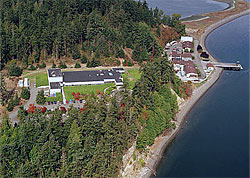
Marine Sciences Laboratory, Sequim, WA

No one seemed to know what was going on behind the fence. ”It’s top secret,” said the townspeople. No one I asked seemed to care. Our rental property was on the lagoon just around the corner on the other side of the sandbar in this photograph of the lab.I wondered then why a marine environmental research laboratory was under the Department of Energy rather than the Department of the Interior. I assumed it must have to do with the development of oceanic energy and sustainability, but wondered why such a facility would be under wraps as top-secret. I also wondered about the manager of the operation, Battelle. Clearly Battelle was one of vast network of private corporations under federal government contract, but what qualified it to manage this research center? What was Battelle?

This morning’s email about the whales and dolphins piqued my interest again. The website for the Pacific Northwest National Laboratory says the following about our Sequim next door neighbor . The bolded print is mine.

The Marine Sciences Laboratory (MSL), headquartered at the Pacific Northwest National Laboratory’s Sequim Marine Research Operations on Washington State’s Olympic Peninsula, is the Department of Energy’s only marine research laboratory. This unique facility and the capabilities of its researchers deliver science and technology that is critical to the nation’s energy, environmental and security future.

Building upon a history of research related to marine and coastal resources, environmental chemistry, water resources modeling, ecotoxicology and biotechnology—and more recently, national and homeland security—the MSL is emerging as a leader in these three areas:

  • Enabling sustainable development of ocean energy
  • Understanding and mitigating long-term impacts of human activities, including climate change, on marine resources
  • Protecting coastal environments from security threats”

There is no way to know whether MLS was part of the Navy own environmental impact study. The Navy is under the Department of Defense. MSL is under the Department of Energy. But the third area of MSL’s “research operations” – “protecting coastal environments from security threats” – and the use of the word “operations” make it a natural fit for such research.

The recent addition of national and homeland security as a third focus of MSL’s research operations increases the likelihood of its being a player in this debate.

Its three areas of emerging leadership lead me to imagine how vigorous the debate would be among the staff behind the fence next door at the end of Washington Harbor Road. Presumably those who work at a marine sciences lab are oceanographers who stake their lives on protecting Earth’s greatest treasure. Introduce national and homeland security – i.e., national defense operations – and one can imagine how hot the debates would be among the scientists weighing the respective mandates to protect the American coast (the Navy program) and to “mitigate long-term impacts of human activities, including climate change, on marine resources” (high decibel sonar signals and explosions that render whales and dolphins deaf, disoriented, dead).

The National Resources Defense Council (NRDC), a leader in the battle to regulate sonar use and protect marine life, reminds us that whales and other marine mammals rely on their hearing to find food, find a mate, and navigate their ocean habitat.

If you’ve ever seen a submarine movie, you probably came away with a basic understanding of how sonar works. Active sonar systems produce intense sound waves that sweep the ocean like a floodlight, revealing objects in their path.

Some systems operate at more than 235 decibels, producing sound waves that can travel across tens or even hundreds of miles of ocean. During testing off the California coast, noise from the Navy’s main low-frequency sonar system was detected across the breadth of the northern Pacific Ocean. …

Stranded whales are only the most visible symptom of a problem affecting much larger numbers of marine life. Naval sonar has been shown to disrupt feeding and other vital behavior and to cause a wide range of species to panic and flee. Scientists are concerned about the cumulative effect of all of these impacts on marine animals.

Even the Navy estimates that increased sonar training will significantly harm marine mammals more than 10 million times during the next five years off the U.S. coast alone.
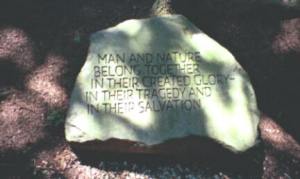
Tillich Park - "Man & nature belong together..."

Tillich Park – “Man & nature belong together…”

“Man and nature belong together in their created glory, in their tragedy and in their salvation.” These words of theologian Paul Tillich greet visitors along the path of Tillich Park in New Harmony, Indiana where Tillich’s ashes are buried.

Tillich loved the ocean. It became for him, as it is for me, a symbol for God. The human attempt to conquer nature would not end in human glorification or to salvation. To the contrary, human arrogance regarding nature portended great tragedy.

A nation that defines its security in ways that kill the whales and the dolphins invites such a great tragedy, biting the hand that feeds us – the ocean on which the planetary “homeland” of every nation depends.

The Moment to Decide

Words are POWERFUL! They shape our most important decisions.

Language is the primary mechanism of mind control: truth becomes falsehood and falsehood becomes truth; beauty becomes ugliness and ugliness becomes beauty; goodness becomes evil and evil becomes goodness, twisted by the language of innuendo and word association.

American Crossroads’ campaign ad (see yesterday’s “Campaign Ads and the Snake”) is a case in point, an illustration of Timothy Egan’s New York Times piece,Deconstructing a Demagogue“:

Back in 1994, while plotting his takeover of the House, Gingrich circulated a memo on how to use words as a weapon.  It was called “Language: A Key Mechanism of Control.” Republicans were advised to use certain words in describing opponents — sick, pathetic, lie, decay, failure, destroy.  That was the year, of course, when Gingrich showed there was no floor to his descent into a dignity-free zone, equating Democratic Party values with the drowning of two young children by their mother, Susan Smith, in South Carolina.

Today, if you listen carefully to any Gingrich takedown, you’ll usually hear words from the control memo.

The cynicism that pervades the American electorate is due, in part, to this demagogic use of language. Words are precious things. Holy things. Sacred things. When they get twisted, they become vulgar and profane, one might even say ‘demonic’ in the sense in which philosophical theologian Paul Tillich defined ‘demonic’ as the twisting of the good.  (Paul Tillich, “Life and It’s Ambiguities,” Systematic Theology, Vol. 1, p. 102).

Paul Tillich was one of the first university professors dismissed from his teaching position during the Third Reich. At the invitation of Reinhold Niebuhr, he came to America where he taught at Union Theological Seminary in the City of New York, Harvard Divinity School, and the University of Chicago.

Tillich and his academic colleagues in theology, philosophy, and ethics (Willem Zuurdeeg, Martin Niemoller, Karl Barth, Dietrich Bonhoeffer, and Elie Wiesel) left us a rich legacy of careful analysis of the demagogic use of language.

Looking at America today, some observers argue that Hitler won his war after all. The Third Reich’s use of language and rhetoric is the substance of Language: a Key Mechanism of Control. The prescription that once led a nation regarded as “the most sophisticated culture” to swallow the toxin of twisted truth is with us still. The poison is peddled as cure and candy by candidates bought and sold by the private corporate powers whose Super PAC ads control our airwaves in America.

American Crossroads, led by the cunning of Karl Rove and the funding of the Koch Brothers and other wealthy Right Wing funders, is a Super PAC whose manual of operations is Gingrich’s memo, “Language: a Key Mechanism of [Social] Control,” renamed here as “Demonic Language: the Work of the Snake.” 

But the snake does not own the garden. Nor is it the author of language. Truth always has a way of peeking out from behind the bushes. And sometimes it cries out loud and clear, as it does from an old hymn I learned in childhood. It sings from the pews and in my heart in the hymn lyrics penned by James Russell Lowell I especially treasure in times when, watching a campaign ad, I need assurance that the snake has not won.

Once to every man and nation Comes the moment to decide, In the strife of truth with falsehood…. Though the cause of evil prosper, Yet t’is truth alone is strong; Though her portion be the scaffold, And upon the throne be wrong; Yet that scaffold sways the future, And, behind the dim unknown, Standeth God within the shadows, Keeping watch above His own.

– James Russell Lowell, 1845

Click to feel the power of the music on Preston Hawes’ violin. 

Stuff

We have so many things

we cannot count them all.

(We’ve added virtual

to piles of actual…)

We’ve had to rent more space–

or buy another house

just to store all our things.

And then we find, of course,

our houses are too small;

we tear them down so all

our stuff, our toys, the things

we bought to sooth our soul

will not have to be thrown

away.  (Because our own

city, village, or town

is surrounded by things

in stinking, seeping hills

of trash, garbage, the frills

we thought were essentials.)

Our hell is filled with things.

– Steve Shoemaker, Urbana, IL, May 9, 2012

“Man and nature belong together in their created glory – in their tragedy and in their salvation.” – Paul Tillich quote on monument in Tillich Park, New Harmony, Indiana.

Paul JohannesTillich's gravestone in the Paul TillichPark, New Harmony, Indiana

Paul JohannesTillich’s gravestone in the Paul TillichPark, New Harmony, Indiana

Inscription on Paul Tillich’s gravestone reads:

 “He shall be like a tree planted by the rivers of water that bringeth forth his fruit in due season. His leaf also shall not wither; and whatsoever he doeth shall prosper.”

– Psalm 1: 3

God above God

A visit to Tillich Park in New Harmony, Indiana, inspired these lyrics. Unfortunately, the blog editing continues to erase the stanza divisions. Each stanza is four lines.

God above God, Source of all Be-ing,

You Whose Name is above all our names:

Help us to kneel; Break down our fences;

Shine through the dark clouds religion has made.

Source of all life, Ground of all Be-ing,

God of the a-corn, the seed and the rain –

Send now your grace, seasons and har-vest,

Circle of life that our hearts have disdained.

Mother of nat-ions, Father of pe-oples,

Known as Allah, Adonai, El-o-him ~

Known, yet not known, Be-yond all perception

But for your grace in all cultures revealed

God of the cross, Life to the pla-net,

You Whom we cross with our gods and our ways –

Raise us to life, breathe now Your Spirit,

Restore us to life as the kin to all Life.

God above God, Source of all Be-ing,

You Whose Name is above all our names:

Help us to kneel; Break down our fences;

Dispel the dark clouds our religions have made.

– Gordon C. Stewart, November 4, 2005

Sung to tune “Dexter”  4.5.7 D with Refrain

http://www.youtube.com/watch?v=aYmXDCTbdak

“God above God” is the language of Paul Tillich for whom God is not a being among others – an object of finitude – but the Ground of Being Itself, the Ground that remains when all of our concepts and idea collapse.

The source of this affirmation of meaning within meaninglessness, of certitude within doubt, is not the God of traditional theism but the “God above God,” the power of being, which works through those who have no name for it, not even the name God.

PAUL TILLICH, SYSTEMATIC THEOLOGY, VOL. 2, P.12

“Man and nature belong together in their created glory – in their tragedy and in their salvation.” – Paul Tillich monument, Tillich Park, New Harmony, Indiana.

The Web of Sanity and Fullness

Pond with morning mist evaporating

Pond with morning mist evaporating

A newspaper reporter asked me some questions. We were preparing for a First Tuesday Dialogues series on sustainability called “The Good Green Earth.”

The series would bring five speakers, including  spokespeople from the Gulf of Mexico deeply engaged in hazard assessment, technology, and recovery in the wake of Deepwater Horizon.

What’s your sense of the possibilities and trends for sustainability in your work now and what does it look like in the future?

I responded that one of my inspirations is Paul Tillich, according to whom:

Being religious means asking passionately the question of the meaning of our existence and being willing to receive answers, even if the answers hurt.

Faith consists in being vitally concerned with that ultimate reality to which I give the symbolical name ‘God’. Whoever reflects earnestly on the meaning of life is on the verge of an act of faith.

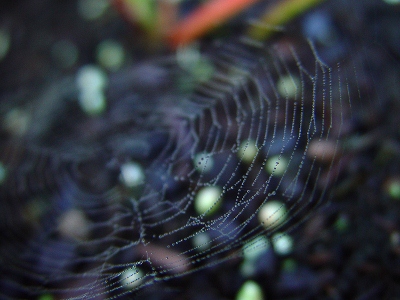
The Spider’s Web with Morning Dew

My calling as a pastor was to help us here at Shepherd of the Hill and here in Chaska literally “go out of our mind.”

Because the collective mind that has delivered us to this place is killing us and destroying the balance of nature.

My calling is to shake us loose from the mental and spiritual chains of species superiority, My calling is to shake us loose from the mental and spiritual chains of species superiority, the mistaken notion that we – humankind – are the exception to Nature.  It’s a call to help re-shape our understanding of ourselves as participants rather than owners, participants rather than conquerors or manipulators, members of a diverse natural order of interdependent life. The spiritual resources are there in Hebrew scripture, in the New Testament epistles to the Ephesians and the Colossians, and in the ancient respectful spirituality of some of America’s indigenous people. By “going out of our mind” we will come back into a the web of sanity and fullness.

What factors do you see pushing towards or against sustainability?

Historian of science and technology Lynn White said flat-out that the root problem of the sustainability crisis is religious or spiritual, and so is the solution.

So, number one, we have to address the old and emerging questions about what Tillich called “Ultimate Reality” and the meaning of our existence.  We have to go into labor to set the new theological and anthropological  paradigm free from of the old destructive thinking.  What we are beginning to find as we go into this spiritual labor is that this more respectful, more holistic way of thinking is not new at all – it’s the older paradigm that got side-tracked by greed and pride.

Building of the Tower of Babel – Master of the Duke of Bedford

God has “come down,” as it were, to frustrate our attempts at building the secure city called Babel; God is making us nomads again who recognize that we and the Earth are already full, not empty. Every settlement comes to nothing. Every tower built as a monument to pride falls. And number two, and I’m afraid there is no other way to say this – we will never make it without leaving behind the economic system of greed. Capitalism is killing us.

The consolidation of wealth and corporate power have a stranglehold on national, state, and local public policy. The members of the boards of the oil companies sit on the boards of General Motors and Ford.  So it’s no wonder that U.S. federal policies on transportation are car-friendly and suspicious of mass-transit, regardless of a car’s gas mileage. Osalescence is built in because you can’t sell something five years from now if the old model is still like new. Our health care and the FDA are in the palm of the insurance and drug company’s so that it’s illegal to go across the border to fill your prescription in Canada.

Finally, the sustainability of the human species itself is, I believe, imperiled by chemical alterations that are meant to do good but that, in the long run, make us biologically less resistant and resilient. Our natural immune systems are being weakened by pesticides in the food we eat and by the pharmaceuticals we ingest from the drug store.

Black tar heroin - U.S. Drug Enforcement Administration

Black tar heroin – U.S. Drug Enforcement Administration

We have become a nation of addicts.  Addicted to illusionary dreams of abundance.  Addicted to prescription drugs.  Addicted to fast food and faster short-term solutions. Even instant gratification is too slow. Controlled by advertizing that sells us prescription drugs that’ll give you an immediate erection but may send you to the emergency room if it last more than four hours,or drugs that may ruin your liver or land you in a casket, and the real pushers are not the petty drug peddlers on Minneapolis’s North Side. The real pushers are legal. They’re given license, while those who would shut them down are looked upon as crackpots and throw-backs who are opposed to progress.

So…what’s stopping real progress, a more Earth-friendly way of organizing human affairs that embraces reality itfself, “Being-Itself”?  The intransigent, legal, institutionalized arrangements of power and money, on the one hand, and our willing compliance with the de-democratization of America that salutes the system of greed. We have to learn again, and we are – very slowly –  pushing and screaming, that “the Earth is the Lord’s and the fullness thereof”. We have turned it over to the forces of greed and destruction.

The Good, Good Earth: Our Island Home

The Good, Good Earth: Our Island Home

We need to recover the gratitude and spiritual paradigm of a natural abundance in order to push against the false promises of those who would have us believe that our lives and the world would be empty without all the stuff that ends up in the landfills or washes ashore in the estuaries of the Gulf of Mexico.

So……Chime in, friends. How would you answer the reporter’s questions?