This sermon connects the interruption of Paul’s journey to Syria with the recent U.S. threat to bomb Syria to destroy evil in the name of goodness.
On the Road to Damascus
Reply

This sermon connects the interruption of Paul’s journey to Syria with the recent U.S. threat to bomb Syria to destroy evil in the name of goodness.
A sermon at Shepherd of the Hill Presbyterian Church in Chaska, Minnesota. It could also be called “Take a Risk – Stand for Something!”
Gordon C. Stewart, August 8, 2013 copyright.
I have always been bemused by time . . . and place. I am on a train listening in the night to the eerie sound of the train whistle and the constant click-clacking of the wheels. Where were we? Where are we going – and why, just my mother and I?
We were between times and places. My father had shipped out for war in the South Pacific. Hewas somewhere on a ship and might not return. My mother and I were on our way from LA to Boston. Two different places: one hours behind, one many hours ahead. But for the time being, there was only the now of the train, the whistle, and the steady clickety-clack from the track carrying us from there to here to there, from then to now to then. Perplexity with time and place is my earliest memory.
We are all in transit. But from where to where and from when to when have become less and less my questions.
I do not share the popular view that time is an illusion or that the material world is the prison from which we will be released at death. Time and place are gifts of creaturely existence, boundaries within which we live our lives appreciatively or scornfully in the midst of the Eternal. To scorn them is to deprecate existence itself in the Promethean hope that we can steal fire from the gods to become what we are not: timeless and placeless.
Time and place are set within the larger Mystery that Rudolph Otto called the Mysterium tremendum et fascinans – the Mystery that makes us mortals tremble and fascinates us at the same time, the Mystery of the Eternal without which we are nothing that draws us to itself like iron to a magnet. Time and place – birth, finite life, death – exist within the Mystery of that which does not die: Eternity.
I am not amused by the denial of death that is so rampant in our culture. Surveys show that roughly 90% of Americans, regardless of religious affiliation, believe in life after death, by which they do not mean that life will go on without them, but that they themselves will never die.
I have come to believe that the denial of death and the fear of death lie close to the core of American culture at its worst. Ernest Becker’s The Denial of Death informs how I see the world and myself; Becker sits beside me as I turn to the Scriptures in the morning.
Psalm 90:1-5, paraphrased by Isaac Watts (1719) and sung as the hymn “O God, Our Help in Ages Past” is as much in my early memory bank as the train whistle on the ride to Boston. It has always represented a mature faith that takes seriously Otto’s Mysterium:
Before the hills in order stood,
Or earth received its frame,
From everlasting Thou art God,
To endless years the same.A thousand ages in Thy sight
Are like an evening gone;
Short as the watch that ends the night
Before the rising sun.Time, like an every rolling stream
Bears all its sons away;
They fly forgotten, as a dream
dies at the opening day.O God, our help in ages past,
Our hope for years to come,
Be Thou our guard while life shall last
And our eternal home.
Standing at the gravesites over the years, I have prayed the same prayer so many times that it has become an essential part of me. I confess that I don’t know what it means exactly but it expresses the sentiment of good faith as I have come to understand it for myself.
O Lord, support us all the day long,
until the shadows lengthen,
and the evening comes,
and busy world is hushed,
and the fever of life is over,
and our work is done.
Then, in Your mercy,
grant us a safe lodging,
a holy rest,
and peace at the last.
The shadows have grown longer since the trip to Boston and the first time I sang the hymn. Evening is closer now. The sense of the Mysterium tremendum et fascinans is different but no less real now than it was on the train to Boston. The hush of the busy world will come soon enough. Between now and the day my work is done, I want to listen more attentively for the Hush in the midst of time, and give thanks that the Silence is not empty. It is full of Eternity. I am bemused by time.
Click O God, Our Help in Ages Past for a video that captures the spirit of the hymn and the prayer.
It’s startling when you see your own name on the obituary page!
But there it is, right there, posted on the internet.
Published in the The Argus on 10 May 13
STEWART Gordon On 3rd May 2013, Gordon aged 86 years. Resident of Sussex Heights sadly missed by family and friends. Funeral Service at Hove Cemetery on Wednesday, 22nd May at 10.00 a.m. (Graveside service) Flowers or if desired donations for the Martlets Hospice may be sent to S.E Skinner and Sons, 145 Lewes Road, Brighton, BN2 3LG Tel. 01273 607446.
Condolences to the family of the older Gordon in Sussex Heights this Wednesday. Some day it will be this Gordon Stewart…with the middle initial ‘C’ on the obituary page, but I won’t be reading it. For Gordon’s family and for all who will eventually stands at the grave, this lovely graveside prayer from The Book of Common Prayer offers consolation and call us to live our days with meaning, thanksgiving, and hope:
O Lord, support us all the day long
until the shadows lengthen, and the busy world is hushed,
and the fever of life is over, and our work is done.Then, in Your mercy, grant us a safe lodging
and peace at the last.
A sermon on forgiveness as releasing or letting go preached at Shepherd of the Hill Presbyterian Church in Chaska, MN April 7, 2013. The sermon is indebted to Professor Robert Kegan, neo-Piagetian psychologist at Harvard University and Professor Mona Gustafson Affinito, Southern Connecticut State University Professor Emerita and author of Forgiving One Page at a Time and other books on the theology and psychology of forgiveness.
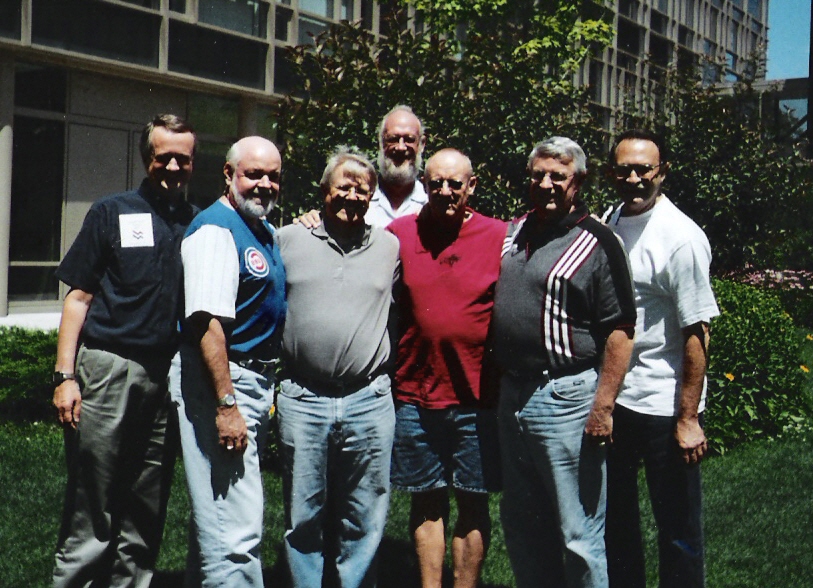
Dale Hartwig (red shirt) and the Chicago Seven Gathering, McCormick Theological Seminary, 2004.
MEMORIAL TRIBUTE to be shared at the Celebration of Life & Victory over Death for DALE HARTWIG
Dale was such a joy for all of the Chicago Seven (now Six). His quiet spirituality brought a stillness to the room, or tears, and so much reality and the tenderness of a poet. The last time all seven of us McCormick alums gathered in Chicago, we sat around a long table sharing our thoughts and work. Dale and I were sitting next to each other, as we often did, at one end of the table. When it came his turn, Dale moved some papers in front of me and asked that his words be read. His contribution, as I recall it, was a Greek exegesis from a New Testament text that reminded us of his love for biblical exegesis, he being the only one of us who left seminary to become more proficient in NT Greek than when we left. His sharing also included a poem he had written. As I read it aloud on his behalf – his surrogate voice – he began to weep because his words had been heard! Here’s the poem in memory of that sacred Hartwig moment – one of many – that the rest of us will forever cherish.
“THE SURROGATE VOICE” – GORDON C. STEWART (WRITTEN IN THANKSGIVING FOR THE CHICAGO GATHERING ’04)
As the surrogate voice reads on,
the author sits and sobs
his wrenching tears from primal depth;
from some abyss of joy
or nothingness…or both.
The author’s sighs and piercing sobs-
arrest routine,
invoke a hush,
dumb-found the wordy room.
He cannot speak,
his Parkinson’s tongue tied,
his voice is mute, in solitude confined,
all but sobs too deep for words.
Another now has become
his voice, offering aloud with dummy voice
the muted contribution
in poetic verse the ventriloquist’s voice has penned.
The abyss of muted isolation ope’d,
his words, re-voiced aloud,
hush the seven to sacred silence, all…
except from him, their author.
Whence comes this primal cry:
From depths of deep despair and death,
from loneliness, or depths of joy
We do not know.
The surrogate voice reads on
through author’s sobs and sighs,
through his uncertain gasps for air
and our uncertain care.
The iron prison gates – the guards
of his despair – unlock and open out
to turn his tears from prison’s hole
to tears of comrade joy.
His word is spoken, his voice is heard,
a word expressed
in depth and Primal Blessing,
pardoned from the voiceless hell.
The stone rolls back,
rolls back, rolls back,
from the brother’s prison’s tomb,
the chains of sadness snap and break!
At one, at one, we seven stand,
in Primal Silence before the open tomb,
as tears of loss, of gain, of tongues released
re-Voice unbroken chords of brotherhood.
In the Company of Hysterical Women from New Zealand published “Live below the Line: Day One” this morning as we in Minnesota, USA are launching a press release to announce the screening of a film on the new face of poverty in America. Click HERE to read In the Company of Hysterical Women’s post.
Here is today’s press release for “The LINE: Poverty in America. It’s not what you think”:
CHASKA, Minn., Sept. 24, 2012 – The new face of poverty in America is the subject of a new documentary film called The Line. The public is invited to a free screening of the movie at Shepherd of the Hill Presbyterian Church in Chaska, Minn. on Tuesday, Oct. 2 at 7 p.m. CST in conjunction with the premiere in Washington D.C. and sites all over the United States.

Logo for “The Line”
The Line is a groundbreaking documentary from Sojourners, a national Christian, non-partisan organization committed to faith in action for social justice, and Emmy Award-winning producer Linda Midgett. It features real people, their struggles, and their inspiring and creative responses to the challenges they face. The goal of the film is to break through traditional political divides, foster honest dialogue, and refocus our society on the common good.
Shepherd of the Hill Pastor Gordon C. Stewart will host a discussion immediately following the 40-minute film as part of First Tuesday Dialogues, a community forum held at the church from October through May each year that examines critical public issues locally and globally.
“Poverty is a faith issue. When I learned about the film I thought we should show that here. It fits our First Tuesday Dialogues program mission,” said Pastor Stewart. “What is more critical than poverty? The middle class has been slipping for a long time now. The problems are structural. Hand outs – traditional Christian charity – don’t address the deeper problem.”
Working through Sojourners magazine, Sojourners’ website sojo.net, public speaking events, media outreach, educational resources, books, advocacy, and trainings, Sojourners is an internationally influential voice at the intersection of faith, politics, and culture.
Shepherd of the Hill Presbyterian Church is located at 145 Engler Blvd. in Chaska, Minn. 55318. www.shepherdofthehillchurch.com
 Views from the Edge