
“Good” Friday?

It’s Good Friday. Why would anyone call it “GOOD”? Today the Roman Empire executed Jesus. Beat him, stripped him, mocked him, jeered at him, hoisted him intot he air on cross, threw dice for the purple royal robe in which they had clothed him, pierced his side with a soldier’s spear, heard him cry from the cross, “Eloi, Eloi, lema sabachtani!” “My God, my God, why have you forsaken me!” Why would anyone in their right mind call this horror “GOOD”?
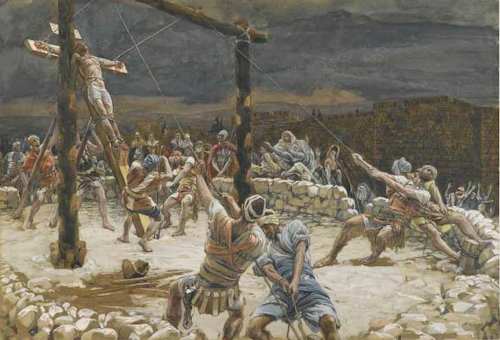
The raising of the cross - James Tissot

Sebastian Moore, O.B, speaks to this in The Crucified Jesus Is No Stranger (Seabury Press, 1977).

The meaning of the Christ-event is that in it the wrestle of man with his God-intended self is dramatized and led through the phases of rejection, hatred, crucifixion, destruction, surrender, new life. Oscar Wilde said, “each man kills the thing he loves.” Those who stop short of evil in themselves will never know what love is about. They will never receive the crucified. – p. 37

The human race thinks it can go on with all its Narcissistic human normalities, of war, of politics, of religion, and that somehow the vast other side of the picture will look after itself. So in opting for “himself as conscious”, man is opting for an ultimate solitude.

And ultimate solitude is death. It is to be cut off from the tree of life, and to wither. – pp. 69-70

For your further reflection, this poem received today from Steve Shoemaker.

Good Friday?

What makes this Friday Good is not what Rome

did to Jesus: torture, false witnesses,

and finally capital punishment.

In all regimes these standard practices

preserve the powerful, but then foment

disgust, infamy,  abroad– shame at home.

The dying one, the empty tomb was good

only if we are justified by trust,

mysteriously by God’s grace made whole.

The goodness cannot stay with us, it must

be passed on to the world–this is our role.

The Good is recalled in the feast:  soul food.

In a few moments I will host the Good Friday meditation – readings from the Gospels, long silences, the movements of Garbriel Faure’s Requiem…silence…reading… until it all soaks in.

I can’t get to Easter by by-passing the cross. Click  to hear the music.

Sojourners Today

This morning Sojourners chose to publish last Sunday’s sermon (posted yesterday on “Views from the Edge”) on it blog, “God’s Politics:  a Blog with Jim Wallis and Friends”. Click THE STONES ARE SINGING for the Sojourners post to read and hear it, “like” it (If you do :-)), post a comment,or send it to a friend by email.

Once again, special thanks to Dennis Aubrey and Via Lucis (click the link for today’s Good Friday photos) for permission to use his magnificent photographs and written description of his time in the Basilica of Mary Magdalene in Vezelay, France.

Reading Dennis’ words from the pulpit near the end of the sermon, I had to stop. It was as though years of trying to understand had come together into a single moment. When  the Gospel writer has Jesus respond to his critics with “I tell you, if these keep silent, the very stones will cry out,” he is quoting from the Scriptures of his Jewish faith – Ode against the Chaldeans in the Book of Habakkuk “The stone shall cry out from the wall, and the beam out of the framework shall answer it. Woe to him that builds a town with blood, and establishes a city by iniquity.” (Hab. 2:11-12)


“Easter Morning”

Steve Shoemaker

It’s Monday of Holy Week. I’m walking with Jesus as best I can toward the cross and  toward the celebration of Easter. This year I’m walking with members of the congregation who are  suffering, in great pain, sick, dying people, trying the best I can to be with them fully in ways that, by the grace of God, might help. This is not head stuff. It’s heart stuff. I get tangled in my head too often. I open the morning email. There’s this double acrostic poem from my old friend Steve Shoemaker, the 6’8″ and shrinking Ph.D. kite-flyer theologian and poet. Thank you, Steve.EASTER MORNING

Either Jesus really did rise or

All his followers made up the worst

Series of lies in history…  Poor

Thomas certainly was right to doubt

Even after hearing tales:  what four

Reached the tomb (or five?)  Who saw him first?


Matthew says two women, Mark says three;

Or was it just one, as said by John?

Reports of what eye-witnesses can see

Never can be trusted.  Luke said one

In the road joined two who could not see–

Not until he broke the bread…  No one

Got the story straight! Conspiracy?


Even grade school kids could do as well.

And Luke throws in Peter saw him too–

Somewhere unreported…  Who could tell

That this jumble of accounts could do

Enough to give faith and hope to all.

Resurrection?  Who could think it true?


Maybe just the simple:  those whose eyes

Open to the light through grief, through tears…

Reminded of love, of truth, of grace…

Needing to be fed, hands out for bread…

Inspired by the scriptures, in whose head

Grow visions:  life can come from the dead.

I’m adding this visual: “Disciples John and Peter on their way to the tomb”:

Disciples John and Peter Run to the Tomb

Burnand, Eugène, 1850-1921. Disciples John and Peter on their way to the tomb on Easter morning, from Art in the Christian Tradition, a project of the Vanderbilt Divinity Library, Nashville, TN.  http://diglib.library.vanderbilt.edu/act-imagelink.pl?RC=55038 [retrieved April 2, 2012].

Steve and I would love to hear your reflections and responses to Steve’s poem or Burnand’s painting. Thanks for coming by.