“What faith you have in God is very unimportant compared with the faith God has in you.”
– Steve Shoemaker, June 26, 2012

“What faith you have in God is very unimportant compared with the faith God has in you.”
– Steve Shoemaker, June 26, 2012
“Damn” is not his last name,”
Said Herb
To the man on the stool
With the beer at the bar.
….
“What?” said the man with the beer
To Herb,
Drinking his vodka and milk
On the stool at the bar.
….
I said, “God damn!”
Said the man with the beer.
…..
“And I said ‘Damn is not His last name!’”
Cried Herb with his vodka and milk.
…..
“Pow!” came the fist
From the man with the beer.
…..
“What’d you do that for?”
Asked Herb from the floor
To the man with the beer
On the stool at the bar.
– Gordon C. Stewart, June 6, 2012, Chaska, MN
“Requiem” by Eliza Gilkeyson,
arranged for choir
by Craig Hella Johnson,
sung by The Chorale in Vienna
She had come to the church to worship God,
to hear a touring choir sing classics with
some spirituals–she thought the choir was good.
The young liturgical dancer was lithe,
quite serious as she embodied grief
and bafflement at death from tsunami,
earthquake, and flood.
The choir prayed for relief,
for understanding from Mother Mary.
The worshiper, offended by the dance,
looked at the floor, her eyes narrow and hard,
her jaw was clenched, her lips were white and thin.
In choir and congregation there were tears
in sympathy with grieving mother, child…
To turn away from beauty is a sin.
– Steve Shoemaker, on tour, Vienna, Austria, June 12, 2012
The Dove World Outreach Center (DWOC) is in the news again. Scroll down to the bottom to click the link to the Huffington Post story. Or, you’ve time, read this piece that was published by MPR following the DWOC’s threat to burn the Quran.
How a single voice threatened to spark a forest fire
by Gordon C. Stewart
September 28, 2010Everyone from time to time feels insignificant. As I did, while watching fires burn across the world, lit by the words of one pastor in Florida. I felt like a spectator in the stands watching the game I care about go terribly wrong, a hostage of verbal terrorism uttered in the name of Christ.
I would imagine that the Rev. Terry Jones and his small congregation also had felt insignificant before they announced the 9/11 Quran burning, and that they were stunned when their pastor’s voice, although terribly misguided, lit the forest on fire without ever burning a Quran. One of their own, one who had felt insignificant, had raised his voice and now had the ear of a commanding general, the secretary of defense and the president of the United States.
The difference between the Rev. Jones and most people is that he has a pulpit. On any given Sunday he speaks and a few people actually listen. Most of us do our ranting and raving in the shower, at the water cooler or with like-minded people at the coffee shop, but we don’t much expect anyone to listen.
But as the Jones story developed, those of us with pulpits were feeling no less beside the point. Then, as I prepared for worship, I was drawn by some old lines about spiritual arson. “Consider what a great forest is set on fire by a small spark. The tongue is a fire … a restless evil, full of deadly poison” and “the seeds of righteousness are sown in peace by those who make peace” (Letter of James 3).
The thought crossed my mind: We could invite a Muslim friend to join me in the pulpit, perhaps my neighbor Muhammad or Abdi or one of their children, whom I meet daily while walking the dogs. I decided to invite Ghafar Lakanwal, a Pashtun Afghan-American cultural diversity trainer, a Muslim and naturalized U.S. citizen, to bring greetings of peace and share some passages about peacemaking from the Quran in our Sunday worship on 9/12.
Our little church in Chaska welcomed Ghafar, and his words about the spiritual “obligation to learn, not burn” still ring in our ears. Our service drew media attention, and Ghafar’s words were heard on the evening news and noticed by a stranger in Australia, who sent a message through the church website. “I was touched,” he wrote, “when I read about your recent Sunday service in the news. … I for one can testify that it has certainly comforted a far away Muslim to know that there are neighbors who will stand together in difficult times. My salaam [to you]. May we all grow together to attain Allah’s pleasure.”
“Ah!” someone will say. How can any Christian rejoice when the author uses the name “Allah” for God? But the reaction to the “name” is misbegotten. It is not the name of God; it’s the Arabic word for what we in English call God. The forest fire lit in defense of “God” in advance of the anniversary of 9/11 reminds us that two kinds of religion potentially exist everywhere people gather to practice their faith. One kind burns. The other kind learns. One hates; the other loves.
As James, writing to those who would follow Jesus, put it: “With [the tongue] we bless the Lord and Father, and with it we curse those who are made in the likeness of God. From the same mouth come blessing and cursing. My brothers and sisters, this ought not to be so” (James 3:9-10). We can set the forest ablaze with our small spark or we can use it to light a candle of hope and peace. But, after the events of this month, none of us can again think that what we say is insignificant.—-
When will we ever learn? Click HERE for the whole story and leave your comment.
A series of exchanges on Via Lucis about the history of human cruelty led me to publish this children’s prayer for sanity. There are supposed to be line breaks, but they keep disappearing.
Dear God,
Please teach me how to pray.
We have more questions every day.
Our minds and fingers seem to find
and make a mess (we leave behind)
for other’s hands to fix and clean.
(Sometimes we’re even mean.)
Often we feel that we’re so small
that we don’t matter much at all.
And yet we know you made us right
and even called us “good” in spite
of all we do. So help us know,
dear God, how we should grow.
– Steve Shoemaker, Urbana, IL, March 27, 2012
Steve’s program “Keepin’ the Faith” can be heard anytime @ www.will.illinois.edu/keepinthefaith, including archive programs.
One: God, remind me of my neighbor,
take away my pride.
…
Two: God, remind me of my power,
don’t let me run and hide.
– Steve Shoemaker, Urbana, IL, March 26, 2012
How’s it going with your neighbor, pride, power/ powerlessness, running and hiding? Just a question. Steve’s poems sometimes get under my skin! 🙂 How about yours?
“A Grandfather’s Concern: Literacy, Literalism – and the Measure of Truth” – a social commentary published several years ago on MinnPost.com – came to mind today as I read the humorous comments “Owning a Canadian” about the Bible and homosexuality. I post it here with a name that better reflects the tongue-in-cheek spirit in which it was written.

Jack at age two
I’m worried about my grandchildren. They live in Kentucky.
A New York Times story by Laurie Goodstein re-published by the Star Tribune (12.12.10) as “Creationism meets the Constitution” triggered the concern. Its focus was the separation of church and state, occasioned by a proposed Christian theme park. But my concern was for my grandchildren.
Kentucky ‘s Governor and the Kentucky Tourism, Arts and Heritage Cabinet seem enthralled with a new Christian theme park called “Ark Encounter. “ Ark Encounter will be developed by “Answers in Genesis,” developers of The Creation Museum in Petersburg, Kentucky that shows humans and dinosaurs living together on a planet that is 6,000 years old, a kind of Disneyworld for the illiterate.

Ark at “Ark Encounter”
My concern is for Jack and Mimi’s survival. I’m proud of Jack. He’s 10 years old now. He’s a thinker. His emails to me are flawlessly literate. According to his dad, he doesn’t need Spell-Check. He knows how to spell. In addition to being literate, his emails are sometimes literary.
“The developers of Ark Encounter, who have incorporated as a profit-making company, say they expect to spend $150 million, employ 900 people and attract 1.6 million visitors from around the world in the first year. With the Creation Museum only 45 miles away, they envision a Christian tourism corridor that would draw busloads from churches and Christian schools for two- and three-day visits.” (NYT article)
If he goes the literalist route, Jack might find himself like the little boy who, when asked whether Noah did a lot of fishing on the ark, answered no…because he only had two worms. Eventually, his native curiosity and literary bent would free him for the less obvious symbolic riches of sacred text.
But the issue is not only in Kentucky. It’s everywhere that people refuse to read the Bible literately as literature. It may be sacred literature, but it is literature. The folks from “Answers from Genesis” who are building the Ark Encounter insist that the Bible must be read literally. According to my dictionary, “literal” means “restricted to the exact stated meaning; not figurative.” Genesis is factual but not figurative.
My hope for Jack and Mimi is that they’ll board a different ark – the ark of literacy that will rescue them from the sea of literalism that misses nine-tenths of what is sacred – the poetry, the metaphors, the similes, the parables, the literary allusions of The Song of Solomon, the Psalms, or the prophet Habakkuk who climbed up, figuratively, on “the watch tower” to see what God would say to him about the world in which he lived.
The more I think about it, the less concerned I become…unless, of course, Jack and Mimi, succumbing to peer-pressure, conclude that to be a person of faith means you have to swallow a camel. While some of their friends are trooping off to see the young giraffes in Noah’s ark – “We think that God would probably have sent healthy juvenile-sized animals that weren’t fully grown yet,” said the head the project, ”so there would be plenty of room” – I hope Jack and Mimi stay off the buses to Ark Encounter. More than one person’s faith has been killed by encounters that pitted faith against reason.
I hope Jack and Mimi stay home to read their Bible not as a collection of “literal” facts but as sacred literature that will lead them into the deepest sacred recesses of the soul and into the heart of the world itself. When someone asks whether they take the Bible literally, I hope they’ll be able to answer that they don’t read it literally; they read it literately. Otherwise, there would be no worms.
– Gordon C. Stewart, originally published as “Literacy and Literalism” on www.minnpost.com.
President Obama’s support for gay marriage made headlines yesterday. In Minnesota the issue will come before the voters in November: Should the Minnesota State Constitution be amended to define “marriage” as between a man and a woman? One of my colleagues weighed in on the question from the pulpit of the Oak Grove Presbyterian Church. I post it here because it says more clearly than I what I believe.
“Standing on the Side of Love”
Oak Grove Presbyterian Church
Galatians 3:26-28
Bill Chadwick
Sunday,April 29, 2012
Today I invite us to think together about the amendment that is before the voters of Minnesota this fall that would place into the state constitution the requirement that marriage is reserved for one man and one woman.
I have a pastor friend, now retired, who loved to rile people up. If I might play amateur psychologist, my theory is that as the child of an alcoholic he was uncomfortable when things were calm. Well, my parents were teetotalers. As am I. I love calm. I hate conflict. I would much rather not talk about the amendment. I do so only because of the ordination vows I took almost 35 years ago. I am preaching today about the Marriage Amendment only because I am attempting to follow faithfully my Lord and Savior, Jesus Christ. I might be mistaken. I once again remind you, that in the Presbyterian way of doing things, “Just because the preacher says it, doesn’t mean you have to buy it.”
I believe that to be faithful the Church always needs to take a stand, just like it did against slavery, just like it did in favor of human rights for women, for people of color. The Church ALWAYS needs to take a stand on behalf of human rights for all of God’s children. And especially so when it comes to fair treatment of LGBT folk, since the church has consistently led the way in their persecution.
When my grandchildren ask, “What did you do when the issue of human rights for gay people was still being debated?” I don’t want to have to say to them, “Well, as you know, Grandpa doesn’t like conflict, and I didn’t want to offend people, and I was afraid it might affect contributions, so I kept my mouth shut.” I especially don’t want to say that if the questioning grandchild happened to have been born gay.
There is so much to say that I couldn’t do it in one sermon, so I put a bunch of stuff in the bulletin handout. What I would like to do primarily in the sermon is to tell stories, most of them personal.
My story. It has been a long journey for me to get to where I am today. The Presbyterian Church was just starting to talk about the ordination of gay people when I graduated from seminary 35 years ago. The following year was the first vote at General Assembly, when the proposal was roundly defeated. In the lead-up to that vote I preached a sermon using Acts 10 and 11 as my basis. That is the story of Peter praying at midday on the rooftop in the city of Joppa. He has a vision in which a sheet comes down from heaven laden with all kinds of animals, clean and unclean (according to Jewish dietary laws), and Peter hears a voice saying, “Rise, Peter, kill and eat.” And Peter protests, “Surely not, Lord. Nothing impure or unclean has ever entered my mouth.” The voice spoke from heaven a second time, “Do not call anything impure that God has made clean.” This happened three times. Immediately following, he encounters Cornelius, a Roman centurion who has had his own vision. Long story short, Peter realizes what the vision was trying to tell him: It’s time to change his mind! The gospel is not just for Jews, God’s love is for uncircumcised Gentiles as well. That is absolutely mind-blowing for Peter! It’s against the scriptures. It’s against tradition. But God was doing a new thing and commanding Peter to get on board.
So the gist of my 1978 sermon was this: I am still not quite ready to ordain homosexual individuals, but I am open to the possibility that the Spirit might someday change my mind.
Over the next few years I continued reading the latest Biblical scholarship and scientific research. I met and became friends with several very committed Christian people who happened to be gay. They had undergone extensive therapy and prayer for years and still couldn’t change who they were. I finally came to the conclusion that people simply are born who they are; gay people clearly have God-given gifts for ministry and that we should welcome all God’s children to use their gifts in ministry in ordained positions.
And we should encourage people to form committed relationships. I was happy to bless civil unions.
But marriage?… It somehow didn’t seem right to me to call a same-sex commitment “marriage.” Why? Just pure emotion, tradition, inertia.
Nothing logical about it. I am embarrassed to say that it was only a few years ago that I moved to the point of fully supporting marriage equality.
Another story. My younger brother, John, and I were extremely close growing up. I was so excited when he and his wife started having children. I didn’t have any of my own yet. I loved being an uncle. Many of you had the joy of watching Claire and Jim grow up here at Oak Grove. A couple of GREAT kids! Claire grew up, fell in love with a wonderful man, and married him two years ago. Jim grew up, but when he falls in love he will not be able to marry the one he loves. By the time Jim was three or four years old, I was very sure that he was gay. Jim didn’t choose to be gay. Why shouldn’t Jim be able to share the same right to marriage as his sister does? Jim has told me that a lot of his relatives got married at Oak Grove and it would mean a lot to him to someday be married here.
One comic has said, “Let gays marry. Why shouldn’t they be as miserable as the rest of us?” That may be kind of a funny line. But I’m not miserable. My marriage means the world to me. On Tuesday Kris and I celebrated our 24th wedding anniversary. My marriage is a place of safety, welcome, commitment, companionship, intimacy, trust. That can all happen without marriage. But our relationship is acknowledged, encouraged and celebrated by the world and by the church. Why should Jim be excluded from that acknowledgement, encouragement and celebration because of an accident of birth?
Marriage says “We are family” in a way that no other word does.
About two months ago while flipping through the TV channels one evening I came across a presentation of the Broadway play, Memphis, which won the Tony Award for best musical in 2010. Have any of you seen it? I wasn’t familiar with it, but the TV program was just starting. I was quickly captivated and I watched the entire thing. And then a few weeks ago a touring production came to the Ordway in St. Paul and Kris and I went to it and thoroughly enjoyed it. (Unlike most straight men I love musical theater.) The play is set in the 1950s and is loosely based on the career of a Memphis radio disc jockey. In the musical the lead character is called Huey Calhoun and through the course of the play Huey meets a wonderful singer named Felicia, and eventually they fall in love. Huey asks her to marry him and she says, “Yes. Yes, I love you with all of my heart and I would marry you, Huey, …if I could.” She means, if it were legal. But he is white, and she is black. In Memphis in the 1950s it was against the law for a white person and a black person to marry.
Doesn’t that just make you shake your head in sadness? In amazement? I am utterly confident that fifty years from now—or probably less, maybe half that—almost everyone will be shaking their heads about the current ban on gay marriage in the same way that almost everyone shakes their heads at the ban on interracial marriage of a half-century ago.
Even if this amendment passes, it is just a temporary bump in the road on the way to the inevitable. According to the Gallup Poll (May, 2011) 70% of young people in America favor gay marriage. When the loudest voices opposing gay marriage come from the Church, it’s one more nail in the coffin…of the Church. The Church is brushed aside by the younger generation as being narrow-minded, judgmental and irrelevant.
You sometimes hear the statement, “Gay marriage is a threat to heterosexual marriage.” How so? Two of our very good friends, Suzanne and Diane, were legally married in Massachusetts eight years ago. My wife, Kris, flew out to be in the wedding. We see them socially on a regular basis. Eight years. Their marriage has not affected my marriage one bit. Any more than your marriage (pointing to congregation) or your marriage affects my marriage. Whom you choose to love does not affect whom I choose to love.
Another story. About a woman named Ruth. (I’m indebted to St. Paul theologian David Weiss for this insight.) You (probably) know Ruth’s words, even if you don’t know her story: “Wherever you go, I will go; wherever you live, I will live. Your people will be my people, and your God will be my God.” (Where do we so often hear these words?) This is one of the most often quoted texts at straight marriages. But these words were spoken by Ruth to her mother-in-law, Naomi. These words were spoken by a woman whose people, the Moabites, were condemned in the Bible – forever. She has no business pledging – and fulfilling – a vow of faithfulness like God’s own promised faithfulness. But while her love for Naomi was ethnically and culturally odd and her (later) marriage to Boaz (a Hebrew) was religiously dubious, thanks to her odd love and dubious marriage she became the great-grandmother of King David. Her off-limits love became a blessing.
I could give other germane Biblical stories: The stories of Rahab, Hosea, the parable of the Good Samaritan, several women in Jesus’ life, and others. As Weiss notes, “The Bible is full of stories about a God who welcomes surprising people into God’s family. Stories about heroes and heroines whose praise-worthiness lies in their promised faithfulness to another person.” (See Weiss’s book, To the Tune of a Welcoming God: Lyrical reflections on Sexuality, Spirituality and the Wideness of God’s Welcome (2008, Langdon Street Press).
If you support marriage equality, what can you do? Outfront Minnesota is an organization working to defeat the Amendment. The Outfront folks expect that there will be an onslaught of misleading advertising this summer financed by the Mormon Church and others. An Outfront trainer noted, “We believe that the way forward is not to be found in loud and angry debate with the opposition. We think this only entrenches people. Rather, our research finds that the single most effective way to advance our position is through one to one conversations. So, our strategy over the next months is to facilitate a million conversations. And, we have scheduled numerous trainings to help people plan those conversations, and feel comfortable having them.” You can find information on the Outfront website. Please hold gentle conversations with your friends and neighbors.
Final story. Tuesday afternoon I was toiling away in my study when our receptionist came and knocked on my door to inform me that there was a man here who has just moved from another town and he is looking for a new church and wanted to know about Oak Grove. I’m always eager to tell folks about Oak Grove so I bounded out to greet him. We introduced one another and then walked out into the hall where I started to give him a little tour and tell him about the church. But he stopped just outside the office and interrupted me, “You have a flag out front,” referring to the rainbow flag.
“Yes,” I said. And I was thinking “Hmm. This could go either way.” (I remind you that in 2008 a man came into a church in Tennessee with anger in his heart at what he called “liberal gay-lovers” and he opened fire, wounding seven and killing two.) This was not in the back of my mind; this was in the front of my mind. Was this man in front of me happy that we had the flag or was he here to set me straight, so to speak?
He continued. “Does the flag mean you welcome everyone?”
“Yes, that’s what it means.”
A big grin spread across his face and he pumped my hand again. “That’s what I’m looking for!” And for the next twenty minutes he told me about his spiritual journey and how he had been hurt by some of his previous church experiences. He said he was looking for a church that would preach positive messages and where everyone was welcome. At the conclusion of our conversation he shook my hand again and said, “I’ll see you Sunday at 8:15.” (And he was here. And he received a very warm welcome from you Oak Grovers.)
We are in the season of Eastertide. The essence of Easter is the message that Love wins. Why take the temporary detour of this amendment?
Love will win.

Pond with morning mist evaporating
A newspaper reporter asked me some questions. We were preparing for a First Tuesday Dialogues series on sustainability called “The Good Green Earth.”
The series would bring five speakers, including spokespeople from the Gulf of Mexico deeply engaged in hazard assessment, technology, and recovery in the wake of Deepwater Horizon.
What’s your sense of the possibilities and trends for sustainability in your work now and what does it look like in the future?
I responded that one of my inspirations is Paul Tillich, according to whom:
Being religious means asking passionately the question of the meaning of our existence and being willing to receive answers, even if the answers hurt.
Faith consists in being vitally concerned with that ultimate reality to which I give the symbolical name ‘God’. Whoever reflects earnestly on the meaning of life is on the verge of an act of faith.

The Spider’s Web with Morning Dew
My calling as a pastor was to help us here at Shepherd of the Hill and here in Chaska literally “go out of our mind.”
Because the collective mind that has delivered us to this place is killing us and destroying the balance of nature.
My calling is to shake us loose from the mental and spiritual chains of species superiority, My calling is to shake us loose from the mental and spiritual chains of species superiority, the mistaken notion that we – humankind – are the exception to Nature. It’s a call to help re-shape our understanding of ourselves as participants rather than owners, participants rather than conquerors or manipulators, members of a diverse natural order of interdependent life. The spiritual resources are there in Hebrew scripture, in the New Testament epistles to the Ephesians and the Colossians, and in the ancient respectful spirituality of some of America’s indigenous people. By “going out of our mind” we will come back into a the web of sanity and fullness.
What factors do you see pushing towards or against sustainability?
Historian of science and technology Lynn White said flat-out that the root problem of the sustainability crisis is religious or spiritual, and so is the solution.
So, number one, we have to address the old and emerging questions about what Tillich called “Ultimate Reality” and the meaning of our existence. We have to go into labor to set the new theological and anthropological paradigm free from of the old destructive thinking. What we are beginning to find as we go into this spiritual labor is that this more respectful, more holistic way of thinking is not new at all – it’s the older paradigm that got side-tracked by greed and pride.
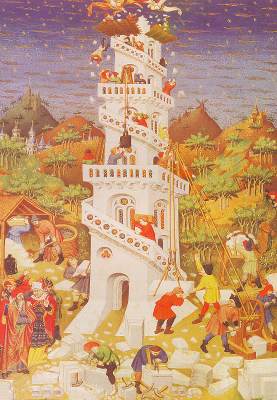
Building of the Tower of Babel – Master of the Duke of Bedford
God has “come down,” as it were, to frustrate our attempts at building the secure city called Babel; God is making us nomads again who recognize that we and the Earth are already full, not empty. Every settlement comes to nothing. Every tower built as a monument to pride falls. And number two, and I’m afraid there is no other way to say this – we will never make it without leaving behind the economic system of greed. Capitalism is killing us.
The consolidation of wealth and corporate power have a stranglehold on national, state, and local public policy. The members of the boards of the oil companies sit on the boards of General Motors and Ford. So it’s no wonder that U.S. federal policies on transportation are car-friendly and suspicious of mass-transit, regardless of a car’s gas mileage. Osalescence is built in because you can’t sell something five years from now if the old model is still like new. Our health care and the FDA are in the palm of the insurance and drug company’s so that it’s illegal to go across the border to fill your prescription in Canada.
Finally, the sustainability of the human species itself is, I believe, imperiled by chemical alterations that are meant to do good but that, in the long run, make us biologically less resistant and resilient. Our natural immune systems are being weakened by pesticides in the food we eat and by the pharmaceuticals we ingest from the drug store.

Black tar heroin – U.S. Drug Enforcement Administration
We have become a nation of addicts. Addicted to illusionary dreams of abundance. Addicted to prescription drugs. Addicted to fast food and faster short-term solutions. Even instant gratification is too slow. Controlled by advertizing that sells us prescription drugs that’ll give you an immediate erection but may send you to the emergency room if it last more than four hours,or drugs that may ruin your liver or land you in a casket, and the real pushers are not the petty drug peddlers on Minneapolis’s North Side. The real pushers are legal. They’re given license, while those who would shut them down are looked upon as crackpots and throw-backs who are opposed to progress.
So…what’s stopping real progress, a more Earth-friendly way of organizing human affairs that embraces reality itfself, “Being-Itself”? The intransigent, legal, institutionalized arrangements of power and money, on the one hand, and our willing compliance with the de-democratization of America that salutes the system of greed. We have to learn again, and we are – very slowly – pushing and screaming, that “the Earth is the Lord’s and the fullness thereof”. We have turned it over to the forces of greed and destruction.

The Good, Good Earth: Our Island Home
We need to recover the gratitude and spiritual paradigm of a natural abundance in order to push against the false promises of those who would have us believe that our lives and the world would be empty without all the stuff that ends up in the landfills or washes ashore in the estuaries of the Gulf of Mexico.
So……Chime in, friends. How would you answer the reporter’s questions?
Last Saturday I bit my tongue and went to an estate sale in hopes of buying a patio set. It was sold by the time I got there. Here and gone in a heartbeat.The rest of the stuff, except for the men’s suits (wrong size) was junk.
The memory that lasts is the house itself. Highland Park is a lovely neighborhood in Saint Paul. Beautifully constructed old Tudor homes on a tree-lined street…except for…the house with the estate sale…a lavishly done white retro Art Deco house…plopped down like a fly on top of a French Soufflé.
 I blurted out to another shopper, “This place is really strange.” “Yes!” she said. “What were they thinking?”
Right then I thought of the ongoing conversation with Dennis Aubrey of Via Lucis Photography about the Romanesque and Gothic churches that still inspire reverence and awe eight centuries after they were built.
Dennis: “One of the wonderful things about these [Gothic and Romanesque] churches was that they took so long to construct and design that the intellectual currents that drove the builders were deep and powerful, not short, erratic eddies of fashion.”
Dennis had posted a question about a contemporary artistic installation at the Church of Saint Hilaire in France. Would the newly created installation at the Church of St. Hilaire stand the test of time. Might it also come from sources that are “deep and powerful, not short, erratic eddies of fashion”? Would it stand the test of time as compared with Gothic and Romanesque structures with their high vault ceilings that lift our eyes and hearts to something else for which we human beings long? I had shared with Dennis that I find most contemporary church architecture banal and uninspiring.
I wrote to Dennis: “The culture of individualism is NOT Romanesque or Gothic where the glory is directed away from the individual, where the individual gets to feel…well…very small, humble, rather insignificant in the best way. I, too, see wonderful works of contemporary architecture, and I hope I’m not just being a cranky old man here. The comment about banality is not about those magnificent creations but rather about what I believe is the prevailing dumbing down of our time that leaves us bereft of awe, the sense of grandeur, wonder, or humility [one feels in Gothic and Romanesque spaces]. There’s a flattening, a leveling of existence itself to human proportions. The belief in species superiority displaces everything that suggests otherwise. My comments, I think you know, are not so much about the new installation at St. Hilaire – which, in and of itself, strikes me as quite lovely – but more about the age in which we live where nothing much seems to be of lasting value.”
Dennis: “Gordon, I think it was a form of this ‘prevailing dumbing down’ that inspired us to these churches in the first place. I became increasingly disturbed by rampant commercialism, when the point of commerce is to create obsolescence so that goods can be replaced whether necessary or not. Fashion and styling is substituted for value. PJ and I wanted to concentrate on something that had intrinsic value, and when we began exploring these churches in 2006, we found that something.
“One of my favorite books of all time is Raymond Chandler’s The Long Goodbye [published in 1953]. In it, there is a speech by the wealthy Harlan Potter:
“’You can’t expect quality from people whose lives are a subjection to a lack of quality. You can’t have quality with mass production. You don’t want it because it lasts too long. So you substitute styling, which is a commercial swindle intended to produce artificial obsolescence. Mass production couldn’t sell its goods next year unless it made what it sold this year look unfashionable a year from now. We have the whitest kitchens and the most shining bathrooms in the world. But in the lovely white kitchen the average American housewife can’t produce a meal fit to eat, and the lovely shining bathroom is mostly a receptacle for deodorants, laxatives, sleeping pills, and the products of that confidence racket called the cosmetic industry. We make the finest packages in the world, Mr. Marlowe. The stuff inside is mostly junk.’”
Well, the kitchens today aren’t just for the “housewives,” thank goodness, but the rest hit too close to home.
I think of the height of the Gothic arches and the things that will last when someone says at my departure “Dust to dust, ashes to ashes” and holds an estate sale.
I sit down with the Scriptures for something longer lasting than deodorants, laxatives, sleeping pills, or a plastic patio set. I want something like the lasting value of the Gothic and Romanesque architecture “took so long to construct and design,” where “the intellectual currents that drove the builders were deep and powerful, not short, erratic eddies of fashion.”
I’m drawn to the English translation that preserves the clear distinction between the Divine and the human – the use of the archaic word “thou” for God. Like the vaults of St. Hilaire, the language lifts up my heart from the flat banality of our self-preoccupations and species grandiosity.
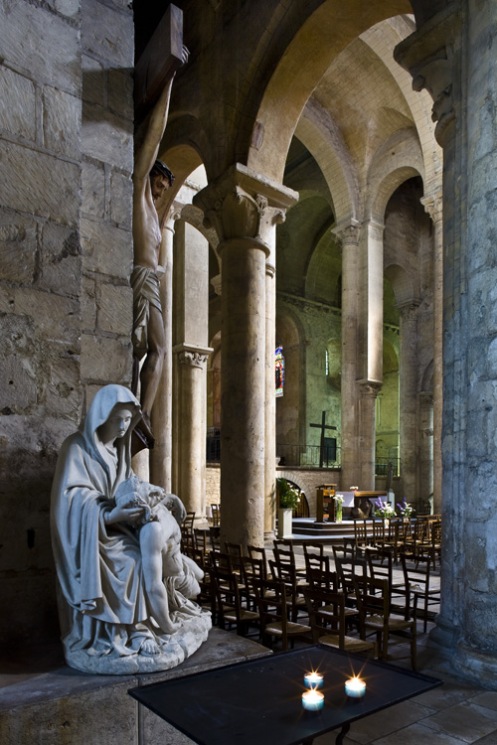
- Basilique Saint Hilaire, Poitiers (Vienne) Photo by PJ McKey
“O Lord, how majestic is thy name in all the earth!
When I look at the work of thy heavens, the work of thy fingers,
The moon and the stars which thou hast established;
What is man that thou art mindful of him…?
O Lord, our Lord, how majestic is thy name in all the earth!” (Psalm 8)
“Lord, thou hast been our dwelling place in all generations.
Before the mountains were brought forth, or ever thou hadst formed the earth and the world,
From everlasting to everlasting thou art God.
Thou turnest man back to the dust, and sayest, ‘Turn back, O children of men!’
For a thousand years in thy sight are but as yesterday when it is past, or as a watch in the night.” (Psalm 90:1-4)
 Views from the Edge