The President’s Speech on the Economy

Aired earlier today on All Things Considered (MPR, KNOW, 91.1 FM).

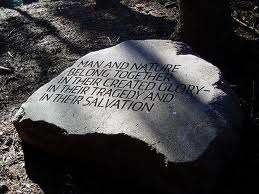
Paul Tillich quote in Tillich Park, New Harmony, IN.

Paul Tillich quote in Tillich Park, New Harmony, IN.

Today President Obama began a series of speeches about the future of the American economy. I hope he takes us back to the basics of what an “economy” is.

Economics is about a household and how to manage it. The household is a family, a state, a nation, a planet.

The English word “economy” comes from the Greek work oikos – the Greek word for house. The word “economics” derives from the Greek word oikonomia–the management of a household.

Before it is anything else, economics is a perspective, a frame of reference. Before it decides anything about household management, it knows that there is only one house. Good household management – good economics – pays attention to the wellbeing of the entire house and all its residents.

In America and elsewhere across the world, we are coming to realize that the planet itself is one house. What happens in one room of the house – one family, one city, one nation – affects what happens everywhere in the house. Paul Tillich caught the clear sense of it when he wrote that “Man and nature belong together in their created glory – in their tragedy and in their salvation.” That is to say, there is only one house.

The essential question of economics is not about systems – capitalism, communism, socialism, or something else. The essential question is spiritual, philosophical, and ethical. It’s whether we believe that there is only one oikos, one house; the subsequent question is about how best to manage it for the wellbeing of all its residents and the fragile web of nature without which the house of the living would not exist.

Very often what we call ‘economics’ is not economics. It’s not oikonomia. It’s something else. It assumes something else, and when we forget what an economy and economics really are, we enshrine greed as the essential virtue, ignoring and imperiling everyone else and everthing in the one house in which we all live.

I dream that the President will preach the old Greek common sense: that in his own way, he will reclaim the essential premise of an economy and the ethical task of economics. By bringing the Greek origins to our television sets, headsets, and iPads, he can call us to move forward out of the partisan houses of nonsense.

There is only one house.

The House We Live In

Gordon C. Stewart, April 3, 2012

The economy is broken. While most of us have been holding our breath, some of us have been out buying the most expensive jewelry at Tiffany’s. Investor’s Business Daily reported that Tiffany’s profits rose by 56 percent during the 2nd Quarter of 2011.

‘Economics’ is about the house we all live in. We get the word from the Greek word oikos (household).   Economics (Oikonomia) is how we arrange things in the one household. They don’t teach that in MBA programs.

This is not an economy. It’s something else. It’s an anti-economy, the antithesis of one household in which all residents are housed, fed, secure, and peaceful.

Profit vs. loss is not a way to manage a household. It divides the members of the household into winners and losers, owners and renters, charitable givers and those who receive, or do not receive, the winners’ charity.

What we call the American economy is spiritually and morally bankrupt. It’s not just broken financially.  Warren Buffett’s proposal to increase taxes on those who can afford to shop at Tiffany’s only scratches the surface of the household problem.  One could argue that the system – free market capitalism – is working the way it’s set up to work. Or one could argue that it isn’t.

It all depends on what floor of the house one lives in.

Two percent of the rooms are in the penthouse. They’re very large, decorated by the best interior designers and decorators. The furnishings are custom-made.  Those who live in the penthouse have a private elevator to leave the for lunch at the country club or the yacht club.  Over lunch they discuss how to maximize their profits with more blue chip stocks or bonds and whether to leave the penthouse for a week, a month, a season in exotic places. They discuss their charitable giving, encouraging each other to give to their favorite causes. Sometimes, in the best of clubs and social circles, they argue vociferously, just like the rest of us, about the economy in the Greek sense, the oikos. They are not all of one mind.  Some belong to the  Buffett Fraternity, others to the Trump Circle, even if they wish “the Donald”  would be more subtle.

The other 98 percent of the rooms in the house are rentals of various sizes. Some very large, some modest, and some small.  Only a few of the tenants have long-term leases or the protections of rent control.  The most vulnerable of us live downstairs on the smallest rooms on the lower levels. A growing number of us have been forced into the cellar.

And the rest?  We watch “the Donald” to catch a glimpse of life in the penthouse. We watch our neighbors and family members move to smaller rooms or to the basement, fearing that we, too, will end up in the cellar, but hoping that someday we’ll win the lottery and move upstairs to the penthouse.

Meanwhile, the folks who own Tiffany’s are laughing all the way to the bank, confident that the 98% are too preoccupied to get what’s happening…right there under our noses in the one house where we live.

Economics 101: “The Earth is the Lord’s and the fullness thereof, the world and all who live in it” (Psalm 24:1). How, then, shall we re-arrange the one house? How will we Occupy it?

Cuban Altar Boys, the Pope, and Occupy

Pope Benedict has called for political reform in Cuba. The Cuban government has refused the request.  It continues to insist on one party rule.

Ninety miles away, here in the U.S., we have Occupy because an oligarchy has stolen the rule of the people. (“They may squirm in hearings, but Wall Street oligarchs know who has the power“.) The Supreme Court’s ruling has given the green light for some of the people (i.e. corporations) to rule the airwaves with the unlimited spending that buys elections “of the people, by the people, and for the people.” Which people? Follow the money and you will see the illusion that America is a democracy. We have hoods over our heads.

We’re an oligarchic society. For all intents and purposes we live under the rule of the few, for the sake of the few. Fewer and fewer of the crumbs in Jesus’ parable of the poor man Lazarus are falling from the rich man’s table.

Why would Raul and Fidel Castro, two former altar boys, and the Cuban Communist Party refuse to open up the Cuban political system?

One need only review the history of Cuba prior to the revolution for their reasoning. I’ve had this conversation. I had it in 1979 in Cuba, and I had it in 1966 in Czechoslovakia behind the Iron Curtain. See yesterday’s post (The Wafer and th Loaf: the Pope and Raul Castro)

The Iron Curtain was altogether different from the Cuban embargo. The Iron Curtain was raised from the other side of the fence. It was put up by what we then called the Eastern Bloc, not by us in the West, while the Cuban embargo, the Iron Curtain meant to strangle the success of the socialist experiment, was built by the U.S.  Against all odds, Cuba has survived without access to the world’s largest market 90 miles to the north.  Somehow or other, against all odds, Cuba defended itself successfully against the giant to the north’s invasion at Playa Giron, “the Bay of Pigs”. It has lived ever since in fear of its northern neighbor, especially its ex-patriot Cuban business class in Florida that led the Bay of Pigs Invasion. Now Pope Benedict is urging the Cuban government to open up the political process, to expand political freedom.

Partly it’s a matter of perception.

Here in the West we decried the Iron Curtain as the means of dictatorial regimes to keep people in East Germany from fleeing to West Germany. To us the Berlin Wall was a prison wall intended to keep people from fleeing to freedom.  As seen by the Czechoslovakian family with whom I lived during the summer of 1966 and by the students at the university in Bratislava, the Iron Curtain served an altogether different purpose. It wasn’t to keep them in. It was to keep us out. They believed in the egalitarian society they were hoping to create. The Wall had been raised to wall out the corrosive influences of Western materialism, the power of money that is capitalism, the culture of greed, the survival of the fittest, the culture of selfishness.

Today Cuba is poor. Or is it? How do we measure poverty…or wealth?

Prior to the Cuban revolution led by Fidel Castro and Che Guevara, two former altar boys, Cuba was the U.S.’s source of sugar. The sugar came from sugar plantations owned by American Sugarwhose American elites and their Cuban partners gathered for lavish vacations on the white sands of Varadero Beach.  The American one-percent was reaping the profits and lying on the beach with their Cuban corporate friends at Varadero. It made no difference to them that the literacy rate of the Cuban people was among the lowest in the world.  The vast majority of the people could neither read nor write. It didn’t seem to matter to the elites or to Batista, the Cuban dictator whose government they had bought and paid for.  The vast majority of Cubans – those who spent their days cutting sugar cane on the large plantations, peasants who scratched out a living with a few chickens and pigs, and those who worked in the tourist industry in Havana and at Varadero Beach – had no health care, no dental care, and no safety net other than the Church’s charity. It was an island of economic injustice relieved by episodic acts of religious charity.

In short, Cuba was an oligarchy.

If Cuba “opens up” the way the Pope and most Americans believe they should, Cuba will very quickly become again the place it was before the former altar boys came down from the mountains to ousted Batista and American Sugar.

Is Cuba poor? Is America poor?  Cuba has had universal health care for longer than the US. Has had the Civil Rights Act. No one goes without seeing a doctor.  Its literacy rate is one of the highest in the world because of its government’s commitment to education and literacy for all its citizens.  Here at home a conservative U.S. Supreme Court is weighing arguments that could turn back America’s closest thing to universal health care, and the literacy rate is dropping, the prison population is mushrooming with school dropouts who can’t read or write. Those who can afford it, move their children out of the public schools into private schools.  The gap between the haves and have-nots widens every day. And the people on Wall Street who keep the rest of us living in the illusion that our future security rests with the interests of the oligarchy is as tall and thick as it ever was.

During his trip to Cuba Pope Benedict not only called for reforms in Cuba. His words also pointed north to the U.S. and the system that enshrines private capital and greed rather than God as the central principle around which Western societies are organized.  Pope Benedict denounced the ills of capitalism, as he has done repeatedly.

Benedict bemoaned a ‘profound spiritual and moral crisis which has left humanity devoid of values and defenseless before the ambition and selfishness of certain powers which take little account of the true good of individuals and families.’” (Nicole Winfield and Andrea Rodriguez, Huffington Post, 3/27/12).

The calls to open up the political system, on the one hand, and to end the ills of capitalism, on the other, are twin calls that echo 90 miles to the north as well as across Cuba.  We live in a closed system where the ills of capitalism turn the Constitutional rights and freedoms of a representative people’s democracy into a money game, a single-party oligarchy in which the one-percenters put hoods over our heads while they look forward to the installation of another Batista, the day when the can join their friends again on the white sands of Varadero Beach.

A Journey of Faith into Economics

 – Gordon C. Stewart Feb. 12, 2012

North Philadelphia street scene

Where I grew up Karl Marx was the enemy of all that was good and true. The United States and the Soviet Union were in a dead heat in the Cold War between the Christian and capitalist West, and the atheistic, Communist East. In elementary school we dove under our desks during air raid drills to prepare us for the atomic bomb that would be dropped on Broomall, Pennsylvania, population 1,000. We began the school day reciting the Pledge of Allegiance – “one nation under God” – and a prayer that asked for God’s blessing. In World War II our fathers had beaten back the evil of Nazism. Now, evil was threatening once again from fascism’s opposite, godless Communism. It was either us or them.

It took a while before I asked about the coupling of Christian faith and capitalism or read Marx himself. To read him or to entertain the idea of a classless society was heretical treason, or treasonable heresy. Church and nation were two sides of the same thing. But the more I recited the Pledge of Allegiance, went to worship and youth group,  and became acquainted with the poverty of north Philadelphia, I began to realize that “freedom and justice for all” was, at best, an aspiration, not a fact.  At worst, it was a compelling myth that allowed us to think of ourselves as the chosen whose job was to eliminate evil from a fallen world.

Two summers working as a street worker for the Presbytery of Philadelphia in the poorest neighborhoods rattled my world and shook me to my knees. Every Monday through Friday during the summers of 1961 and ’62, I traveled an hour-and-a-half by bus and subway from my suburban home in Broomall to north Philadelphia and back trying to make some sense of these two very different worlds. How and why did they exist – one white; one black? One materially satisfied; one not? Martin Luther King, Jr. and the civil rights movement were answering that it was because of  the politics and economics of white privilege.

When I read the work of Willem Zuurdeeg, a Dutch philosopher of religion who grew up as part of the underground resistance during World War II, I found the philosophical mind that looked below the surface to the deeper convictions that hold our hearts and minds captive. The rest of the story is too long to tell.

Capitalism, like Communism, is an idol manufactured by the human heart, one of the convictions, often unexamined, that vie for our worship and allegiance. No economic system is now, or ever will be, perfect. Its efficacy and utility are to be judged by what it does to the people who live under its mindset and institutions.  Today, I hear strident voices that sound like the voice of the late Senator Joe McCarthy who turned over the tables looking for America’s internal enemies. I would like it to be said when I am gone that I honored the memories of Edward R. Murrow whose courageous reporting exposed McCarthyism, and of Joseph Walsh, the attorney for the Army who spoke aloud the words that brought an end to the power of the McCarthy Hearings to destroy decent, dissenting American citizens: “Have you no decency, Sir? Have you no decency left?”

Ours is a later time. The issues of our day are complex. But underneath the debates, the “us against them” mindset of World War II and the Cold War is no less alive than it was then. However and wherever McCarthy’s eyes flash while his finger points and his voice rises again, those of us who hear a Deeper Voice must not be silent. The Deeper Voice is the “still small Voice” of conscience and dissent.