The Church on the Bridge

Pettus Bridge, Selma to Montgomery

Pettus Bridge, Selma to Montgomery

If some churches are like opium dens, others are like Pettus Bridge, the bridge over the Alabama River you must cross to get from Selma to Montgomery, Alabama.

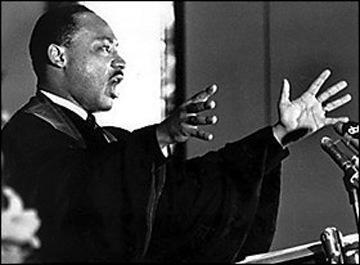
In the history of America’s civil rights movement, Pettus Bridge and the events of “Bloody Saturday” represent a crossing over from the society addicted to violence, hatred, and war to “the peaceable kingdom” of Isaiah. Think Jesus. Think Martin Luther King, Jr. Think Congressman John Lewis. Think all the anonymous souls who dared to cross the bridge from here to there.

“Have we not come to such an impasse in the modern world that we must love our enemies — or else? The chain reaction of evil — hate begetting hate, wars producing more wars – must be broken, or else we shall be plunged into the dark abyss of annihilation.” [The Rev. Dr. Martin Luther King, Jr.]

I suspect Karl Marx never knew a church like that. What he saw was religion as a tool of the powerful, an ideological overlay on reality to keep their subjects compliant with the existing social order.

The church of the bridge is no opium den. No one is doped up. No one is in a stupor. People don’t go there to hide. It is by nature a place that calls for commitment and action. The Church as Pettus Bridge is spiritually, economically, politically, and culturally revolutionary. It requires far-reaching transformation of people, structures, and systems. It’s a risky place. The church on the bridge requires you to put your whole body, mind, and soul on the line – on the  bridge – fully conscious that the troops the old social order will come after you. It is the church of Jesus and the prophets, and of Paul at his best:

I appeal to you therefore, brothers and sisters, by the mercies of God, to present your bodies as a living sacrifice, holy and acceptable to God, which is your spiritual worship. Do not be conformed to this world, but be transformed by the renewing of your minds, so that you may discern what is the will of God—what is good and acceptable and perfect. [Epistle to the Romans 12: 1-2, NRSV]

Every time the Church of the Bridge gathers for worship, the pews are filled with people wearing crash helmets. They expect something real to happen. They expect to make it happen. When they gather around the Lord’s Table for Eucharist, they know what they are celebrating: “the peaceable kingdom”, the City of God on the other side of violence, hatred, and war that puts them on the bridge.



MLK Day 2015 – the house next door

94 South Street, St. Augustine, FL

94 South Street, St. Augustine, FL

On Martin Luther King Day 2015 the historic house next door to us on The Freedom Trail here in St. Augustine is a faint shadow of its former self. A weathered sign by the rear entry reads:

“NO TRESPASSING by order of the City of St. Augustine. Violators will be prosecuted to the full extent of the law.”

Some of the louvered glass windows on the back porch are broken out. Sheets and blankets cover the windows.

The White family paid the price for their courage. James and Hattie were leaders in the Civil Rights Movement, as was their son Samuel. But, as Isaac Watts (1674–1748) reminds us in his poem and hymn “O God, Our Help in Ages Past”:

Time, like an ever-rolling stream,
Bears all its sons away;
They fly forgotten, as a dream
Dies at the opening day.

Time has a way of placing brackets around even the best historic moments. James, Hattie, and Samuel, their 14 year-old son, who was sent to reform school for sitting in at the downtown St. Augustine Woolworth’s, have been borne away by time. The three of them are deceased; their story and the dream is still alive.

When young Samuel and his three friends later known as “the St. Augustine Four” were arrested at Woolworth’s, the authorities agreed to release them to their parents’ custody on one condition: that they sign a statement that their children would not violate the law again. The four young men pleaded with their parents not to sign the pledge, assuring their parents that they, the sons, could make no such pledge. Mr. and Mrs. White refused to sign. Fourteen year-old Samuel was sent to reform school for a year. He served six months of the sentence before Dr. Martin Luther King, Jr., Jackie Robinson and other civil rights movement leaders came to St. Augustine to shine the national spotlight on St. Augustine. Samuel and the other incarcerated member of The St. Augustine Four were released by order of the Governor of Florida. The Civil Rights Act followed.

For all the saints, who from their labours rest,
Who Thee by faith before the world confessed,
Thy Name, O Jesus, be forever blessed.
Alleluia, Alleluia!

And when the strife is fierce, the warfare long,
Steals on the ear the distant triumph song,
And hearts are brave, again, and arms are strong.
Alleluia, Alleluia!

– William Walsham How  (1823 – 1897) 

New Legislators, Selma and MLK

Verse – Advice to New Legislators

Support each capital IDEA
(notice the capital letters)
made in the State Capital
(but not always in the CapitOl building)
which will gain financial capital
(if it garners enough political capital)
by making good use of social capital
(without wasting natural capital)
and be sure to capitalize on it.

-Steve Shoemaker, Urbana, IL, Jan. 14, 2015

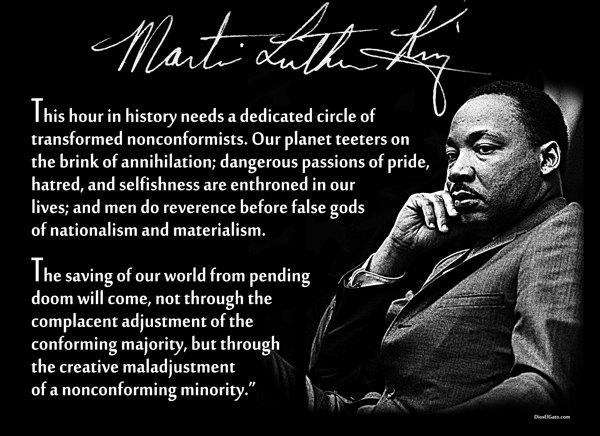
This hour of history - The Rev. Dr. Martin Luther King, Jr.

This hour of history – The Rev. Dr. Martin Luther King, Jr.

The Rev. Dr. Martin Luther King, Jr., whose life America celebrates this weekend, had a different IDEA. His was of a world “in which men no longer take necessities from the masses to give luxuries to the classes.

A mutual friend who marched with Dr. King from Selma to Montgomery and had just seen “Selma” sent the line, reminding us of “the lessons that are severe, easily forgotten amidst the King mythology, but as relevant today as they were when he first voiced them.

MLK Assassination: A Memory

The Rev. Dr. Martin Luther King, Jr.

Forty-four years ago today the Rev. Dr. Martin Luther King, Jr. was assassinated in Memphis, Tennessee. Read this morning’s Washington Post story.I was with about 200 teenagers from “the projects” in Decatur, Illinois when the news broke. First Presbyterian Church and the Office of Economic Opportunity had partnered to create a youth program at the church. Charles Johnson, a former Blackstone Ranger from Chicago, and I (the 29-year-old Assistant Pastor) jointly administered the program.

We were in the church basement when the voice rang out from the steps, “Dr. King’s been shot! Dr. King’s been shot!” The room was filled with shock and anger. Some of the kids preferred Malcolm X to Dr. King, but on that night it didn’t matter. The room was united, overwhelmed by tragedy, another violent act of racial hatred.

Dr. King’s assassination came two months after the release of the report of the President’s National Advisory Commission on Civil Disorders (the “Kerner Commission”) that had concluded:

Our nation Is moving toward two societies, one black, one white—separate and unequal.”

The conclusion of the Kerner Report about police violence had been demonstrated on the church parking lot two weeks before Dr. King’s assassination. On that night Decatur police officers, without warning, had stormed into the crowd of black kids in the church parking lot at the end of the evening program. They came waving billy clubs and spraying mace. I was there. I saw it. Forty store windows in downtown Decatur were broken out that night. A number of the kids were arrested.

While the Decatur Chief of Police and I squared off with our different accounts of the events on the front page of The Decatur Herald, the board of First Presbyterian Church, which included a prominent sitting Judge, stood united and firm. We would not close the program, as the Chief was demanding.

First Presbyterian Church, Decatur, IL

When the voice announced that Dr. King had been shot, the adult leaders of the program had reason to fear the worst. Quickly we rounded up tape recorders. We made an announcement inviting the kids into smaller circles, spread out throughout the church building, that would give each and all of them time to talk.  We announced that, in light of what had happened two weeks before, we wanted their voices to be heard by the Chief, the Mayor, and the members of the Decatur City Council. We were all outraged; the feelings needed to be spoken and shared.There was no violence in Decatur that night. There was no riot.

The tapes were edited and played for the city officials.

The program continued without further interruption.

The Spirit of Martin Luther King, Jr. prevailed. And it still does.