I dreamed I saw Joe Hill last night,
Alive as you or me
Says I, “But Joe, you’re ten years dead,”
“I never died,” says he.
“I never died,” says he.
I dreamed I saw Doug Hall last night,
Alive as you or me
Says I, “But Doug, you’re 11 years dead,”
“I never died,” says he.
“I never died,” says he.
If Doug Hall had heroes, foremost among the candidates were Joe Hill, the labor organizer and Paul Robeson, whose rendition of Old Joe Hill was his Doug’s favorite. Willie Nesbitt echoed Robeson’s versions of Old Joe Hill and Old Man River at Doug’s Memorial Celebration November 14, 2004.
Those who live and die for economic justice never die. They live on through those who pick up the shovels when they’re gone.
Eleven years ago tomorrow – November 14, 2004 – the sounds of Windy Downwind’s flute and AIM founders Clyde Bellecourt, Dennis Banks, and Bill Means’s Honor Song convened the respectful celebration of the life of Doug Hall in the St. Felix School Gymnasium in Wabasha, MN.
I often think of Doug and his life-partner Marian, but it was yesterday’s re-descovery of “The Book of Doug”, a gift from the Hall family following the celebration of Doug’s life, that led to this post.
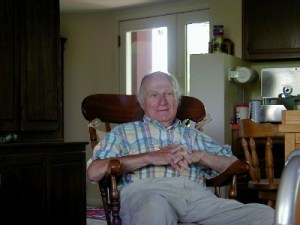
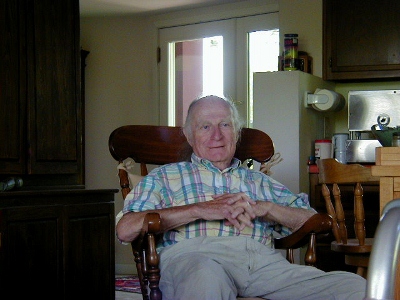
Doug Hall at home in Wabasha
Verse – His Own True Self
He sits and smiles,
His dog Sparky
Resting against his leg,
His eyebrows hanging
Like willow branches.
The bell has tolled
For him, a tolling
Like a wind-song
From the North
Marking the end.
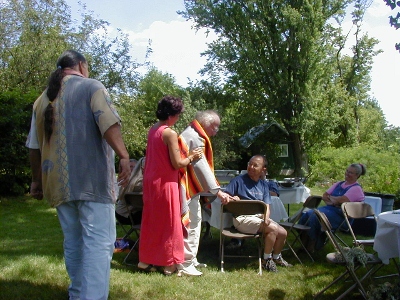
Stephanie Autumn and Clyde Bellecourt honoring Doug with Indian blanket
He sits and smiles,
Peaceful, thankful,
Accepting, connecting
With those he loves,
Caring for those he will leave
The earth, his home,
Calls him to itself,
Beyond eternal claims
Or expectations,
He sits at peace
Mortal flesh he knows
Cannot prolong itself,
Nor should it seek what it
Cannot attain
Beyond its measure.
No control of time
Which bears us all away,
No need now to storm
The barricades against
The end of time.
He sits and smiles
In gratitude and wonder
For sun and shadow,
For all creatures great and small,
For family love and friends.
For these he sits and smiles –
This self-disclaiming man
Who intended nothing
But his own true self
In whatever time was his.
[Gordon C. Stewart, 2004]
Windy’s flute and the Honor Song drumming echoed Doug’s spirit. Like Old Joe Hill, Doug’s voice still echoes down through the ages of time for all who seek justice, love mercy, and walk humbly on this Earth.
Minnesota Law and Politics named Doug Hall to Minnesota’s Legal Hall of Fame. Scroll down to #38 to read the Law and Politics’ tribute to him.
His dog Sparky
Resting against his leg,
His eyebrows hanging
Like willow branches.
The bell has tolled
For him, a tolling
Like a wind-song
From the North
Marking the end.
He sits and smiles,
Peaceful, thankful,
Accepting, connecting
With those he loves,
Caring for those he will leave
The earth, his home,
Calls him to itself,
Beyond eternal claims
Or expectations,
He sits at peace
Mortal flesh he knows
Cannot prolong itself,
Nor should it seek what it
Cannot attain
Beyond its measure.
No control of time
Which bears us all away,
No need to storm
The barricades now
Against the end of time.
He sits and smiles
In gratitude
For wonders of sun and shadow,
For all creatures great and small,
For family love and friends.
For these he sits and smiles –
This self-disclaiming man
Who intended nothing
But his own true self
In whatever time was his.
– Gordon C. Stewart, October 2, 2004
Doug Hall was a giant of a man. He was revered throughout the state of Minnesota as the quintessential “street lawyer” in Minneapolis, a nationally known labor lawyer who left his practice to become the founding Director of The Legal Rights Center, Inc, “a law firm of, by, and for the people.” The people were indigent American Indians and African-Americans.
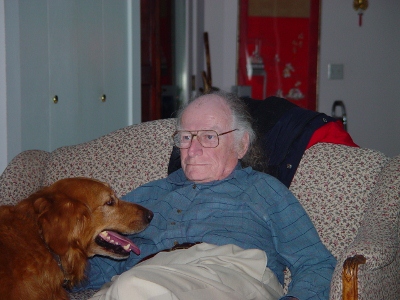
A few days after receiving the call from Doug and Mary with the news that Doug had been diagnosed with terminal cancer, Kay and I spent time with them at the farm near Wabasha, MN. Kay captured a picture of Doug that day with his dog Sparky.I went home and wrote a reflection that later became the opening words of the Memorial Celebration for his life.
A former Chief Judge in Minnesota’s Fourth District Court recalled pulling Doug aside one day into his chambers.
“Doug, I thought you should know a lot of people are talking around the courthouse.”
“Hmmm,” said Doug.
“They’re saying that you’re a communist.”
Re-telling the story all these years later, the Judge starts to laugh and pauses. I beg the question: “What did Doug say?”
Through laughter and tears, he says, “He smiled and said, ‘Hmmm..and what’s their point?'”
His memorial service was a rare event: a collection of street people, former clients, MN Supreme Court Justices, a U.S. District Court Judge who began his legal career with Doug as his mentor, the founders of the American Indian Movement (“AIM”) and African American community leaders, colleagues and friends, Indian drumming, and the sounds of Paul Robeson and Old Joe Hill. The Poem “His Own True Self” opened his Memorial Celebration in Wabasha followed by these words:
We are a diverse bunch. We are the colors of the rainbow. We are rich and dead broke. We are former defendants and former fellow counsel. We are Supreme Court Justices and District Court Judges – and we are “customers” of the court system and the corrections system. We are public defenders and prosecutors, probation officers and corrections officers, restorative justice practitioners, legislators, union organizers and people from the streets. But mostly we are just people who all share the same destiny, the same dependence and interdependence. And no one here is to be treated with more honor than another.
Whose flesh is the flesh of hills and hummingbirds and angleworms,
Whose skin is the leathered skin of the barge-toter and the old Indian Chief and the smooth skin of a newborn babe,
Whose color is the color of the zebra and the brown bear and the green grass snake,
Whose hair is the aurora borealis, the rainbow and nebulae,
Whose eyes sometimes shine like the evening stars, and then like fireflies, and then again like an open wound,
Whose touch is the touch of life and the touch of death,
Whose name is everyone’s, each and all alike, for just a fleeting moment on the shore of time, the hem of your eternity:
Grant us to see ‘tis only the splendor of light hideth thee.’ Let Your healing balm salve the tender wounds of grief and turn the tears of mourning into tears of unshakable joy.
God of the sparrow, God of the whale, God of the pruning hook: You ask only that we do justice, love mercy and walk humbly with You. Lead us to take the claims of justice, mercy and humility into the palaces and chambers of power where public policy is made and administered. Give us confidence that, though truth still sways upon the gallows, yet it is truth alone that is strong.
Let our lives flow in endless song above earth’s lamentations. Let no storm shake our inmost calm. No tempest dim our vision. No noisy gongs or clanging cymbals of ignorant armies clashing by night drown out the gentle sounds of the flute and the dulcimer, the quiet chords of love.
For this work and this alone, raise us up on eagles’ wings to follow Wamble Pok-he, our lead eagle now departed, and to see him standing there, like old Joe Hill, as big as life and smiling with his eyes. “What they could not kill,” says Joe, says Doug, “went on to organize, went on to organize.” “I did not die,” says he. “I did not die. Where workers strike and organize,” says he, “You’ll see Doug Hall,” says he, “We’ll see Doug Hall,” says he. How can we can we keep from singing? Amen.
– GCS, pastoral prayer at Doug Hall’s Memorial Celebration, Wabasha, MN.
Stephanie Autumn and Clyde Bellecourt honoring Doug with Indian blanket
Doug was the definition of “the street lawyer.” The farewell to Doug was attended by the people he had defended over many years, the founders of the American Indian Movement, African-American activists, U.S. District Court Judges, MN Supreme Court Justices, Indian drummers, and “America’s troubadour, Larry Long.” Doug was an important figure in the standoff between the federal troops and the AIM members who occupied Wounded Knee. He served as Director of the Legal Rights Center, and, in the last decade of his life was a leading figure in the state-wide movement for restorative justice. He was the Honorary Chair of the Minnesota Restorative Justice Movement.
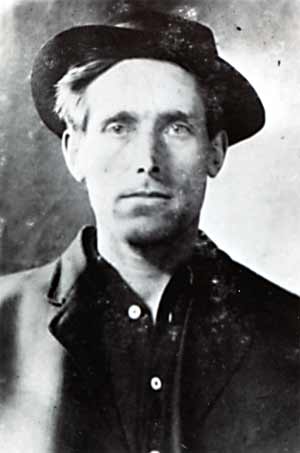
Joe Hill, Swedish-American labor organizer, songwriter, (1879-1915)
I dreamed I saw Joe Hill last night
Alive as you or me.
Says I, “But Joe, you’re ten years dead.”
“I never died,” says he,
“I never died,” says he.
“In Salt Lake, Joe,” says I to him,
Him standing by my bed.
“They framed you on a murder charge.”
Says Joe, “But I ain’t dead,
Says Joe, “But I ain’t dead.”
“The copper bosses killed you, Joe,
They shot you, Joe,” says I.
“Takes more than guns to kill a man.”
Says Joe, “I didn’t die,” Says Joe,
“I didn’t die.”
And standing there as big as life,
And smiling with his eyes, Joe says,
“What they forgot to kill Went on to organize,
Went on to organize.”
“Joe Hill ain’t dead,” he says to me,
“Joe Hill ain’t never died.
Where working men are out on strike,
Joe Hill is at their side,
Joe Hill is at their side.”
“From San Diego up to Maine
In every mine and mill,
Where workers strike and organize,”
Says he, “You’ll find Joe Hill.”
Says he, “You’ll find Joe Hill.”
I dreamed I saw Joe Hill last night
Click HERE for “Ending student expulsions: Minneapolis Public Schools, Legal Rights Center partner for restorative justice.”
Public Schools face daunting challenges. Unlike private schools that can select their students, the public schools are just that – they belong to all of us, they educate the whole population, not just the cream that is skimmed from the top. Urban schools systems like the Minneapolis Public School System provides education to the poorest of the poor, the middle class, and wealthier families committed to public education.
In Minneapolis alone, the students coming into the schools speak over 80 different languages from as many different cultures. What happens in the public schools will determine America’s future.
The restorative justice partnership between the Minneapolis Public Schools and Legal Rights Center is a natural. Legal Rights Center, Inc. (LRC) was founded in 1970 by four leaders of the American Indian and African-American communities in Minneapolis, and a lawyer named Doug Hall. Clyde and Peggy Bellecourt, Syl and Gwen Davis, and Doug Hall gave birth to a law firm that belongs to the people, a non-profit law office staffed by community advocates and street lawyers who work for the people of the street.
Michael Friedman, the current Executive Director of LRC, continues the tradition of the spirit and heart of these founders.
Douglas Hall, Founding Director, Legal Rights Center, Inc.
During the last decade of Doug Hall’s life, I served as Executive Director of LRC. Kay and I spent many hours, days, and weekends with Doug and Mary on their farm near Wabasha, MN. Doug had become convinced that restorative justice offered the best hope for empowering and repairing communities affected by multi-generational violence and trauma. In his last years, Doug gave birth to the Minnesota Restorative Justice Campaign and served as its chair for three years.Michael Friedman, the board and staff of LRC are carrying the torch for Doug and Mary Hall, Clyde, Peggy, Syl, and Gwen.
The day of Doug’s memorial service, his daughter Claire walked through the woods to the small clearing where the family had buried Doug’s ashes. There were four stones pointing in the four directions. In the center were Doug’s remains. A bald eagle sat in the center of the stones on Doug’s ashes. While his ashes remain there on the farm, his legacy and spirit are soaring in the new partnership to stop the prison train before it gets on the tracks…in the school system.



 Views from the Edge