Today’s Washington Post breaking news announcing that the U.S. will be one of five nations leading the way on limiting methane and soot (see earlier post with link below) prompts me to re-publish Climate Change commentary on “All Things Considered” (MPR.org) – personal reflection on a day with Earl, the old oyster fisherman, on the “Skipjack” on the Chesepeake Bay.
Washington Post Story on Climate Change
A Washington Post story on Climate Change reports this breaking news:
“With global efforts to reduce carbon dioxide emissions stalled, the United States and five other countries are starting a new program to cut other pollutants — including methane, soot and hydrofluorocarbons — that contribute to global warming.
“Secretary of State Hillary Rodham Clinton is set to announce the five-year initiative Thursday morning. Canada, Sweden, Mexico, Ghana and Bangladesh are also participating. The plan will be administered by the United Nations Environment Program, with a $12 million contribution from the United States for the first two years. Canada will add $3 million; contributions from the other countries are not known.”
It goes on to report, “Paul Bledsoe of the Bipartisan Policy Center noted that, in the United States, efforts to reduce methane and soot are far less politicized than efforts to reduce carbon dioxide. Even one of the most vehement congressional opponents of limiting carbon dioxide emissions, Sen. James M. Inhofe (R-Okla.), supports cutting soot emissions. Senator James Inhofe (R, OK), supports cutting soot emissions.”
I have to remind myself to celebrate small steps. This is one of them. My hope and prayer is that Senator Inhofe’s acceptance of scientific evidence supporting action on methane and soot will be one small step toward a saner discussion of global warming. I just asked the question of the Washington Post whether they know why Senator Inhofe is convinced by the scientific evidence re: methane and soot, and, likewise, what scientific evidence convinces him that we do not need to limit carbon dioxide emissions. Anybody know?
.
Religion and the White House
Gordon C. Stewart Feb. 14, 2012
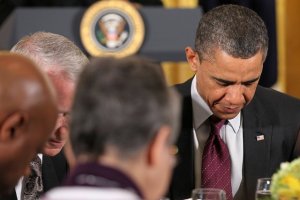
Is the religion of presidential candidates off limits?
President Obama’s remarks at the 2012 National Prayer Breakfast and Mitt Romney’s statement about the poor and the wealthy resurrect a question regarded since 1960 as off the table.
The religious issue in 1960 was the Roman Catholicism of John Fitzgerald Kennedy. No Roman Catholic had ever been elected President. The question was whether a faithful Catholic would be subservient to the Bishop of Rome, the Pope, in matters of state. Finally the question was put to Kennedy himself.
Since that time, with the exception of conservative fundamentalist Christians, American culture has increasingly accepted the separation of one’s religion from one’s politics. Religious faith is regarded as private; political beliefs are public.
The old adage that the way to best assure civil tranquility is to steer clear of religion, sex, and politics is good advice at family reunions and the like, but does it serve the public interests of an informed electorate in a democratic republic?
It should not go unnoticed that then-candidate Obama’s faith was brought into the national spotlight when his political opposition sought to paint Mr. Obama as un-American because of comments made by pastor Jeremiah Wright.
The unspoken journalistic rule that “religion is off-the-table” was set aside by ABC’s investigative reporting into 500 hours of sermon tapes by Mr. Obama’s pastor and its decision to air a one-minute excerpt from one of Mr. Wright’s sermons.
It made no difference that the sermon from which the excerpt came was biblically-based and in the bold African-American preaching tradition of Sojourner Truth, Dr. Martin Luther King, Jr., and Howard Thurman that thunders the Hebrew prophet’s voice in scripture as it apply to today’s news. Nor did it matter that the statement about the chicken’s coming home to roost on 9/11 came after a long recitation of the history of American violence at home and abroad. Mr. Obama’s religion was on the table.
The public wanted to know. Was the President a Christian? Or was he, as some of his opponents claimed or insinuated, a Marxist, a secret Muslim, or un-American?
Mr. Obama eventually denounced the excerpt from Rev. Wright’s sermon, resigned from the church, and used the controversy to spell out his own views in a brilliant speech in Philadelphia on race in America called “A More Perfect Union.”
So here we are in 2012.
Mitt Romney is a member of the Church of Jesus Christ of the Latter Day Saints (LDS), a Mormon. His statement about the very poor, the middle class, and the wealthy became the center of media controversy. “I’m in this race, he told CNN following his primary victory in Florida, “because I care about Americans. I’m not concerned about the very poor. We have a safety net there. If it needs repair, I’ll fix it. I’m not concerned about the very rich, they’re doing just fine. I’m concerned about the very heart of America, the 90-95 percent of Americans who right now are struggling.” To be fair, his statement, like the Rev. Wright’s ignoried his earlier remarks. Nevertheless, the statement deserved careful scrutiny.
At the same time, President Obama’s religion was in the news again because of heavy criticism for connecting his faith with his public policies at the 2012 National Prayer Breakfast where he described his motivation as “living by the principle that we are our brother’s keeper. Caring for the poor and those in need.” “These values,” he said, “they’re the ones that have defined my own faith journey.”
In doing so, Mr. Obama voiced a conviction central to the Judeo-Christian tradition. The belief goes to the heart of the Christian faith – the Golden Rule: “Do unto others as you would have them do unto you” and Jesus’ parable of the Last Judgment in which Jesus tells his listeners that, if they want to know where to find “the Son of Man,” they will find him among the poor and destitute (Matthew 25:31-4.).”Insofar as you have done it to one of the least of these, you have done it to me.”
Mr. Obama’s view came under attack from a number of quarters. One response came in the Washington Times with the headline “President Obama misrepresents the teachings of Jesus at National Prayer Breakfast,” arguing that “Jesus did not teach that wealthy people should give more money to the government or charity than others should.” And on CNN on-line, the public comments re: the President’s position ran heavily against his view.
At the same time, Mitt Romney’s stock was rising. So is his religion. Years ago Leo Tolstoy asked the American Ambassador to Russia about the new religion in America, the Ambassador pleaded ignorance, Tolstoy described Mormonism as “the quintessentially American religion” that would one day catch fire and be unstoppable.
Is religion on the table or off the table in 2012? If it’s on the table for discussion, as in Mr. Obama’s Prayer Breakfast statement, the question about the “quintessentially American religion” should also be on the table. How would Mr. Romney’s religious views affect his public policy decisions? What difference would it make to his conduct of foreign policy that his religion is American-centric, believing that “Christ appeared in the western hemisphere between his resurrection and ascension to heaven; that the State of Missouri is the site of the Garden of Eden as well as the site where Jesus will return at the Second Coming? “For this and other reasons, including a belief by many Mormons in American exceptionalism, Molly Worthen speculates that this may be why Leo Tolstoy described Mormonism as the “quintessential ‘American religion'” (Wikipedia).
One does not need to be a partisan opponent or a despiser of religion to ask whether a candidate for the Presidency believes that America is sacred, God’s chosen people, and if so, what the implications are for how he would use American power and influence in a world that is always just one step away from nuclear holocaust.
It was the pernicious idea of American exemption from the way of the nations that got us into Iraq, and it is the rejection of that idea that has allowed us to begin to pull back into a more humble and realistic way of being America. The idea of American exceptionalism is widespread across party and religious lines in America, and, most sadly, an electorate that fears the future may fall for whichever candidate continues the illusion that America is God.
If I could ask one question to those who aspire to the White House, I would ask them to reflect, line by line, on the Clifford Bax’s hymn (1919):
Turn back, O man, forswear thy foolish ways.
Old now is earth, and none may count her days.
Yet thou, her child, whose head is crowned with flame,
Still wilt not hear thine inner God proclaim,
“Turn back, O man, forswear thy foolish ways.”
Earth might be fair, and all men glad and wise.
Age after age their tragic empires rise,
Built while they dream, and in that dreaming weep:
Would man but wake from out his haunted sleep,
Earth might be fair and all men glad and wise.
Earth shall be fair, and all her people one:
Nor till that hour shall God’s whole will be done.
Now, even now, once more from earth to sky,
Peals forth in joy man’s old undaunted cry—
“Earth shall be fair, and all her folk be one!”
Melody from The Genevan Psalter

You don’t get to have a non-Jewish Jesus
Gordon C. Stewart Feb. 14, 2012
“Who was Jesus?” I asked the Jehovah’s Witnesses who had rung the doorbell. Through the upstairs window where I do my writing, I had seen the van pull over across the street and empty out. I thought perhaps there was a family gathering next door until two of them walked up the drive way.
An email response to “Whitney Houston, the Leper, and You” (posted below) reminded me of the conversation that ensued. Here’s the email from Ann in Texas:
“So nice to hear from you and feel your energy out there flushing out injustice and ranging around in the ‘big ideas,’ and formative experiences. Bravo! Passion writes action… and here’s mine… an odd reaction, I’m sure, but to the leper story, and the overturning of the tables and all the examples we use to cast aspersions on ancient Judaism that help perpetuate in my mind a subtle continuing contemporary anti-Judaism and the continuing need for an Israel that has morphed into “pants” to small to hold it. Now there’s a view from the edge!”
I share Ann’s concern. I hold my breath every time I preach or write on texts like this, painfully aware of the anti-Semitism that continues in subtle and not-so-subtle forms.
When the Jehovah’s Witness rang the doorbell, I was deep into writing a sermon on planetary stewardship and sustainability in the wake of the B.P. oil “spill” – Deep Water Horizon blow out in the Gulf of Mexico.
The dogs were barking up a storm at the two men standing on their porch. I went down, answered the door, and stepped outside to meet them.
They were kind and gentle people. They wanted me to know that the world was coming to an end. “Yes, I know,” I said, “what do you fellas think about the crisis in the Gulf of Mexico?” They preferred to talk about Jehovah, the Book of Revelation, the end of the world… and Jesus.
“Okay, let’s talk about that. “Who was Jesus?”
“He was the Son of God.”
“And who was the Son of God?”
“Jesus Christ.”
“And who was Jesus Christ? Christ is not Jesus’ last name. It’s a title. So who was Jesus?”
“The Son of God, Jesus Christ.”
“Let me ask it differently. Who was Jesus of Nazareth?’ Who were his people and what was Jesus’ religion?
“What do you mean?”
“Well, Jesus was a real man, in real time. He lived in a particular time and place. Jesus didn’t suddenly plop down out of the sky. So who was Jesus of Nazareth?
“He was the Messiah, the Christ. He came to bring the new Covenant.”
“And what about the first covenant? What was Jesus’ religion?
“He was a Christian,” they said.
“Jesus was a Christian?! You can’t follow yourself. A Christian is someone who follows the Christ. Jesus was not a Christian. Jesus was a Jew. And he’ll always be a Jew. You don’t get to make him up like that. We can’t create Jesus in our own image. You don’t get to have a non-Jewish Jesus!”
We talked then about Jesus and the Book of Revelation. We discussed the fact that the Book of Revelation is a literary genre of the first century called “apocalyptic” that was peculiar to that time; that it was written by a disciple of Jesus held prisoner by the Roman Empire on the Isle of Patmos, who was denouncing the imperial claims of the Roman Empire, and proclaiming its end in bizaare images of Jewish Scripture (in Danile and Ezekiel). The Book of Revelation wasn’t, as so many think today, a book of predictions about the future or the end of the world.
“You’ve thought about this a lot,” said one of the men. “You really seem to have spent a lot of time studying this.”
I thanked him for the compliment and responded that although I’ve been thinking about these matters all my life, I still know very little.
At the end of the 45-minute conversation, I told them how much I respected their commitment to their beliefs and their sacrifices of time and money. I took their literature and invited them to think about what Jesus would have us do about the crabs, the oysters, and the oil-soaked birds drowning in oil in the Gulf of Mexico.
If we were all as committed to the healing of the planet and to the care of the poor as my visitors were that day to spreading their message with urgency, the world would be a better place.
Those of us who carry the name “Christian” don’t get to have a Jesus who is a Christian. The only Jesus we get to have was and always will be the Jewish Jesus of Nazareth, whose people have been crucified many times by the anti-Semitic pogroms of those who claim to follow him.
The Jesus who heals the leper also tells the leper to “go and show yourself to the priest and offer the sacrifices that Moses commanded for your cleansing….” Jesus is telling the man to practice his Jewish tradition, but Christian interpreters typically fail to notice the startling clarity of Jesus’ Jewishness. Likewise, any reading that begins with the assumption that Jesus was a Christian mistakes Jesus’ turning over of the money-changers’ tables in the temple as his rejection of Jewish faith and practices rather than the deepest affirmation of the Jewish covenant by which he lived. In faithfulness to the covenant, he protested the abuse of the covenant by the religious leaders of his time who had forsaken their high calling by collaborating with and cozying up to the Roman economic and military powers that occupied Jerusalem – just like today.
Thank you, Ann, for the email that reminded me.
Whitney Houston, the Leper, and Us
Two news stories caught my eye this week: The death of Whitney Houston and Minnesota Governor Mark Dayton’s visit to the Hospital for the Criminally Insane in St. Peter, Minnesota. The New Testament Gospel text for this morning was the story of Jesus and the leper (Mark 1:40-45). The title of the Sermon was simply “THE LEPER” preached at Shepherd of the Hill Presbyterian Church, Chaska Minnesota, February 12, 2012. Here’s the text of the sermon:
Just another leper,
the better left unseen.
“Surely it is their own fault
for not keeping clean.”
Just another AIDS case
now hidden well away,
“They must have brought it on themselves
promiscuous or gay.”
Just another boat person
sponging on me and you,
“They’ve only got themselves to blame
by trying to jump the queue.”
Just another drug addict
shooting up behind the shed,
“Don’t waste your pity on such trash
they’re better off dead.”
Just one determined Jesus
coming through our lands,
welcoming all the unclean mob
with warm, saving hands.
– Copyright B D Prewer 2002, “Lepers, Jesus and Us”
Who is the leper? Could he be me? Could he be you?
I’ve spent a lot of time with the leper. I live inside his body. The sense of nausea with my own sorry self, and I’ve met him a thousand times in the same sense of leprosy I’ve experienced in the lives of others.
This disease is part of the human condition itself. The sense that there’s something wrong with us, something that doesn’t belong, isn’t worthy, needs to stay hidden, closed off from the rest of the world, a leper kept at arms length from full participation in the fullness of life.
Sometimes the disease is so clear it slaps you in the face. We see it clearly in others.
Whitney Houston, that beautiful soul – the god-daughter of Aretha Franklin and cousin of Dione Warwick – is found dead somewhere in Beverly Hills. “Cause of death unknown.” But what we do know is that she struggled for years with the horrors of addiction, this sense of isolation and self-accusation that was the lot of the leper who came to Jesus that day.
Some of the lepers are people of fame and apparent success, like Whitney.
Others are people of infamy. Like the psychotic mother who took the life of her nine-year-old son when the voices told her to kill him. As we did at The Legal Rights Center, we took her case not because she was innocent, but because she was a human being – the most obvious of lepers, a decrepit sinner who had stabbed her son more than a hundred times. She had gone off her medication, and the “voices of the Devil” had taken over. After rhe State had committed her to the Minnesota Department of Corrections’ Hospital for the Criminally Insane, a sorry place, if ever there was one, I visited her. I listened to her sobs. I watched the tears streaming down her face, looking through the glass of the prison visitation room tha t stood between us. The walls of her inner prison were thicker and higher than the walls of the hospital that housed her. Back on the medication that put her back in her right mind, she was inconsolable, a leper who could never undo what the voices had told her to do.
But it’s not just the likes of Whitney,whose sense of leprosy was hidden by success, or the likes of Mary, the pitiful victim of criminally insanity, who is the leper.
We all are.
Listen to Dietrich Bonhoeffer, one of the great heroes of the Christian faith, in words of Voices in the Night, preserved from his prison cell where he was imprisoned for his participation in a failed conspiracy to assassinate Adolf Hitler. He is alone in the middle of the night, restless, ill at ease, in dis-ease, you might say, with the dis-ease of spiritual leprosy, lying there, listening in the night for the sounds inside and beyond the prison.
Night and silence.
Only footsteps and shouts of the guards.
Do you not hear it in this silenced house,
Shaking, breaking and collapsing,
As hundreds kindle the glowing ember of their hearts?
Their songs they hide,
My ears are open wide.
“We who are old, and we who are young,
We children of every tongue,
We who are strong, and we who find it hard,
We who sleep, and we who guard,
We who are poor, and we who have all,
Together into failure fall, (italics mine)
We who are good and we who are unclean,
Whatever we have been,
We…with scars we cannot hide,
We witnesses of those who died,
We who are defiant and we who are bemused,
By long isolation, sorely abused.
Brother, we seek and call for thee!
Brother, do you hear me?”
Who was the man who broke the rules to force his way through the clean crowd, shouting “Unclean! Unclean!” while he coveed his face until he got to Jesus?
Could he be me? Could he be you?
“If you will it,” he says to Jesus, “you can make me clean!”
And stretching out his hand with great compassion, he touches the untouchable, and says, “I will! Be clean!”
“Just one determined Jesus coming through our lands, welcoming all the unclean mob with warm, saving hands.” And the cleansed man ran and told everyone what Jesus had done for him.
How about you?
“It’s not easy being real”
Last night I listened to President Obama’s speech on contraception and religion institutionso courtesy of Unedited Politics. I then looked to see if there were comments. There was only one:
“This has nothing to do with so called women’s health, it’s Marxism 101.”
With no elaboration as to how or why the President’s speech or position on women’s health care, on the one hand, and religious liberty, on the other, was Marxism 101, the comment accomplished what such comments nearly always do, until they are challenged. It called someone by a name. End of discussion. No need to explain how or why it’s Marxism. “Bad! Boogie Man! Evil in the White House!! The Marxists are out to get us!”? So I wrote my own comment:
Oh, my! Dear friend, whoever you are, you must never have taken Marxism 101. This isn’t Marxism. It’s the work of a democratic republic – messy, balancing values that sometimes conflict with each other, protecting the rights of the minority against the tyranny of the majority, and guaranteeing equal protection (in this case, health coverage) to all citizens. It’s comments like this – confusing a health care position with Marxism (i.e. communism?) – that divert the discussion and take us back to the darkest time of American history, the Senate Hearings of Sen. Joseph McCarthy that painted decent, patriotic Americans as evil. The President is NOT a Marxist, my friend. Time to rescind the comment for the sake of civil discussion that helps to solve real problems.
The reply came soon after:
Try reading his books and consider the fact that he attended a Marxist church for 20 years.
Again, I replied:
I’ve read Marx. I spent the summer of 1966 in Bratislava, Czechoslovakia as the Chicago Ambassador of the Experiment in International Living. I lived with the Schulz family, all members of the Communist Party. Marxism is more than a figment of my imagination. And the church Obama attended is a CHRISTIAN Church, United Church of Christ, one of America’s historic “mainline” denominations. ABC watched 500 sermon videos and chose to air a one-minute clip from a sermon on one of the Hebrew prophets that led viewers to conclude Jeremiah Wright was a communist. Radical? Yes. Off the wall? Sometimes. But Marxist (i.e. not Christian, not a disciple of the Jesus who turned over the money-changers tables)? No. And to talk about this President as a Marxist is…go back and watch Joe Welsh’s final rebuke to the character assassination campaign of Sen. Joe McCarthy: “Have you no decency, Sir. Have you no decency left?” Please think twice before raising McCarthy’s ghost. It’s ugly.
In 1966 I was certain that my finalist interview with the selection committee of the Chicago Chapter of the Experiment in International Living had disqualified me as a candidate as Chicago Ambassador to Czechoslovakia for the summer of ’66.
“You’re a Christian and a seminarian, asked Paul Harvey. “Why would you want to go to a communist country?” I responded at some length that I didn’t trust the stereotypical representations of Eastern Bloc countries any more than I would trust their representations of the West. I felt there was propoganda on both sides of the Cold War. I wanted to see for myself. I also told them that there was a theologian in Czechoslovakia named Josef Hromadka, the father of Christian-Marxist dialogue. I had been reading Hromadka and others and wanted to participate in this discussion. I believed that the Marxist classless society was a rendition of the central biblical message of the Kingdom of God. I came out of the interview and said to another candidate, “Well, I just eliminated myself. Hope you have a great summer.”
To my surprise, they selected me. The generosity of Pan Schultz and Pani Schultzova, their son Vlado and daughter Jana who welcomed me like a member of their own family, conversations with students about Franz Kafka and the existentialists at the university coffee shop, and the ugliness of fellow-American Ambassadors (there were 11 of us) who insisted on ice cubes in their drinks combined to further open the aperture of my camera lens as I look at the world.
I decided long ago not to keep silent when the labels like “Marxism 101” march across the field of my camera. My experience is only mine, but it’s the only experience I have, and God knows how limited it is. But, I decided to to heed Frederich Buechner counsel – “Listen to your life”, he wrote – and to speak out loud what I see and hear, hoping and praying, as I do every Sunday morning before I dare to preach, that in some inscrutable way, “the words of my mouth and the meditations of all of our hearts will be pleasing in Thy sight, O Lord, our Rock and our Redeemer.” I’d love to hear your meditations. Leave comment to share.
“It’s Beautiful!”
Sometimes it takes a visitor from someplace warm to remind us of the beauty in the cold
Gordon C. Stewart published by MPR December 30, 2010
About this time of year, people in the Upper Midwest are wishing we were in Florida, Arizona, California or Mexico. The snow and cold get old.
But there’s a beauty to the snow and cold. Last week my friend Steve, who lives in Florida, finally came to Minnesota. Steve and I went to junior high school together in Pennsylvania. He’s lived mostly in the sunny climates of California and Florida. I’ve become a Minnesotan.
I’ve been trying to get him here for years; he always laughed when I told him how beautiful it is. “It’s cold!” he’d say.
Last week when, to my eyes, the snow had gotten dirty and the cold was bone-chilling, Steve finally came to Minnesota for his nephew’s wedding. When I picked him up at his hotel, the first words out of his mouth were, “It’s beautiful! This is really beautiful!”
We drove to the Dunn Brothers in downtown Chaska for a cup of coffee. “Wow, this is really neat,” he said. “We don’t have anything like this in Florida. This is a real town.” After an hour of catching up over coffee, he asked if we could walk down to the river. We walked the few blocks to the river and along the path that runs along the top of the levy in front of the townhomes.
It’s a beautiful scene of the Minnesota River. I was freezing up there, but Steve shot pictures, as excited as I would be snapping pictures of sea turtles spawning on a warm beach in Florida.
They say beauty is in the eye of the beholder. Steve was beholding it. I was not — until I got home and saw the picture Steve had posted on Facebook, and the comment posted by someone who hadn’t been chilled to the bone on the riverbank. “That’s beautiful!” she wrote. “It’s so perfect it doesn’t even look real.”
And I realized: It is beautiful, and it is real. Just like the real downtown and the old corner coffee shop where strangers get to know each other by name — a real place to warm ourselves while we complain about the winter weather over a cup of coffee.
About the middle of January I’ll forget how beautiful it is here in Minnesota. I might spend a few days at Steve’s condo in Florida just to get warm, and to realize again what we have here that Steve doesn’t have there.
In the meantime, when the snow and cold get old, I’ll look at the Currier and Ives picture Steve put up on Facebook to remind myself of the beauty I take for granted in the Land of 10,000 (frozen) Lakes.
“Say the word ‘freedom'”
When the political campaigns speak of ‘freedom,’ listen with care
Gordon C. Stewart, published By MPR, aired on “All Things Considered”, August 31, 2011 Click LISTEN to hear the commentary on Minnesota Publc Radio.
My hearing continues to get worse. In the sound-proof booth of the hearing test, the audiologist asks me to repeat the words I hear…
“Say the word ‘good’.”
“Wood.”
“Say the word ‘cold’.”
“Hold.”
“Say the word ‘gold’.”
“Goal.”
It’s not easy inheriting my mother’s hearing loss. Getting the words wrong often separates me from normal conversation.
But it also has its advantages. I listen more carefully, and the world of silence brings me to a deeper reflection about the words we hear every day.
I’ve begun to listen more carefully when the word “freedom” is used.
“Say the word ‘free.'”
“Free,” we say. And something deep within us hears the national anthem: Land of the free, and the home of the brave.
We Americans love freedom.
Future anthropologists will likely observe that freedom was the most treasured word in the American vocabulary. It is the most powerful word in our language.
No one understands this better than the handlers of political candidates. They know that the word evokes an unspoken reverence, and that perceived threats to freedom alarm us and cause us to get back in the ranks of freedom’s faithful. They know the nature of language and of word association.
“Say the word ‘freedom’,” they say.
“Democracy.”
“Say the word ‘regulation’.”
“Socialist.”
“Say the word ‘socialist’.”
“Un-American.”
“Say the word ‘government’.”
“Enemy.”
“Say the word ‘American’.”
“Free.”
Freedom stands alone in the American pantheon.
Ironically, in the hands of the unscrupulous, the word we associate with individual liberty can cause a collective stampede. It calls us from grazing freely in the pasture to joining a mindless herd.
We don’t like heresy; we’re afraid of being heretics.
My hearing will continue to get worse. It will take me into a world of increasing silence. In a way, I wish the same for the rest of my countrymen. We could all use some time away from the word-association games.
When we hear the word “freedom,” we should be free to listen carefully and understand it for ourselves.
The American Dream on the Ropes
Gordon C. Stewart | MinnPost.com, Wednesday, March 16, 2011
“Sometimes I feel like a motherless child.” The homeland I mourn is the world I once thought I knew. It was far from a perfect world, by any measure, but its ideals seemed intact. There was set of shared expectations of fairness, some measure of equality, the vision of a more just and peaceful world freed from poverty, oppression and war.
Today that world is as much of a memory as my boyhood home. Something has died. The American dream is rising in Egypt, in Tunisia, and across the Arab world, but it is on the ropes here in America. The cry for democracy, basic human rights, and an end to Mubarak’s self-serving economy has its echo in Madison, Wis., where workers have stood tall for the right of collective bargaining. But not tall enough to stop the turning back of the clock. Nor are they bold enough to strike, as unions would have in my youth.
All across America the hard-earned gains of the labor movement are being painted as evil, yet not a single person on Wall Street has gone to jail for the fraudulent, greedy schemes that brought the American economy to its knees in September-October, 2008. Not one. The idea of democratic rule — the rule of ordinary, hard-working people — has been high-jacked by a ruling class that has no shame while it takes home most of the cookies. It pays little or no taxes, cries foul about spending, raids the Social Security Trust Fund to pay for its wars, blames the deficit on liberal social programs, and leaves the crumbs from its budget-cutting for the rest of us to fight over.
The Soviet Union was feared
My generation’s formative years during the Truman and Eisenhower administrations had us ducking under our school desks in preparation for a nuclear bomb that was sure to drop on my little town outside of Philadelphia. The U.S.S.R. was the enemy and was out to get us. “Getting us” would mean, we thought, an end to democracy, an end to freedom.
Never did it occur to us that the end of democracy and freedom would come from what President Dwight Eisenhower later warned of: the American military-industrial complex that would usurp the people’s right to rule themselves. Never would it have occurred to us that a U.S. Supreme Court would rule that corporations are “persons” when it comes to the electoral process — people just like us free to spend the money none of the rest of us “persons” has to buy an election.
Sunday mornings after church I remember turning on the religious show that featured Oral Roberts ranting and raving and waving and “healing” his bizarre church in Oklahoma City — thinking that this must be some kind of joke. What was bizarre then has become mainstream today. Michele Bachmann, whose law degree comes from Oral Roberts University Bible-based O.W. Coburn School of Law (now defunct) and Sarah Palin, whose church makes Oral Roberts look temperate, would have been laughed off the stage when I was a kid. Today they own the stage, and their Annie Oakley, winner-take-all politics and economics set the agenda — not only in Minnesota and Alaska, but in Wisconsin and in Washington, D.C. Patriotism has become a white fundamentalist Christian packing a semi-automatic on the lookout for the same people Sen. Joseph McCarthy hunted down in the early ’50s.
I remember Joe McCarthy. I didn’t like him then. I don’t like him now. And I don’t like those who imitate him wearing lipstick on their beauty-queen faces and have the gall to call the president of the United States “un-American.” We no longer need a House Un-American Activities Committee to conduct our witch hunts. The verdicts are rendered ad hoc by demagogic politicians with law degrees from a law school founded by Oral Roberts that lasted only seven years before closing its doors.
Americans want ‘real’ people as leaders
Who needs Harvard, Yale, Princeton, the University of Minnesota, the University of Wisconsin, the University of Michigan or Notre Dame? We want our elected leaders to be “real” people untainted by elitist educations. And we want them to tell us that “taxes” — the word that once upon a time stood for my share of personal responsibility for America’s infrastructures, values, financial security and national defense — are greedy government conspiracies to rob our us of what is rightfully ours.
“Sometimes I feel like a motherless child a long way from home,” sang the African-American slaves picking cotton out in the fields. Some who sang the songs were children who had been separated from their mothers and families as prize chattel on the slave blocks. Others sang it mourning their African homeland. Sometimes “home” stood for heavenly release from the terror of the plantation. The mournful tones from the cotton fields echoed off the walls of the plantation owners’ mansions. The owners considered their work force part of their plantation American Way of Life, while the enslaved workers sang of a different homeland right under their masters’ noses.
I have not been stolen away. But the sense of grief, anger and sadness could not be more real. My mother has died. My country has been stolen. “Come, my brother, come my sister, a long way from home.”
Sorrow Floats: the Healthy Deregulated Capitalism Myth Just Keeps Re-surfacing
Gordon C. Stewart | Thursday, Sept. 10, 2009 – MinnPost.com
“Sorrow floats.” Perhaps the line from a John Irving novel — in which “Sorrow,” the stuffed family dog preserved by a taxidermist, floats to the surface of the lake after a plane crash — helps explain what is happening in America.
Something dear to the American family died one year ago last September-October. Prior to the series of chilling events of that period, most of us had lived with the illusion of relative economic and financial health. Then Sorrow was rushed to the emergency room for government resuscitation.
Since then our memories of that pre-September 2008 world have taken a turn that families often take at funerals when the eulogies bear little resemblance to the reality of the deceased. We’re quarreling over what was real and what is mythical reconstruction.
Following the plane wreck that takes the lives of the Berry family parents in Irving’s “The Hotel New Hampshire,” the stuffed family pet bobs to the surface of the lake, floating among the wreckage. Sorrow floats. So does the thing we lost last fall.
What died? A ruling assumption
What died last year was the ruling assumption that an unregulated free-market system was the best way to organize an economy and that laissez-faire capitalism is democracy’s natural ally. The market almost crashed. It didn’t crash only because the federal government intervened to prevent a repeat of the crash of 1929. Sometime between mid-September and Oct. 7, when Congress passed its bill to stabilize the financial markets, the myth of the virtue of deregulated capitalism died. It was stuffed by the taxidermy of government intervention, but it still floats.
When a conviction or a myth dies, it doesn’t go away. It continues to bob to the surface. Sometimes, as in the case of the Berry family, the old dog is much easier to love after it is dead. Sorrow — obese, lethargic, and persistently flatulent in its old age — no longer waddles through the dining room to foul the air and ruin everyone’s dinner. In the public psyche, the unpleasant memories of the real life Sorrow give way to the stuffed Sorrow, a thing of nostalgia that lives on … even after it’s dead, and long after the plane has crashed.
Over and over, we forget
Sorrow and its old illusions float every time the reconstructed memory, forgetting the real Sorrow, barks about “socialism.” Sorrow floats every time we shout each other down in town-hall meetings. Sorrow floats every time nostalgia forgets that it was only by government intervention that Sorrow is still around. Sorrow floats every time we forget the voracious appetite, unscrupulous predatory practices, insatiable greed, and the obesity that led to the deaths of Lehmann Brothers, Merrill Lynch and Bear Stearns, not to mention insurance giant AIG and all the banks that had taken the plunge into a market of deregulated derivatives and mortgages that led to the epidemic of home foreclosures, bankruptcies, pension-fund collapses and job losses. Sorrow, the old dog that failed us, still floats and still barks a year after the crash when the mind forgets and nostalgically remembers a system we thought was working in our interest.
Old ideas and convictions die hard. The powerful economic forces that grew fat during the years when government was viewed as the people’s enemy will stoke the fires of public anxiety and anger, taking advantage of the floating Sorrow that reminds us of something that we love more in retrospect than we did the day it died of its own obesity.
The Rev. Gordon C. Stewart is pastor of Shepherd of the Hill Presbyterian Church in Chaska. He is the moderator of Shepherd of the Hill Dialogues and former executive director of the Legal Rights Center. The views expressed in this article are his own and do not represent the views of anyone else.