Maybe we bumped our heads getting a little snack last night! And the night before that, and…. Will it ever stop?

Maybe we bumped our heads getting a little snack last night! And the night before that, and…. Will it ever stop?
by Gordon C. Stewart, written five weeks ago in flight from Minneapolis to Los Angeles…before we learned that Kay’s ankle was broken.
“Pay attention. Live in the moment. Don’t rush to be where you aren’t. Be right where you are.”
If, for instance, you’re on the stairs… well, watch your step!
This morning Kay and I rose early to catch a flight for a much-needed vacation on the coast of California. We’re excited about this trip, planned at the last moment in the aftermath of losing the dog companions who have been with us for all but the first month of our 14+ year marriage.
Lonely at home without Maggie and Sebastian, I called Kay last Thursday. “Let’s get out of here. The house is empty without them…but we now have freedom to travel. Let’s go somewhere fun.”
Fred, Kay’s colleague at work, said he knew just the place: Cambria, California, a four hour drive north of LA, one his favorite places on the California coast just south of Big Sur.
Within 24 hours we had booked the flights, found a beautiful home in Cambria through VRBO (“Vacation Rental by Owner”), and looked forward to flying out of Minnesota on Monday (today).
Yesterday, Susan Lince, a local artist who moved to Chaska two years ago after teaching Eskimo children in northern Alaska, led us through exercises to become more aware of the senses. Most important is being where you are….touching, tasting, smelling, hearing, seeing.
So…this morning…with Maggie and Sebastian gone, we packed our bags and headed downstairs to the garage.
I had gone first, packed most of the bags in the car, and was waiting for Kay. I assumed she had gone back to get something or to turn something off in the kitchen. I was wrong.
She had fallen down the steps – nine of them – carrying a suitcase I had missed. She came into my sight in the garage limping badly on the ankle that is severely sprained, at best, pulling the suitcase behind.
We iced the ankle and left home for the airport.
Right now we’re on Sun Country Airlines Flight 421 to Los Angeles. Kay has been treated royally since we arrived at the terminal. A wheelchair. Special privileges in getting through security without a line. A Sun Country Airlines attendant pushing her wheelchair and taking care of her needs while the husband who had forgotten the suitcase that contributed to her fall took care of his own bodily needs. The people at Gate 3 arranged for us to change seats so that Kay could have her own row of seats to keep her leg up during the flight.
So…Live in the moment. Touch, see, smell, hear, and taste where you are. And if you’re on your way to California, watch your step when you’re still in Minnesota. You could end up feeling the cold of an ice-pack on your ankle.
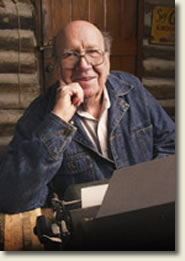
Will Campbell
Will Campbell was that rare person of integrity who seemed to fulfill the hard calling described once by his friend William Stringfellow – “to be the same person everywhere all the time” – and his different places still blow the mind.
He was idiosyncratic. Who else would or could march at the forefront of the Civil Rights Movement in the 1950s and ‘60s, once the law was changed, turn his ministry to sipping whiskey with the Good Ol’ Boys on the front porches of the Ku Klux Klan?
Campbell was a son of the Deep South, a white Southern Baptist preacher raised in Mississippi, who betrayed his white privilege as a matter of Gospel discipleship. He became one of the closest friends of the youth Rev. Dr. Martin Luther King, Jr., the only white person present at the founding of the Southern Christian Leadership Conference that led the charge for Civil Rights in America. He was trusted that much.
His life was threatened repeatedly. He gained national prominence as a field worker for the Department of Racial and Cultural Relations of the National Council of Churches, the nation’s largest ecumenical council that suffered heavy criticism from anti-civil rights forces across the country, but especially in the Deep South. The National Council of Churches and Will Campbell were to their critics what the KKK was to those who worked to eliminate segregation in America.
When the nine black school children walked through hostile crowds to integrate the public school system in Little Rock, Arkansas, Will Campbell was one of four people at their side.
He became Director of the Committee of Southern Churchman, a position he used to promote racial reconciliation, his vocation until the day he died.
With the passage of the Civil Right Act, the man who spent his ministry to help win freedom for blacks did something no one could have imagined. He chose to re-direct his ministry to the new lepers of society, the defeated hooded enemies of integration, the Ku Klux Klan.
No one but Will Campbell would have done this, and few others could have done this. But he did. He became known as the chaplain to the KKK. Campbell wrote in Brother to a Dragonfly, one of 26 publications that bear his name:
“I had become a doctrinaire social activist without consciously choosing to be. And I would continue to be some kind of social activist. But there was a decided difference. Because from that point on I came to understand the nature of tragedy. And one who understands the nature of tragedy can never take sides.”
Will Campbell was not a hater. He was a reconciler who loved people. All kinds and conditions of people, even his ‘enemies’. He was the same person everywhere all the time.
He confused his critics – first the Right and then the Left – by insisting that his soul did not belong to any team – racial, political, religious, cultural. It belonged to the Kingdom of God. There was only one team, and that was the family of ALL God’s children everywhere. Compassion came first in his hierarchy of values. Compassion led him to campaign for justice in the Civil Rights Movement, and compassion led him to sip whiskey with the cross-burners in the rocking chairs on their front porches. His was a ministry of reconciliation, a living, idiosyncratic expression a bold declaration of the biblical gospel that God was in Christ reconciling the world to God’s own Self.
The notice of Will’s death (June 3, 2013) at the age of 88 in Nashville, Tennessee reminded me of just how hard it is to be a disciple of Jesus, how hard it is to love my neighbor as myself, especially when the neighbor is the enemy of my own claims to righteousness. Would that all of us were as idiosyncratic as Will.
New Zealander David Earle of “In the Company of Hysterical Women” published this today. It features actor Patrick Stewart addressing the issue of domestic violence. Click
If only church leaders could speak like this ….
to read David’s post.
A dear friend sent an email about cause-weariness. She’s not alone in suffering an assault of email alarms and solicitations. She’s very conscientious and exhausted. I responded:
I, too, find myself increasingly angry. And that’s not a good thing. It’s right, but it’s not good for my soul. You have always been a tender, gentle, loving, musical person with that unique sense of humor, and this hits you hard, maybe harder than it hits me. I, too, am weary of all the emails and solicitations. They, too, have come to make me angry. “Just leave me alone!!!” I say to myself…and… out loud sometimes. “I’m not on your team. I’m not on anybody’s team. I don’t like teams. And stop treating me like one of the President’s best friends! He doesn’t know me from the man-in-the-moon, and, NO, you can’t get another $100 from me by peddling a raffle for lunch with the president! I don’t like gambling. Never have. Never will. Giving should be giving, not for purposes of getting.”
Anyway, you get my point.
I am torn between being a responsible disciple and citizen – staying abreast of current events and looking deeply into their meaning and the powers and principalities behind them – and living in the joy to which we are called.
I don’t know what to do either. I do know that you are one of God’s very precious children with a love of music and the arts. Listen to LOTS of music and spend time with beauty to off-set the ugliness.
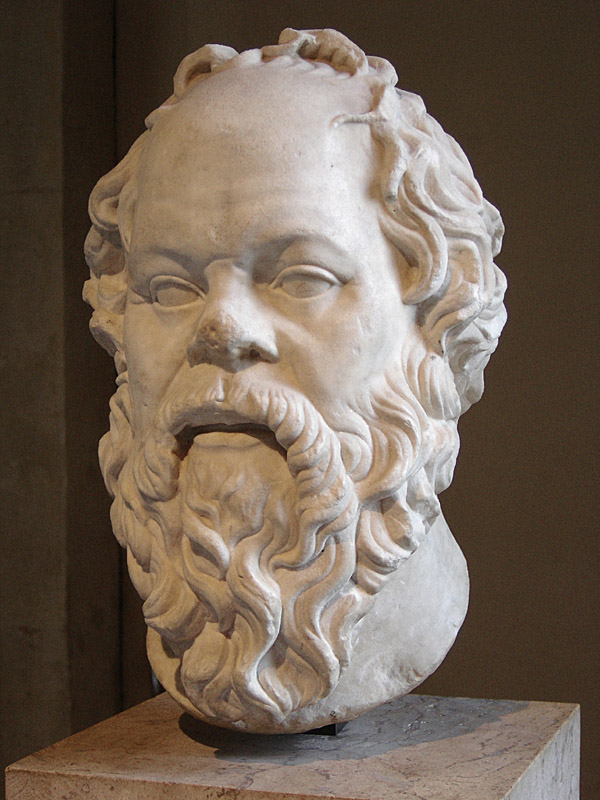
Socrates, The Louvre
– Steve Shoemaker, Urbana, IL, May 18, 2013

Sebastian (1999 – 2013)
“Lord, make me half the man my dog thinks I am.”
Ever dream of being lost? Or confused? Distraught? Inconsequential and dispensable? Join the club.
Scene 1
It’s my first Sunday back from a sabbatical. I am returning to the pulpit of the large church with the great music program. I love this church and am glad to be home.
Scene 2
It’s Sunday morning just before worship. I’m running VERY late. My robe is in the office up several flights of stairs but I can’t remember exactly where. It’s just “up”. The robed Choir – the best in the city – is coming down the stairs while I’m trying to go up the stairs to find my robe in the lost office. No one in the Choir acknowledges my presence. They are in a rush down to the Chapel.
Scene 3
I walk into the Chancel. The Chapel is fairly full. Attendance is good. I take my normal seat as their Pastor, prepare myself for the Call to Worship that will follow the Choir’s Choral Introit. Three Choir members dressed as animals crawl out onto the front of the Chancel and start to sing. I realize then that there is no Order of Worship. Instead there is a music program.
(The music program has always been a thing of controversy. A great blessing with the highest standards and exquisite classical musical taste, but it is also criticized for drawing attention to itself and demanding disproportionate financial resources from the church budget. I am a big supporter of the music program, but have also worked to maintain its rightful place in worship and within the broader life of the church.)
Scene 4
I am confused and annoyed that this appears to be a music program stuck into the hour of Morning Worship. This is NOT worship. The congregation and I have been blind-sided. It is not what anyone in the congregation expected. It is performance, not worship.
Two members of the congregation who love music but who care more about the integrity of worship get up and head for the doors.
More people – five or six at a time – are getting up and leaving. Disgust is emptying the place.
Scene 5
I am no longer in the Chancel. I am in the rear balcony pleading with those who are leaving.
“This is not worship! This is something else. I’m sorry. This has to stop!” But the few people who remain are heading for the exits.
Scene 6
The Director of Music is deeply distressed. He’s gone too far, and he knows it. Finally…he knows it. So do some of the members of the Choir. What to do? Call them together quickly right now…but newer members of the Choir whose faces and names I don’t recognize are heading down the stairs for the doors. They don’t like conflict and, I suppose, feel hurt and unappreciated, like their Director.
Scene 7
I realize that I had returned from sabbatical without giving the church office an Order for Worship in time to meet the deadline for printing. I am disappointed with myself and upset with the Director of Music. I’m feeling lost. Alone. Invisible. Clearly dispensable. My first day back from sabbatical there has been no welcome, no acknowledgement. I have lost all of the control that, over the years, has kept the Music Program, its Director, and its critics from killing each other in ecclesiastical warfare, and, from the looks of it, everyone and everything I have worked for is…lost.


