
The Neighbors in St. Augustine

The men gather late in front of the house every morning before the resident gets up.

Mostly in their 60s and early 70s, they arrive on bicycles or on foot with paper bags scrunched close at the top. The minority, the younger ones in their 20s, don’t use bags. They don’t hide the beer can or the pint. They pull the cheap, green, plastic chairs from the yard out to the sidewalk to start the day.

The older ones survived the St. Augustine Civil Rights Movement of the early 60s and the violent reaction of the white city fathers of St. Augustine to the passage of the Civil Rights Act.  They tell stories. The younger men don’t seem to care.

I walk next door most every day to say hello. The conversations become windows into humanity, disparate perspectives, and history itself.

Why did the once young men who waded in at Butler Beach in 1964, survived the fire bombing of their homes and the beatings by theKu Klux Klan end up here bleary-eyed with paper bags?

They grow louder as the day wears on. One of them stands in the middle of the street blocking traffic as if to say to passersby, “This is OUR neighborhood!” Several times a day a car pulls up to the curb, opens the window, and exchanges something with the men. They disappear, one by one, into the house for a time.

At noon one day I walk next door and find myself in the middle of what appears to be an argument between one of the older men sitting in the yard and a 20-something man sitting on the sidewalk with his back turned to the street. I come by to say hello. The older man greets me. We say good morning. “You’re a Reverend, right?”

“Well, yes. Sort of..,” I smile, “more or less reverent.” We enjoy a good laugh.

“So,” he says, pointing to the young man holding his open Pabst Blue Ribbon, “doesn’t the Bible say ‘Instead of giving a man a fish, you should teach him how to fish?'”

“Well, no. The Bible doesn’t say that, but it’s pretty close to some of what the Bible teaches.”

“See,” says the young man, “I told you the Bible doesn’t say that!”

The Civil Rights Movement survivors recall how some of their classmates got out of town and left them behind. One of them owns upscale hotels in Atlanta and Miami. He comes home in his big Mercedes every five years or so. According to the men next door, he and others who got out look down their noses at the shrimp boat workers who lived hand-to-mouth existences in the old neighborhood where they grew up together.

The Civil Rights Movement in St. Augustine is still a matter of debate both among its veterans and among the young men who have no living memory of it.  For young and old alike, the men who gather daily next door are a community to each other. They have taken their “place” in the post Civil Rights Movement era of St. Augustine.

They are part of America’s left behind. They’re going nowhere their feet or bicycles can’t take them. They care about each other. They are without pretense. They have each other, old friends and younger ones who are going nowhere. They are a local chapter of the community of the stuck. Their numbers are growing all across America.
 

Morning Moon

just a muslim scimitar
but no single star in sight
clouds obscure the rest of sky

three so young are killed by hate
trusting they opened their door
though they’d seen his gun before

today’s dawn they will not see
moonlike from behind the clouds
they observe us as we cry

– Steve Shoemaker, Feb. 15, 2015

Verse – Skin in the 1960s

Each month the Playboy magazine
would come in a brown envelope.
I was in Seminary then
and Hefner sent it free to keep
the clergy up on all his thoughts
(he called it his philosophy.)

The stories actually had plots,
some jokes were good, but I would see
the women first, the centerfold,
the air-brushed flawless, pale white skin.
Penthouse and Hustler were more bold,
showed pink as if it were a sin,

but Sports Illustrated was best
(because bikinis revealed less.)

– Steve Shoemaker, Feb. 12, 2014

Look what the ocean coughed up

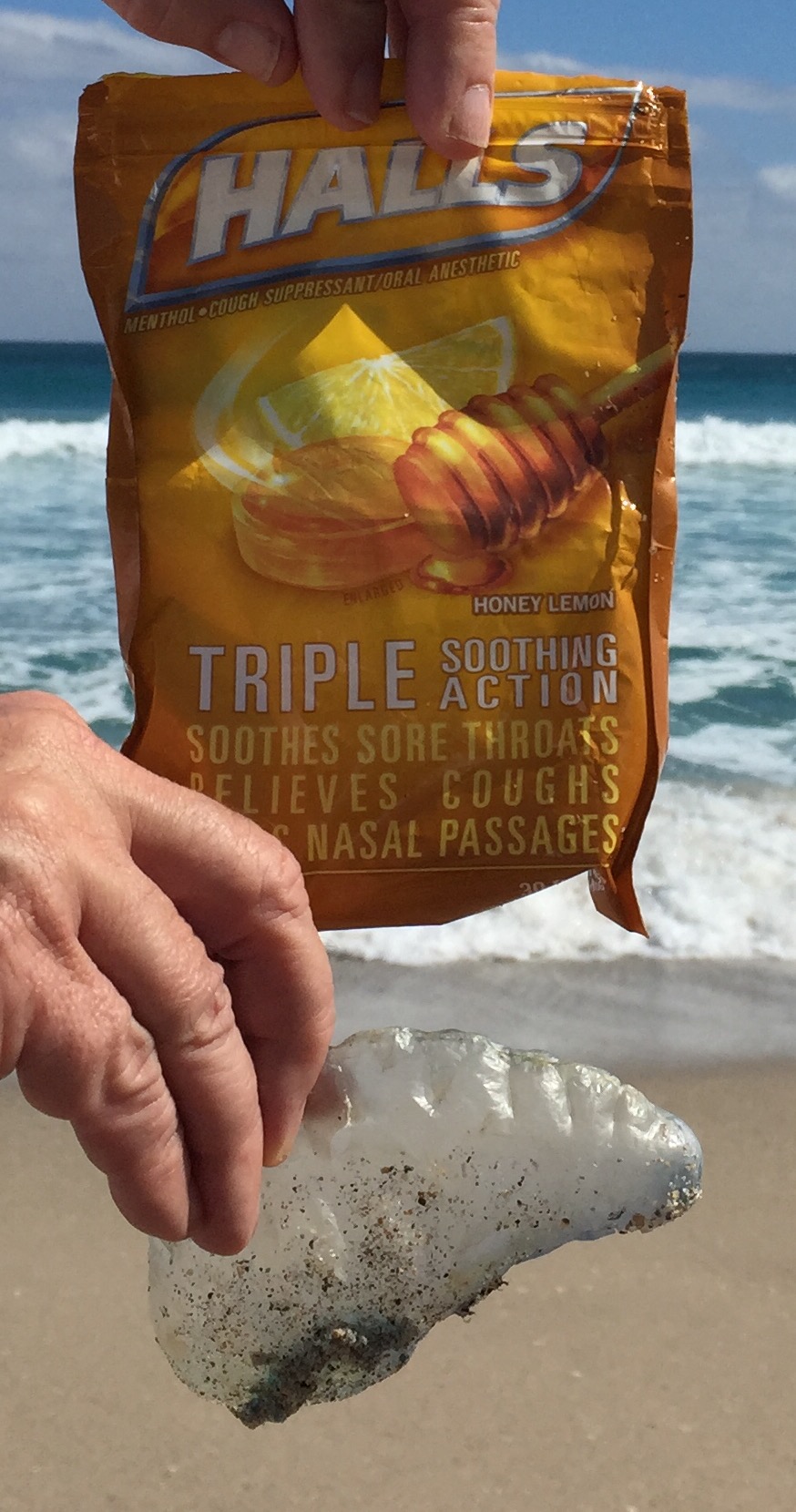
What the ocean coughed upLook what washed up on Palm Beach this morning.

Like the whale that coughed up Jonah into the sea, the ocean is coughing up Halls cough drops along with a Portuguese Man-o’-War on the beach.

But there’s a difference. The sun and time will disintegrate the dead Man-o’-War in a few days time; the cough drop package, still zip-locked with three plastic wrapped fresh lemon menthol cough drops, will be around until who knows when.

The Halls cough drops and other plastics manufactured by a Pomethean species at war with Nature were found a few feet from the decaying Man-o’-War. Click Plastic Pollution for more information about the effects of plastics on the ocean, sea mammals, and the land. The ocean is coughing. But Nature always wins; it always has the last cough.

Coughed up on the beach

Coughed up on the beach

– Gordon C. Stewart, beautiful Palm Beach, FL, Feb. 11, 2015

Verse – 2018

Remember before the great internet fail,
We all were connected, each head to a tail,
But then that world virus
Began to excite us
To chew one another by texts and email.

Our data was stolen, our passwords were known,
Our bank accounts empty, our credit had flown
Out into cyberspace.
Now the whole human race
Starts in again fighting just over a bone.

– Steve Shoemaker, Urbana, IL , Feb, 11, 2015

Burdened

Image

Scroll down to “View Original” and click the link for Joshi Daniel’s photo of the man carrying a heavy burden.  If inspired, share a comment on what you see and the human condition.

joshi daniel's avatarJoshi Daniel Photography

Old man in Trivandrum carrying a big load on his head Old man carrying a big load | Trivandrum, Kerala, India

View original post

Verse for bird lovers

Parakeets
(Budgies to you Aussies)

From Down Under
Now they chatter
To bird lovers
Everywhere

In and out of
Cages flying
Chatting chirping
Pretty bird

Green and yellow
Happy fellow
Shakes a feather
Talks to you

Sits on finger
Lampshade shoulder
Scolds then perches
On your head

– Steve Shoemaker, Urbana, IL, Feb. 7, 2015


Wading in the Water

St. Augustine Beach, Feb. 4, 2015

St. Augustine Beach, Feb. 4, 2015

So here we are, both newly retired, wading in the water of St. Augustine Beach in the Florida sun. Today the beach is peaceful. It was not always so quiet on these white sands.

Barclay in cold Minnesota

Barclay in cold Minnesota

Back home in Minnesota it’s cold. This photo of Barclay looking out the window into the world of white arrived this morning. Barclay knows where he is. We’re not sure we do.

Away from home and all familiar routines here on the white sand beach,  we’re getting our feet wet on the very beach where national news coverage pushed the Civil Rights Act over the top in 1964.

Kay and I each wondered what the world beyond work would feel like. Now we know. It’s weird. The world is still very much with us. Every day I talk with  some of those arrested on St. Augustine Beach who gather next door to our rental home in St. Augustine. We’re all still wading in the water.


“Goodnight, Mrs. Calabash”

My generation grew up with former Vaudeville comedians George Burns and Gracie Allen, Eddie Cantor, Sid Caesar and Imogene Coca, Red Skelton, and Jimmy Durante. Jimmy signed off every show with “Good Night, Mrs. Calabash, wherever you are.” No one knows for sure who Mrs. Calabash was.

Good night from Views from the Edge. See you in the morning.

Gordon C. Stewart, Chaska, MN

Gender Economics: It used to be even worse

 When I Was a Grad Student

The lowest legal wage
was all I made
as part-time teller
in a city bank.
No teller could receive
a tip–if paid
the cameras would see,
you know… “Your back
pocket. The cash you stole!”
At end of day
your balance true would not
be evidence
of innocence no matter
what you’d say.

My wife made ten times
what I did, and hence
in 1968 she applied for
a credit card. No way–
she was not head
of our household. At Field’s
she tried once more:
a woman manager
was brave and said
the card could be in her
own name. My wife
was a real person, too,
with her own life…

– Steve Shoemaker, Urbana, IL, Feb. 5, 2015

Editor’s Note: Steve was a student at McCormick Seminary in Chicago. Nadja was a research scientist at Northwestern.