

Dylan Thomas
“I am at the most transitional period now,” wrote Dylan Thomas to his friend. “Whatever talents I possess may suddenly diminish or suddenly increase. I can with ease become an ordinary fool. I may be one now. But it doesn’t do to upset one’s own vanity.”
In that spirit, I accede to my dear friend Bob’s suggestion to post author “endorsements” of Be Still! Departure from Collective Madness on Views from the Edge. “Why not?” I said to myself. “It’s your book! If you don’t promote it, who will? Who cares if you’re a fool! If you don’t do it now, your limited talents may suddenly decrease!”
 AUTHOR ENDORSEMENTS
”As a person who navigates the pleasures and perils of the twenty-first-century campus, having Be Still! at my fingertips will be like having a counselor, a guide, a very present help in these times. This volume touches the pulse of our times with the rare combination of unwavering candor and tender mercy.”
—Lucy A. Forster-Smith, Sedgwick Chaplain, Senior Minister in the Memorial Church, Harvard University
”These are lovely, powerful, centering essays–messages from and for a fragile but beautiful planet.”
—Bill McKibben, Author of Eaarth: Making a Life on a Tough New Planet
”This wondrous collection of rich snippets would be of interest and value if only for the rich source material that Gordon Stewart quotes from, as it must be an inexhaustible memory and/or file. But the many words he quotes are no more than launching pads for Stewart’s expansive imagination and agile mind that take us, over and over, into fresh discernment, new territory, unanticipated demands, and open-ended opportunity. All of that adds up to grace, and Stewart is a daring witness to grace that occupies all of our territory.”
—Walter Brueggemann, Columbia Theological Seminary, Author of Remember You Are Dust, The Prophetic Imagination, and many other books.
”Gordon Stewart has a way with words, a clean, clear, concise, and yet still creative way with words, a way that can set the reader almost simultaneously at the blood-stained center of the timely–the urgent issues of our day–and also at the deep heart of the timeless, those eternal questions that have forever challenged the human mind. Stewart looks at terror, Isis, and all their kin, from the perspective of Paul Tillich and, yes, John Lennon. He moves from Paris, Maine, by way of the town drunk, toward the City of God. This is strong medicine, to be taken in small, but serious doses. Wear a crash helmet!
—J. Barrie Shepherd
Author of Between Mirage and Miracle and many others
”Be Still! is needed at this American moment of collective madness even more than the moments that occasioned many of the essays originally airing on public radio and other venues. With a keen eye and a knack for telling the right story at the right time, Rev. Stewart speaks to the pressing issues in our politics, economy, and culture, and consistently, often poignantly, puts them in ethical and theological perspective that clarifies what too often mystifies. Great bedside reading for those of us who stay up at night concerned about where our world is heading!”
—Michael McNally, Ph.D
Professor of Religion, Carleton College; Author of Honoring Elders: Aging, Authority, and Ojibwe Religion
”Be Still!: Departure from Collective Madness, is exactly what its title proclaims: a departure from the frenzy and folly of our times. Each essay offers the reader an opportunity to breathe deep, to fall into the story or idea and consider what it means to be a citizen, a friend, a human being. The topics covered are both particular and universal (usually both at the same time), and the writing is wonderfully concise and open–much like poetry! This is a book you will want to open again and again; it s what the world needs now, more than ever.”
—Joyce Sutphen
Minnesota Poet Laureate; Professor in English, Gustavus Adolphus College
”In Be Still! Stewart masterfully spins a counter-narrative to the collective madness that is gripping our world. Like the psalmist, Stewart prays thoughtfully through metaphors and religious tradition, meshing theologians with news headlines to lead the reader to a deeper, more sustained truth. Be Still! reads like part op-ed and part parable. In these troubling and anxious times, may we, who have ears to hear, listen!”
—Frank M. Yamada
President, McCormick Theological Seminary, Author of Configurations of Rape in the Hebrew Bible: A Literary Analysis of Three Rape Narratives

Joanna Baillie (1762-1851)
Then, after heeding my friend Bob’s and Dylan Thomas’s advice, I heard the reassuring voice of Joanna Baillie speaking from long ago:
“Pampered vanity is a better thing perhaps than starved pride.”
- Gordon C. Stewart, Chaska, MN, March 26, 2017.


 With stern face and the determined voice of a righteous prosecutor Gowdy shifted the focus of the hearing away from the question of outside foreign interference in the election process to the leaks coming from inside the intelligence community itself, and the need to find and prosecute the leakers under the U.S. Espionage Act of 1917. A breach of secrecy of classified material is punishable by as much as 10 year prison sentence.
 McCarthyism began with Senator Joseph McCarthy’s conviction that the communists had infiltrated the federal government as well as the left-leaning entertainment industry and the media. He was looking for spies and traitors, American citizens whose nefarious purposes posed the greatest threat to the United States of America.
 Are there times when a government employee’s loyalty to the U.S. Constitution and and the duty of conscience supersedes the vow of secrecy under which she works? Are whistleblowers traitors? Patriots? Or something in between?
 Watching today’s U.S. House Permanent Select Committee on Intelligence my eye was drawn to a man sitting behind the two witnesses, FBI Director James Comey, and NSA Director Mike Rogers. Like a good baseball coach or intelligence officer, the man in the dark yellow tie and the French cuffs was stone-faced. But it appeared he was giving smoke signals or baseball signs to someone on the Congressional panel asking the questions.
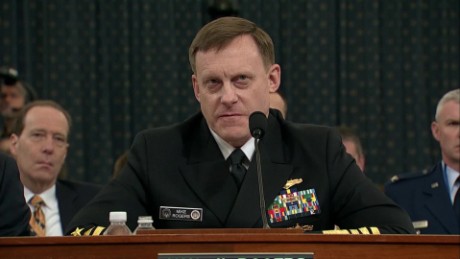 Today in America there’s a lot of smoke but the meanings of the signals are known only by a few. And those of us who watch a televised hearing as citizens of a democratic republic are left to watch, listen, and smell our way to what’s real and what’s not.
 Views from the Edge