Global Thaw

Mid-March

Minnesota

Gentle rain

Global thaw

Mid-March

Madness

This morning it was hot enough to fry and egg on the pavement… in Minnesota.

Anyone else think the absense of climate change/global warming/global thawing from the national spotlight on the way to a national election is madness?

Just asking.

Ya gotta love Bill Maher

Gordon C. Stewart  www.gordoncstewart.com  March 23, 2012

Ya gotta love Bill Maher. Well, actually, you don’t have to, but I do.

I rarely miss “Real Time with Bill Maher” (HBO). Why? Because he’s real. So are his guests. Is Bill’s language outlandish? Is his tongue stuck in the 7th grade locker room? Yes. Despite the frequency of the ‘f’ word, the saintliest, as well as the unstaintliest, mouths from left , right and center consider it an honor to sit on the panel or be a featured guest. on Real Time. Go figure how Madeleine Albright, Amy HolmesCornel West, Herman Cain, Sen. Bernie Sanders, Rep. Dana Rohrabacher, Rep. Keith Ellison, P.J. O’Roarke, Michael Moore, Andrew Sullivan, and David Frum appear on Maher’s show. They accept the invitation because it’s one place where manure is called what it is and where the real gutter talk is exposed for what it is. He’s not interested in being nice. He’s interested in truth. And he’s not afraid to engage the opposition in matters political, economic, or religious.

“If it weren’t for throwing conniption fits, we wouldn’t get any exercise,” he wrote (“Offense Intended – and that’s OK,” Star Tribune, 03.23.12). “I have a better idea. Let’s have an amnesty – from the left and from the right – on every made-up, fake, totally insincere, placated hurt, insult, slight and affront. Let’s make this Sunday the National Day of No Outrage. One day a year when you will not find some tiny thing someone said and pretend you can’t barely continue functioning until they apologize.”

Maher wasn’t born or raised in Minnesota where we’re proud of Minnesota Nice, most of the time .But you don’t have to have been raised elsewhere to know that Minnesota Nice often leaves us itching for some unpolished reality. How else do we explain the election of a tough-talking, often crude professional wrestler radio talk show host as our governor?  Jesse Venturawas elected because he said what he thought and meant what he said in a world where candidates for political office rarely say what they mean or mean what they say. Underneath Minnesota Nice is a volcano of Minnesota mean, as well as nice.

Jesse is one weird dude. And that’s partly what attracted the people who were tired of taking Minnesota Nice too far. We want civility, but sometimes we get a little tired of not really talking about what we’re really talking  about.

None of us really wants to live in Pleasantville. Remember “Pleasantville” – the film about two 1990s teenage siblings, Jennifer and David, who get sucked into their television set where they become characters in the make-believe town of Pleasantville, David’s favorite TV show? Nothing much ever happens in Pleasantville. There is no conflict, no real feelings; just polite, mannerly sameness that is insulated from and apathetic toward anything that might smack of unpleasantness. Pleasantville is a nice place – happy, smiling, repressed and suppressed, orderly…without color.

As Jennifer and David play along in the perfect and pure little town of Pleasantville, their presence soon cracks open the boredom of gray uniformity. Color begins to break through the grayness as the citizens of Pleasantville discover sex, art, books, music and the concept of non-conformity, leading the Mayor to campaign to turn Pleasantville back to what it once was – a nice place where nothing much ever happens, and no one speaks like Bill Maher.

Maher’s Op Ed piece concludes:

“I don’t want to live in a country where no one ever says anything that offends someone. That’s why we have Canada. That’s not for us. If we sand down our rough edges and drain all the color, emotion and spontaneity out of our discourse, we’ll end up with political candidates who say nothing but the safest, blandest, emptiest, most unctuous focus-grouped platitudes and cant. In other words, we’ll get Mitt Romney.”

This morning Unedited Politics posted an excerpt from 1994 Romney-Kennedy Debate on health care, veterans, spending, deficits.

The Surrogate Voice

Some moments last a lifetime.

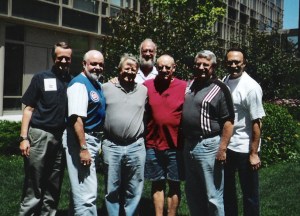
Chicago Seven - Dale Hartwig in red shirt

My friend Dale has Parkinson’s. He has boarded a train in Michigan (he’s now in a long-term care center there) to be with “The Chicago Seven” – the seven former classmates who gather annually at McCormick Theological Seminary. This year, Dale’s speech is hard to comprehend. He is reduced to listening. Death and dying are sitting at the table.At the morning reflection and round-table sharing, Dale is sitting to my right. When his turn comes, we look at Dale. There is an awkward silence. He hands me something. He wants me to read aloud what he’s written. I read his words aloud.

Gordon C. Stewart  – written in thanksgiving for the Chicago Gathering, 2004:

“THE SURROGATE VOICE”

The surrogate voice reads on,

the author sits and sobs

wrenching tears from primal depth:

from some abyss of joy or nothingness…or both.

The author’s sighs and piercing sobs

arrest routine,

invoke a hush,

dumb-found the wordy room.

He cannot speak,

his Parkinsons’ tongue tied,

his voice is mute, in solitude confined,

all but sobs too deep for words.

Another now becomes his  voice

offering aloud in a dummy’s voice

the muted contribution

in poetic verse the ventriloquist’s voice has penned.

The abyss of muted isolation ope’d,

his words, re-voiced aloud,

hush the seven to sacred silence,  all…

except from him, their author.

Whence comes this primal cry:

From depths of deep despair and death,

from loneliness, or depths of joy

We do not know.

The surrogate voice reads on

through author’s signs and sobs,

through his uncertain gasps for air

and our uncertain care.

The iron prison gates – the guards

of his despair – unlock and open out

to turn his tears from prison’s hole

to tears of comrade joy.

His word is spoken, his voice is heard,

a word expressed

in depth and Primal Blessing,

pardoned from the voiceless hell.

The stone rolls back,

rolls back, rolls back,

from the brother’s prison’s tomb,

the chains of sadness snap and break!

At one, at one, we Seven stand,

in Primal Silence before the open tomb,

as tears of loss, of gain, of tongues released

re-Voice unbroken chords of brotherhood.

 All moments are sacred. Some last a lifetime.

She Could Give a Kiss

Morning reflections composed today by my friend Steve Shoemaker

She Could  Give a Kiss

She could give a kiss

and not have less to share.

He could take a kiss

and still have more to give.

She could have a child

and still have time for him.

He could be a child

and run away from her.

–  Steve Shoemaker, 03.21.12

Your Dear Eyes

 Your dear eyes…

Macular Degeneration,

what a multi-syllabic curse.

Hazel:   sometimes blue,

sometimes green, birthing

children’s eyes of blue and gold…

Flashing with indignation,

pensive, wise, creative, wary–

yes, windows to a good soul.

Let us see all that we can see

while we can.  Travel, taste, hear,

feel and, yes, smell what is good

around the world.  All of us

are fading into dust:  some of us

receive a warning–fair or unfair.

– Steve Shoemaker 03.21.12


“And the Word became flesh….” and words.

Little Steve at Sheldon Jackson Church, Colorado

Sometimes it comes in a poet’s words. The flesh it comes in is all shapes and sizes. Here’s a photo of Steve (6’8” and shrinking) standing behind a historic pulpit at Sheldon Jackson Church in Colorado. Sheldon was a bit shorter. Who says ministers don’t have a sense of humor!LEAVE A COMMENT on Steve’s poems. He, I, and others would love to know what you think. Or, in today’s butchered English, “Me and him” look forward to seeing/hearing the words YOU share.

My Father’s Portrait

We’re all cut from our parents’ cloth. It falls to each of us to finish their unfinished business.

Following my mother’s death, it fell to the three sons and our spouses to clean out the apartment and arrange for distribution or disposal of the belongings.

My father had died two years earlier.

Don, Bob and I spent an afternoon alone in the apartment using a rotation method to divide the belongings.  By order of birth, we would each choose what we wanted. Round one: Gordon, Don, Bob; round two: Gordon, Don, Bob – I-2-3; 1-2-3 – until everything  any of us wanted was chosen.  The rest would go to auction or to Goodwill.

Among my parents’ personal art was an oil painting of my father. In my early years, I loved that painting.  Handsome man. Robed in his clergy robe, dignified, smiling, tender eyes, a man of stature, our Dad. The painting had been in the family for as long as I can remember and, as best I can recall, had hung in Dad’s pastor’s office at Marple Church when I was a teenager. Now it hung in the narrow hallway just inside the entrance to my parents’ apartment. It was the first thing a visitor saw – a reminder to all who entered that Dad had once been someone special, a man of the cloth.

One-two-three, we chose our favorite pieces.  We agreed that monetary value made no difference to our selection process. All that mattered the value each of us placed on an item.  The grandfather clock was clearly worth the most in dollars, but the clock had been purchased late in our parents’ marriage; it bore only the most recent memories, not the memories of home.  It could not compare with the knicknacks – one of our mother’s Hummel figurines, a Baltimore Oriole paper weight, my father’s dog tags from World War II, a dish, a lamp, a photo, or the original painting given by a parishioner that reminded me of Robert Frost’s “Stopping by the Woods on a Snowy Evening” – artifacts of precious times now gone except for memory.

But there was another painting, a portrait of Dad in his ministerial robe.

As we went around the room, the painting didn’t move. Nobody picked it. Finally, Don asked with a smile, “Who wants Dad’s painting?” Deferring to me, Bob chimed in. “You’re the oldest! You should have it. It’s okay with me. I don’t want it!” “Sure,” said Don, “I don’t want it. Go ahead, Gord, you should have it. You’re the oldest!”

We all looked at each other and began to laugh about the elephant that had been sitting for years in the living room.

I looked at the picture. There was Dad, clear as day, a keepsake that had meant so much to  our father and mother, and we didn’t want his picture?  “I don’t want it,” I said, and  started to say more but couldn’t get the words out. Grief had overcome me. I couldn’t speak. I shuddered with sobbing. My brothers watched and waited in silence. When finally I composed myself enough to complete the thought through the tears, the words came out slowly . . . in staggered gulps. “I hate that thing! I always wanted to rip that robe off him! He never took it off!  He was always the minister. I just wanted him to be his own naked self. I just wanted him to be Dad.”

Reflecting on it years later, that moment was one of many breakthrough moments of taking off my own robe. I hadn’t worn mine for five years and hadn’t missed it. I began to find my own naked self bereft of the robe while working for a poverty criminal defense law firm founded by African American civil rights activists and founders of the American Indian Movement. Unconditional love was not a creedal statement; it was a daily fact of life, the treasure of grace held by many kinds of vessels. “We hold this treasure in earthen vessels….”

I took the painting of Dad and took him with me on the long flight home to the Legal Rights Center.  When I got there, I put the painting in storage, as a reminder that the work isn’t finished for me or my offspring. Who knows, someday one of the great-grandchildren may bring Dad’s painting out of the closet.

“To the Sea” re-blog

Woke up this morning to this photograph by Portuguese photographer Paolo Flop, posted on PhotoBotos.com. PhotoBotos introduced the piece this way:

I keep wondering what this woman is doing here?  Why does she have a lantern in the water?  Paulo’s photography doesn’t answer a lot of questions, but it sure does inspire them.  We have a lot of people who visit our website mention that they get inspiration to write a poem, story, or paint a picture from the photographs we post.  I think this one has story written all over it.  Feel free to add your poem or link to your artwork in the comment section.

Let the photograph speak for itself. Contemplate it. Drink it in. What “story” does it write for you? Then share your comment here. You can also add your comment on PhotoBotos.com. My comment is posted on Photobotos.com.

Gordon C. Stewart's avatarViews from the Edge

The Ongoing Saga of Cain and Abel

Gordon C. Stewart | published by MinnPost.com

Religion and politics: oil and water? The problem is that each stakes a claim for the same turf. They both answer the question of how we live together. The fact that religious creeds and political creeds stake claims to leads some of us to separate them, not only as they are separated by the U.S. Constitution, but by carving out different spaces on the same turf: one private/personal sphere (religion), the other public/social sphere (politics). Religion says to politics: Keep your hands off my private beliefs! Politics says to religion: Keep your hands off public policy!

With the exception of adherents of the extreme right or left in religion or politics, most of us have had enough of religious or political fundamentalism. We’re tired of explosive tirades and single-issue politics whose test-tube is organized religion. We’re equally tired…

View original post 1,014 more words

Throwing Up in the School Cafeteria

Gordon C. Stewart          Feb. 28, 2012

“It makes me want to throw up!”

Nothing causes indigestion more than a food fight over religion and politics. Just because there’s a food fight in the school cafeteria doesn’t mean we should join it.

The 2012 election is shaping up as a battle over religion and the state. But the battle is ill-framed, using a shotgun that sprays everywhere.

The failure to differentiate the issues is widespread in the thinking of the candidates, their supporters and detractors, and news media that are increasing driven by sensational sound-bites that increase viewership and profits than by professional journalistic standards that would help clarify the debate.

Take Mr. Santorum’s statement on ABC’s “This Week” when asked how his faith fits in with his ideas about governing. He referred to then-candidate John Fitzgerald Kennedy’s speech affirming the absolute separation of church and state. The speech, he said, makes him “want to throw up.”

“I don’t believe in an America where the separation of church and state is absolute,” he said. “The idea that the church can have no influence or no involvement in the operation of the state is absolutely antithetical to the objectives and vision of our country.”

There are three separate issues here: 1) the role of religion in shaping public policy; 2) the role of a candidate’s personal faith in the exercise of the duties of elected office in a democratic republic; and 3) the wall of separation between church (institutional religion) and the State.

The question was not about church (i.e. institutional religion) and state. It was issue #2: how the candidate’s faith/religious convictions would influence the way he would govern, if elected President of a pluralistic democratic republic.

“To say that people of faith have no role in the public square? You bet that makes you throw up. What kind of country do we live that says only people of non-faith can come into the public square and make their case?” Santorum asked.

In that respect, Mr. Santorum is correct. For the public or a candidate to assume that it would make no difference would assume that faith and religion are strictly private, personal matters, while politics is a public matter. But as theologians, ethicists and critics of religion like Bill Maher agree, that’s not how it works. What we believe privately informs and drives what we do publicly, whether our personal convictions are religious or some version of secular humanism.

The cross-over between these core convictions and public policy is too important to ignore. The “culture wars” are real. The definition of marriage, the rights of women v. the rights of the unborn, institutional principle/conscience (e.g. contraception) and health care, the value of public education, end-of-life decisions, war and peace, workers’ rights, America’s role in the world, the distribution and re-distribution of wealth, wealth and poverty, and capital punishment are public issues hotly debated by an electorate whose varying religious and secular convictions place them front and center on the national agenda.

The genius of the U.S. Constitution lay in its framers’ ability to differentiate  between individual faith and institutional religion when it comes to matters of State.  What was later described as the “wall of separation” between church and state was, in fact, a wall that prevents the establishment of any one religion as the religion of the State. That is to say, the United States of America was not and would never be a theocracy. It would bea secular democratic republic which respected the free exercise of religion, whatever its stripe.

The founders were also clear that the success of the experiment in representative democracy rested on its citizens being what John Adams called “a moral people and religious people”  instructed in civility and committed to the search for goodness and the common good. They drew the line between the State and institutional religion to protect the republic from the horrors they had witnessed when the two had merged in the attempted theocracy of the Massachusetts Bay Colony, and to protect the free exercise of religion from the restrictive powers of the State.

In that sense, all three questions are fair game. Given the current food fight, the question is not whether to keep all such discussions out of the school cafeteria. Only when we, the electorate, inform ourselves of the nuances of the debate, will the cafeteria be more civil and the candidates stop throwing up in public because they swallowed the wrong question.

On and off my rocker

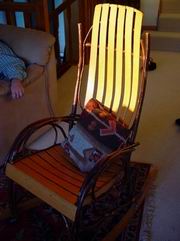
My Rocking Chair

My Amish Rocker

“WHY, in a world filled with yelling and screaming, would you ‘PREACH’? Are you off your rocker?”

I can’t help it. I’m a preacher. I have to preach. But it’s the time in the rocking chair that matters most, times when I sit in Jacob Miller’s Amish rocker preparing for Sunday that I love the most. Jacob made the rocker just for me in his Amish shop in Millersburg, Ohio on a farm that spoke volumes about peace and love.

I approach the pulpit in fear and trembling, knowing that it is sacred space where people expect to hear a different kind of word, its sacredness only as real as the humanity that walks into it. The requirements of preaching result in a daily discipline: a fresh cup of strong coffee with the Scriptures in one hand the newspaper in the other.

We live in a crazy world where religion is a source of great sorrow as well as a source of joy. Religion divides and religion unites. It opens us up to the Other, or it walls us off. It broadens us or narrows us.  It increases our circulation or it constricts our arteries.

Not long ago American Christians seemed to take for granted that Christianity and our country were simply flip sides of the same coin (a curious blending of the Judeo-Christian idea of an “elect” people and the national misappropriation of Jesus’ “city set upon a hill”  as a light to the other nations). That bogus idea is dead, but the news is still reaching our ears, like the news of the town crier in Frederich Nietzsche’s The Gay Science:

Have you heard of that madman who lit a lantern in the bright morning hours, ran to the market place, and cried incessantly, “I seek God! I seek God!” As many of those who do not believe in God were standing around just then, he provoked much laughter…Whither is God,” he cried. “I shall tell you. We have killed him – you and I.   All of us are murderers…. God is dead.  God remains dead. And we have killed him….

– Friedrich Nietzsche, The Gay Science (1882), Section 126.

That god is already dead, but the message is still reaching our ears. The death of this god “clears the decks for the God of the Bible,” wrote Dietrich Bonhoeffer in a letter from a prison cell July 18, 1944 before his execution by the Third Reich:

Christians range themselves with God in his suffering; that is what distinguishes them….  As Jesus asked in Gethsemane, “Could ye not watch with me one hour?” That is the exact opposite of what the religious man expects from God. Man is challenged to participate in the sufferings of God at the hands of a godless world. He must therefore plunge himself into the life of a godless world, without attempting to gloss over its ungodliness with a veneer of religion or try to transfigure it. He must live a ‘Worldly” life and so participate in the suffering of God. He may live a worldly life as one emancipated from all false religions and obligations. To be a Christian does not mean to be religious in a particular way, to cultivate some particular form of asceticism (as a sinner, a penitent or a saint), but to he a man. It is not some religious act which makes a Christian what he is, but participation in the suffering of God in the life of the world.

Dietrich Bonhoeffer, Letters and Papers from Prison

I’m no Dietrich Bonhoeffer. But his words and life frame the way I look at the world. To whatever extent the sermons and commentaries that appear here reflect Bonhoeffer’s spirit, I am grateful to him and to others who have shaped my ministry: Ted Campbell, Paul Louis Lehmann, Lewis Briner, William Sloan Coffin, Jack Stotts, William Stringfellow, James Cone, Sebastian Moore, and a host of others. When my attempts fail to keep faith with their examples, they reflect my shortcomings and foibles. If and when any of them manages to speak a Word through my human frailty, it is because I have stood on their shoulders on the watchtower, grasped again by the Spirit of the Living God.

“I will take my stand to watch, and station myself on the tower, and look forth to see what G-d will say to me, and what G-d will answer concerning my complaint. And the LORD answered me, ‘Write the vision; make it plain…so those who run may read it. For still the vision awaits its time….'” (Habakkuk 2:1-3a)

Jacob Miller’s Amish rocker is my watchtower. A cup of coffee, Habakkuk, and the morning newspaper. Thank you, Jacob, for the place to be on your rocker when I’m about to go off mine!

“Where are the ashes!!!”

Gordon C. Stewart, February 24, 2012

It happened on Ash Wednesday.

“They’re missing! Where are the ashes?!” It’s fifteen minutes before the Service. “Where are the ashes!”

Every year I put the ashes for the Ash Wednesday Service in the credenza in my office. I never gave it a second thought that we had moved the credenza out of my office last fall. I rush downstairs to look for it. No credenza anywhere. Then…I remember. We sold it at the Annual Fall Festival! Somebody has our ashes!

What to do with no ashes? Burn some newspapers? Smoke a cigar and use the ashes? No time.

I grab a pitcher and pour water into the baptism font.

I begin the Service with the story of the missing ashes. Smiles break out everywhere. Maybe even signs of relief. “Instead of the imposition of ashes this year, we will go to the font for the waters of baptism, the waters of the renewal of life.”

We have some fun justifying the change in the Service, focusing on the that part of the Gospel text for the day – the words of Jesus himself. “And when you fast, do not look dismal, like the hypocrites, for they disfigure their faces that their fasting may be seen my others….But when you fast, anoint your head and wash your face, that your fasting may not be seen by others but by your Father who is in secret…”(Mt. 6:16-18).

People come to the font, one-by-one, for “the Imposition of … [Water]”. I dip my hand into the font. “Pat, (making the sign of the cross on her forehead), “Dust to dust; ashes to ashes. You are a child of God. Live in this peace.”

After the Service is over, one of the worshipers asks whether anyone has done the same for me. She reaches her hand into the font. “Gordon, dust to dust, ashes to ashes. You are a child of God…..”

I’ll never forget it. Neither will they. And somewhere in this world someone has a credenza with a sack full of ashes. Whoever you are, feel free to keep them. They’re all yours.