“Rats and roaches live by competition under the laws of supply and demand; it is the privilege of human beings to live under the laws of justice and mercy.”
― Wendell Berry
Supply and Demand
1

“Rats and roaches live by competition under the laws of supply and demand; it is the privilege of human beings to live under the laws of justice and mercy.”
― Wendell Berry

Pledge of Allegiance
Five visitors from Germany were guests of an international service club recently where my friend Steve Shoemaker is a member.After the meeting, they asked Steve some questions.
Why ask Steve?
For starters, he’s 6’8″ and he’s up for Club President soon…unless he’s impeached before taking office for his Letter to the Editor.
Dear Editor,
Five folks from Germany recently visited central Illinois as part of a local service club program to improve international understanding.
At one point they asked me about something they did not understand: why do Americans begin so many gatherings with a ‘”patriotic” song, the Pledge of Allegiance, and a prayer?
As foreign visitors, of course, they felt excluded from at least the first two–often at events designed supposedly to welcome them… And if from a non-Christian religious tradition, they felt excluded from all three.
Perhaps especially because they were from Germany, remembering the horrors of two world wars begun partly from excessive beliefs in the superiority of their nation and religion, they were sensitive to expressions of exceptionalism at U.S.A. sports events and service club meetings.
Can we welcome others better by showing the American virtue of hospitality, finding rituals that affirm the equality of all, and treating others the way we wish to be treated?
Steve’s an affable chap and hard not to like. At the next meeting Steve and some of the members had a nice chat. There’d been some conversation, they had a different opinion, they said, and the good thing was they were all free to disagree.
Hmmm.
Click HERE for a quick history lesson on the evolving text of the Pledge of Allegiance.
What do YOU think? Chime in with a comment to expand the discussion. I’ll send them to Steve for the next meeting.

Bishop James A. Pike (February 14, 1913 - September 1969)
It was a crazy week.I should rather say…I was a little crazy last week…in the sense that Bishop James Pike was a little crazy the night he walked down the hotel corridor in the altogether to knock on his friend William Stringfellow’s door at 4:00 in the morning.
According to the story, as told by Bill Stringfellow, the knock on his door awakened him from a sound sleep.
He opened the door to see the Bishop stark naked with a book in his hand. “Bill, you have to hear this! This is amazing!” The Bishop was oblivious to his nakedness. He plopped down in a chair and proceeded to tell his lawyer and his friend what he thought he had just discovered about Jesus in the wilderness. When he had shared the information, we wandered back down the hallway to his own room with his nose stuck in the book.
James Pike had become obsessed with Jesus in the wilderness. So absorbed in the Gospel accounts that he ate, drank, and slept them. His naked self was in those stories. Something about the wilderness temptations of Jesus consumed his total attention.
James Pike died sometime later in the Judean wilderness where the Gospels say Jesus spent 40 days and 40 nights. The date of his death is known only as the month of September in the year 1969, about the same time that I met Bill Stringfellow.
Why do I tell this story now? I was a little like the Bishop last week with the story of Barabbas. I get like that sometimes. I’ve remembered to pull my pants on to take the dogs for a walk, but in every other way, I can identify with the completeness of James Pike’s attention to the biblical story. I’m a little ”nuts” – with apologies to everyone who knows better than to use that kind of pejorative language to describe a state of mental illness.
I write this today not to arrive at your door in the altogether to tell you what I think I’ve discovered about Barabbas. I write quite simply because I miss the likes of Bishop Pike and Bill Stringfellow. I feel the need to honor the sacred memory of two very strange saints, one of them (the Bishop) tried for heresy and the other (Bill) who defended him in the church courts. I’m grateful for the courage and idiosyncrasies that left the more conventional, less curious church bureaucrats and the House of Bishops mystified. Bill Stringfellow’s own words of tribute to his friend Jim speak, in hindsight, not only of the Bishop but of the Stringfellow himself. May the both rest in peace.

William Stringfellow (April 26, 1928 – March 2, 1985), lay theologian, lawyer, author, social critic, alien in a strange land.
“The death to self in Christ was neither doctrinal abstraction nor theological jargon for James Pike. He died in such a way before his death in Judea. He died to authority, celebrity, the opinions of others, publicity, status, dependence upon Mama, indulgences in alcohol and tobacco, family and children, marriage and marriages, promiscuity, scholarly ambition, the lawyer’s profession, political opportunity, Olympian discourses, forensic agility, controversy, denigration, injustice, religion, the need to justify himself.By the time Bishop Pike reached the wilderness in Judea, he had died in Christ. What, then, happened there was not so much a death as a birth.”
I wish we were all that crazy.
To learn more about Bishop Pike, click HERE. For William Stringfellow, click HERE.
 Reflections on a Dew Drop
Gordon C. Stewart
Born in water – in a Mother’s womb
the sea of amniotic fluid
– the primordial sea
from which all life begins
“Dust to dust, ashes to ashes”
we say at the end
but it’s the water that goes first
– the one percent
that makes the dust
dance and glisten
into consciousness.
i stand on the porch in the morning
camera trained on a dew drop
hanging from a leaf.
In the drop i see a human reflection
– me with my camera –
And i wonder.
Am i looking at the dew drop?
Or is the dew drop looking at me?
Or perhaps there is no ‘it’ or ‘i’,
But a Sea of water everywhere,
an All that contains us all.
In this acrostic verse Steve Shoemaker imagined Simon of Cyrene, the innocent foreign (Libyan) bystander conscripted to help carry Jesus’s cross. Jesus of Nazareth was found guilty of “subverting the nation and refusing to pay tribute to Caesar.”
SIMON OF CYRENE
Since I was in Jerusalem for Passover,
I bought nice gifts both for my wife and the two boys.
Money I had, position in Cyrene, power…
Only meaning was missing, reason for my days.
Now my bags are knocked down and a Roman soldier
Orders me to carry a young condemned man’s cross.
From deep within his eyes I see a place of peace.
Crying women followed us all along the road.
Years later I could still recall, he turns and says,
Remove your tears for me, there are for you ahead
Even worse times to come: no men, no pregnancies,
No children, no city–for battles, sieges, war
End families, prosperity, leave just the poor.
- – Acrostic Verse – Steve Shoemaker – Urbana, IL, April 22, 2012
Steve (1943-2016) continued the work of Simon of Cyrene. He lived his life on behalf of the poor. We’re missing him today.
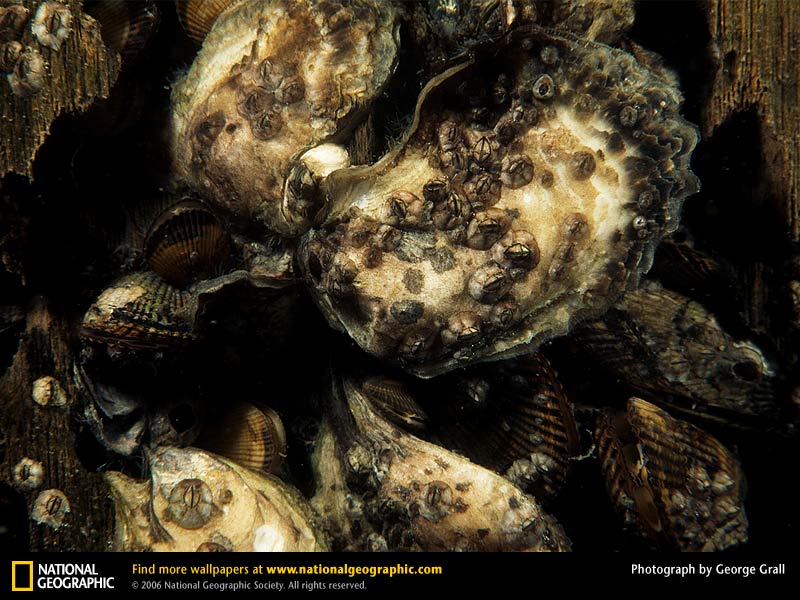
Oysters
A COMMENTARY FOR EARTH DAY – Rev. Gordon C. Stewart | Friday, June 4, 2010 – published by MinnPost.comThe “spill” in the Gulf of Mexico raises the most basic questions about how we humans think of ourselves.
We’re at a turning point. The crisis we can’t seem to kill in the Gulf of Mexico puts before us the results of a more foundational crisis than the black goo that is choking the life out of the Gulf. The uncontrolled “blow-out” raises basic questions about how we think of ourselves and the order of nature.
Fifteen years ago I was with a group of pastors who spent four days with the Chesapeake Bay Foundation, whose mission is to protect and clean up the Chesapeake Bay. Our time there began with a day on the bay on a Skipjack, one of the last remaining motorless sailing vessels that used to harvest oysters by the tens and hundreds of bushels from oyster beds. The director of the Chesapeake Bay Foundation and an old waterman named Earl, who had worked the bay for 54 years, took us to school.
Back then the oyster population had shrunk to a fraction of 1 percent of what it used to be. Fifteen years before our visit the oyster population would filter all the water in the bay in three days’ time. A single oyster pumps five gallons of water through its filtration system every day.
The oysters were close to extinction; the bay’s natural filtering system was in danger. “It’s humans who’ve done this,” said the old waterman. “They’ll come back; I have to believe they’ll come back.”
Others were less hopeful. The Maryland Department of Natural Resources discussed the damage to the wetlands and the estuaries, the seedbeds of life. It had sounded the alarm for public action to protect the birthplaces of all the seafood we eat, the places on which the whole chain of life depends.

This week we heard from the Gulf of Mexico that the attempted “top kill” has failed and that the “spill” is spreading in every direction — not only on the surface, but below the surface — a glob the size of the state of Texas. I think of Earl and his Skipjack as I see the poisoned oysters in the hands of Louisiana oystermen whose livelihood depends on clean Gulf waters. “It’s humans who have done this.”
But it’s not every human who has done this violence to the Gulf. It was not the indigenous people of North America, nor was it the Moken people (“the sea gypsies”) who, because they see themselves as part of nature, anticipated the 2004 Asian tsunami while the rest of the world was caught by surprise. It was a specific form of humanity known as Western culture that sees humankind as the conqueror of nature.
Our language is not the language of cooperation with nature. “And God said, ‘… fill the earth and subdue; and have dominion over the fish of the sea and the birds of the air and over every creeping thing that creeps upon the earth’ ” — (Genesis 1:28), a conquering view based in the idea of species superiority expressed in the phrase “top kill” for the attempt to plug the hole that is killing the oysters and fish of the sea.
Insofar as interpreters of the Book of Genesis have shaped this Western hubris, my Judeo-Christian tradition bears responsibility for this crisis. The idea of human exceptionalism springs from the Bible itself.
But no sooner do I sink into confession and despair than I remember a prayer that Earl called to my attention on the Skipjack 15 years ago, the prayer of St. Basil from the third century that offers a more hopeful understanding of ourselves, a view like Moken people’s that knows that the whole world’s in an oyster:
“The Earth is the Lord’s and the fullness thereof. O God, enlarge within us the sense of kinship with all living things, our brothers and sisters the animals to whom You have given the Earth as their home in common with us. We remember with shame that in the past we have exercised the high dominion of man with ruthless cruelty, so that the voice of the Earth, which should have gone up to You in song, has been a groan of travail. May we realize that they live not for us alone, but for themselves and for You, and that they have the sweetness of life.”

I stand looking through the picture window at the pond behind the house. The small nature raft in the middle of the small pond is peopled with Canadian geese preening in the mid-morning sun. To their left, three or four ducks paddle across the pond – but something is different.
They’re moving much faster than usual. They don’t seem frightened; they’re just moving faster.
Then I see why. A muskrat is chasing them – ten yards or so behind. I’ve seen this before – mallards and muskrats playing a game of catch us if you can. Speed up, slow down, speed up. Nobody ever catches anybody and nobody ever gets caught. They just chase and get chased. It’s play.
As the mallards paddle past the raft with the muskrat in hot pursuit, the muskrat makes a sudden 90 degree turn, races at full speed and leaps up for the raft, the geese flapping their wings, scattering in flight just as the muskrat lands and springs into the air. A flying-muskrat in hot pursuit, an air-Jordan muskrat suspended in mid-air, a flying goose wanna-be, leaping and laughing for joy. Muskrat heaven! Sheer unadulterated play.
I envy the muscrat, the ducks and the geese today. I know I’m making the story up, but the story I tell speaks aloud a yearning for more playfulness. An enjoyment of each other with natural games that keep away the boredom and challenge our pretensions.
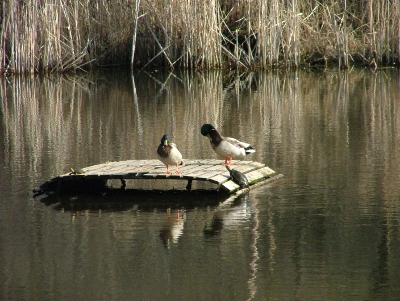
Nature raft with Mallards
I watch the pond a lot these days to learn about myself and us. Oh, I know! There’s also terror and danger in that pond – the snapping turtle lurks beneath the surface, the fox roams the edges, and my neighbor sometimes stands on his deck with his shotgun aimed at the little muskrat who dares to burrow his home under his manicured lawn. But today all of that is beside the point – upstaged by ducks and geese and a muskrat in self-forgetful play. I stand looking through the window and give thanks for quacking mallards, honking geese and a funny little creature whose muskrat heaven restores my natural sense of play and joy.
Sunday, April 22, is Earth Day. My friend Steve sent this poem this morning.
Hope it lifts your spirits and causes you to do something crazy for the Earth.
“Earth Day” – Steve Shoemaker, April 20, 2012

Kites - Morro Bay Kite Festival
Earth Day is best observed with string and kite.
A little bit of wind is nice, but not
Required: just hold the spool and run–take flight!
To make a kite, buy line and glue, get
Help by recycling– all the rest is free:
Day-old newspapers can be cut just right,
And sticks from fallen branches, two or three.
Your spirits will fly up just like the kite!
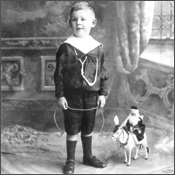
Author C.S. Lewis as a child before his mother's death
“NEWS: 24/7”
a poem by
Steve
Shoemaker
April 20, 2012
The writer, C.S. Lewis, said he never read the newspapers or owned a TV. “If any-
thing important happens, someone will always say,”
he claimed. His house was filled with books. The life he led
began each day with prayer, with pen and a notebook,
food, teaching, more writing, then meeting friends for beer
and talk and laughter. 50 books of his appear
in 65 years on this earth. “Just take a look,”
he said, “I’m the last dinosaur you’ll ever see!”
His day of death was not reported on TV:
November 22, 1963.
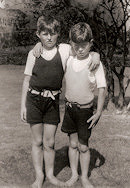
JFK with big brother Joe Kennedy
C.S. Lewis’s books have been translated into more than 30 languages and have sold millions of copies. The Chronicles of Narnia are the most popular. having been popularized on stage, TV, radio and film. His book A Grief Observed, an exceptionally honest reflection following the death of the love of his life, Joy Davidman, meant a great deal to me in dealing with my own raw grief. The film Shadowlands was based on A Grief Observed. Lewis was no stranger to the grief that shocked the world in Dallas November 22, 1963, the day he died without the notice he deserved.
“…God’s demand for perfection need not discourage you in the least in your present attempts to be good, or even in your present failures. Each time you fall He will pick you up again. And He knows perfectly well that your own efforts are never going to bring you anywhere near perfection.”
– C.S. Lewis, Mere Christianity
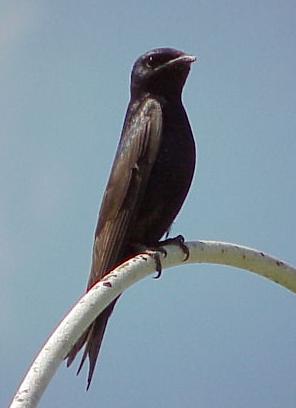
Purple Martin
The early morning is cool and sunny. The walking trail has been shaded by huge oaks, elms, and ash trees, the path shimmering with light and shadow. I come out of the shadows and suddenly it is there: Purple Martin Place, 76 Purple Martin houses on poles reaching for the sky, each one labeled with a number. “ In my father’s house are many mansions” and a host of chirping Purple Martins flying out across the large open field.I remember the Benedictine morning mass at St. John’s Abbey where I had retreated on the hard walk to the end of my 33-year-old step-daughter Katherine’s terminal cancer. RIP.
From their Purple Martin Mansions
The Purple Martins swoon and swoop
O’er the green grass field shimmering
In early morning light cooled by the breeze
A Purple Martin chorus chants its antiphons
En masse above the green grass field,
A purple Benedictine chorus sings praise
To the morning on their way to breakfast.
– June 1, 2011
Two Views from the Edge commenters found themselves singing the hymn “Morning Has Broken” after reading the poem. Click to hear and watch a magnificent instrumental and photographic rendering of the hymn. Here’s the first stanza:
Morning hasd broken
Like the first morning,
Blackbird has spoken
Like the first bird.
Praise for the singing!
Praise for the morning!
Praise for them singing,
Fresh from the Word
– Gaelic melody; lyrics by Eleanor Farjeon, 1931
 Views from the Edge