
Waiting for new Krispy Kreme to open.
Use a cliche for a doughnut.
But for Krispy Kreme
These words are supreme:
They melt in your mouth in a minute.
– Steve Shoemaker, Urbana, IL April 8, 2013

Waiting for new Krispy Kreme to open.
– Steve Shoemaker, Urbana, IL April 8, 2013
Click We the People and the Republic We Must Reclaim for Lawrence Lesssig’s TED discussion of the electoral process and what he calls “Lesterland” (the U.S.A.).
Here’s what TED says about Lawrence Lessig:
Why you should listen to him:
Lawyer and activist Lawrence Lessig spent a decade arguing for sensible intellectual property law, updated for the digital age. He was a founding board member of Creative Commons, an organization that builds better copyright practices through principles established first by the open-source software community.In 2007, just after his last TED Talk, Lessig announced he was leaving the field of IP and Internet policy, and moving on to a more fundamental problem that blocks all types of sensible policy — the corrupting influence of money in American politics.
In 2011, Lessig founded Rootstrikers, an organization dedicated to changing the influence of money in Congress. In his latest book, Republic, Lost, he shows just how far the U.S. has spun off course — and how citizens can regain control. As The New York Times wrote about him, “Mr. Lessig’s vision is at once profoundly pessimistic — the integrity of the nation is collapsing under the best of intentions –and deeply optimistic. Simple legislative surgery, he says, can put the nation back on the path to greatness.”
“In [Republic, Lost], Lessig … details how money came to corrupt our government, how our broken system hurts both the Left and the Right, and what it will take to return American democracy to its rightful owners – the people.”
Rolling Stone blog, October 5, 2011
MOVIE LOVER
(Acrostic)
Responding quickly to a word
Or face, or plot or place… seeing
Gladly signs of wit, insight and
Even truth… in the dark writing
Relentlessly for all who read…
…
Ever hoping goodness will win
Before greed drags it down… helping
Everyone see beauty in one
Rosebud film frame… celebrating
The movies… overlooking none.
– Steve Shoemaker, Urbana, IL, April 3, 2013
NOTE: Film critic Roger Ebert and Steve Shoemaker were friends.. Steve is a great admirer. The Ebert Film Festival at the University of Illinois has long been one of the highlights of Steve’s year. He has often spoken of the magnificent way Roger continued to review the films and “chat” with Festival attendees by means of his computer after he could speak no longer with his resonant voice.
Washington’s Playbook to Provoke North Korea came to our attention this morning in a comment on yesterday’s Views from the Edge post “Little Boys with Toys” from a highly respected historian.
Sometimes the COMMENTS move in directions that deserve wider attention. This is one of those times. Below are 1) the comment, 2) Views from the Edge’s reply, and 3) an invitation to weigh in on the discussion.
1) The COMMENT:
As much as I agree with thoughts just posted about Kim Jong Un I think they need to be tempered by an understanding of the origin of North Korea’s behavior. Imagine a country 1/2 the size of Minnesota, N. Korea, with its 30 million people. Could Mn. feed 30 mill. people in its northern half where ag land is limited by forests and rock as N. Korea has to try and do? Not likely.
Then we have to consider the fact that in 1945 Henry Cabot Lodge was the US diplomat that unilaterally made the 38th parallel the border for the US interest in decapitating the nation of Korea to prevent it from going communist. How would we feel if an outside force turned the US into 2 countries to weaken us a nation.
At the time N. Korea has just seen the US drop 2 atomic bombs a few hundred miles away on Japan. The US then proceeds to bomb every building in N. Korea during the Korean War. Literally the US made the decision to bomb N. Korea back into the stone age. Again this done to a country that is geographically half the size of Minnesota. Why do we wonder about the behavior of the leaders of a country that has been treated this way by us. Me thinks Washington “doth protest too loudly”.
If we as a nation were willing to do what we did to N. Korea 67 yrs. ago why would we think the present US bellicose attitude is anything more than propaganda to perpetuate the neutralization of N. Korea as a force that might interfere with our interest to dominate Southeast Asia.
An understanding of geo-strategic theory we inherited from the British after WW II is instructive in understanding the hidden history of N. Korea. It is necessary to read Halford MacKinder, the 1890s British father of geo- strategic theory, to understand the Pentagon’s morally bankrupt approach to N. Korea.
2) The REPLY
I couldn’t agree more with the geo-political analysis of the sordid history that has isolated this small nation. As the old saying goes, “Just because you’re paranoid doesn’t mean there’s nobody out to get you.” They have many reasons to hate the U.S. A nation half the size of Minnesota with 30M people devastated by the Korean “Conflict” has ever reason to fear the most powerful nation on the face of the Earth. We (the U.S.A.) have not honored the terms of the treaties with N. Korea. They have no reason to trust.
The historian’s eye brings all of this front and center, and serves to remind us that we in the U.S. are constantly conditioned by propaganda and misinformation campaigns from the highest sources.
Even so, I can’t help but see the same father-son relationship in N. Korea that we saw in George Herbert Walker Bush and his son George W. who sought to finish (and outdo!) his father’s “manly” work. In both cases a sense of the numinous is shrunk to the size of the father and the nation that once worshiped him. Or…so I think 🙂
3) YOUR thoughts on the matter?
(Previously published commentary on North Korean leader with more attractive title) 🙂
Rudolph Otto’s idea of the mysterium tremendum et fascinans, the source of holy dread and attraction that sends shudders down the human spine, rises to the fore as North Korea’s young leader Kim Jong Un plays with the possibility of nuclear holocaust.
It’s one thing to play with toys. It’s something else when the toys are nuclear bombs and missiles.
In The Idea of the Holy: An Inquiry into the Non-rational Factor in the Idea of the Divine and its Relation to the Rational, Rudolph Otto examines what he called the “numen,” the non-rational mystery that evokes feelings at once terrifying and sublime regarding our human condition.
“Otto on the Numinous” provides a concise introduction by an unidentified City University of New York English professor.
In The Idea of the Holy: An Inquiry into the Non-rational Factor in the Idea of the Divine and its Relation to the Rational, Rudolph Otto identifies and explores the non-rational mystery behind religion and the religious experience (“non-rational” should not be confused with “irrational”); he called this mystery, which is the basic element in all religions, the numinous. He uses the related word “numen” to refer to deity or God.
Forced, necessarily, to use familiar words, like “dread” and “majesty,” Otto insists that he is using them in a special sense; to emphasize this fact, he sometimes uses Latin or Greek words for key concepts. This fact is crucial to understanding Otto. Our feeling of the numinous and responses to the numinous are not ordinary ones intensified; they are unique (I use this word in its original meaning of “one of a kind, the only one”) or sui generis (meaning “in a class by itself”). For example, fear does not become dread in response to the numinous; rather, we cease to feel ordinary fear and move into an entirely different feeling, a dread that is aroused by intimations of the numinous or the actual experience of the numinous.
The word “absolute” is used in its metaphysical sense of “existing without relation to any other being; self-existent; self-sufficing” (OED); its adjectival form, “absolutely,” is used with the same meaning.”
The fact that North Korea’s young leader Kim Jong Un is threatening the world with nuclear holocaust does what World War I did to many theologians who had presumed that history is on a course of inevitable progress.
It is not.
The power of death is enticing, a sin to which Robert Oppenheimer, the father of the bomb, later confessed. The human will to power becomes evil when real soldiers, real nuclear bombs, and real missiles, and real threats of destruction are mistaken for childhood toys or computer games where human folly can be erased by hitting a delete button.
We are all children inside, for both good and ill.
Looking at the young North Korean leader, psychiatrists might see an Oedipus complex, the son outdoing the father at the game of nuclear threat, the boy who played with matches and determined that if his father was afraid to light the fuse, he would step out from his father’s shadow onto the stage of world power in a way the world would never forget.
But deeper and more encompassing than any Freudian analysis is Rudolph Otto’s mysterium tremendum et fascinans.
The philosophical-theological debates about Modernism and Post-Modernism are interesting. They deserve our attention. But neither Modernism’s rationalism nor Post-Modernism’s deconstructionism is equipped to address the most basic reality which encompassing the human condition: the mysterium tremendum et fascinans and the horror of its daemonic distortion in the shrinking of it by the human will to power.
Whenever we take the ultimate trembling and fascination of the self into our own hands, the world is put at risk. In the world of the ancients and the pre-historical world of our evolutionary ancestors the consequences were limited to a neighbor’s skull broken with a club. In the advanced species that has progressed from those primitive origins, we have fallen in love with our own toys of destruction, the technical achievements and manufactured mysteries that are deadly surrogates for the mysterium tremendum et fascinans that sends shudders down the spine in terror and in joy before what is Real.
Our time is perilously close to mass suicide. Unless and until we get it straight that I/we are not the Center of the universe, the likes of Kim Jong Un – and his mirror opposites but like-minded opponents on this side of the Pacific – will hold us hostage to the evil that lurks in human goodness.
Progress isn’t all it’s cracked up to be. The ancient shudder of the creature – the human cry for help in the face of chaos and the heart’s leap toward what is greater than the self or our social constructs – unmasks every illusion of grandeur in a world increasingly put at risk by little boys with toys.
P.S. Just as this piece was in final editing, Dennis Aubrey published “Mysterium Tremendum” on Via Lucis Photography.
Rudolph Otto’s idea of the mysterium tremendum et fascinans, the source of holy dread and attraction that sends shudders down the human spine, rises to the fore as North Korea’s young leader Kim Jong Un plays with the possibility of nuclear holocaust.
It’s one thing to play with toys. It’s something else when the toys are nuclear bombs and missiles.
In The Idea of the Holy: An Inquiry into the Non-rational Factor in the Idea of the Divine and its Relation to the Rational, Rudolph Otto examines what he called the “numen,” the non-rational mystery that evokes feelings at once terrifying and sublime regarding our human condition.
“Otto on the Numinous” provides a concise introduction by an unidentified City University of New York English professor.
In The Idea of the Holy: An Inquiry into the Non-rational Factor in the Idea of the Divine and its Relation to the Rational, Rudolph Otto identifies and explores the non-rational mystery behind religion and the religious experience (“non-rational” should not be confused with “irrational”); he called this mystery, which is the basic element in all religions, the numinous. He uses the related word “numen” to refer to deity or God.
Forced, necessarily, to use familiar words, like “dread” and “majesty,” Otto insists that he is using them in a special sense; to emphasize this fact, he sometimes uses Latin or Greek words for key concepts. This fact is crucial to understanding Otto. Our feeling of the numinous and responses to the numinous are not ordinary ones intensified; they are unique (I use this word in its original meaning of “one of a kind, the only one”) or sui generis (meaning “in a class by itself”). For example, fear does not become dread in response to the numinous; rather, we cease to feel ordinary fear and move into an entirely different feeling, a dread that is aroused by intimations of the numinous or the actual experience of the numinous.
The word “absolute” is used in its metaphysical sense of “existing without relation to any other being; self-existent; self-sufficing” (OED); its adjectival form, “absolutely,” is used with the same meaning.”
The fact that North Korea’s young leader Kim Jong Un is threatening the world with nuclear holocaust does what World War I did to many theologians who had presumed that history is on a course of inevitable progress.
It is not.
The power of death is enticing, a sin to which Robert Oppenheimer, the father of the bomb, later confessed. The human will to power becomes evil when real soldiers, real nuclear bombs, and real missiles, and real threats of destruction are mistaken for childhood toys or computer games where human folly can be erased by hitting a delete button.
We are all children inside, for both good and ill.
Looking at the young North Korean leader, psychiatrists might see an Oedipus complex, the son outdoing the father at the game of nuclear threat, the boy who played with matches and determined that if his father was afraid to light the fuse, he would step out from his father’s shadow onto the stage of world power in a way the world would never forget.
But deeper and more encompassing than any Freudian analysis is Rudolph Otto’s mysterium tremendum et fascinans.
The philosophical-theological debates about Modernism and Post-Modernism are interesting. They deserve our attention. But neither Modernism’s rationalism nor Post-Modernism’s deconstructionism is equipped to address the most basic reality which encompassing the human condition: the mysterium tremendum et fascinans and the horror of its daemonic distortion in the shrinking of it by the human will to power.
Whenever we take the ultimate trembling and fascination of the self into our own hands, the world is put at risk. In the world of the ancients and the pre-historical world of our evolutionary ancestors the consequences were limited to a neighbor’s skull broken with a club. In the advanced species that has progressed from those primitive origins, we have fallen in love with our own toys of destruction, the technical achievements and manufactured mysteries that are deadly surrogates for the mysterium tremendum et fascinans that sends shudders down the spine in terror and in joy before what is Real.
Our time is perilously close to mass suicide. Unless and until we get it straight that I/we are not the Center of the universe, the likes of Kim Jong Un – and his mirror opposite but like-minded opponents on this side of the Pacific – will hold us hostage to the evil that lurks in human goodness.
Progress isn’t all it’s cracked up to be. The ancient shudder of the creature – the human cry for help in the face of chaos and the heart’s leap toward what is greater than the self or our social constructs – unmasks every illusion of grandeur in a world increasingly put at risk by little boys with toys.
P.S. Just as this piece was in final editing, Dennis Aubrey published “Mysterium Tremendum” on Via Lucis Photography.
at the end of my life
as at an earlier time
i read (reed)
sport pages
…
political reporting
had my attention
during my long
middle ages
…
features
like novels
i always
have read (red)
…
comics i read (red)
when i was a child
and when we had kids
at home
…
in heaven (or hell)
I expect to read
poetry
– Steve Shoemaker, Urbana, IL, April 4, 2013
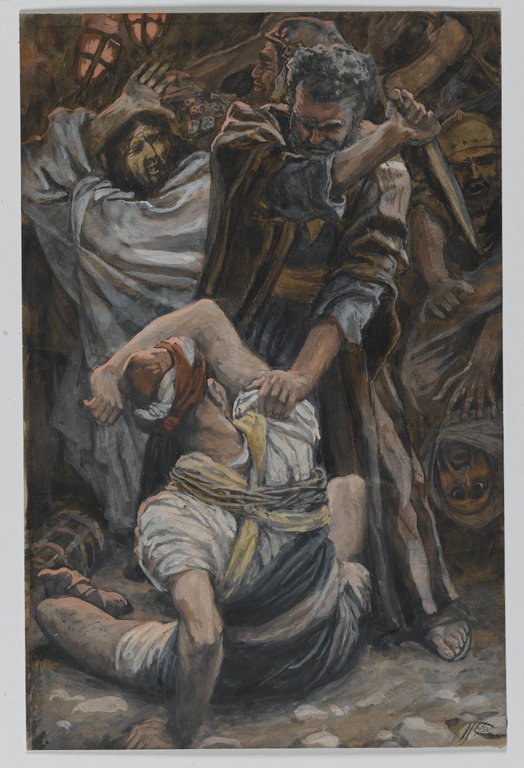
Peter cuts off the ear of Malchus – James Tissot
Jesus of Nazareth (ca. 30 CE): “Those who take up the sword will die by the sword.” (Matthew 26:52b)
American City Council (2013 CE): Mandatory Gun Ownership Law Passes in Georgia Town
Gun-buying after Newtown massacre (2013): : Customers pack Connecticut gun stores after deal on laws
George Carlin (ca. 2000 CE): “I’m not concerned about all hell breaking loose, but that a PART of hell will break loose… it’ll be much harder to detect.”
Yesterday Sojourners’ blog God’s Politics: a blog with Jim Wallis and friends published “The Garden Outside Pleasantville.” Thanks to Jim Wallis and the Sojourners staff for republishing.
Click HERE for the piece on Sojourners.
This is the manuscript of the Easter sermon yesterday at Shepherd of the Hill Presbyterian Church in Chaska, MN. The sermon was an exploration into the contemporary meaning of the text: The Gospel According to John 20:1-18.
In some way or other, I think it’s safe to say that we all have a kind of nostalgia for the innocence and purity of the Garden of Eden…before what we call “the fall.” We have a sense that we are not supposed to be outside the gates of the Garden…out here. At the expulsion of the man and the woman in the story from Genesis, .the cherubim (angels) are posted at the gate to be sure that those who have been expelled cannot get back in. The cherubim and a twirling, flaming sword keep Adam, Eve – you, me, all of us – on this side of the gate, outside the Garden of Eden.
Well it’s a story, of course, but isn’t it our story? Nostalgic for a world where nothing ever goes wrong But illness comes, a marriage goes bad, a relationship with someone you love falls apart just when you think it’s to lead to something more permanent, you lose a job, you suffer depression, you suffer from an illness, you’re left alone in grief over the loss of a loved one. Or you yourself are dying, and there are wars and rumors of wars. We watch the children and wish that we could protect them, but we can’t, even though we are parents and grandchildren, aunts and uncles. Out here…outside the Garden…it’s rough sometimes.
In this morning’s Gospel (John 20:1-18), the Risen Christ’s appearance to Mary takes place in a garden The garden is outside the empty tomb. Until Mary turns and sees the One she supposes to be “the gardener”, the text has said nothing about Jesus being laid to rest in a garden. It says only that Jesus was laid in a tomb in which no one had yet been buried.
Mary has already been there by herself in the early morning darkness. When she sees, to her great horror, that the tomb is empty, she runs to tell “the other disciple” and Peter.
What do they do? Well…these are guys, you know. They race each other to the tomb.
We don’t ever compete, do we, guys!? And Peter loses! The other disciple gets there first, and then Peter follows, huffing and puffing. Peter, bold man that he is, goes in. Peter in this story is like detective Joe Friday in the old Dragnet series: “Just the facts, Ma’am; just the facts!” He sees the facts. The burial cloths are lying there as though the body had evaporated out of them, but the napkin that had covered Jesus’ face, was neatly rolled up in a place by itself. Then the other disciple goes in, sees the same thing. He believes…and then…they just…go home.
Well…what happened to Mary? They leave Mary there? By herself? And it is Mary who gets it – because Mary continues to stand there, weeping. She’s feeling her grief, feeling her sorrow, and it is as she is feeling her sorrow and her grief. It is as she goes down into the horror of the cross, the horror of having stood helplessly at the foot of the cross that she experiences the Risen Christ.
It is there that there is suddenly a garden, a new garden of Paradise.
I don’t know how it is with you, but sometimes I want to live in a perfect world. I want everything to be in its place. I don’t want any problems. I don’t want to feel anything. Someone I love much once said, “I hate feelings!” This is about feelings, brothers and sisters.
There is a certain kind of Christianity that says “No, no, no!” to every “negative” feeling. It wants everything to be happy. Like Steve Martin dancing around with happy feet. All we want is happy feet. But you don’t get happy unless you know sadness. You don’t get to laughter unless you know what it is to cry real tears of sorrow.
—————————————————-
This distorted kind of Christianity, this preference for the perfect world without any negative feelings or experience is humorously by the film Pleasantville.
David, who is played by Toby McGuire, and his sister Jennifer (Reese Witherspoon) lead very different high-school social lives. Jennifer is popular and shallow. David is introverted, keeps to himself, and spends most of his time watching television. David’s favorite show is Pleasantville, a nostalgic throw-back black and white television series about the idyllic Parker family in the late 1950s. The little imaginary town of Pleasantville is, for David, a kind of Garden of Eden in which nothing ever goes wrong. Everyone is nice. No one ever feels pain. They are just, well… so nice.
One evening David and Jennifer fight over the TV. Jennifer wants a concert. David wants to watch Pleasantville. As they fight, the remote control breaks.
A mysterious TV repairman, played by Don Knotts, shows up, quizzes David about Pleasantville, and replaces the remote control with a strange new one. When the TV repairman leave, David and Jennifer resume their fighting, and are sucked through the television set into the black white gray, colorless world of the Parkers’ Pleasantville living room.
They are no longer David and Jennifer. They must pretend to be Bud and Mary Sue Parker, the son and daughter of the Parker family of Pleasantville.
David and Jennifer witness the wholesome nature of the town, such as a group of firemen rescuing a cat from a tree. David has to remind Jennifer that they must stay in character and not disrupt the lives of the town’s citizens, who don’t even notice the difference between the show’s original characters of Bud and Mary Sue, and their role replacements, David and Jennifer. In keeping with the show’s plot, Jennifer dates a boy from high school, but when she has sex with him, a concept unknown to the boy and to everyone else in town, the spell of colorless innocence is broken.
Slowly, Pleasantville begins to change from black and white and grayness to color. Flowers and the faces of people who have experienced bursts of emotion begin to have some color.
David becomes friends with Mr. Johnson, who owns Pleasantville’s cheeseburger and soda fountain. He introduces Mr. Johnson to colorful modern art via a book from the library, sparking in him an interest in painting. Mr. Johnson and Betty Parker fall in love, causing her to leave home, throwing George Parker, Bud and Mary Sue’s father, into confusion. The only people who remain unchanged are the city fathers, led by Big Bob, the mayor who sees the changes eating away at the values of Pleasantville. The city fathers resolve to do something about their increasingly independent wives and their rebellious children.
As the townsfolk become more colorful, a ban on “colored” people is instituted in public places. A riot begins when a nude painting of Betty, painted by Mr. Johnson, appears on the window of Mr. Johnson’s soda fountain. The soda fountain is destroyed, books are burned, and people who are “colored” are harassed in the street. As a reaction, the city fathers announce new rules preventing people from visiting the library, playing loud music, or using paint other than black, white, or gray.
When David and Mr. Johnson protest by painting a colorful mural on a brick wall, depicting their world, they are arrested. Brought to trial in front of the town, David and Mr. Johnson defend their actions, arousing enough anger and indignation in Big Bob, the mayor, that Big Bob becomes colored as well.
Having seen Pleasantville change irrevocably, Jennifer stays to finish her education, but David finally manages to return to the real world by use of his magical remote control.
———————————————————-
Easter is about a full color world. FULL of color. Full of emotion. Ups and downs. It has nothing to do with this imaginary, utopian Garden of Eden that never was and never will be, in which we no longer have to feel much of anything. “I hate feelings!”
There is no return to the Garden in which the man and the woman live in unconscious innocence, no way back into the black and white and gray world of the Garden of Eden from which humankind is expelled.
But this morning we see a colorful woman. She is a colorful woman, this Mary of Magdala, who stays with Jesus all the way through.
According to one tradition in the Church, this Mary was a prostitute. Mary Magdalene comes to Jesus, stays by Jesus, is healed by Jesus. Now she is in deep grief on this morning when, so far as she knows, her Lord was still buried in that tomb following a Roman crucifixion, dead and gone.
It is this Mary who goes out early in the morning, “while it was still dark.” Women don’t go out in the night; they don’t go out unescorted in the dark. But Mary does! And when the other disciple and Peter, the two heroes to whom she had gone for help, abandon her, she is there by herself.
“Why are you weeping?” ask the two angels, one where Jesus’ feet and been and one where his head had been. The cherubim!
These cherubim, who guard the way back into the lost paradise of the Garden of Eden, are there in the tomb. “Why are you weeping?”
Mary’s voice breaks into a stammering primal cry of horror. “They have taken away my Lord, and I do not know where they have laid him! Tell me where he is! Let me hold him!”
She turns around. The gardener greets her. The Risen Christ greets her, but she does know that it is Jesus. She supposes him to “the gardener”. She is in a garden where only the gardener would be early in the morning. The One she assumes to be the gardener greets her. She doesn’t recognize him. He asks the same question, “Woman, why are you weeping? Whom do you seek?” Mary gives the same answer.
Then he calls her name. “Mary!”
“Rabboni (Teacher)!!! It’s YOU!!! Is it really YOU?”
How about you? Why are you weeping? ask the Cherubim and Jesus.
“Mary, Mary, Mary!’ Her name is called. Your name is called, the name of the real you. Not some black-and-white-and gray, colorless character in a Pleasantville world, but the real flesh-and-blood, colorful you, the real Mary. The real Bob. The real Jane. The real you in living color.
“Do not hold me,” he says, “for I have not yet ascended to the Father. But go to my brothers and sisters and tell them I am ascending to my Father and your Father, to my God and your God.”
”Go! Go! Go now!”
Tell each other. Tell each other it’s not over. Tell each other you have seen me. Tell each other that Caesar did not have the last word. Tell each other that life is greater than death, greater than might. Tell each other that you have heard the cherubim, standing guard from within an empty tomb, asking you why you are weeping. Tell them that you have heard the Gardener’s own voice in the New Garden outside my empty tomb!
Today the tears of sadness and the cries of horror are turned into the tears of gladness and shouts of exuberant joy:
“Christ is risen!” brothers and sisters, “Christ is risen! Christ is risen!” Alleluia! Alleluia! Alleluia!”
 Views from the Edge