The Prophets: Parents of Newtown

The parents of the murdered children of Sandy Hook Elementary School in Newtown are back in Washington, D.C today and tomorrow. They are meeting with our nation’s law-makers.

Like Jeremiah, “the Weeping Prophet” who cried over the plight of his people, these mourning parents are courageous spokespersons for sanity, compassion, and an end to America’s love of violence.

May the Spirit that inspires these grieving parents to leave home for meetings in the center of American power and public scrutiny stir the consciences of the Congressional Representatives and Senators with whom they meet.

A friend brought to my attention “Thank God, I’m Alive” on the latest tragedy of gun violence to garner national attention in Santa Monica, California.

As Moses said when Joshua wanted to silence two people (Eldad and Medad) who were speaking out without authorization: “I wish that all God’s people were prophets!” (Book of Numbers 11:29, Torah, Hebrew Bible).

I invite your prayers and well wishes for the parents of Newtown as they carry forward the prophetic tradition. Let no one silence you. Speak the truth with love, and let the Spirit do its work.

Please share your comments.

Let sleeping dogs lie

Poet and guilt-free friend

Poet and guilt-free friend

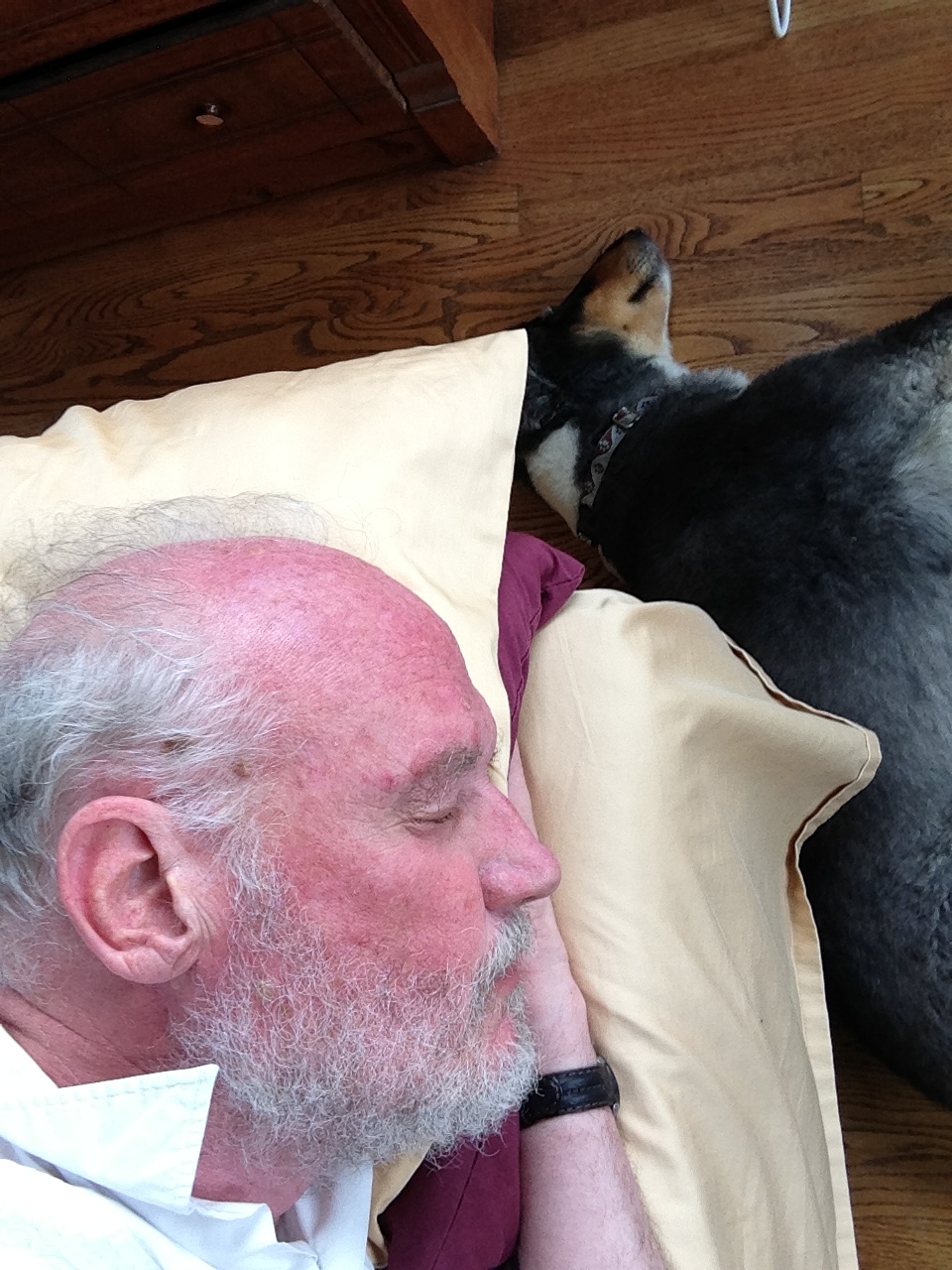
EDITORIAL NOTE: The author of this poem is the bald one, not the one with all the hair. He was taking a nap during the daytime because he couldn’t sleep at night.

AWAKE

I do not want to be awake. I wish,
instead my racing mind would shift into
a neutral gear, spin to a stop, rehash
no more today/tomorrow/yesterday.
I meditate, I take slow breaths, I say
the very first prayers that I ever knew…
I try to sing myself a lullaby,
but silently, so not to wake nearby
a gently sleeping soul who has it seems
a clear conscience and peaceful dreams.

– Steve Shoemaker, Urbana, IL, sent by email to Editor @12:25 a.m., June 11, 2013

EDITOR’S NOTE: Albert Camus said, “A guilty conscience needs to confess. A work of art is a confession.”

Thanks you, Steve, for the art.

Nets

cherry-pieVerse — by Steve Shoemaker

We lug heavy bags of birdseed
from store to car to garage
steel storage can to feeders.
We keep squirrels away.
We watch the birds feast.

We fertilize and water and prune
the young fruit trees in the orchard
and see blossoms, then growing fruit.
Cherries are loved by birds and us.
Let birds eat seeds–nets mean pies.

It’s raining, its pouring

Maybe we bumped our heads getting a little snack last night! And the night before that, and…. Will it ever stop?

Hide-and-Seek: Oysters Can’t Hide

Oysters can't hide!

Oysters can’t hide!

The subsistence fishers who have inhabited Isle de Jean Charles since 1830 see things differently from BP and the mainline press.

‘Come to Louisiana. Everything is fine’ say the BP ads. Well, they’re not fine. There are no oysters. There are no shrimp,” said Chief Albert Naquin of the Isle de Jean Charles Band of the Biloxi-Chitimacha-Choctaw during a recent three hour conversation in Chaska, Minnesota.

Chief Naquin and Kristina Peterson were on route to Duluth for a consultation of American indigenous people focusing on the Mississippi River from its headwaters in Minnesota to its mouth in Louisiana, the site of the vanishing traditional home of the Isle de Jean Charles tribe.

Kristina is a professional community disaster recovery specialist who splits her time between the University of New Orleans Center for Hazards Assessment, Response, and Technology (CHART) and the Blue Bayou Presbyterian Church in Gray, LA, where she is the Pastor. Kristina had come to Chaska, MN two years ago as speaker for First Tuesday Dialogues: examining critical public issues locally and globally, a community forum of Shepherd of the Hill Presbyterian Church.

For three hours we discussed what was happening three years after the ecological tragedy America has almost forgotten.

ABOUT ISLE DE JEAN CHARLES

The people of Isle de Jean Charles have been there since 1830. They re-settled there after fleeing the U.S. government’s forced re-settlement program, leaving their native lands in search of a place where they could continue their culture and live together in hiding.

The place that became home was a piece of solid land hidden deep in the freshwater marshlands of the Louisiana Delta. When they settled there, the island measured 10 miles long by five miles wide.

From there they fished the coastal waters abundant in oysters, crabs, shrimp, and fish. They grew their own vegetables and fruit trees, and used its green pasture for horses and cows. The members of the tribe in hiding shared their seafood, dairy products, chickens, and produce with each other in a barter economy.

“My mother told me every time I went out to play, ‘If you see a stranger, hide.”’

THE 1940s: OIL CANALS

As Chief Albert tells the story, the accelerated erosion of the Gulf coastlands dates to the early 1940s. Big oil received a license from federal, state, and local authorities to dig canals through the Delta marshlands in search of oil. The new canals cut every which way, often crisscrossing, in search of liquid gold. And as they did, the marsh began to disappear. The salt water of the Gulf of Mexico seeped further and further into the Delta.

Chief Naquin and his people do not forget. They have long attention spans. They remember that oil canals were created by licensed permission under specified conditions. They remember that the licenses had time limits The time limits have long since passed. They remember what others have ignored or conveniently forgotten: the terms of the licenses required the oil companies to remediate the land at the conclusion of the license period.

The reclamation never took place. The Chief remembers. Click HERE for BP’s online promotion of its work to restore the Gulf of Mexico since Deep Water Horizon. There’s nothing about the canals or the licenses that required reclamation of the Delta.

ISLE DE JEAN CHARLES TODAY

The island that once measured 10 miles by five miles has shrunk to two miles long and one-quarter mile wide. The island will not survive.

Chief Naquin has been working to negotiate a suitable substitute for their ancestral home. The Army Corp of Engineers offered an alternative site that would have kept the tribe together, preserved their way of life, and helped bring income to the tribe by means of a visitor center for tourists.

A condition of occupying the new land, however, was that 100% of the tribe’s members vote Yes on the proposal. The vote was 85%. The 15% minority are mostly older people who have lived their entire lives on Isle de Jean Charles and insist they will go down with the island.

“When’s the last time any city, any nation, any group, any organization was asked for a vote of 100%?” asks Chief Naquin. “It’s impossible. We had 85% but it wasn’t enough.”

There is no hiding place. There is no lasting hiding place.

CHASING DOWN THE STRANGER: SURVIVAL BEYOND HIDING
Perhaps survival beyond hiddenness is the lesson of Isle de Jean Charles. Not just the Chief’s people who once hid from hostile powers in the Louisiana Delta, but all of us who hide from the harsh reality of the crony capitalism that grants a permit to oil companies to cut their canals through our fragile ecosystems and then allows those same companies to disappear into hiding from the initial terms of the licenses.

They call the oil rigs “rigs” for a reason. The whole thing is rigged.

If we see a stranger on what used to be Isle de Jean Charles; if we see canals still crisscrossing through the marsh; if we’ve seen the fires of Deep Water Horizon light up the Gulf of Mexico and slick the waters and estuaries with black gold; if we’ve seen the evidence of breaking-and-entering in the house of the Gulf Coast waters, if we see empty oyster shells where once there were oysters; if we’ve heard about the oil companies hiding without anyone playing seek, we can ignore the game or we can seek and find for the sake of survival.

There is a stranger on our island. The fire of Deep Water Horizon lit up the horizon to expose his hideout. The blazing fire in the Gulf of Mexico three years lit up the world with a previously hidden truth that called us to embrace the more transparent future we share with the shorebirds, shrimp, crabs, and oysters.

The oysters can’t hide. Will we, who can make moral choices, hide, or will we seek and call to account the strangers on our island?

Be in the Moment

by Gordon C. Stewart, written five weeks ago in flight from Minneapolis to Los Angeles…before we learned that Kay’s ankle was broken.

Pay attention. Live in the moment. Don’t rush to be where you aren’t. Be right where you are.”

If, for instance, you’re on the stairs… well, watch your step!

This morning Kay and I rose early to catch a flight for a much-needed vacation on the coast of California. We’re excited about this trip, planned at the last moment in the aftermath of losing the dog companions who have been with us for all but the first month of our 14+ year marriage.

Lonely at home without Maggie and Sebastian, I called Kay last Thursday. “Let’s get out of here. The house is empty without them…but we now have freedom to travel. Let’s go somewhere fun.”

Fred, Kay’s colleague at work, said he knew just the place: Cambria, California, a four hour drive north of LA, one his favorite places on the California coast just south of Big Sur.

Within 24 hours we had booked the flights, found a beautiful home in Cambria through VRBO (“Vacation Rental by Owner”), and looked forward to flying out of Minnesota on Monday (today).

Yesterday, Susan Lince, a local artist who moved to Chaska two years ago after teaching Eskimo children in northern Alaska, led us through exercises to become more aware of the senses. Most important is being where you are….touching, tasting, smelling, hearing, seeing.

So…this morning…with Maggie and Sebastian gone, we packed our bags and headed downstairs to the garage.

I had gone first, packed most of the bags in the car, and was waiting for Kay. I assumed she had gone back to get something or to turn something off in the kitchen. I was wrong.

She had fallen down the steps – nine of them – carrying a suitcase I had missed. She came into my sight in the garage limping badly on the ankle that is severely sprained, at best, pulling the suitcase behind.

We iced the ankle and left home for the airport.

Right now we’re on Sun Country Airlines Flight 421 to Los Angeles. Kay has been treated royally since we arrived at the terminal. A wheelchair. Special privileges in getting through security without a line. A Sun Country Airlines attendant pushing her wheelchair and taking care of her needs while the husband who had forgotten the suitcase that contributed to her fall took care of his own bodily needs. The people at Gate 3 arranged for us to change seats so that Kay could have her own row of seats to keep her leg up during the flight.

So…Live in the moment. Touch, see, smell, hear, and taste where you are. And if you’re on your way to California, watch your step when you’re still in Minnesota. You could end up feeling the cold of an ice-pack on your ankle.

Remembering Will Campbell

Will Campbell

Will Campbell

Will Campbell (1924-2013) is unforgettable. Beyond unusual, he was idiosyncratic. In death, he calls us to the deeper selves we so easily lose.

Will Campbell was that rare person of integrity who seemed to fulfill the hard calling described once by his friend William Stringfellow – “to be the same person everywhere all the time” – and his different places still blow the mind.

He was idiosyncratic. Who else would or could march at the forefront of the Civil Rights Movement in the 1950s and ‘60s, once the law was changed, turn his ministry to sipping whiskey with the Good Ol’ Boys on the front porches of the Ku Klux Klan?

Campbell was a son of the Deep South, a white Southern Baptist preacher raised in Mississippi, who betrayed his white privilege as a matter of Gospel discipleship. He became one of the closest friends of the youth Rev. Dr. Martin Luther King, Jr., the only white person present at the founding of the Southern Christian Leadership Conference that led the charge for Civil Rights in America. He was trusted that much.

His life was threatened repeatedly. He gained national prominence as a field worker for the Department of Racial and Cultural Relations of the National Council of Churches, the nation’s largest ecumenical council that suffered heavy criticism from anti-civil rights forces across the country, but especially in the Deep South. The National Council of Churches and Will Campbell were to their critics what the KKK was to those who worked to eliminate segregation in America.

When the nine black school children walked through hostile crowds to integrate the public school system in Little Rock, Arkansas, Will Campbell was one of four people at their side.

He became Director of the Committee of Southern Churchman, a position he used to promote racial reconciliation, his vocation until the day he died.

With the passage of the Civil Right Act, the man who spent his ministry to help win freedom for blacks did something no one could have imagined. He chose to re-direct his ministry to the new lepers of society, the defeated hooded enemies of integration, the Ku Klux Klan.

No one but Will Campbell would have done this, and few others could have done this. But he did. He became known as the chaplain to the KKK. Campbell wrote in Brother to a Dragonfly, one of 26 publications that bear his name:

“I had become a doctrinaire social activist without consciously choosing to be. And I would continue to be some kind of social activist. But there was a decided difference. Because from that point on I came to understand the nature of tragedy. And one who understands the nature of tragedy can never take sides.”

Will Campbell was not a hater. He was a reconciler who loved people. All kinds and conditions of people, even his ‘enemies’. He was the same person everywhere all the time.

He confused his critics – first the Right and then the Left – by insisting that his soul did not belong to any team – racial, political, religious, cultural. It belonged to the Kingdom of God. There was only one team, and that was the family of ALL God’s children everywhere. Compassion came first in his hierarchy of values. Compassion led him to campaign for justice in the Civil Rights Movement, and compassion led him to sip whiskey with the cross-burners in the rocking chairs on their front porches. His was a ministry of reconciliation, a living, idiosyncratic expression a bold declaration of the biblical gospel that God was in Christ reconciling the world to God’s own Self.

The notice of Will’s death (June 3, 2013) at the age of 88 in Nashville, Tennessee reminded me of just how hard it is to be a disciple of Jesus, how hard it is to love my neighbor as myself, especially when the neighbor is the enemy of my own claims to righteousness. Would that all of us were as idiosyncratic as Will.

If only church leaders could speak like this …

New Zealander David Earle of “In the Company of Hysterical Women” published this today. It features actor Patrick Stewart addressing the issue of domestic violence. Click

If only church leaders could speak like this ….

to read David’s post.

I’m not going to take it anymore!

A dear friend sent an email about cause-weariness. She’s not alone in suffering an assault of email alarms and solicitations. She’s very conscientious and exhausted. I responded:

I, too, find myself increasingly angry. And that’s not a good thing. It’s right, but it’s not good for my soul. You have always been a tender, gentle, loving, musical person with that unique sense of humor, and this hits you hard, maybe harder than it hits me. I, too, am weary of all the emails and solicitations. They, too, have come to make me angry. “Just leave me alone!!!” I say to myself…and… out loud sometimes. “I’m not on your team. I’m not on anybody’s team. I don’t like teams. And stop treating me like one of the President’s best friends! He doesn’t know me from the man-in-the-moon, and, NO, you can’t get another $100 from me by peddling a raffle for lunch with the president! I don’t like gambling. Never have. Never will. Giving should be giving, not for purposes of getting.”

Anyway, you get my point.

I am torn between being a responsible disciple and citizen – staying abreast of current events and looking deeply into their meaning and the powers and principalities behind them – and living in the joy to which we are called.

I don’t know what to do either. I do know that you are one of God’s very precious children with a love of music and the arts. Listen to LOTS of music and spend time with beauty to off-set the ugliness.

Sober and Drunk

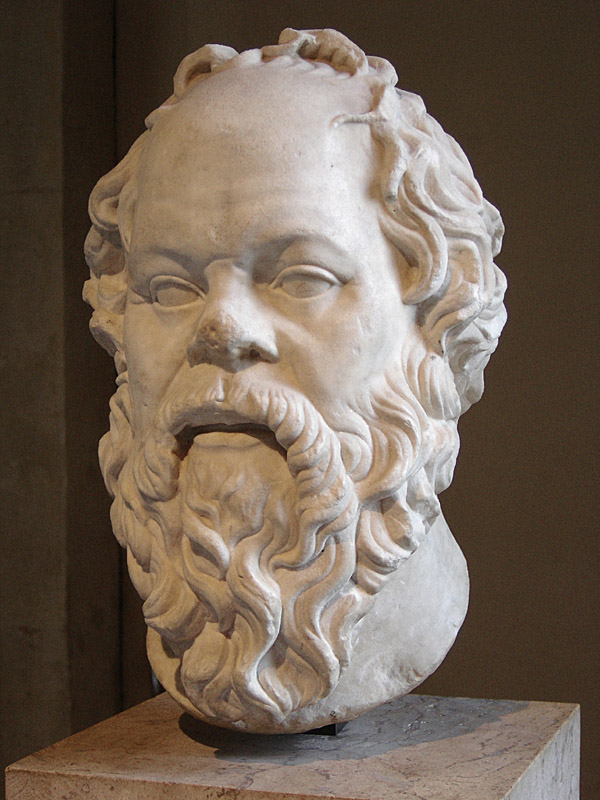
Socrates, The Louvre

Socrates, The Louvre

Is it true Socrates said
we should argue every problem
sober and then drunk? Well fed
then hungry? Free then enslaved? When
we try to ascertain truth,
historical or otherwise,
science, engineering, math–
is the answer that we all prize
irrefutable? Will all
bow down to its logic, reason,
pertinence? Or will it fail
to win the imagination,
hearts as well as minds–dreamers
as well as the philosophers?

– Steve Shoemaker, Urbana, IL, May 18, 2013