I’m sorry to disturb you again!

When was the last time you had time to waste before boarding a flight? The uber drops you off at the curb in plenty of time. You check your bag. You pass through security. You have an hour or so to kill before the 11:10 boarding of your flight on Concourse C.

You haven’t had breakfast. You go to the food court, buy a coffee and a breakfast sandwich, and take a seat at a small table in the food court. You reach for your iPhone to check the time, read the texts and tweets, and read the e-edition of your favorite news source. But it’s missing! You rummage though your pockets or your purse. You’ve forgotten or, God forbid, lost your iPhone. You never do that. Never, never, never!

You scarf down the coffee and croissant sandwich and go across the hall for a newspaper. You buy a copy of today’s New York Times, return to the table in the food court, read the front page headlines, open to the sections of interest, and get absorbed in the latest news or this morning’s crossword puzzle or sudoku.

Suddenly, you realize you’ve lost track of time. You reach for your iPhone and remember. You look for a clock, but there are no clocks. You leave the food court in search of a clock. There are no clocks.

You race down the concourse toward your gate, looking for a clock to see whether you’re late for your flight. But there are no clocks. None. Anywhere. Not even on the flight arrival and departure boards. The flight boards display the schedule and whether your flight is on time, delayed, or cancelled, but they do not tell you what time it is now.

Arriving at the gate, there is no line for boarding. You breathe a sigh of relief when you learn you’re not too late. You sit down in the waiting area and sheepishly ask a stranger for the time. She checks her phone and gives you the time, while you explain that you’ve left home without your new iPhone6, or maybe you’d lost it, as though she cares.

On board the flight, you fasten your seat belt and break the rule of privacy. “Hi, my name’s Bob. Is this home, or do you live in Denver?” “Denver,” he says without looking up from his smartphone. You might as well have asked for his Social Security number. This flight will be a long exercise with silence, a chance for meditation, but you can’t do meditation without the meditation app on your iPhone.

After take-off, you take out the New York Times. It’s been awhile since you read a newspaper in print, and you’d missed out on an aisle seat where you could spread out. Your left arm is flush against the window. As you unfold the newspaper, you intrude again into the space of the guy from Denver in the middle seat. He looks up and shakes his head. You apologize for your rudeness and carefully fold the newspaper in half the way commuters do on trains on their way to work in the city. You settle down with the properly-folded newspaper. A headline leaps from the page:

Do Not Disturb: How I Ditched my Phone and Unbroke My Brain”(Kevin Roose, Feb. 23, NYT) comes to the rescue. It begins:

“My name is Kevin, and I have a phone problem. And if you’re anything like me — and the statistics suggest you probably are, at least where smartphones are concerned — you have one, too.”

I do! Yes! I do! you say to yourself. You wonder whether Kevin also has a clock problem. Whether he’ll lament our isolation in a world missing the one thing we all had in common before smartphones: public clocks on the tower of the old village square . . . and in airports!

On the way to baggage claim, the problem is bigger than the absence of a friendly clock. You’re in a strange city without information on where you’re supposed to go. The address of your hotel, how to get there, contacts, e-mail and text information, phone numbers, and the name of the restaurant where you’re to meet the headhunter for the job interview are carefully stored on your iPhone.

What to do? At baggage claim, a stranger takes pity on you. She lends you her smartphone. A family member answers your call, finds your phone, follows your instructions for unlocking your iPhone, and begins to give you the information you’ve asked for. But without a phone to take down the information, you’re still helpless!

“Hold on a minute,” you tell the family member back home, and return to the stranger. “I’m sorry to disturb you again, but do you have a pencil and a piece of paper?”

Elijah and the Missing Children

Bumpa, you’re mean! Why do you keep saying that?

Say what, Elijah?

That there’s no national emergency?

Because there isn’t.

Yes there is.

No, there isn’t. How would you know? You’re only 21.

You’re cruel, Bumpa! POTUS is kinder than you!

What’s gotten into your little head?

My head’s not little! My head’s bigger than 96 percent. Doctor said so! I’m in the top four percent!

I know. That’s good. But you shouldn’t get a big head about that! So, tell me, why do you think there’s a real national emergency? 

POTUS declared it. I saw it on PBS!

On Sesame Street? Did Big Bird tell you?

No. It came on after Sesame Street. I saw it!

What did you see, Elijah?

MISSING children, Bumpa! Don’t you know? 1,475 kidnapped children, Bumpa! That’s a national emergency! We need to help rescue all those kidnapped children!

I hear you. We do. But the kidnappers didn’t come from south of the border. The kidnappers are not here illegally.

Uh-huh!

No, they aren’t. They’re legal. Homeland Security took them!

I like security. So there’s no national energency? The children are safe?

Well, no, Elijah. Homeland Security took them away from their parents, and then Homeland Security lost them

So the President called a national emergency to find them, right?

No, Elijah. POTUS hasn’t said one word about the missing children.

Why, Bumpa? Why? That’s not right! Jesus loves the little children, all the children of the world, right?

Right! It’s not right! 

Right, I told you! You’re wrong! There is a national emergency.

— Bumpa and Elijah, Chaska, MN, Feb. 18, 2019

You CAN go home again

Thomas Wolfe had it right. “You can’t go home again.” But he was only half right. Memory is the gauge of the deepest affections that feel like home. For 11 years Knox Church in Cincinnati was my spiritual home. That was 25 years ago (1983-1994), but by memory and affection, it was yesterday. Calendars and clocks mean nothing to the time of the heart.

Preparing for the visit, I recalled Charlie Chaplin‘s surprise when he reportedly entered a Charlie Chaplin Look-Alike Contest in Monte Carlo and came in third. Would I come in third in my own look-alike contest? Whose faces would I recognize after all these years? Would they recognize me? Would my slow pace and weathered face contradict memory’s sense of home-coming?

Back at the Minneapolis-Saint Paul Airport (MSP), a golf cart driver who assists less abled passengers had given me a ride to the farthest gate of Concourse E. “Where you headed?” he’d asked. “Gate so-and so, Terminal E,” I answered. “Hop on. You’d never been able to walk that far,” he said with a smile, and began to weave through the pedestrian passengers down the interminable corridor to the last gate of Concourse E.

Knox members Bob and Connie had been assigned to welcome home their old friend at baggage claim. At the Cincinnati Airport, there was not a golf cart in sight for passengers with a bad back or hips. Limping along the long concourse toward baggage claim, the story of Charlie in Monte Carlo lightened my load.

Tired and sore from the second long walk, I spotted a man on a balcony looking down at the arriving passengers. By the time I came into his view, the other passengers from Delta Flight 5277 had come and gone. The Bob I knew years ago was immaculately dressed — gray suit, white shirt and tie, and a well-polished pair of Allen Edmonds. The man on the balcony was casually dressed in a polo shirt and khakis. As I drew closer, I looked up; he looked down. I squinted. He squinted. After a closer look, visions of Simon and Garfunkel singing “Old Friends” danced in my head. I waved to Bob. Bob waved to me, two old retired friends together again after 25 years.

Walking to the car, I noticed something unusual. Bob was wearing my shoes! I’d had my mousy-looking Ecco walking shoes for five years. Never, never, never had I seen them on someone else’s feet. They’re ugly, and as far from Allen Edmonds as my Gate was from baggage claim! “Most comfortable shoe I’ve ever worn,” said Bob.


After all these years, Knox fit like an old shoe. Thomas Wolfe never had it so good. Thomas Wolfe never flew home to Cincinnati!

— Gordon C. Stewart, Chaska, MN, February 11, 2019.

Dynamite at the Sushi Bar

I go to Sake Sushi‘s Happy Hour and strike up a conversation with a stranger. We look to be the same age. Turns out it’s his birthday. “Well, happy birthday!” I say. “How old?”

“A lot older than you,” he says. “I don’t think so,” I reply and ask “How old?” “Seventy-two,” he says. “Gotcha by four years,” say I. “I thought you were maybe 65,” he says. I love this guy! So began last night’s friendly conversation that took us outside our respective comfort zones.

We live in bubbles that burst even while celebrating a birthday — separate bubbles that collide when CNN is served with drinks on the big TV screen in front of the sushi bar.

“Fake news,” he says. “Just a pack o’ lies.” I have a feeling this isn’t going to go well. “So where do get your news?” “I don’t pay much attention to politics,” he says. “As long as the economy is good. That’s all I care about. Business is booming. I’ve made a lot of money the last two years.” 

What little news he gets is from a different bubble from the one I live in. “We’re in big trouble,” I say. “What you’re calling an economy is not an economy; economics is not measured by the stock market. There is only one economy — the planet and everything in it — and it’s not doing well. It’s only a matter of time.” 

“Where do you get your news?” he asks. I answer that I get it from as many sources as I can. “Ever watch FOX News?” “Every once in a while. As little as possible,” I say, and now we’re both out of our bubbles that make us both “Bubble Boys”. The conversation turns to the occupant of the Oval Office he credits with the booming economy. “He’s going down,” I say. He laughs. ‘No way,” he says, and changes the subject to Barack Obama as a failed president. “He almost destroyed the military,” he says. “Obama made us weaker. Trump inherited a mess. He’s turned it around. America’s strong again.” He’s ex-military, a former Marine once stationed for eight year in Okinawa.

General Jim Mattis

I call his attention to the number of Generals who have left the Trump Administration. He knows nothing about that. I mention General Mattis. “Mad Dog? Great General! The best!” he says. “What about him?” I ask whether he’s read Secretary of Defense Mattis’ letter of resignation. He hasn’t. He has no knowledge of Mattis’ disagreement with the president’s policies. I urge him to read it. He says he will.

The wait person brings a large paper sack with a take-out order of his favorite Japanese dish. “It’s not on the menu,” he says. “Just ask for ‘Dynamite’. I guarantee you’re gonna love it!” “So it’s the ‘Dynamite Roll’?” I ask. “No, it’s different. You have to ask for it.” “So, if I ask for ‘Dynamite’, will they know what I’m talking about?” “The American girl won’t. Ask one of the Japanese guys. They’ll know. Get some and take it home. I guarantee you’re gonna love it!”

The mere thought of Dynamite puts us in the same bubble. We’re Bubble Boys in one bubble: the global economy of shared taste buds. As he rises to leave for home, I thank him for his Dynamite recommendation and the conversation, shake his hand, and wish him a Dynamite 72nd Birthday.

Next time I wander over to the bar at Sake Sushi, I’ll ask for Dynamite . . . and two Martinis.

— Gordon C. Stewart, Chaska, MN, February 1, 2019.

The Hostages 2019

Going through airport security recently, I thanked the TSA employees for working. Other passengers did the same. It’s an odd thing to do. We expect employees to show up for work. We also expect their employers to pay them for their work. No one can expect employees to work without compensation.

New flag of the TSA unveiled at the TSA’s 2018 commemoration of the 9/11 attacks.

These TSA workers have families. Their needs are not shut down. Only the paychecks that pay the rent and utility bills, the public transportation to and from work, groceries, insurance, prescriptions, and day care for their families are shut down.

Denver Airport security

“Thank you for working,” said the passengers going through the security procedures put in place to prevent another high-jacking like those on 9/11. Their work is essential to national security. Looking back on it, I’m ashamed of myself. You don’t thank hostages for being hostages. You free them from their hostage-taker . . . without paying the $5.1 Billion ransom to make America safe again.

— Gordon C. Stewart, Chaska, Minnesota, January 20, 2019

The Bluster Contest

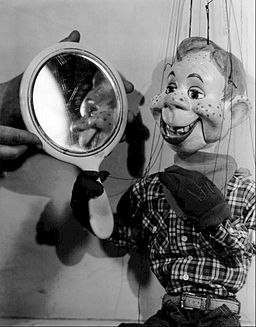
Readers who aren’t geezers didn’t watch the Howdy Doody Show Monday through Friday from their TV dinner trays.

I was never a big fan of Uncle Bob, the emcee, or the mindless Peanut Gallery that broke into frenzies of foolish applause, but I always chuckled when Mr. Bluster appeared.

In this episode Mr. Bluster insists on the impossible — a ROUND mailing envelope to contestants in the “Bluster Contest.

All these years later, I wonder whether another Howdy Doody fan in Queens sat like the rest of my generation in front of his television, eating a Swanson’s TV dinner on a TV dinner tray.

–Gordon C. Stewart, Chaska, MN, Jan. 10, 2018, the 20th day of the federal government shutdown.

The Return of the Night Visitor

He slinks down Pennsylvania Avenue, head down in a hoodie at 3:00 A.M., disguised as a homeless man, escaping the watchful eye of the Secret Service and the television cameras, returning to the dilapidated tenement in the poorest part of the city.

FBI Unabomber sketch

The tenement dweller who owns nothing has been waiting for him since their last visit. The apartment door is ajar, as it always is, in anticipatory welcome of all the homeless.

“Welcome, Donald. I wondered when we’d have another visit.” As he had during the first visit, he lifts the heavy coat from the visitor’s slumping shoulders, and points to the furniture he’d rescued from a dumpster — an old folding chair missing a slat, and the torn red-leather wingback, facing each other each as they had before. The night visitor pauses and chooses the high wingback.

The scene is the same as previously. The room is dimly lit by a small table lamp, the kind of late night or early morning light that creates an ambiance of calm and invites intimate conversation. The tenement dweller takes his seat in the folding chair. The visitor sits in silence, his hoodie still covering his head, not wanting to be seen, but wanting to be seen. The room is silent.

“I’ve been very concerned, friend. I see you’ve been tweeting a lot again. It must be lonely inside the wall. But it doesn’t show outside your wall. Others can’t see it. The you who’s visible to those outside the wall is cruel, vengeful, because in the world outside your wall And you’ve shut down the government over the wall. What’s that about? Tell me about that.”

“I can’t sleep. The family’s gone to Florida. I’m alone here with no one but the maids, the cooks and the butlers. My mind won’t stop. I watch television to settle down but now it only makes things worse. Even my favorite network may be turning on me.”

“What brings you here? It’s 3:30 A.M.

“I don’t know.” The table lamp flickers.

“Feels pretty dark, doesn’t it?”

“Very dark. Very dark! The darkest ever!”

“Why is that?”

The visitor lowers his head, like a child confessing to his parents. “I have all the power in the world but I’m helpless to help myself. I can’t stop tweeting. It’s like it’s not real. I could destroy the world with the push of a button. I’ve shut down the government. The power scares me. And there are all these investigations. My mind never stops. I can’t sleep.”

The tenement dweller in the small folding wood chair sits quietly in the hush that comes when truth has been spoken. His eyes are full of compassion for the homeless man who had opted for the big red leather wingback. The visitor has regressed since their last conversation. His need for self-assurance has grown worse. The walls have gone up.

“Remember our last visit, Donald? Your disguise is not a disguise. You’re hiding something. Do you ever watch ‘Ray Donovan‘?

Ray Donovan

“No. Why? Who’s Ray Donovan?”

“Ray’s’a fixer’, like Michael, but that’s not why I asked. Ray’s a lot like you, Donald. Ray’s running from what was done to him in childhood. He was molested by the man he trusted. His parish priest. He’s not been the same since. Ray built a wall around his heart. He’s cruel. He’s heartless. But inside the wall? He’s very tender, Donald. He’s homeless within his own wall. You can’t live inside the wall.”

From his small, wood chair, the tenement dweller reaches out his hand. They share a long silence before the host put Donald’s heavy coat back on his shoulders. In the pre-dawn darkness, the disguised night visitor returns to his homeless place on Pennsylvania Avenue. He hears singing from the street below.

“Softly and tenderly Jesus is calling—
  Calling for you and for me;
Patiently Jesus is waiting and watching—
  Watching for you and for me!
“Come home! come home!
  Ye who are weary, come home!
Earnestly, tenderly, Jesus is calling,
    Calling, O sinner, come home!”
Will Lamartine Thompson (1847-1909)

The tenement dweller smiles at the sound, but h knows it won’t be long before he comes back.

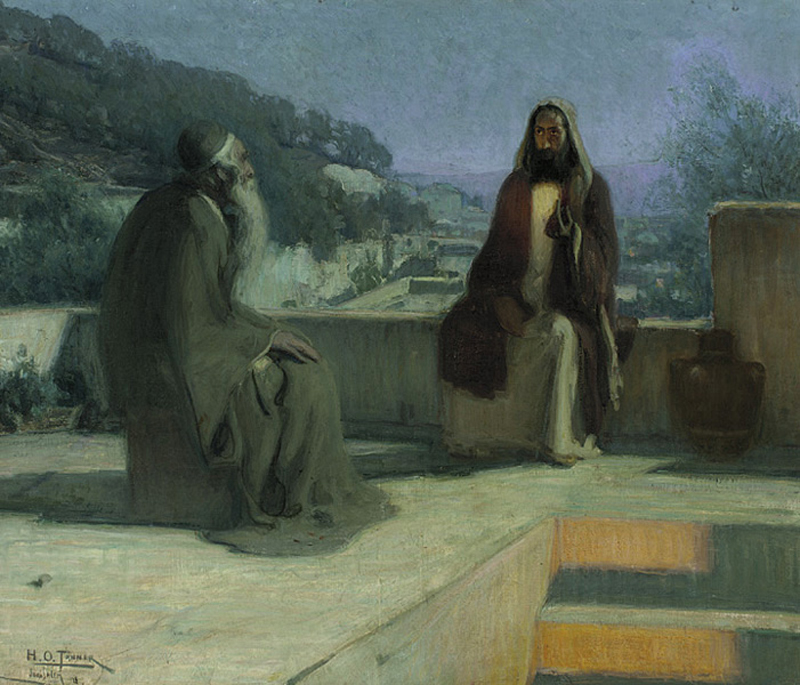
Nicodemus and Jesus on a rooftop, Tanner, Henry Ossawa, 1859-1937
Nicodemus and Jesus on a rooftop, Henry Ossawa Tanner (1859-1937)

Gordon C. Stewart, Chaska, MN, March 12, 2017.

Tell that Fox

Most every day I get up around 4:30, go downstairs, brew a pot of coffee, and begin to percolate. The percolations always sound about the same. With one difference. Coffee doesn’t stew. I do.

Looking in from the outside, you might say “You can take a man out of the pulpit, but you can’t take the pulpit out of the man,” and you would be partly right. But I have no desire to stand in a pulpit. I loved the early mornings when a sermon began to percolate — pausing over a biblical text while world events swirled around my head. I still do. You can’t take that part of the pulpit out of the man.

SWIRLING AND STEWING

The world is always swirling, but these days the swirling feels different. More like a tornado. I go to bed with the news storming in my head and I get up early with it still swirling. But, no matter how ominous the news is, I know I can always take time out to get a better grip, to settle the spinning, to go into the eye of the storm I have become. 

Some mornings, it’s a word that pops up to hold my attention. Yesterday it was two words: serpents and doves. This morning there are three: serpents, doves, and a fox. Stay with me. Views from the Edge is my pulpit in retirement; it’s my pulpit, and I’ll cry if I want to! But this morning the words don’t lead me to cry. They inspire hope and define the way forward.

It began yesterday with serpents and doves. “Behold, I am sending you out as sheep in the midst of wolves, so be wise as serpents and innocent as doves,” says Jesus to his disciples. 

“WISE AS SERPENTS”?  

Get yourselves educated. Become intimately familiar with the world you’re walking into. Be wise to the culture of cunning.” 

“INNOCENT AS DOVES”? 

Become like the dove that brings the olive branch back to the ark; work on whatever is not peaceful in your own hearts.”

Then this morning, along came the fox. “Go and tell that fox. . . ,” says Jesus to those who have come to warn him. 

“GO AND TELL THAT FOX”?

It’s not quite what it seems. The word is hard to render in English. In the culture of the times, it was a derogatory term, a slap in the face, according to biblical linguist Randall Both. Sort of like ‘pipsqueak’. Or small-fry, usurper, poser, clown, insignificant person, cream puff, nobody, weasel, jackass, tin soldier, peon, hick, pompous pretender, jerk, upstart. 

The ‘fox’ is Herod Antipas, the despised tetrarch, a Jewish national who feathered his own nest, a turncoat who served at the pleasure of the Roman Emperor Tiberias. He had ingratiated himself to Tiberias by changing the name of the Sea of Galilee to the Lake of Tiberias and by building a new city with a lush vacation palace on the site of a Jewish cemetery. Herod was a turncoat to his faith and his country. Herod was a usurper. 

“Go tell that fox, ‘I will keep on driving out demons and healing people today and tomorrow . . . .”

“DEMONS AND HEALING”?

The ‘demons’ in the New Testament are not creepy little creatures, although they are creepy. They are twisters of goodness and truth, liars and tricksters who take possession of a person or a society. Sometimes they hold power and authority, building palatial palaces and private clubs, ingratiating themselves to a foreign power by changing the name and language of a local treasure. The demons make us sick. Healing comes as a result of throwing out the demons to end the demonic occupation. Driving out demons and healing is the continuing work of the community gathered around Jesus.

Like I said, you can take the man out of the pulpit, but you can’t take the pulpit out of the man. Sometimes in the storm that is America today, a word pops up and percolates with the coffee: serpents, doves, and foxes. Five minutes before going back upstairs for my afternoon nap, I hear the words with which Jesus often ended an obscure parable:

“Let those with ears hear.” Хорошего дня.

–Gordon C. Stewart, Chaska, MN, November 30, 2018.

Go home! There’s no room for you in this inn!

And so it came to pass in the third century of a democratic republic that the Wise Men returned to the countries from which they had come. Their sudden departure came the same way they had come: they had seen a star rising in the West. 

The original star that invited them to follow it was a sign of great promise. It was a lofty promise — a bright star in a dark sky — beckoning them to go and see this great thing that had come to pass. Leaving behind their camels, they boarded ship with only a trace of frankincense, gold, myrrh, and a translator, and followed the star to a foreign continent.

Statue of Liberty –NY Harbor

Having braved the high seas, they saw a statue over which the star stood still. A torch held high in the Lady’s hand burned as brightly as the star that shone above her, and a plaque was there they could not read. “Send these . . . tempest-tossed to me,” read the translater, “I lift my lamp beside the golden door!” And, hearing the words of welcome . . . they opened their gifts of gold, frankincense and myrrh and with exceeding great joy set foot upon the land and settled there.

There would be times when the Wise Men and their descendants continued to see the star shining still above the Lady of welcome, and times when the star was covered by clouds and the Lady stood battered by storms, but the flame seemed eternal. 

Then, suddenly, in the third century of their sojourn, the different kind of star appeared — an entertainer who scoffed at the modest amounts of gold, frankincense, and myrrh which the tempest-tossed Wise Men had presented the Lady to whom the star had led them. And so it came to pass in the republic’s third century that the Wise Men’s descendants boarded ship for the East, escaping the new star who was wrestling babies from their parents’ arms, extinguishing the torch over which the star once had stood, and replacing the plaque at the foot of the Lady with a new message:

Go home! There’s no room for you in this inn.”

— Gordon C. Stewart, Chaska, MN, November 29, 2018

My Dog’s Happy Hour

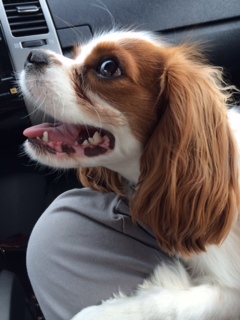
Barclay smiling

Barclay smiling in the car

There’d been no intention of a Happy Hour yesterday when I decided to go to Target for a short errand. “Barclay,” I asked, “wanna go for a ride in the car?” Barclay cocked his head, ran for the door to the underground garage, and leaped for joy. We drove to Target. I cracked open the windows, left Barclay in the car. In the parking lot, I see my friend Chuck, whom I’d been with an hour earlier on a business matter where I’d asked whether he’d ever been to Ike’s. He hadn’t. “Why do you ask? Is it good?” “I don’t know. I’ve never been there,” I’d said. “My neighbor Michael tells me it has the best Martini in town — not one of those tiny Martinis you get at most places around here. It’s big, and they give you the shaker, too.”

Inside Target, Chuck and I take our places in the line for picking up prescriptions. The line is long. Neither of us is good at waiting. We decide, on the spur of the moment, to go to Ike’s Happy Hour for a different prescription. We leave Target and join Barclay for the trip to Ike’s. At Ike’s I again leave Barclay in the car, opening all four windows a little more than I had at Target. As he always does, Barclay smiles. He knows the routine. He lies down on the driver’s seat.

Sitting at the bar for our nonprescription drugs, we notice the wind has come up and it’s pouring rain outside. “Do you think Barclay’s okay?” asks Chuck. “He’ll be fine,” I say, “nothing flusters him. He’s not afraid of storms.” The Martini is everything Michael had said it would be. So is the Happy Hour food he’d recommended: two mouth-watering beef tenderloin sliders with grilled onions and horseradish sauce, one on pumpernickel, the other on sourdough, for $7.50. We love this place!

We pay the tab and head back to the car. Barclay is calm until Chuck opens the passenger door. Barclay sits up, smothers Chuck with kisses, and says, “I was worried about you guys!” Both seats are partially wet from the storm. Barclay is dry. We are not.

Barclay on chest

Barclay

We leave Ike’s parking lot and drive back to Target where Chuck had left his car. Chuck goes in for his prescription. Barclay and I call it a day and head home. Safe at home in the underground garage, Barclay stays put like a petulant child. “Dad, why can’t I stay in the car? I love Happy Hour!”

  • Gordon C. Stewart, Chaska, MN, October 4, 2018