The Story of Dick and Dorothy…and Lee

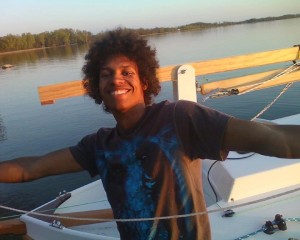
His name was Lee.  He was a quiet man.

He was friendly enough – just not terribly outgoing.

He wasn’t the sort of person who would call attention to himself.

Lee lived across the street from Dick and Dorothy.

Like Lee, Dick and Dorothy didn’t socialize much – not at all in fact.

And their house was quiet – their house was really quiet!  You see, Dick and Dorothy hadn’t spoken to one another in years.  Their only child, Susan, was grown and gone.  Back in those days, divorces were extremely rare.  You lived together “till death do us part” – even if the differences were irreconcilable and the hostile silence was deafening.

Dick and Dorothy had a dog named Trixie.  It was obvious if Trixie needed water.  What was not so obvious was whether or not Trixie had been fed.  So Dick and Dorothy had silently devised a system to clarify this matter without having to speak to one another.   If you fed Trixie, you placed her bowlful of food in a different location in the kitchen than it had been previously.

Dick and Dorothy and Trixie may have invented the progressive dinner.

During January of 1967, there was a terrible blizzard.  Every weekday Dick commuted to and from Chicago – 26 miles one way – and by the time he got home at 6:00 p.m., his driveway was filled with almost two feet of drifted snow!  The car never made it up the gentle grade to the garage.  In fact, it barely made it into the driveway.  The rear end of the car was a traffic hazard in the street.

Lee was watching from his cozy living room as Dick trudged to his garage to fetch a snow shovel.  So Lee did what any good neighbor would do.  He bundled up, grabbed his own shovel, and headed across the street to help his friend.  The wind was howling and the snow was still coming down.

It took them 45 minutes to get Dick’s car to the garage.  After thanking Lee profusely for his help, Dick invited his neighbor into the kitchen to get warm over a cup of coffee.  Dorothy joined them at the kitchen table.

At first, the conversation was awkward.  Lee knew the dynamics of this dysfunctional household.  Dick made a comment.  Lee replied.  Dorothy made a comment.  Lee replied.  This went on for a while.

But then – something happened.  Something changed.  Dorothy made a comment.  And DICK REPLIED.  Then, DOROTHY REPLIED.  Lee had the good sense – or perhaps the divine wisdom – to keep his mouth shut and just wait and see what would happen next.

That was the beginning for Dick and Dorothy.  They began to talk.  They started communicating with one another in other ways than by moving the dog dish.  The healing began. The relationship was renewed.

Lee was the catalyst.  Where there had been hatred – Lee sowed the seed of love.

Lee wasn’t an outspoken champion of peace and justice and reconciliation.

Maybe Lee was just at the right place at the right time.

Was Lee an angel?  Dick and Dorothy’s daughter, Susan, will tell you he was.

I think he was too.  I know I’m proud of him.  Lee was my father.

– Harry Lee Strong, Pastor, United Church of the San Juans in Ridgeway, CO, January 3, 2013. Harry is a dear friend and former classmate, McCormick Theological Seminary Class of ’67. Like frequent contributor Steve Shoemaker, Harry is one of six former classmates who gather annually for a week of fellowship and reflection.

I Wish…

“70”

When I say I have reached “Three score and ten,”

most folks today do not recall the phrase-

is from the Bible.  They just think of when-

“Four score and seven,” Lincoln said, in days-

of war.

                          At six-foot-eight I was too tall

for drafting to the war in Viet Nam.

My college friends were sent to fight and fall.

I went to Seminary–just a lamb

far from the wolves, from death, from…  (I almost

mis-wrote “…from Agent Orange”–for which no cure

exists–or rhyme.)

                                   I wish that I could boast

my years were spent in waging peace, in pure

activities alone:  but many a day  

I failed.  (It is for mercy that I pray.)

Steve Shoemaker at historic pulpit of Sheldon Jackson in CO.

Steve Shoemaker at historic pulpit of Sheldon Jackson in CO.


– Steve Shoemaker, Urbana, IL, December 19, 2012

Hee-Haw

“Just put the burro here,” he said,

“She’ll calm the horses of the folks

inside the inn.”  And so they tied

me to the pole above the trough.

I was surprised he later led

a man and girl into the stall

and pointing to the straw, he said,

“Sleep here,  this simple space is all

that’s left tonight, and if the child

is born the cries won’t wake the guests.”

… 

He grimaced, but she somehow smiled

and sank down to the ground.  Their rests

did not last long.  Her labor soon

began and then the baby, wrapped

and warm, was laid under the moon

light bright where we, the stock, were trapped

and fed.  I brayed when shepherds dumb

barged in and said a king had come…

– Steve Shoemaker, Urbana, IL, Dec. 11, 2012

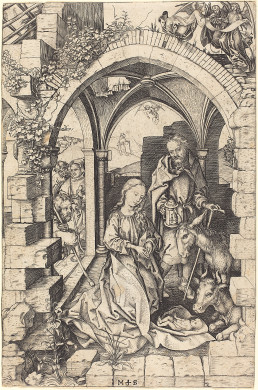
The Nativity, Martin Schongauer,  c. 1470/1475, National Gallery Collection

The Nativity, Martin Schongauer,
c. 1470/1475, National Gallery of Art Collection


Bonfire

Even the embers warm

Univ. of Illinois Campus YMCA bonfire
Univ. of Illinois Campus Y bonfire

If we move our chairs and logs

Close enough.  The flames

Began roaring, jumping

High above our heads

As balsam branches, pines

Burned first furiously.

Reflections off glasses,

Earrings, flash like the stars

Above in the moonless night.*

Two kites, tethered, can be heard,

Not seen, above the prairie.

Marshmallows ignite if held too long

Near the glowing coals

S’Mores give a sugar rush

After the tangy stuffed mushrooms.

No one can remember a ghost story

Or campfire song. The troubles

Of Job are all forgotten

As the sparks fly upward.

* In the photo there is a moon. This was photo-shopped out in the poem–poetic license.God seems to have chosen to have the Bible written this way, also;  some things were omitted (or added) for the sake of the form or sound of the poem or story.

– Steve Shoemaker, Urbana, IL, Dec. 1, 2012

The photograph is of University of Illinois students who were engaged in service projects at the oldest student organization, the University Y (1873), where Steve served as Executive Director.

The Gift of Green Again

Spencer Swanson

Spencer Swanson, a 16 year-old student at the Integrated Arts Academy in Chaska,  died tragically on October 15 when an errant arrow from his good friend’s bow ricocheted and hit Spencer

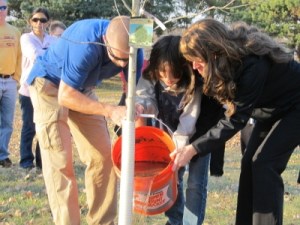
At 3:00 p.m. yesterday, November 20, Spencer’s schoolmates who study visual arts, cultinary arts and horticulture, gathered with Spencer’s family to dedicate a new 10′ tall red oak tree in his memory.

I never met Spencer, his friend, or their families. I attended yesterday’s dedication at the invitation of John Hopkins, a member of Shepherd of the Hill who teaches horticulture at the school. “The kids have put this program together,” said John. “If you’re not doing anything at 3:00, swing by.”

Spencer’s death had hit everyone at the school hard. I went to show support from the wider Chaska community for the students who had put this program together, as the program said,

“To comfort and help restore the hearts affected by the hurt of Spencer’s death.”

The printed program featured not only a carefully selected poem of Pakistani poet Faiz Ahmed Faiz, “When Autumn Came”  but art created from closer to home by the students of the Arts Academy.

Brieann’s drawing depicts her fallen schoolmate as a tree growing taller with the caption “Grow till Tall”; Dominika, another of Spencer’s schoolmates, wrote and read aloud her poem “I can see a lot of life in you”:

Hold on to the memories of

the ones we love and lost.

Take time to say what’s right.

Take time to forgive and not

fight. Each day’s a gift and

not a given right. You have to

wonder and find out what’s

your light.  Is it the One to

come?

Each day is new and full of life.

Listen through the whistling wind.

Your time is here

be content don’t linger.”

There were words there on the hill… but not many. There was quiet…. No cell phones ringing. No one texting. No one looking around in boredom. Just all of us, young and old, at home, for a moment, in the sacred silence of the community standing together to celebrate life in Spencer’s honor.

tree dedication

“To plant a tree is to give body and life to one’s dreams of a better world,” wrote Russell Page.

The red oak will grow over the years to great height and girth, spreading its branches for the birds and the squirrels, reminding each of us to honor the gift of life and the gift of the community of thoughtful speech and silence.

This is the way that autumn came to the trees:

it stripped them down to the skin,

left their ebony bodies naked.

It shook out their hearts, the yellow leaves,

scattered them over the ground.

Anyone could trample them out of shape

undisturbed by a single moan of protest.

The birds that herald dreams

were exiled from their song,

each voice torn out of its throat.

They dropped into the dust

even before the hunter strung his bow.

Oh, God of May have mercy.

Bless these withered bodies

with the passion of your resurrection;

make their dead veins flow with blood again.

Give some tree the gift of green again.

Let one bird sing.

Faiz Ahmed Faiz

“You can’t cheat an honest man”

William Stringfellow observed that the greatest personal challenge is to be the same person… in every time…in every place.

If I’d been able to whisper words into the President’s ear last night, or make him speak like an Edgar Bergen dummy on my lap, he would have asked, “Which of the different people you have been  – from which time…and from which place – is the one you asking the American people to vote for?”

But, alas, I only get to grump and moan, holding the President on my lap, like Mortimer Snerd on the lap of Edgar Bergen. Are we really that dumb?

A lot of gas is holding up this balloon.

“Best Chicken Soup I’ve Ever Had:”

“Think global; buy local” goes the aphorism. But buying locally gets harder and harder. Locally owned and operated shops are going out of business while the big chain stores eliminate their ability to compete.

Yesterday I wandered into one of those remaining locally owned places in downtown Chaska for a bite to eat. I didn’t mean to, but I did. I started out for Arby’s. I love Arby’s. But the smoke from the parking lot near Arby’s caught my eye. “Smells like hamburgers,” I said to myself, looking for a free lunch.

The smoke was pouring out of a Big Green Egg in front of Ace Hardware several doors down from Cooper’s Market. When it turned out that the hamburgers on the grill were being grilled for the store’s employees – what store does that anymore? – I walked next door to Cooper’s Market.

Coopers has been around a long time. The Cooper family sees itself and its grocery store as part of the community. They live and work here. They believe in this place. They donate tons of food for local charitable events without much recognition.

But their physical location in “Old Chaska” (i.e. downtown) has put them at a competitive disadvantage with Rainbow, Target, and other supermarket chains up the hill in “New Chaska” where I live.

In New Chaska, the corner butcher shop, the locally owned drug store complete with soda fountain, and the candy store that sold kids bubblegum, baseball cards and home-made ice cream when I was a kid are  memories of a by-gone era when neighbors were also the small business people that owned Set Pancost’s Drug Store or Messy Bessy’s candy store. Sorry, Bessy, but that’s what we called the place we went to after school in my home town. The mom-and-pop restaurant with the home-cooked meals still exists at places like Wampach’s in Shakopee, but they’re hard to find, and they’re disappearing fast.

The chicken noodle soup was the best I have ever eaten…anywhere. I was astonished how good it was. I had to tell somebody.  “Did you make this soup?” I asked the woman behind the deli counter.  “Not today,” she said. “I think Jim made it.” “Best chicken soup I’ve ever had.  It was amazing!” She smiled, said thanks, and continued, “We buy everything fresh here. Nothing is frozen. It’s all fresh every day.”

“And what was the spice on the roasted chicken?” “It’s our own blend of spices,” she said. “You won’t find that at Kentucky Fried Chicken,” I said. “I love this place. I’m going to write about this. Your light shouldn’t be hidden under a bushel. People need to know.”

So…if you’re reading this, thinking big global thoughts up or down the street from downtown Chaska, but wanting to buy locally, now you know.

Go to Cooper’s. Then take a trip across Chaska Boulevard for a stop at the Malt Shop for “the best malts in Minnesota” and Dolce Vita’s, the locally owned and operated wine shop that ranks with the very best in New York City or San Francisco. And you won’t have to travel across the globe to get there.

The “Nones” at the coffee shop

The “Nones” are the fastest growing group in the United States religious landscape. Time publicized the story in its March 12, 2012 issue.

Last week Rose French, religion editor of the Star Tribune here in Minneapolis, personalized the Pew Forum research in  “Fastest growing group in religious circles? The ‘Nones’”  (10.15.12).

The story begins with Marz Haney, a young woman who grew up attending an evangelical Christian church every Sunday. But she had questions. And, it appears, the church she attended wasn’t big enough for her big questions.

Questions and doubts are not enemies of faith. They are the friends of faith. They refine, correct, expand, and reform faith. They challenge what Jean-Paul Sartre called “bad faith.”

Sartre, of course, thought that all religious faith was bad. Some of the “Nones” agree with Sartre. Others still profess faith or “spirituality” but live it outside the boundaries of the traditional institutions that no longer hold meaning for them.

“I had some doubts all along. I was sort of in continual doubt about my personal salvation,” says Marz Haney.

That Marz and others have concluded that spirituality/faith/religion is all about personal salvation brings me great sadness. That she would think so is a reflection of the right turn that began to dominate the American religious landscape beginning in the 1950s.

To many of the “Nones”, fear and hate have become the face of Christianity. Sometime in the late ’50s, the televangelists began to change the face of Christianity to the world. Those who tuned in watched and heard the voices of snake oil salesmen selling purple handkerchiefs that would heal, if only you purchased one and put the hanky on your television screen while the evangelist prayed for you. Intelligent faith was turned into an oxymoron. One either is intelligent and without faith, or full of faith and without intelligence.

At the coffee shop recently, the proprietor who greets me “Good Morning, Your Reverence” with a smile, invited me to join a conversation he was having with two other coffee drinkers. “You can help us here,” Mike said. His grin told me this was a set up. “If God created the world, who created God?”

“Hmmm. Interesting question. Really good question. Really, really, really good question. It assumes, of course, that everything is created. That’s the way we think. If something’s here, it has to have been created. But that begs the question endlessly. So….maybe some things are not created. Whatever that is ultimate reality. In theology, the word we use for the ultimately real is ‘God’.”

Several weeks later a young couple sat at the table at The School of the Wise, a coffee shop and wine bar humorously named after the euphemism for speakeasies during the era of Prohibition. The couple had sent a message through the church’s website inviting a conversation about their needs and whether Shepherd of the Hill Church might be a good fit.

They were “Nones”. I love this couple! They made my evening. So honest. So genuine. So open. Wondering and hoping that perhaps Shepherd of the Hill might be a place unlike that mega-church up the road whose very small print declares belief in “the intention, eternal punishment of the wicked”. They were cautious but feeling the need for a community that welcomes rather than scorns, unites rather than divides, thinks as well as feels, and moves them beyond self-absorption in the comfortable but confining precincts of economic privilege.Sitting in a coffee shop with The New York Times on Sunday Morning over a cup of coffee was no longer enough.

Which, of course, is what the gospel is about, as I understand it.

Jesus had one message: “the Kingdom of God/Heaven is at hand.”  A “Kingdom” is a society, a commonwealth. A society is people in relationship. “At hand” means “Now!” The kingdom of Heaven was something like the heaven the young couple and I were experiencing right there at the back table in The School for the Wise – real people in real relationships, exploring ultimate reality over delicious mocha-mint-lattes, looking beyond our privilege and celebrating the magnificence of a moment that is at the very heart of  creation as we know it.

Back To Top

Exhaustion

I’m exhausted…spiritually exhaused. They’re exhausting me…all the emails…and the voice mails telling me that if I don’t give one more dime one more time…my candidate is going to lose…and the world will come to an end…and it’s going to be… my fault.

Anyone else feeling that way?

I’m also torn up inside. I’m trying to be civil…trying to understand why this election is even close…and trying not to be haughty and naughty.

I’m missing my afternoon nap. I love my afternoon nap with Maggie and Sebastian, my buddies here at home. They still sleep like logs…the way I used to…before the Presidential debates and emails that clog my inbox and the phone calls from chummy best friends I’ve never met who want just one more donation of “just $5” so so-and-so knows s/he can count on me.

It’s an illusion. Anyone else feeling that way?

Meantwhile…between the emails and the phone calls…I visit the dying…in hospice care…who live on the edge of existence itself…who sip comfort from the deeper wells. My spirit is strangely quieted. Strangely calmed.  We sit in silence. I read a psalm or two. We…the dying…and I are refreshed. Ready for a nap.

I go home and stumble upon a prayer by Wendell Berry “To the Holy Spirit”:

O Thou, far off and here, whole and broken,

Who in necessity and in bounty wait,

Whose truth is light and dark, mute though spoken,

By Thy wide grace show me Thy narrow gate.”


Wendell Berry, Collected Poems, North Point Press, 1964.

America and “the Fall”

WikiLeaks’ Julian Assange addressed the United Nations General Assembly yesterday. His speech is reminiscent of American theologian William Stringfellow who declared in 1968 that we were already living under the rule of “extra-constitutional powers and authorities” that operate covertly in the shadows of democracy.

Watch WikiLeaks founder Julian Assange speaking by satellite from Ecuador where he lives in exile. Unedited Politics deserves credit for posting this.  Of particular interest are references to President Obama that hold his Administration accountable while seeming to grant some credit and holding out hope that he might change things.

Julian Assange Speech to UN General Assembly: “US Trying to Erect National Secrecy Regime” – 9/26/12.

William Stringfellow

William Stringfellow – author, lay theologian, lawyer among the poor and defense attorney for Bishop James Pike and the Berrigan Brothers (Frs. Phil and Dan) – wrote the following in 1973:

“In this world as it is, in the era of time, in common history – in the epoch of the Fall, as the Bible designates this scene every principality has the elemental significance of death, notwithstanding contrary appearances. This is eminently so with respect to nations, for nations are, as Revelation indicates, the archetypical principalities… All virtues which nations elevate and idolize – military prowess, material abundance, technological sophistication, imperial grandeur, high culture, racial pride, trade, prosperity, conquest, sport, language, or whatever – are

subservient to the moral presence of death in the nation. And it is the same with the surrogate nations – the other principalities like corporations and conglomerates, ideologies and bureaucracies, and authorities and institutions of every name and description…

“The Fall is where the nation is. The Fall is the locus of America… Since the climax of America’s glorification as a nation – in the ostensible American victory in World War II, most lucidly and aptly symbolized in Hiroshima – Americans have become so beleaguered by anxiety and fatigue, so bemused and intimidated, so beset by a sense of impotence and by intuitions of calamity, that they have, for

the most part, been consigned to despair… Racial conflict has been suppressed by an elaborate apartheid; products which supposedly mean abundance turn out to contaminate or jeopardize life; the environment itself is rendered hostile; there is a pervasive Babel; privacy is a memory because surveillance is ubiquitous; institutional coercion of human beings has proliferated relentlessly. Whatever must be said of earlier times, in the past quarter century, America has become a technological totalitarianism in which hope, in its ordinary connotations, is being annihilated.”

An Ethic for Christians and Other Aliens in a Strange Land, William Stringfellow, 1973. (Bolded print added by Views from the Edge)