Mom’s Handkerchief – Good Friday

As a child, I wondered why they called Good Friday ‘good’. It wasn’t. It was awful.

At the annual Good Friday service my mother’s cheeks were wet. She’d hold her handkerchief in one hand and, without drawing attention to herself — Mom was shy and shunned attention — she would dab the tears, hoping no one would notice.

A soloist would sing:

Were you there when they crucified my Lord?
Were you there when the crucified my Lord? Oh……
Sometimes it causes me to tremble, tremble, tremble.
Were you there when they crucified my Lord?

Mom would dab her cheeks and eyes.

As I grew older I began to understand why they called the Friday of the crucifixion ‘good’. It wasn’t good because they nailed him to the tree, or because they took him down and laid him in a borrowed tomb. It was good because, in that deep darkness, tears fall in grief and in hopes of something else. Tears that recognize both the betrayal, denial, flight — our  own and others’ – and the steadfast love, courage, and magnanimity of the man on the cross.

Both sides of the human condition are front and center on Good Friday. So is the sense of god-forsakenness – the wrenching cry from the cross, “Eloi, Eloi, lama sabachthani?” (“My God, my God, why have you forsaken me?”) — the gnawing feeling of senselessness, meaninglessness, and helplessness, hanging alone, tortured and mocked, over the abyss of nothingness.

Over the years, I’ve learned that a healthy sense of denial is sometimes a good thing. So is truth-telling. Good Friday brings me face-to-face with myself at my worst and my best. And at the heart of it all is a man with arms spread wide, looking out at us who still crucify him — ours is a Good Friday world — with eyes that reach my soul. “Father, forgive them, for they know not what they do. Into Your hands I commit my spirit.”

On Easter Mom would dab her eyes for joy because she’d brought her handkerchief with her from Good Friday.

— Gordon C. Stewart. Chaska. MN, April 3, 2015.
Confession is good for the soul

Tears welled up last Sunday listening to the Gospel reading for Passion Sunday: Palm Sunday. The reading was LONG, but it didn’t matter. It pierces the heart, step by step –  the human psyche revealed under an electron microscope, humanity on parade. All in one long reading. The tears that welled up Sunday didn’t fall, but they will later this week during Tenebrae, the service of Light and Shadow by the end of which the church is left in darkness, every worshiper’s candle extinguished by recognition of our participation in betrayal, sleeplessness, flight, and denial. One by one, the individual candles get blown out. All of them.

Holy Week for liturgical Christians is a solemn time of confession. There is no escaping our participation in the passion: our readiness to betray, doze off when asked to “watch with me one hour”, flee in fear for security, throw the switch, consciously or unconsciously, into psychological and public denial. Yet there is, at the same time over it all, the faithfulness, the wakefulness, the courage, the embrace of reality in its horror for the sake of love’s transforming power, the light of Christ himself.

Christians live in the dynamic paradox of faithlessness and faithfulness, sin and grace. We include a Prayer of Confession in the Sunday liturgy. Last Sunday at Trinity Episcopal Church in Excelsior, Minnesota, the Prayer of Confession, which came following a dramatic reading of the Passion Narrative, expressed the conscious and unconscious nature of sin and grace.

God of all mercy, we confess that we have sinned against you, in thought, word, and deed, by what we have done and by what we have left undone. Some sins are plain to us, some sins escape us, some we cannot face. We repent of the sin that enslaves us, the evil we have done, and the evil don on our behalf. Forgive, restore, and strengthen us through our Savior Jesus Christ, that we may not turn from your love, but serve only your will. Amen.

We barely know ourselves. Some sins are plain to us. Some escape us. Others are too painful to face. Holy Week is time to wade into the waters of self-reflection, confident that these waters are the healing waters of the deeper Self, the crucified-risen One who cannot finally be betrayed, fled, denied, or killed.

Sunday’s liturgy ended with the singing of the hymn “My Song Is Love Unknown,” lyrics by Samuel Crossman, 1664, music composed by John Ireland. 


A Note from Briant

Image

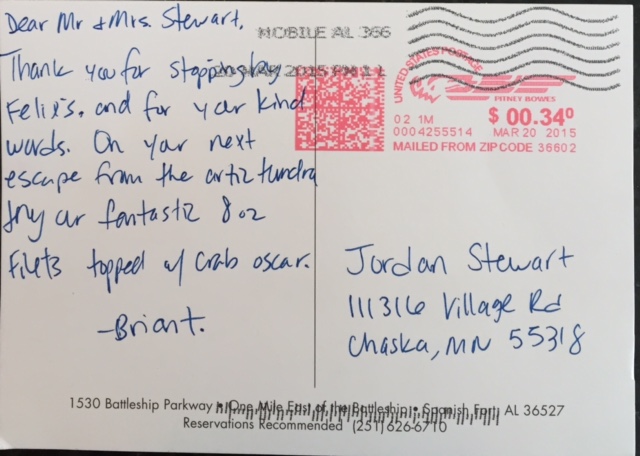
We couldn’t believe our eyes when this postcard arrived from our waiter last month in Mobile, Alabama.

Postcard note from Briant, waiter at Felix's Fish Camp Grill in Mobile, AL

Postcard note from Briant, waiter at Felix’s Fish Camp Grill in Mobile, AL

Okay, so he spelled my name wrong. Who cares. We really liked Briant. Enough to write a recommendation on TripAdvisor. Which resulted in the note. Felix’s Fish Camp Grill near Mobile, Alabama knows how to make friends and build its business.

– Gordon C. Stewart, Chaska, MN, March 24, 2015

Felix's Fish Camp Grill postcard

Felix’s Fish Camp Grill postcard

GUEST POST: I went to Gordon College and My Roommate was Gay

Haddayr Copley-Woods posted this on her blog. Haddayr is a writer published by many venues, including aired commentaries on Minnesota Public Radio’s “All Things Considered” program. In light of Views from the Edge’s recent posts on the topic of religion and sexuality, we’re glad to share this first-person story of a student’s dilemma at Gordon College.

Brothers

Our Dad would take a bathroom scale
in both his calloused hands and squeeze
200 pounds. He said his boys
should also press their weight. To fail
meant hearing yet again how he
when in the Navy chinned himself
a hundred times a day. His laugh
at photos when he was skinny
before he read the Charles Atlas
booklet reminded each of us
of Dynamic Tension. We’d take
a towel and pull and tug to make
each tiny bicep that we had
grow big to be as strong as Dad.

– Steve Shoemaker, Urbana, IL, Feb. 27, 2015

Lunch at Felix’s Fish Camp

Felix's Fish Camp near Mobile, Alabama

Felix’s Fish Camp near Mobile, Alabama

Driving home to Minnesota from Key West, Florida, Kay and I stop for lunch near Mobile, Alabama. Trip Advisor ranks Felix’s Fish Camp the #8 most highly recommended of 581 restaurants in Mobile, right on the waterfront. An old fish shack; our kinda place!

Our waiter has Southern DNA written all over him. His style is the epitome of Southern hospitality: unhurried, gracious, warm, personable, respectful, friendly. “Yes, Ma’am. No, Sir.”

In his late-2os, Brian is very tall. He kneels down beside the table to get acquainted. He introduces us to Felix’s, talks about the menu, asks about our tastes, and zeroes in on the dishes we might like most.

The man in the next booth overhears the conversation.  He’s smiling. Getting to his feet with the help of his cane, he comes by to say hello. Turns out he’s from Duluth, Minnesota, a traditional stronghold of the Democrat Farm Labor Party. He and his wife closed their chiropractor office in Duluth three years ago to retire near his son in Mobile. He asks what brings us here and what we did for a living. He smiles. “You’re a pastor. You like people. What church?” “Presbyterian,” I say.  “I’m a Lutheran,” he says. “What’s your favorite Scripture? Mine is Psalm 91. I learned it as a child and can still recite it from memory.”

Lunch at Felix's Fish Camp, Mobile, Alabama

Lunch at Felix’s Fish Camp, Mobile, Alabama

Brian delivers the fish, topped with fried oyster, shrimp with cheese grits, and side dishes of almond green beans, cheese grits, and turnip greens to die for.

At just the right moment, as skilled waiters do, Brian returns to ask whether we’d like desert, maybe some lemon pie or Key Lime Pie. The lemon is more unique to Felix’s but he thinks perhaps we might prefer the Key Lime.

After the Key Lime pie, we thank Brian for his extraordinary hospitality and service, promise to write a review on TripAdvisor, pay the bill, and say goodbye.

The relocated Minnesota couple leave at the same time. As the four of us walk way out together, our new friend wishes us a safe trip home and then says “Before you go, I have a question for you. Which Republican do you like for 2016?”

His wife grimaces. We just smile. Maybe he’s forgotten that he’s from Duluth, or maybe he’s being playful one last time…or maybe he’s confusing Christian and Republican. We’ll never know. Life is funny like that.

– Gordon C. Stewart, Chaska, MN, Feb. 26, 2015


The Neighbors in St. Augustine

The men gather late in front of the house every morning before the resident gets up.

Mostly in their 60s and early 70s, they arrive on bicycles or on foot with paper bags scrunched close at the top. The minority, the younger ones in their 20s, don’t use bags. They don’t hide the beer can or the pint. They pull the cheap, green, plastic chairs from the yard out to the sidewalk to start the day.

The older ones survived the St. Augustine Civil Rights Movement of the early 60s and the violent reaction of the white city fathers of St. Augustine to the passage of the Civil Rights Act.  They tell stories. The younger men don’t seem to care.

I walk next door most every day to say hello. The conversations become windows into humanity, disparate perspectives, and history itself.

Why did the once young men who waded in at Butler Beach in 1964, survived the fire bombing of their homes and the beatings by theKu Klux Klan end up here bleary-eyed with paper bags?

They grow louder as the day wears on. One of them stands in the middle of the street blocking traffic as if to say to passersby, “This is OUR neighborhood!” Several times a day a car pulls up to the curb, opens the window, and exchanges something with the men. They disappear, one by one, into the house for a time.

At noon one day I walk next door and find myself in the middle of what appears to be an argument between one of the older men sitting in the yard and a 20-something man sitting on the sidewalk with his back turned to the street. I come by to say hello. The older man greets me. We say good morning. “You’re a Reverend, right?”

“Well, yes. Sort of..,” I smile, “more or less reverent.” We enjoy a good laugh.

“So,” he says, pointing to the young man holding his open Pabst Blue Ribbon, “doesn’t the Bible say ‘Instead of giving a man a fish, you should teach him how to fish?'”

“Well, no. The Bible doesn’t say that, but it’s pretty close to some of what the Bible teaches.”

“See,” says the young man, “I told you the Bible doesn’t say that!”

The Civil Rights Movement survivors recall how some of their classmates got out of town and left them behind. One of them owns upscale hotels in Atlanta and Miami. He comes home in his big Mercedes every five years or so. According to the men next door, he and others who got out look down their noses at the shrimp boat workers who lived hand-to-mouth existences in the old neighborhood where they grew up together.

The Civil Rights Movement in St. Augustine is still a matter of debate both among its veterans and among the young men who have no living memory of it.  For young and old alike, the men who gather daily next door are a community to each other. They have taken their “place” in the post Civil Rights Movement era of St. Augustine.

They are part of America’s left behind. They’re going nowhere their feet or bicycles can’t take them. They care about each other. They are without pretense. They have each other, old friends and younger ones who are going nowhere. They are a local chapter of the community of the stuck. Their numbers are growing all across America.


Wading in the Water

St. Augustine Beach, Feb. 4, 2015

St. Augustine Beach, Feb. 4, 2015

So here we are, both newly retired, wading in the water of St. Augustine Beach in the Florida sun. Today the beach is peaceful. It was not always so quiet on these white sands.

Barclay in cold Minnesota

Barclay in cold Minnesota

Back home in Minnesota it’s cold. This photo of Barclay looking out the window into the world of white arrived this morning. Barclay knows where he is. We’re not sure we do.

Away from home and all familiar routines here on the white sand beach,  we’re getting our feet wet on the very beach where national news coverage pushed the Civil Rights Act over the top in 1964.

Kay and I each wondered what the world beyond work would feel like. Now we know. It’s weird. The world is still very much with us. Every day I talk with  some of those arrested on St. Augustine Beach who gather next door to our rental home in St. Augustine. We’re all still wading in the water.


Life begins on the other side of despair

It was Jean-Paul Sartre, the French existentialist novelist, philosopher, and playwright, who declined the Nobel Peace Price for Literature in 1964, who said it. “Life begins on the other side of despair.”

Sartre’s statement resonates with those who have stood at the edge of the abyss of the loss of life’s meaning. Some don’t make it to the other side. Some move to the other side of the abyss with no faith but faith in themselves to create meaning they once ascribed to God or some objective moral order. Others arrive on the other side with their inherited faith not only deconstructed, but re-constructed. I am one of the latter.

Reading of the shooting suicide of a 27-year-old Iraq War veteran philosophy student in the library at Mankato State University takes me back to Sartre’s statement about life and despair. Timothy Lee Anderson was an honorably discharged U.S. Army gunner in Iraq. His picture in The Daily Mail shows him in an Iraqi combat zone with his weapon. In the background of the photo, Iraqi women in traditional Muslim dress appear to be crossing the street. How, I ask, does a guy who served as a gunner in the Iraq War choose philosophy as his major when he comes home to the U.S.A.?

Philosophy is not a popular choice these days. Unlike computer science, it’s not job- related. The word ‘philosophy’ derives from two Greek words meaning love (philo) and wisdom (sophia). Philosophy is the love of, and the search for, wisdom.

Wisdom is born of experience, not inheritance. It’s not hard to imagine the dashed, unexamined, inherited convictions of a young Army recruit: a world dependent on American goodness and might; an America with a manifest destiny in the global order; an exceptional nation privileged and responsible, whether by religious or political creed, to bring its blessings to the rest of an ignorant, unenlightened, uncivilized, and sometimes terroristic and defiant world.

Nor is it hard to imagine a soldier’s despair upon return, reflecting on his experience in search of greater wisdom among the philosophers. The early reports of Timothy Lee Anderson’s life experience point to a less than comfortable homecoming with arrests for marijuana and violation of an order for protection. The gun shot he fired at himself on the second floor of the Mankato State University library was a shot of despair, whatever the immediate reasons or circumstances.

The great sorrow is a life that ended too early on the despair side of the yawning abyss of collapsed meaning. It remains to the survivors and the rest of us who look with sadness on Timothy’s tragic departure to learn that claims to religious-national exceptionalism and wisdom go together about as well as bombs and day-care, guns and libraries.

– Gordon C. Stewart, February 3, 2015.


In Memoriam: the MSU Philosophy Student

“The life of the dead is placed in the memory of the living.” – Cicero

The philosophy student who shot himself in the library at Mankato State University yesterday could have been me many years ago. Or is it “could have been ‘I’”? I or me is a question of grammar without much consequence. Philosophy is a question of meaning. Grammarians don’t shoot themselves. Some philosophers do.

I know nothing about the 27-year-old philosophy major at MSU. I don’t need to know more for tears to fall while reading the Star Tribune news report over morning coffee.

A Minnesota State University Mankato student shot and killed himself Monday afternoon in the campus library.

Police were called about 4 p.m. to the library after receiving a report of a suicidal man. After searching Memorial Library, police found the 27-year-old man, a junior philosophy student, on the second floor. Police said he turned the gun on himself and shot.

Police said no one else was in any danger during the incident.

The library was open Monday evening but with access only to the lower level, first and third floors.

I feel sick. It’s sad enough when anyone takes his or her life. It’s sadder still, at least for me, to learn that he was studying philosophy and that he appears to have found a solitary place on the second floor, perhaps among the stacks in the philosophy section of the library, as I imagine it.

He was a junior, as I was when the course in contemporary philosophy plunged me into deep despair. Psychology majors might have called it depression because it looked like that on my face. But there’s a difference between depression and existential despair.

Jean-Paul Sartre’s Being and Nothingness, No Exit and The Flies, and Franz Kafka’s Metamorphosis and The Trial were like nothing I had ever read or heard. They blew my mind to smithereens, leaving me very much alone with the sense of nothingness.

By the time I hit the books in the library that junior year, I ate, drank, and slept philosophy. Of the 18 hours of courses I had decided to carry, only the philosophy course seemed important. Raised in a Christian home, I had always prayed, more or less, giving thanks and asking for blessings on those I loved and the less fortunate. But now prayer seemed a cruel hoax, “bad faith” as Jean-Paul Sartre put it. Why I would return from class and kneel down beside my bed not for “now I lay me down to sleep” but to tell God to go to hell is one of the great ironies, a question grammarians cannot answer.  Had I had a gun that afternoon, my roommate might have found me on the floor in Room 301 of Carnegie Hall.

I know nothing of the circumstances or state of mind of the 27-year-old MSU philosophy student. Perhaps no one will ever know for sure. It may be that his experience bears little or no resemblance to mine all those years ago. It’s not for me to know.

I don’t even know your name, but I sure do feel you! And I feel for those who mourn your loss. “That God does not exist, I cannot deny,” wrote Sartre, “That my whole being cries out for God, I cannot forget” – Jean-Paul Sartre.

Almighty God, Father of mercies and giver of comfort: deal graciously, we pray, with all who mourn; that, casting all their care on You, they may know the consolation of Your love. [The Book of Common Prayer]

Rest in Peace

– Rev. Gordon C. Stewart, Chaska, Minnesota (an hour from Mankato), Feb. 3, 2015.