I stood there on the spot where she was found a few hours before.
An 11 year old girl dumped from a car onto the sidewalk…next a funeral home.
There were tokens of love and remembrance – a teddy bear, a Snickers bar, some fresh flowers, a poem, evidence that fear and intimidation could not stop the love of those who dared to reclaim that piece of land.
Sidney Mahkuk did not die of an overdose. She was overdosed. She was murdered. I wondered how it could happen. I wondered, as Sidney’s older sister would ask later at an impromptu memorial service on that same spot,
“Was she lonely? Was she scared? Did she know we cared? Did she know we loved her?”
I never met Sidney. But I felt very close standing alone hours after her death on the spot where someone(s) had dump her body to send a message perhaps to someone else that you’ll end up here – at the funeral home – if you mess with us.
Then it dawned on me why this felt strangely familiar. This violence was not unusual. It was ghastly, but it was not unusual. Ask the prisoners who died at Abu Graib. Ask the parents of the Sidneys in Baghdad and Felujiah and Kabul. Ask the mothers and fathers of the young Americans who have lost their lives for what they were told was the noble cause of disarming Saddam’s weapons of mass destruction and promoting freedom – American mothers and fathers, Iraqi mothers and fathers whose teddy bears and Snicker bars and poems are ignored…because nobody dares to stand there and say that violence and intimidation are not acceptable.
Sidney’s death is unique. Sidney was unique. One of a kind – a Menominee and Potawatome. Sidney was a stranger on her on own native soil. She was American Indian, one of America’s First People, as the Canadians say. But as a stranger on her own soil she is like many of us who, weeping and bewildered, seek to find our way in this strange and foreign land we call America.
The tears falling on the sidewalk beside the funeral home – and only the falling tears – can wash the blues away and lead again joy.
Sometimes I feel all blue
sad sorry blue
all down in minor key
a rhapsody in blue.
Sometimes
when blue begins to play
its melody in me, sometimes
the minor turns to major key –
Blue bursts into purple and,
leaping into joy,
a burst of sun-burst yellow
splashes the blues away
And I feel all clean
all wet all whole up
like a purple-yellow rhapsody,
an Ode to Purple-Yellow Joy.
NOTE: I was Executive Director of the Legal Rights Center when I wrote this piece. The tears still flow. Like too many other cases in Minneapolis’s poorer neighborhoods, Sydney’s case is still “open”.
This “mind-numbing” sermon was inspired by the obituary of a young man named Josh who suffered “10 years of mind-numbing public schooling.” It was preached at Shepherd of the Hill Presbyterian Church in Chaska, Minnesota, “sharing the message of God’s unconditional love for everyone.”
Ever read an obituary that raised your eyebrows? Ever left a funeral thinking it was case of mistaken identity?
This week my old friend Bob Young shared this obituary with the annual gathering of seminary classmate. Bob has a wry sense of humor. We knew something was coming by the twinkle in Bob’s eye.
This obituary is the exception to phony. It appeared in the Ponca City News:
Joshua Micheal (nope, not a typo it’s really spelled that way) McMahan left this world April 18, 2012. He was loved, hated, praised, and cursed by relatives and friends alike. He ultimately passed as a result of being stubborn, refusing to follow doctors’ (or anyone else for that matters) orders, and raising hell for a little more than three decades. He lived life on his own terms.
Josh was born on Sept. 16, 1978, to Linda Burgert Waller. Josh was a beautiful, unique, kind, and loving spirit man. Joshie endured around ten mind-numbing years of public schooling. He had worked as a pizza delivery boy and call center representative before shockingly becoming independently “wealthy.”
He loved music, beer, movies, vodka, television, and women, but not necessarily in that order. He was also an awesome drummer!/vocalist? and was in several bands over the years. He lived in Ponca City his entire life except for the past year where he was forced to put up with his sister and brother-in-law out in the middle of nowhere — a little piece of terra firma aptly called Haskell.
He is survived by Rosie, his long-time canine companion; a sister, Melanie Waller Ochoa; a brother-in-law, DJ Ochoa; a best friend/brother, Cliff Crull; three nieces, Miranda, Emma, and Camille; and one nephew, Maxx. Josh had no children of his own (at least none that we know of). He was preceded in death by Mom Linda, Grandma Nina Burgert, and Grandpa Joe Burgert.
A remembrance service will be held at 2 p.m. April 25 in the chapel of Trout Funeral Home where you may re-tell the stories he can no longer share. Anyone dressed in a suit or Sunday’s best will be promptly escorted back to their vehicle. Just kidding … we’ll accept you as you are — just as Josh would have in life. Please be wary for any children’s sake, there may be profanity and/or alcohol involved. If you have a special memory or maybe just want to irritate Josh for all eternity, please bring a magnet or sticker to attach to his casket for evermore.
In lieu of flowers or memorial gifts, please give generously, in Josh’s honor, to rockstarmusiceducation.org.
JRock will be placed to rest in the St. Mary’s section of Odd Fellows (the irony) Cemetery in Ponca City and I’m sure he would invite you to come by later and have a laugh on him — literally.
As Bob read aloud Josh’s obituary in his droll manner, we had a great laugh, just as Josh would have wanted, and we felt accepted as we really are. Lord knows we’re all likely “to pass as a result of being stubborn.”
We had a round in Josh’s honor and prayed (not really) that, if someone decides to tell the truth in our obituaries, the writer will have a lively sense of humor…and a whole lot of grace.
Harry followed the obituary with the laughter with the story of a man named Alfred.
Alfred left Russia at the age of 18. After spending a year in Paris studying chemistry, he moved to the United States. After five years, he returned to Russia and began working in his father’s factory making military equipment for the Crimean War. In 1859, at the war’s end, the company went bankrupt. The family moved back to Sweden, and Alfred soon began experimenting with explosives. In 1864, when Alfred was 29, a huge explosion in the family’s Swedish factory killed five people, including Alfred’s younger brother Emil. Dramatically affected by the event, Alfred set out to develop a safer explosive. In 1867, he patented a mixture of nitroglycerin and an absorbent substance, producing what he named “Dynamite.”
In 1888, Alfred’s brother Ludvig died while in France. A French newspaper erroneously published Alfred’s obituary instead of Ludvig’s, noted that Alfred had died a very wealthy man as a result of inventing dynamite. Alfred was irked that the wrong obituary had been published. But he was more disturbed – deeply embarrassed, in fact – by a true obituary about his life. Disappointed with how he would be remembered, he decided to do something different with his life.
Alfred died of a stroke on December 10, 1896, in San Remo, Italy. After taxes and bequests to individuals, he left the majority of his estate to fund the Nobel Prizes. His name was Alfred Nobel.
—————————————–
Somewhere between Josh and Alfred there is you. Somewhere between the two there is I.
If you could write your own obituary, what would it say?
In her book Bird by Bird, Anne Lamott lays her life bare in print. Anne herself is a rare bird. She found her way to a church like Shepherd – small, humble, a bit odd, very loving and very joyful – in Marin City, California whose people accepted her as she was: depressed, addicted to alcohol and drugs, promiscuous, seriously depressed and feeling lost.
In Bird by Bird’s Acknowledgements, she wrote “I want to mention once again that I do not think I’d even be alive today if not for the people of St. Andrews Presbyterian Church, Marin City, California.
But this is the paragraph I want you to remember as you think about the rest of your life and how you will pull together the pieces. The words were written for aspiring writers. But, for our purposes this morning, I ask you to think of life as a kind of writing. It’s a paragraph in a chapter on Perfectionism.
“Your day’s work might turn out to have been a mess. So what? [Kurt] Vonnegut said, ‘When I write, I feel like an armless legless man with a crayon in his mouth.’ So go ahead and make big sprawls and mistakes. Use up lot of paper. Perfectionism is a mean, frozen form of idealism, while messes are the artist’s true friend. What people somehow…forgot to mention when we were children was that we need to make messes in order to find out who we are and why we are here – and, by extension, what we’re supposed to be writing.”
How would you want your obituary to read?
I’d be pleased if mine read something like the following, a mixture of Josh’s and Alfred’s, although it won’t be up to me. It will be written by Kay and family. I won’t get to read it or censor it.
Gordon Campbell Stewart died of a stroke. Actually he didn’t. He died because he wouldn’t listen to his wife, his friends or his doctors and because he had chosen to believe his dogs who thought his nightly bowls of ice cream and cashews would last forever, just like him.
He was a lot like his dog Maggie. Stubborn, occasionally amusing, playful, and very annoying when he didn’t get what he wanted. He was a preacher man, or so he thought, although those who slept through years of his mind-numbing sermons often brought pillows and blankets, and sometimes a flask to church. Fortunately for him, Gordon never noticed.
After many years of self-absorption, he discovered the joy of being mortal. He stopped worrying about tomorrow. He learned to appreciate the fullness of the moment. He learned to listen to the birds…well, actually…since he could no longer hear them, he learned to watch the birds and to imagine their songs after his hearing had gone. He watched the clouds and felt the wind, the snow, and the rain. He found solace in rainbows and rabbits, in squirrels, chip-monks, purple martins and woodpeckers.
He stopped trying to be perfect. He gave thanks for the messes as much as for the cleaning up. Because it was out of the messiness of his life that God shaped him into something more real. It was out of the death of pretense that the truth looked back at him in the mirror until he came to love himself. He gave up suits and expensive shoes. He wore the same pair of pants four days in a row…relaxed fit jeans…and extra large shirts to cover the paunch that eventually killed him.
In the silence of his shrinking world, he turned increasingly inward, sitting at the window at his computer, blogging hour by hour, and going deeper into the once bottomless pit of himself where he found not emptiness but fullness.
Out of the fullness, he has asked that the few people who gather around his ashes sing the strong traditional hymns that meant the world – literally “the world” to him – in hopes that the words and the music would lift you up. “O God our help in ages past, our hope for years to come, our shelter from the stormy blast, and our Eternal Home.” “All creatures of our God and King, Lift up your voice and with us sing, Alleluia! Alleluia! Thou burning sun with golden beam, Thou silver moon with softer beam, Alleluia! Alleluia! Alleluia! Alleluia! Alleluia!”
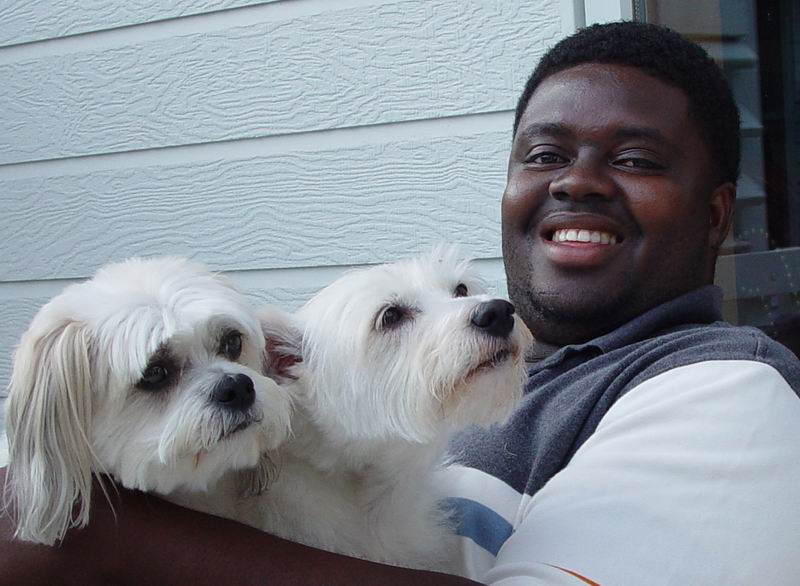
Over the Memorial Day Weekend, my only conversations are with Sebastian (Shih Tzu-Bichon Frise), and Maggie (Three quarters West Highland White Terrier and one-quarter Bichon Frise).
Maggie and Sebastian romping in the snow
Sebastian keeps asking, “Where’s Mom?”
“She’s gone to the cemetery.”
“NO!”
“Yes. She’s gone to TWO cemeteries!”
“NO!!!!” “Not TWO.”
“Yes, two cemeteries.”
“No! Mom’s dead?”
“No… she’s gone to the cemeteries.”
“No. You’re pullin’ our tails…she can’t be buried in TWO cemeteries. Only ONE. We’re not stupid.”
“Okay,” I say. “You’re not stupid. You’re both very bright. Mom’s not been taken to the cemetery like you guys will be if you keep peeing on the rugs and on the corner of the new kitchen island …she’s not buried. She’s DRIVING to the cemeteries in the car.”
“DRIVING? In the CAR?”
“Yes…in DAD’S CAR.”
“We’re going for a ride In DAD’s car?”
“No,” I say. “Mom has Dad’s car. She’s gone to the cemeteries…in Lincoln, Nebraska. It’s Memorial Day. Besides, no rides in Dad’s car until you stop peeing in the house.”
“Aw! That’s not fair. We want to go for a ride in the car…right NOW. Like you always say! ‘Where the ____ is Mom?'”
“Bad dog, you’re not supposed to talk like that. Where’d you learn to talk like that?”
“Mom taught us. We love Mom more than you.”
“I don’t care. She’s not here! I’m all you’ve got until Mom gets home.”
“Mom’s home?” They run to the door.
“Oh boy, oh boy, Mom’s home! Mom’s home!”
“No. She’s coming home tomorrow. Maybe, when she brings Dad’s car….”
“Dad’s car? Ride in the car?”
“No. You have to listen. When she gets back from the cemeteries, Dad will take you for a ride in the car…OR…if you keep peeing in the house, Mom will take you both for a ride… to the cemetery.
“No, no…not the cemetery!” shouts Maggie.
Sebastian saunters over to the island.
“You’re pullin’ our tails,” he says. “Mom wouldn’t take us to the cemetery.”
He looks right at me and lifts his leg: “You’re mean. Wait ’til Mom gets home!”
“A Grandfather’s Concern: Literacy, Literalism – and the Measure of Truth” – a social commentary published several years ago on MinnPost.com – came to mind today as I read the humorous comments “Owning a Canadian” about the Bible and homosexuality. I post it here with a name that better reflects the tongue-in-cheek spirit in which it was written.
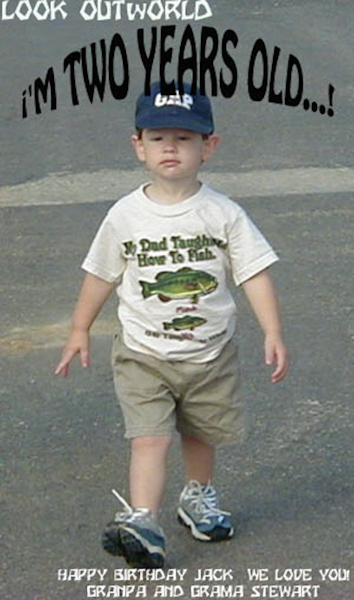
Jack at age two
I’m worried about my grandchildren. They live in Kentucky.
A New York Times story by Laurie Goodstein re-published by the Star Tribune (12.12.10) as “Creationism meets the Constitution” triggered the concern. Its focus was the separation of church and state, occasioned by a proposed Christian theme park. But my concern was for my grandchildren.
Kentucky ‘s Governor and the Kentucky Tourism, Arts and Heritage Cabinet seem enthralled with a new Christian theme park called “Ark Encounter. “ Ark Encounter will be developed by “Answers in Genesis,” developers of The Creation Museum in Petersburg, Kentucky that shows humans and dinosaurs living together on a planet that is 6,000 years old, a kind of Disneyworld for the illiterate.
Ark at “Ark Encounter”
My concern is for Jack and Mimi’s survival. I’m proud of Jack. He’s 10 years old now. He’s a thinker. His emails to me are flawlessly literate. According to his dad, he doesn’t need Spell-Check. He knows how to spell. In addition to being literate, his emails are sometimes literary.
“The developers of Ark Encounter, who have incorporated as a profit-making company, say they expect to spend $150 million, employ 900 people and attract 1.6 million visitors from around the world in the first year. With the Creation Museum only 45 miles away, they envision a Christian tourism corridor that would draw busloads from churches and Christian schools for two- and three-day visits.” (NYT article)
If he goes the literalist route, Jack might find himself like the little boy who, when asked whether Noah did a lot of fishing on the ark, answered no…because he only had two worms. Eventually, his native curiosity and literary bent would free him for the less obvious symbolic riches of sacred text.
But the issue is not only in Kentucky. It’s everywhere that people refuse to read the Bible literately as literature. It may be sacred literature, but it is literature. The folks from “Answers from Genesis” who are building the Ark Encounter insist that the Bible must be read literally. According to my dictionary, “literal” means “restricted to the exact stated meaning; not figurative.” Genesis is factual but not figurative.
My hope for Jack and Mimi is that they’ll board a different ark – the ark of literacy that will rescue them from the sea of literalism that misses nine-tenths of what is sacred – the poetry, the metaphors, the similes, the parables, the literary allusions of The Song of Solomon, the Psalms, or the prophet Habakkuk who climbed up, figuratively, on “the watch tower” to see what God would say to him about the world in which he lived.
The more I think about it, the less concerned I become…unless, of course, Jack and Mimi, succumbing to peer-pressure, conclude that to be a person of faith means you have to swallow a camel. While some of their friends are trooping off to see the young giraffes in Noah’s ark – “We think that God would probably have sent healthy juvenile-sized animals that weren’t fully grown yet,” said the head the project, ”so there would be plenty of room” – I hope Jack and Mimi stay off the buses to Ark Encounter. More than one person’s faith has been killed by encounters that pitted faith against reason.
I hope Jack and Mimi stay home to read their Bible not as a collection of “literal” facts but as sacred literature that will lead them into the deepest sacred recesses of the soul and into the heart of the world itself. When someone asks whether they take the Bible literally, I hope they’ll be able to answer that they don’t read it literally; they read it literately. Otherwise, there would be no worms.
– Gordon C. Stewart, originally published as “Literacy and Literalism” on www.minnpost.com.
Sometimes I feel invisible. People walk by me on the street or in the mall…and it’s like I’m not there. People walk by like ghosts talking to ghosts. They don’t see me. They’re somewhere else, not really there. They walk like people. They talk like people. They look like people. But their eyes are somewhere else…in some far off place. Their heads down, reading or writing a text or staring into space, babbling to someone who’s not there. They don’t see me. I’m invisible.
I have the same experience driving to and from work. Drivers cut in front of me or run up behind me. They laugh and smile and wildly gesture, but there’s no one else in the car! When their driving puts me in jeopardy, and I honk, they keep talking. They don’t look and they don’t hear anything but the voice on the other end of the cell phone. Even my Toyota’s invisible; it’s become a non-material world.
It’s nothing new really. Western spirituality has always been dualistic. It says that we have a body and we have a soul – the physical and the spiritual. We just have these bodies for a while. We don’t really die; we just get rid of these bodies and fly away like birds set free from their cages. It’s an old Greek philosophy that made its way into the writings of St. Paul. The world of “the flesh” is evil; the world of the spirit is good.
The rudeness on the highways and in the malls, in the coffee shops and even in our homes is but the latest expression of this deprecation of bodily existence.
The voice on the other end of the phone is more important than the person in front of me, and the ones I cannot see or hear or receive a text from are unreal…in Iraq, Afghanistan, and anywhere else I decide to hang up and nuke their worlds into the permanent invisibility of nonexistence or the fires of hell.
I sit quietly at the airport gate, waiting for my flight. Used to be people would at least acknowledge one another’s existence – the bare fact that you were really there and not somewhere else or nowhere – but now they’re on cell phones, babbling away as though the room were empty except for them. Because, I suppose, we’re ancient Greeks with head sets, cell phones, and iPods, seduced by the old idea that we are meant for non-embodied existence. It’s just me and my invisible world, and you with yours, a rude collection of loud mouths and headsets, mouths and ears disembodied from eyes that see, noses that smell, hands that touch and minds that actually think in the silence between our noises.
Touch is a basic need. My dog knows it. I know it. Hearing and speaking are important. But the most important communication comes by touch. An animal that goes untouched becomes wild and crazy. So do we.
To touch and be touched is a vulnerable thing. We crave it. But to touch and be touched is a vulnerable thing. It reminds us of our embodied selves, our mortal selves, our dependent and interdependent selves. The non-material world is safer. Unlike the body, the worlds in our head are invulnerable. In the world of disembodied spirits
The oldest Christian creed says “I believe in the resurrection of the body” because those who developed the creed saw the body – the physical world, the material world, the world of the five senses as not only “good” but essential to existence itself. There is no human life without a body. The body is not a thing to be shed. It’s a gift that places us squarely in time and space.
Next Sunday is Pentecost, the day the babbling stopped, the day the Spirit transformed their separate worlds. Tore down the barriers of language, class, race, gender, and nationality with the sound of a mighty wind so profound that they all stopping babbling and listened to the Voice that spoke in and through the strangers around them.
It may be hard to comprehend exactly what happened on the Day of Pentecost – tongues of fire descending and resting on each one – but it’s not so hard to make the translation for us in the era of instant communication lonely crowd.
Do you feel the wind and the tongues of fire calling us back into the celebration of embodied existence? Isn’t it time to see each other again? Talk with people who occupy the same space? Time we grow up and stop talking to imaginary friends or hanging up on real people who don’t do what we don’t want them to do? Time we recover the spiritual joy of physical community: the recovery of sight, smell and touch. Time we pay attention to common courtesy. Time to notice that the person on the other end of my cell phone and I are not the only ones in the universe: a Pentecost in disembodied world of the 21st Century.
Ever read an obituary that raised your eyebrows? Ever left a funeral thinking it was case of mistaken identity?
This week my old friend Bob Young shared this obituary with the annual gathering of seminary classmate. Bob has a wry sense of humor. We knew something was coming by the twinkle in Bob’s eye.
This obituary is the exception to phony. It appeared in the Ponca City News:
Joshua Micheal (nope, not a typo it’s really spelled that way) McMahan left this world April 18, 2012. He was loved, hated, praised, and cursed by relatives and friends alike. He ultimately passed as a result of being stubborn, refusing to follow doctors’ (or anyone else for that matters) orders, and raising hell for a little more than three decades. He lived life on his own terms.
Josh was born on Sept. 16, 1978, to Linda Burgert Waller. Josh was a beautiful, unique, kind, and loving spirit man. Joshie endured around ten mind-numbing years of public schooling. He had worked as a pizza delivery boy and call center representative before shockingly becoming independently “wealthy.”
He loved music, beer, movies, vodka, television, and women, but not necessarily in that order. He was also an awesome drummer!/vocalist? and was in several bands over the years. He lived in Ponca City his entire life except for the past year where he was forced to put up with his sister and brother-in-law out in the middle of nowhere — a little piece of terra firma aptly called Haskell.
He is survived by Rosie, his long-time canine companion; a sister, Melanie Waller Ochoa; a brother-in-law, DJ Ochoa; a best friend/brother, Cliff Crull; three nieces, Miranda, Emma, and Camille; and one nephew, Maxx. Josh had no children of his own (at least none that we know of). He was preceded in death by Mom Linda, Grandma Nina Burgert, and Grandpa Joe Burgert.
A remembrance service will be held at 2 p.m. April 25 in the chapel of Trout Funeral Home where you may re-tell the stories he can no longer share. Anyone dressed in a suit or Sunday’s best will be promptly escorted back to their vehicle. Just kidding … we’ll accept you as you are — just as Josh would have in life. Please be wary for any children’s sake, there may be profanity and/or alcohol involved. If you have a special memory or maybe just want to irritate Josh for all eternity, please bring a magnet or sticker to attach to his casket for evermore.
In lieu of flowers or memorial gifts, please give generously, in Joshs’ honor, to rockstarmusiceducation.org.
JRock will be placed to rest in the St. Mary’s section of Odd Fellows (the irony) Cemetery in Ponca City and I’m sure he would invite you to come by later and have a laugh on him — literally.
As Bob read aloud Josh’s obituary in his droll manner, we had a great laugh, just as Josh would have wanted, and we felt accepted as we really are. Lord knows we’re all likely “to pass as a result of being stubborn.”
We had another round in Josh’s honor and prayed (not really) that, if someone decides to tell the truth in our obituaries, the writer will have a lively sense of humor…and a whole lot of grace.
“What does Obama’s announcement {supporting same-sex marriage) mean to you? Will it make any difference in your life?” asked CNN’s blog this morning
Here’s how I responded:
“The President’s declaration has not changed my life, but it has moved it one step closer to leaving behind the trail of tears the church has inflicted on its own members. I am a pastor. My family and church are straight and gay. I have shared the tears and listened to the sobs and shouts. I have cried their tears and shaken my head and wanted to make a fist.
“Here in the state of MN a referendum to amend the State Constitution – similar to the one that just passed in NC – will be on the ballot. I cringe that the proponents of the amendment – the opponents of marriage equality – often do so “in the name of Christ,” ignoring the fact that we have nothing to indicate any statement by Jesus on this issue, while at the same time they ignore the Beatitudes and other teachings of The Sermon on the Mount that clearly oppose the church’s endorsement of and participation in state-sponsored violence and war. It saddens me.
“My family makes no distinctions among us. Orientation is orientation. Families, churches, and cultures change slowly, and sometimes tumultuously
“My professional life will change when both the church and the state celebrate the commitment of two people, regardless of their gender, to the estate of marriage. Until then… every heterosexual wedding celebration will also remind me of those who cannot celebrate the same.
“A comedian once asked why GLBT folks shouldn’t be allowed to be as miserable as we (heterosexuals) are. Misery and joy do not reside within the lines we draw between “us” and “the other.” My gay son pays little attention. He’s not married, and, although his state permits it, he has chosen otherwise. But, in the event he decides that the blessings and miseries of marriage are for him, the choice should belong to him and his partner of 12 years. And, in the event he should so choose, the church should be there to celebrate and share the cake. When that day comes, my life will have changed.”
How would you respond the CNN question? Leave a comment to generate the discussion here.
And, if you’re looking for a welcoming church, stop by Shepherd of the Hill Presbyterian Church in Chaska Sunday morning at 9:30. Whatever your opinion, or any other source of division – no matter who you are – you’ll be welcome.

 I stood there on the spot where she was found a few hours before.

 Views from the Edge