Two Kinds of Religion

“How a Single Voice Threatened to Spark a Forest Fire”

Gordon C. Stewart, September 28, 2010

Minnesota Public Radio (MPR, 91.1 FM) published this commentary after a Florida pastor threatened to burn the Quran. The same Rev. Jones is part of the story of the toxic video that has inflamed the Muslim world today. Some things never change.

Everyone from time to time feels insignificant. As I did, while watching fires burn across the world, lit by the words of one pastor in Florida. I felt like a spectator in the stands watching the game I care about go terribly wrong, a hostage of verbal terrorism uttered in the name of Christ.

I would imagine that the Rev. Terry Jones and his small congregation also had felt insignificant before they announced the 9/11 Quran burning, and that they were stunned when their pastor’s voice, although terribly misguided, lit the forest on fire without ever burning a Quran.  One of their own, one who had felt insignificant, had raised his voice and now had the ear of a commanding general, the secretary of defense and the president of the United States.

The difference between the Rev. Jones and most people is that he has a pulpit.  On any given Sunday he speaks and a few people actually listen.  Most of us do our ranting and raving in the shower, at the water cooler or with like-minded people at the coffee shop, but we don’t much expect anyone to listen.

But as the Jones story developed, those of us with pulpits were feeling no less beside the point.  Then, as I prepared for worship, I was drawn by some old lines about spiritual arson. “Consider what a great forest is set on fire by a small spark. The tongue is a fire … a restless evil, full of deadly poison” and “the seeds of righteousness are sown in peace by those who make peace” (Letter of James 3).

The thought crossed my mind: We could invite a Muslim friend to join me in the pulpit, perhaps my neighbor Muhammad or Abdi or one of their children, whom I meet daily while walking the dogs.  I decided to invite Ghafar Lakanwal, a Pashtun Afghan-American cultural diversity trainer, a Muslim and naturalized U.S. citizen, to bring greetings of peace and share some passages about peacemaking from the Quran in our Sunday worship on 9/12.

Our little church in Chaska welcomed Ghafar, and his words about the spiritual “obligation to learn, not burn” still ring in our ears. Our service drew media attention, and Ghafar’s words were heard on the evening news  and noticed by a stranger in Australia, who sent a message through the church website. “I was touched,” he wrote, “when I read about your recent Sunday service in the news. …  I for one can testify that it has certainly comforted a far away Muslim to know that there are neighbors who will stand together in difficult times.  My salaam [to you].  May we all grow together to attain Allah’s pleasure.”

“Ah!” someone will say. How can any Christian rejoice when the author uses the name “Allah” for God?  But the reaction to the “name” is misbegotten.  It is not the name of God; it’s the Arabic word for what we in English call God.   The forest fire lit in defense of “God” in advance of the anniversary of 9/11 reminds us that two kinds of religion potentially exist everywhere people gather to practice their faith. One kind burns. The other kind learns.  One hates; the other loves.

As James, writing to those who would follow Jesus, put it: “With [the tongue] we bless the Lord and Father, and with it we curse those who are made in the likeness of God. From the same mouth come blessing and cursing. My brothers and sisters, this ought not to be so” (James 3:9-10).  We can set the forest ablaze with our small spark or we can use it to light a candle of hope and peace. But, after the events of this month, none of us can again think that what we say is insignificant.

Hormones Mixed with Gasoline

Cushman Eagle Motor Scooter

Cushman Eagle

In the mid-’50s, Illinois (and maybe

other foolish States) for just a year

or two allowed 15 year olds to pay

a small fee for what was a lawn-mower

engine on two wheels:  a motor scooter

built by a guy named Cushman.  And for less

than $400 I bought a new

top-of-the-line Eagle.  It had two gears,

a clutch, and a weak horn that barely made

the boys on bikes glance at me going by.

Like me, most scooter riders must have paid,

as well, for bones reset–for with a high

speed of 50, many kids of 15

would crash when hormones mixed with gasoline.

– Steve “You-Know-Who” of WILL was lucky. He got a Cushman Eagle as a kid. Here’s a another guy who wasn’t so fortunate, but who had to wait until he was 60. Look in on the family Christmas. It’s enough to make a grown man cry, in the best of all ways..with joy.

Oblivious Dreaming

Little 6’8″ Steve on his motorcycle with Studebaker Hawk behind

Honda Dream CB 150 Hawk

The motorcycle was too small for me,

but was what I could buy with part-time work.

Not loud and rough like the big bikes Harley-

Davidson made, the slim Honda Dream Hawk

would start not with a kick, but with the push

of a button…  Quiet, purring, and clean–

liked even by my mother–I would ride

130 miles to college, then

come  home the next weekend to see my bride-

to-be.  

         The bike was under-powered, meant

for in-town rides, so on the roads I’d draft

behind a semi-truck to reach a speed

of 65.  The truckers hated that

I stuck so close behind out of their sight,

but I, oblivious, dreamed on my steed…

– Steve Shoemaker, Urbana, IL, host of “Keepin’ the Faith” on Illinois Public Radio WILL at the University of Illinois.

Now he spends his time on the prairie looking for a draft of wind to fly his kite.

Steve waiting for a truck?


Atlas Shrugged

Holding up the rock

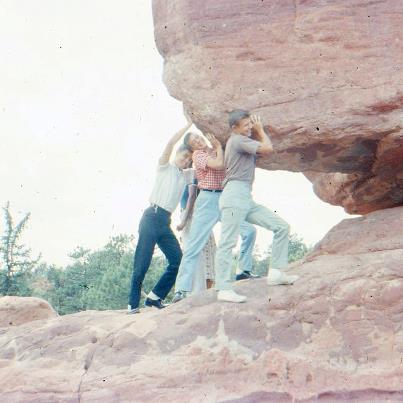
Three young Atlases kept the world from falling years ago.

Steve (left) became a corporate lawyer. Ron (center) went to Vietnam, returned to manage his family business, and became a high school physics teacher. The guy on the right still thinks he’s holding up the world!

We don’t remember where this shot was taken. Today, the day after posting “The Blue Bomb and the Fire Bombs” (Ron owned “the Blue Bomb”), the picture reminds me that somenhow the rock remained balanced there without our help. When the three Atlases shrugged, the world didn’t fall.

My spirit feels lighter.

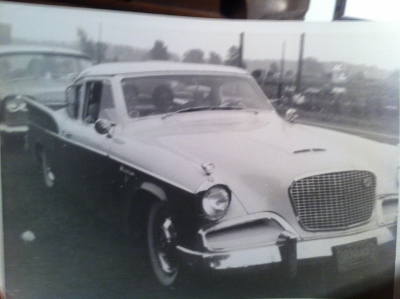
1957 Studebaker Silver Hawk

Steve Shoemaker’s Studebaker Silver Hawk

1957 Studebaker  Silver Hawk

The car was low and light, but had

a V8 engine, squealing tires

from stop signs if you pushed the pedal

down.  At work I bent some wires

to hold  a flower vase inside,

(I was 16 and romantic).

I never offered girls a ride

to school even though I was sick

with love: the car was bold, but I

was shy.

– Little Stevie Shoemaker, Urbana, IL September 11, 2012

Shy Steve and Studebaker in line at the drive-in?

NOTES:1) “This model cost $100 a few years ago–Thanks, college friend, Dwight J.  The 1957 real
car, bought used in 1960, cost $1,000. Thanks, Grandpa Shoe…

2) Nadja, Steve’s girlfriend and future wife, appears to be in the middle of the front seat. Not that shy!

The Blue Bomb and the Fire Bombs

The ’40 Ford convertible

Ron and Mr. Cool in the Blue Bomb

Was a bomb,“The BLUE bomb,”

We called it.

Meant for cruising

With the guys,

Ron at the helm,

Mr. Cool beside.

She purred like a kitten

Except when she’d

Claw and hiss with

Cranky old age.

“Get out and push!

She’ll start if we roll her

Down the hill

And pop the clutch!”

The Blue Bomb was

before the Fire Bombs

That would soon drop…

On Vietnam.

Ron and I were best friends from the time we played for the “Big A’s” in Little League. Ron was a pitcher; I was his catcher. In high school Ron dreamed of being an astronaut. As an Air Force pilot he flew 200 bombing missions over North Vietnam while Mr. Cool was in the streets back home protesting the napalm fire bombs killing peasants and destroying peasant villages in Vietnam.

Back in the States, returning Vietnam veterans began to enroll at the University of Wisconsin-Whitewater where I served as a campus minister. At the anti-war rallies the veterans were seen as serial killers, the enemy. They were persona non grata, the new lepers, shunned and hated. “Leper, go home!”

The phone rang at 2:00 a.m. It was the bartender from the campus pub just up the street. “I have a guy here who’s hysterical. He can’t stop crying. He says he hasn’t slept in three weeks. I’m afraid he’s having a breakdown. I have to close the bar; I don’t know what to do. Can I bring him by the house?”

The inconsolable man at the bar was a Vietnam War veteran who’d been part of the My Lai Massacre. Joseph Conrad’s Heart of Darkness was sitting in our living room. “No, it is impossible. It is impossible to convey the life-situation of any given epoch of one’s existence – that which makes its truth, its meaning – it’s subtle and penetrating essence. It is impossible. We live, as we dream…alone….”  The sleepless vet was dreaming of what he had lived – alone and horrified – suffering flashbacks to the mother and the two children he had shot, lying in the trench. He cried. He talked. There was no meaning to it – no redemption, no going back, no undoing what he had done. No way back to clean hands. “Out, out, damn spot!”

One result of that night was an organizing effort of the anti-war campus ministers and the 300 vets of “The Vets House” (the campus leper colony). The vets went out to tell their varied stories to people in area churches, VARIED stories told by drafted veterans who were as conflicted among themselves about the war as the American public itself.

The vets taught me to remember something I’m embarrassed to say I had forgotten: that no one has clean hands, and that the job in life is not to have clean hands. It’s to get help with washing them, to seek forgiveness, when truth and meaning have been slaughtered. The great human gift – a divine gift – is not to be righteous; it’s to be loving.  I had confused the call of the gospel with being on the right side of almost everything.

Ron and Mr. Cool used to cruise the world in Ron’s “Blue Bomb” – the pitcher and the catcher who had each other’s backs through high school and college. It took years of awkward silence before our different understandings of love of country yielded to the old unbreakable bonds of friendship. The two kids in the Blue Bomb remind me of a deeper kinship that no hell – no heart of darkness – can break.

What QUESTIONS did you ask?

“When I would come home from grade school, my parents would NOT ask, ‘What did you learn at school today?’” reports brilliant scientist Ellis Cowling, North Carolina State University Professor and later Research VP at the University of North Carolina.

“My parents would ask me, ‘What good questions did YOU ask today in school?’”

Thanks to Steve for sharing this memory from his friend at NCSU.

It occurs to me that the question to Ellis is a good one for adults, as well for children. What good questions are you asking today?

A critical mind may not be the key to bliss, but it is the only antidote to answers that make no sense. “The unexamined life is not worth living” (Socrates). Which also means, I suppose, that “the examined life IS worth living.”

After two weeks of partisan convention answers without questions, “What good questions are YOU asking?”

Share them here, if you like. NO platitudes, please. No answers. Just good questions.

Thanks,

Gordon

“It’s Muhammed Ali!”

I only saw him once. Close up.

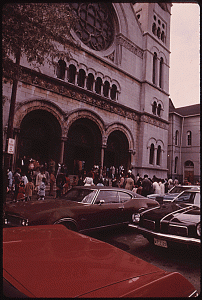
Holy Angels Catholic Church

Holy Angels Catholic Church, the African-American Catholic Church in South Side Chicago, was packed. Father George Clements, a bold community leader on the South Side, had convened the community meeting.

I don’t recall why we were there that afternoon. I only remember who was there.

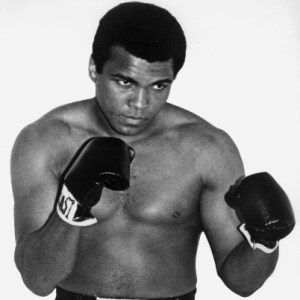
Two pews in front of us sat a Michelangelo-chiseled figure of flesh and blood in a black suit. Massive square shoulders, thick muscled neck, beyond regal…a Greek god, Atlas perhaps, sitting erect and still, near the back of the crowed church. There was no mistaking who he was.

Muhammed Ali

“It’s Cassius Clay!” I blurted out to my fiancee…in what I thought was a whisper… pointing to the large man two rows in front of us.

MUHAMMED ALI!” came the woman’s corrective voice from behind us. The young, embarrassed, white Christian seminarian thanked her, apologized, and sat quietly the rest of the afternoon.

Ali, the World Champion, had changed his name from Cassius Clay. He had joined the Nation of Islam. Ali refused military induction as a conscientious objector. His conviction would overturned by the U.S.Supreme Court. At the time he refused to step forward for induction to serve in the Viet Nam War, he asked:

“Why should they ask me to put on a uniform and go ten thousand miles from home and drop bombs and bullets on brown people in Vietnam while so-called Negro people in Louisville are treated like dogs and denied simple human rights?”

Father George H. Clements went on to become the first African-American in the Archdiocese of Chicago to be appointed to the position of Pastor.

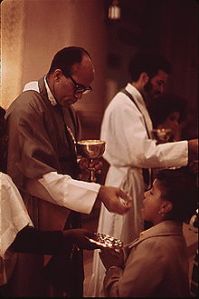
Father George H. Clements at Mass

As Pastor of Holy Angels, Fr. George Clements moved a statue of St. Anthony and set up an altar honoring Dr. King following Dr. King’s assassination. When the archdiocese expressed its disapproval, Fr. Clements refused to reconsider.

Acclamatio populorum—”the people acclaim a saint,” he said. “If the cardinal wants it down, he’ll have to take it down himself.”

The Martin Luther King, Jr. statue remained in place.

Fr. Clements would later become famous as the first priest to adopt a child. He added a new title -“Dad” – as the adoptive father of four African-American children, and founded One Church – One Child, a movement in his parish inviting African-American families to adopt homeless African-American children. The program became nation-wide and still exists today.

Wiping the President’s Tears

President Bush and ordinary citizen

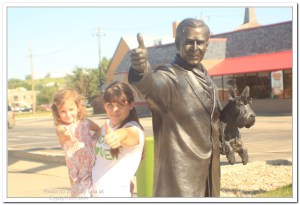
Former President George W. Bush was right there – standing on the corner on Main Street in Rapid City, South Dakota. Most people were ignoring him. He looked lonely standing there all by himself. So I walked over to strike up a conversation.It was the kind of conversation I’ve always wanted to have with George – one where he doesn’t get to talk back or cut me off. I asked questions and made my points. My questions were the same as in the story of the President’s visit to an elementary school. The story goes like this.

The President talks to the children and then opens the floor to questions.

One little boy puts up his hand and George asks him what his name is.

“Billy.”

“And what is your question, Billy?”

“I have three questions. First, why did the USA invade Iraq without the support of the U.N.? Second, why are you President when Al Gore got more votes? And third, whatever happened to Osama bin Laden?”

Just then the bell rings for recess. George assures the kiddies that they will continue after recess.

When they resume, George says, “OK, where were we? Oh! That’s right! –
Question time. So who has a question?”

Another little boy puts up his hand. George points him out and asks him what his name is.

“Steve.”

“And what is your question, Steve?”

“I have five questions.  First, why did the USA invade Iraq without the support of the U.N.? Second, why are you President when Al Gore got more votes?  Third, whatever happened to Osama bin Laden?  Fourth, why did the recess bell go off 20 minutes early?  And Fifth, what the hell happened to Billy?”

All these years later, standing on the corner of Main Street with George W., I was prepared to ask Billy’s original three questions and a few others. I wanted to ask why his Party was blaming President Obama for what happened under his administration.

I never got to ask. as soon as I asked the question about Iraq, something strange happened.

I thought I saw a tear falling from his eye.

I pulled out a handkerchief and reached up to dry his tears. Only then did I realize: I hadn’t been talking with W. I’d been talking with his father, President George Herbert Walker Bush.

W is standing blocks away at the corner of 5th and St. Joseph, a thoughtful consideration for the older Bush, I thought, by the City Fathers of Rapid City. Here’s George, just like he was after declaring victory in the Iraq War: “Look at me, Dad, I finished the job for you!”

George W: “Thumbs up, Dad!”

Mission Accomplished

In remembrance of Leah Thomas

Leah Thomas was an attorney at the Legal Rights Center. Born and raised in southside Chicago, Leah’s older brother had been a member of the Black Panthers. She was raised with the cry for social justice in her bones, full of faith, smiles, laughter, and steadiness, a sturdy legal advocate and “mother” to the juvenile clients she defended in Hennepin County District Court.

She fainted one morning getting her coffee at Panera Bread. Days later she was gone. The funeral was held at her African-American church in Minneapolis. As Executive Director of the Legal Rights Center and Leah’s colleague and friend, I offered the following Tribute to Leah at the funeral.

Like light

Like joy

Like sun breaking through a storm

Her laughter

Brightens the room

Breaks the ice

Fills it with peace.

Mama walks lightly

Amid the trials and the cares

Quick as a black panther

Steady as a turtle

She coos with the tenderness

of the turtle-dove

walks with the strength of a lion.

With steady hand

With sturdy faith

And clarity of mind

She laughs

And soars her craft

Through clouds and storms

To lead us on and through.

Like light,

Like joy,

Like sun breaking through a storm,

She laughs,

She brightens the room,

She wipes our tears

She fills us with her peace.

– Gordon C. Stewart, Legal Rights Center, Inc., Feb. 1, 2005.