The Waiting Room

The voices of the visitors
would drop when they entered
the almost empty anteroom
and stood before the blond wood door
of her positive pressure room.

The air could exit but could not
bring more bad bugs into her lungs
immuno-compromised by stays
in this or other hospitals.

Her breathing stopped on the 4th night
as cancer squeezed another last
breath from exhausted failing lungs.
The empty room keeps breathing out.

[Abigail A. Salyers, 12/24/42–11/6/13, received a Ph. D. in nuclear physics from George Washington University, later did Post-Doctoral studies in Microbiology in Virginia & was the first female tenured Professor in the microbiology department at the Univ. of Illinois. She was elected President of the 40,000 member American Society for Microbiology for 2001-2. She was the author of several books & hundreds of professional articles in her field.]

– Steve Shoemaker, Urbana, IL, November 7, 2013

Verse – The Cancer Joke

She knew cancer
better than almost
anyone else
in the hospital.
Although not an MD,
she had taught
in the Med School
while doing research
and writing books
and using her Ph. D.
to produce others.

Cancer Society money
had come to her lab
of busy bees for years.
She sat on panels
of judges that chose
who would study which
type of the deadly C.

Now the crooked cells
that had begun in her throat
had caused spots, as they say,
on her lungs and heart
and in her bones.

As a pastor married to the lab
headed by this agnostic,
I knew how to visit
folks given the death sentence:
listen, touch an arm, a shoulder,
remember good times together.

She wanted to tell me a joke.
I leaned close to hear the raspy voice
above the hissing oxygen.
“A microbiologist’s joke
is only one millionth as funny
as a regular joke.”

She raised a needle-filled hand
to touch my worried brow
bowed over her dry grinning lips.

-Steve Shoemaker, Urbana, IL, November 5, 2013

Editor’s Note: Steve was “married to the lab” at the University of Illinois through one of its research scientists, his wife, Nadja.

Communio Sanctorum

As a boy I thought of All Saints Day and the Communio Sanctorum, the Communion of Saints, the way I felt about Halloween. It was spooky.

Today it’s no longer spooky. I’m thinking about all the people who have touched my life along the way. Few of them are saints in the sense our culture has come to understand the word, but they were all saints in my book. The extraordinary thing about saints is that they know they are not extraordinary. They refuse to believe they are exceptional.

The people I’m remembering drew little attention to themselves, for the most part. Some of them, like Uncle Dick Lewis, who was an uncle not by blood but by affection only, were people of few words. Uncle Dick stood under the maple tree every Sunday morning waiting for our weekly routine: nothing more than a handshake, the strength of which tested and honored my growing toward manhood. The handshake is the only speech I remember. During the week Uncle Dick’s hands painted houses. On Sunday morning he clasped his hands together after painting a boy into a man under the maple tree.

The place where I grew up was a working class community with a working class church. Its members were house painters, plumbers, carpenters, and bus drivers with a few middle management people sprinkled in, and one generous rich man named George. George and Phoebe always sat in the front row.

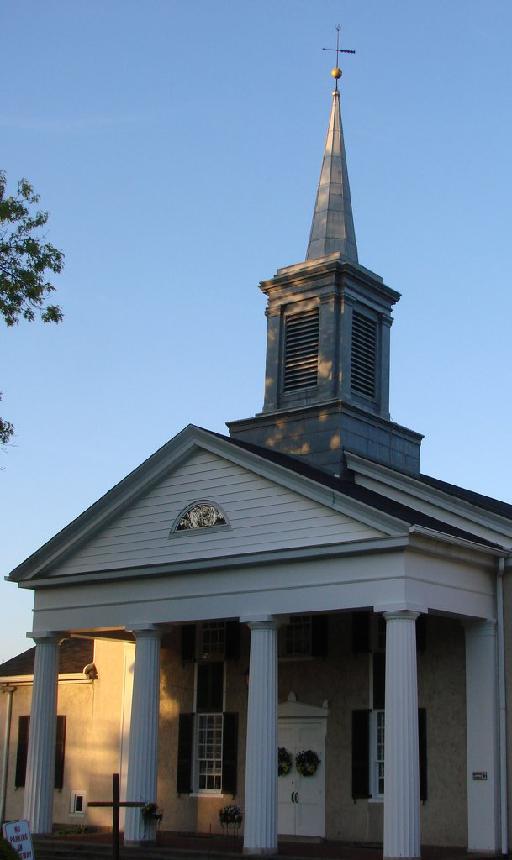
Marple Presbyterian Church, Broomall, PA

Marple Presbyterian Church, Broomall, PA

George decided one day to donate a stained glass window. Although much of the money for the new building had come from George, a stained glass window was inappropriate for Colonial architecture. The church board, with some fear and trepidation, refused the proposed gift. George left the church in a huff. He moved his and Phoebe’s membership to the wealthy church in Bryn Mawr, leaving the carpenters, plumbers, and bus drivers with a clear message: “Good luck. You won’t have George to kick around any more! You’re on your own.”

Karl Marx observed that the rich will do anything for the poor but get off their backs, and that the ruling ideas of any society are the ideas of its ruling class. After George left, they didn’t love Karl, the man everyone at Marple loved to hate, any less than before, but they re-discovered the Beatitudes of Jesus: “Blessed are you poor. Blessed are the meek. Blessed are you who mourn.” Blessed are the peacemakers.”

George was always kind to me in a distant kind of way. He got a chuckle watching the mischievous tow-head preacher’s kid break the rules he didn’t dare break. My only pictures from childhood were taken by Phoebe’s camera. I still see George in his three-piece suit with a big cigar, looking like a statue of William Randolph Hearst, the newspaper magnate – not quite that rich, but likely every bit as lonely before and after the church refused his stained glass window.

Approaching All Saints’ Day this year, I see them all compacted, you might say, into a single communion, the communion of the dead who have left behind every illusion that they were exceptional to the common lot of humankind. I see them gathered again at Marple Church, but gathered differently: George in Uncle Dick’s painter’s coveralls and Uncle Dick dressed in George’s three piece suit smoking George’s Cuban cigar, and Phoebe still taking her snapshots of a community now repaired by the common threads of love and death, dragged kicking and screaming into the Communion of Saints that knows no exceptions.

Chocolate Chips

Although I eat a small handful
right from the bowl (poured there because
there is no crinkly sound tell-tale),
just like Grandpa D did – cookies
need just half as much as are called
for on the yellow package (they,
of course, each year want more chips sold
than were the year before), so I
achieve the perfect dough-chip mix
by not following directions –
just like the old man when he’d fix
them (he taught me sales resistance…)
but then he’d put the Nestle chips
he’d saved into the Cream of Wheat
(you can’t eat too much chocolate.)

– Verse “Chocolate Chips”
– Steve Shoemaker, Urbana, IL, October 29, 2013

Let my people go – Paul Robeson

Click HERE to read Paul Robeson’s testimony before the House Committee on Un-American Activities in 1956. With courage, he shamed the Congressional committee that sought to shame him. “You are the Un-Americans, and you ought to be ashamed of yourselves.”

Not to be further shamed, the Chairman adjourned the Committee.

The First Signs of Dementia

EDITOR’S NOTE: The author of this verse has always had a mental picture of “the grid” of the City of Chicago streets, avenues, and interstates.

The First Signs of Dementia

I cannot see myself on the grid
anymore–the web of avenues,
streets, lanes, and turnpikes. I know the road
I am driving on, but the views
from the height of buzzards are now lost
to my mind’s dim cataractic eye.

Well, at least it happens sometimes. I
hate not knowing when the very last
clear and cogent thought will cross my mind
(double-cross, most likely…) Can there be
exercises for brains? Surgery?
Memory replacement would be kind.

Will I soon not even know my name?
Hell is when all highways are the same.

(Composed while driving on I-57, Urbana to Chicago–but not transcribed while in Work Zones…}

– Steve Shoemaker, Urbana, IL, October 16, on his way to McCormick Days, the annual three-day Alumni/ae event at McCormick Theological Seminary in Chicago. Steve first mentioned losing his grip on the grid last spring on the drive from Midway Airport to the seminary for the annual gathering of old friends.

Give up your faith

“For 40 years,” writes Steve, “I had been a Pastor on college campuses where many students were of the marrying age, and perhaps because I would not accept money for weddings, was often asked to officiate.”

Verse -“Give Up Your Faith”

was what I told several Christians
who were wanting to marry
someone of another Faith.
“It’s the Christian thing to do,”
I said. “Give up what you love
for the person you love.”
(“Remember the Golden Rule?”)

Only a very few became Muslim,
or Buddhist, or Hindu or Jewish,
but I felt those who did were
showing clearly the love of Jesus…
I was glad to be an evangelist.

– Steve Shoemaker, Urbana, IL, October 11, 2013

Teaching my Daughter how to Drive

Her brother let the clutch out much too fast
the first time he tried to start up the van
in the parking lot of the store that closed.
I told her how he lurched and jerked and ran
over the orange cones that I took to use
from soccer practice as a parking space.
The VW died, he swore, but tried
again and then again–giving more gas
and slooowly letting up the clutch. She learned
and did the opposite: the engine roared
as she held in the clutch and mashed the gas
pedal to the floor. I yelled to be heard
above the engine noise, “Let up, let up!”
and as she pulled both feet up, the car died,
of course. She threw the keys at me and cried.

She took the class at school and got an “A.”

– Steve Shoemaker, Urbana, IL, October 9, 2013

Friends

Those who have lived their lives in one place are blessed with enduring friendships over time. The schoolmates who stayed in my home town see each other all the time. They still bump into each other at Vince’s Barber Shop where Vince gave us Kindergartners crew cuts while the older men leafed through the stack of Playboys. The Playboys aren’t there anymore, but the little boys are, complete with oxygen tanks. Vince and his brother Tony, now in their 90s, are still behind the chairs telling stories that recall their relationships over time.

On my way to the 50th high school class reunion back in Broomall, the question occurred whether Vince’s Barber Shop was still there. It was. I walked in and began to introduce myself. “You’re Ken Stewart’s son.” I was a Kindergartner, a sixth-grader, a ninth-grader, and a senior all over again – a boy-turned-man who had been known over time once upon a time.

There are the friendships that date back to childhood, and there are the friendships that come by choice for those of us who left home for various parts of the world. These friendships also come by mutual bonds of affection that date themselves to different times and locate themselves in definable places. Like the hometown friendships that fell into our laps by birth, these later friendships endure by virtue of shared experience. If the early friendships are sustained by common memories of being called into Pop Werfel’s principal’s office for shooting spit balls in class or getting into a fight at recess, afternoons playing hide-and-seek or capture the flag in each other’s backyard, catching fire flies at dusk, or playing in the school band or on a school team, the friendships that come later happen because some spark of commonality draws us to each other.

Old dogs at The Gathering

Old dogs at The Gathering

Sometimes it’s hard to know the difference between the later friendships and those early one. I’m thinking now of my friend Steve Shoemaker from Urbana, Illinois. Although we were in graduate school at the same time, we barely knew each other. Steve was married and lived in the married student apartments. I was single, living in the singles dorm. Each had a job that diminished our free time. We rarely took the same classes. We barely knew each other except by sight and name until 12 years ago when our mutual friend Wayne brought seven kindred spirits together once a year for renewal, friendship, and theology. In jest we called ourselves “The Chicago Seven” until Dale died earlier this past year. (Views from the Edge published “The Surrogate’s Voice” following Dale’s last time the group.) Now we’re just The Gathering.

Steve and Nadja were guests these last two nights here in Minnesota. Steve drove 11 hours to do a program of poetry and reflection on Becoming Free: Go Fly a Kite. When I presented him with the honorarium for Shepherd of the Hill’s Dialogue program, he refused it… on the basis of friendship. “Besides,” he said, “You’re my publisher!” I insisted. So did he. Friendship prevailed.

During last night’s poetry reading Steve was asked how his poems come to be. He often writes in the middle of night, lying in bed, composing on his iPhone, like the other night when a combination of three compound words came to mind: “sleepy-head, lazy-bones, slug-a-bed.”

Then, early this morning in the night following his presentation, the egg was hatched.

Verse – Missing Sunrise

Sleeply-head, lazy-bones, slug-a-bed,
where were you when the sun raised its head?
Purple and violet, rosy-red:
you lie there like you’re already dead…
Get up and greet the day! Live instead
of hiding – cat and dog must be fed!
Alarm dinging, birds are singing, led
by sunlight bringing New Love ahead.

Steve’s verse reminded me of a few lines from Wendell Berry’s Jayber Crown: The Life Story of Jayber Crow, Barber, of the Port William Membership as Written by Himself:

“What I had come to know (by feeling only) was that the place’s true being, its presence you might say, was a sort of current, like an underground flow of water, expect that the flowing was in all directions and yet did not flow away. When it rose into your heart and throat, you felt joy and sorrow at the same time, and the joining of times and lives. To come into the presence of the place was to know life and death, and to be near in all your thoughts to laughter and to tears. This would come over you and then pass away, as fragile as a moment of light.”

Two barber shops. Two barbers. Two places. One story. Don’t “lie there like you’re already dead! Get up and greet the day… led by sunlight bringing New Love ahead.”

Thank you, Steve.

Balm for Cynicism

Friend and colleague John Buchanon posted this piece last night.

Family of John M. Buchanan's avatarHold to the Good

Respect and gratitude for our system of government runs deep in me. I certainly have strong political opinions and commitments and understand the partisan dynamic that makes a two party system work. But I also trust the wisdom of voting citizens, ultimately – not always, but ultimately, to make responsible decisions and elect honest, responsible representatives. I have known a few personally over the years and found them to be persons of integrity, high ideals and a strong sense of vocation in the public, political arena.

My respect and gratitude are being tried at the moment. The federal government is about to shut down and we face a looming credit default in the midst of partisan wrangling and name calling, as one party seems willing to risk economic disaster in order to thwart the other party and humiliate the President. I watched in both amusement and disgust as a United…

View original post 435 more words