The Socks in the Kitchen Sink

Dirty sock washing

Dirty sock washing

She was washing her socks in the kitchen sink next to the hors d’oeuvres and the punch bowl after the ice skating party.

Marguerite was a bit different. Brilliant. Socially challenged. Single. The church group of singles and young marrieds was her closest thing to family. The family was used to the quirks, except for the newly married minister’s wife who’d never seen anything like this.

“What are you doing?”

“Washing my socks.”

“Why?”

“They’re wet.”

Recognizing that Marguerite was clueless, the 22-year-old minister’s wife quietly moved the splattered dish of hors d’oeuvres and the punch bowl to the long table nearby and saved her comments for later. Sometimes you have to stuff a sock in your mouth. Without room for every kind, a church is not a church.

Disclaimer: The picture is not from the church and it’s not Marguerite. It’s staged…I think.

Sermon on Courage, Work, and Assurance

Boy gets a life Lesson on Halloween

Small boy dressed as Robin. I give him candy and he says “I don’t like that. I want the M&Ms in the bowl.” I say, “I already gave you candy”. He says, with more belligerence, “I want the M&Ms”. I say, “Take what you got kid. You can’t always get what you want. How’s that for a life lesson?” Diane bans me from handing out anymore candy.

– Mark Wendorf, Sanford, ME, friend and colleague with a great sense of humor. Diane is Mark’s spouse.

November Frost

White hoarfrost
red Sumac
leaves shriveled
red glistening
in November
morning sun
between seasons
of shriveled
and not yet
leaving blue eyes
red with brilliance
beyond belief

– Gordon C. Stewart, November 5, 2013

I’m no poet, but sometimes I have to pretend I am. My early memories include the beauty of the Sumacs along the coast in Rockport, MA. Every time we left the house, the Sumacs were right there inside the yard with the white picket fence.

There is something about a Sumac tree that is all its own, the red pods in summer set among the green leaves, the red-orange leaves in autumn, the leafless willowy structure with a bare beauty all its own in winter.

This morning’s walk with Barclay, the five month old Cavalier King Charles Spaniel, took us through the fields covered with hoarfrost. We came to the Sumacs. Barclay sniffed the ground. I, too sniffed. Such brilliance goes far beyond belief.

Communio Sanctorum

As a boy I thought of All Saints Day and the Communio Sanctorum, the Communion of Saints, the way I felt about Halloween. It was spooky.

Today it’s no longer spooky. I’m thinking about all the people who have touched my life along the way. Few of them are saints in the sense our culture has come to understand the word, but they were all saints in my book. The extraordinary thing about saints is that they know they are not extraordinary. They refuse to believe they are exceptional.

The people I’m remembering drew little attention to themselves, for the most part. Some of them, like Uncle Dick Lewis, who was an uncle not by blood but by affection only, were people of few words. Uncle Dick stood under the maple tree every Sunday morning waiting for our weekly routine: nothing more than a handshake, the strength of which tested and honored my growing toward manhood. The handshake is the only speech I remember. During the week Uncle Dick’s hands painted houses. On Sunday morning he clasped his hands together after painting a boy into a man under the maple tree.

The place where I grew up was a working class community with a working class church. Its members were house painters, plumbers, carpenters, and bus drivers with a few middle management people sprinkled in, and one generous rich man named George. George and Phoebe always sat in the front row.

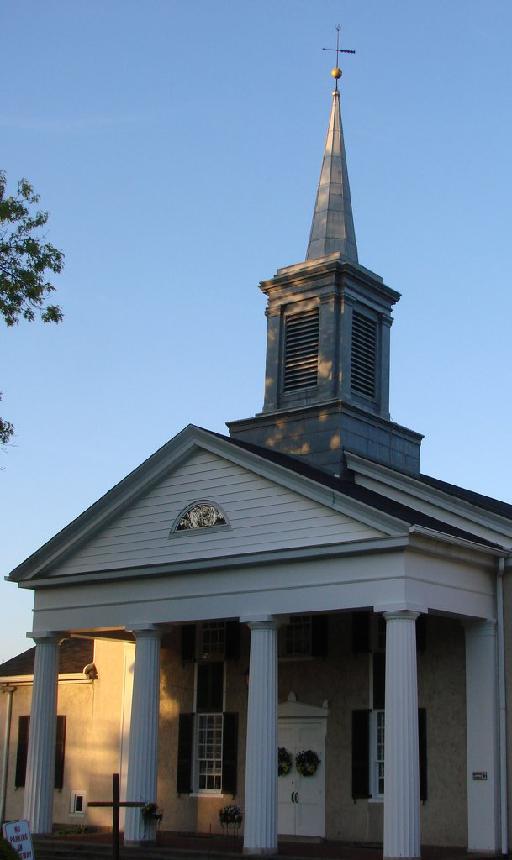
Marple Presbyterian Church, Broomall, PA

Marple Presbyterian Church, Broomall, PA

George decided one day to donate a stained glass window. Although much of the money for the new building had come from George, a stained glass window was inappropriate for Colonial architecture. The church board, with some fear and trepidation, refused the proposed gift. George left the church in a huff. He moved his and Phoebe’s membership to the wealthy church in Bryn Mawr, leaving the carpenters, plumbers, and bus drivers with a clear message: “Good luck. You won’t have George to kick around any more! You’re on your own.”

Karl Marx observed that the rich will do anything for the poor but get off their backs, and that the ruling ideas of any society are the ideas of its ruling class. After George left, they didn’t love Karl, the man everyone at Marple loved to hate, any less than before, but they re-discovered the Beatitudes of Jesus: “Blessed are you poor. Blessed are the meek. Blessed are you who mourn.” Blessed are the peacemakers.”

George was always kind to me in a distant kind of way. He got a chuckle watching the mischievous tow-head preacher’s kid break the rules he didn’t dare break. My only pictures from childhood were taken by Phoebe’s camera. I still see George in his three-piece suit with a big cigar, looking like a statue of William Randolph Hearst, the newspaper magnate – not quite that rich, but likely every bit as lonely before and after the church refused his stained glass window.

Approaching All Saints’ Day this year, I see them all compacted, you might say, into a single communion, the communion of the dead who have left behind every illusion that they were exceptional to the common lot of humankind. I see them gathered again at Marple Church, but gathered differently: George in Uncle Dick’s painter’s coveralls and Uncle Dick dressed in George’s three piece suit smoking George’s Cuban cigar, and Phoebe still taking her snapshots of a community now repaired by the common threads of love and death, dragged kicking and screaming into the Communion of Saints that knows no exceptions.


Rejoicing and Mourning

Verse – Romans 12:15

We often get the biggest gifts just when
we need them least. When we are poor, folks stay
away. They do not even see us then:
invisible, we starve. We work all day,
all night, but if we strike it rich, we find
new friends who buy us lunch, and bring
us business, give us tips on stocks,
and lend us their vacation homes. Remind
me what the prophet said: we are to sing
and dance and eat the fatted ox
with those who celebrate. But we must then
search out the poor who mourn or else we sin.

– Steve Shoemaker, Urbana, IL, October 25, 2013

“Rejoice with those who rejoice; mourn with those who mourn.”

Paul’s Epistle to the Romans chapter 12, verse 15.

Editor’s Note: Have you noticed that we don’t talk about the poor any more? Why, do you suppose?

Ennui

“I hate feelings. I hate them!” said the person who feels them so intensely.

The feelings we hate are the ones that drive us into the dark corners and the basements of the psyche. The only thing worse than being in the grip of sorrow or grief is to feel nothing, or fool oneself into believing that the feelings aren’t there.

Ennui – a listless weariness and boredom – describes this hell.

Like the writer of Ecclesiastes, I listen to all the shouting of our time and feel that I’ve been there before. I prefer not to feel the loss of belief in history as the inevitable upward bend of progress. Listening to the sounds of ignorant armies clashing by night is not good for my sanity. I prefer ennui to constant turmoil, and, in the midst of ennui, I have nothing to say of any worth. No great word of hope.

“All things are wearisome,
more than one can say.
The eye never has enough of seeing,
or the ear its fill of hearing.
What has been will be again;
there is nothing new under the sun.”
-Ecclesiastes, 1:8-9.

In times like these I go through periods of great sadness and move into the protective shell of ennui. Then something like Odetta’s version of “Sometimes I feel like a motherless child” breaks through again to the feelings I hate. Is it sometimes good to hate?

Joshua fit the battle of Jericho

Music like this gives me hope. The music director’s introduction and the piece itself speak of the non-violent battle of resistance against the forces that disenfranchise in our own time, as well as in the time the song was first sung. I need this.

Thanks to the Chaska Herald for additional publicity for this Saturday’s celebration of the 150th Anniversary of the Emancipation Proclamation and the ongoing spirit of emancipation. Click HERE for the story. Emancipation Day Celebration, this Saturday, Oct. 26, with guest artists, Dennis Spears, Momoh Freeman, Jerry Steele, and the Chaska High School Choir.

Let my people go – Paul Robeson

Click HERE to read Paul Robeson’s testimony before the House Committee on Un-American Activities in 1956. With courage, he shamed the Congressional committee that sought to shame him. “You are the Un-Americans, and you ought to be ashamed of yourselves.”

Not to be further shamed, the Chairman adjourned the Committee.

O Let My People Go

For ten or twenty, thirty years or more
the song was sung before the Civil War

by southern slaves in secret. First a call,
and then a sung response that came from all

around, “O let my people go!” And then
another voice, another poet, sang

out still another call, “Tell King Pharaoh!”
And then, “This world’s a wilderness of woe…”

“O let my people go!” Old Lincoln heard
the sad song sung and gave the legal word:

Abolish evil slavery first here,
and finally across the land. For where

no freedom is for some, at risk we all
will be. Each one must listen for the call:

to set each prisoner free.

– Verse “O Let My People Go” by Steve Shoemaker, Urbana, IL, October 23, 2013

Spirituals! (The first one published in 1861, “O Let My People Go,” was transcribed by a YMCA missionary sent to help escaped slaves at Fort Monroe. –Dena J. Epstein, “Sinful Tunes and Spirituals: Black Folk Music to the Civil War,” Univ of Illinois Press, 1977, 2003.)

Editor’s Note: Harriet Tubman was the Moses of the Underground Railroad.