The Lonely Blogger and Steve Martin

It’s been lonely. Traffic is down on Views from the Edge. I ask myself why. But I suspect I know the answer. I’ve broken blogging rule #1. Blogs are mostly about entertainment, not serious stuff . People go to blogs to get away from serious stuff. Not that this one is all that serious, but it’s hardly a rendition of Steve Martin’s happy feet.

Then two comments arrive. The first is from Gary who shares the experience of being influenced early on by Ernest Becker’s seminal work, The Denial of Death.  The second comes from Jim, a former classmate. Both Gary and Jim went on to become teachers.

Gary wrote:

The book title Amusing Ourselves To Death by educator Neil Postman comes to mind. Postman believes we have reduced most values to equate with entertainment. Education he says has to be entertaining. We demand constant amusement through sports, films, travel etc. There is a constant search for entertaining experiences to make us feel alive. It is as though our existence is so fraught with escaping death that the only antidote to dying is amusement. Just as everyone uses humor to take the edge off of awkward social encounters, humor has become the background context of existence. Humor is used as a cover for what human nature really is about and that is “Real Politic” or the feeling that what needs to be done is whatever is practical to survive.

Two other books by Peter Gay and Karl Marx come to mind: Gay’s The Enlightenment: The New Paganism and Marx’s The Communist Manifesto. Gay suggests the Enlightenment led to a loss of traditional religious metaphors to live by, resulting in new forms of paganism arising to supplant the old worldviews. These include everything from “consumerism” to “new age” religions like Scientology. Karl Marx says in his “Manifesto” that “capitalism will destroy all that is permanent”. I think we can say Groucho Marxism seems to be the preferred way to analyze our culture’s ills. Everything has to be couched in humor or it is considered boring. At best we can say humor functions as the sigh of the oppressed as we try to take the edge off of everyday existence that seems to be all about a belief in human society as a survival of the fittest existence. We all want something better but science has been hijacked by capitalism for its own need to constantly revolutionize production to keep novel products arriving to allow us to feel alive when we no longer can see loving people as the real antidote to a preoccupation with fending off death. That was Christ’s reason for sacrificing himself in the face of a pagan Roman Empire. We have come full circle. Hopefully the Coliseum isn’t next as we escalate the need to amuse ourselves to death.

Jim wrote:

Folks get twisted in knots over things which they have neither read nor understood. Back in the days of teaching I had students read a writer who argued that under pure capitalism if profits are to be maximised there are several alternatives: Raise prices; Lower Wages. Then you have a product your workers cannot afford to buy. Because there are more workers than capitalists they will soon suffer. They liked the argument until they learned its author was Lenin.

Thanks, Steve Martin. Thanks, Gary. Thanks, Jim. I feel better.
Poem #5 – Dale Hartwig (1940-2012)

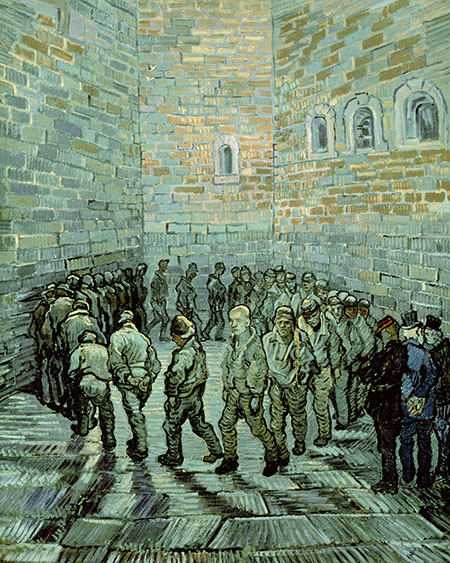
Prisoners Exercising, Vincent Van Gogh, 1890  with Van Gogh looking out and beyond.

Prisoners Exercising, Vincent Van Gogh, 1890 with Van Gogh looking out and beyond.

Dale Hartwig stood out from the crowd. He wrote for himself. His was a rich inner world, a necessity for survival as Parkinson’s shrank his world to the size of his room at the care center. His writings, shared with a group of six close friends, deserve a larger audience.

Dale’s verses and poetry often echo the Hebrew psalmists. They are visceral, sometimes crying out  like Vincent Van Gogh exercising in his asylum at Saint-Remy, and at other times delighting at the sight of a fluttering leaf or falling snowflake outside his care center window. None of Dale’s pieces have titles.

Like prisoners, they only have numbers – the order in which he wrote them, as best we can tell.

Poem #5

Behind and before, Thou goest, O Lord.
Like the wind I cannot see.
But why so silent in ways of my need?
To let you but walk to trust in me.
O my steps are oft frozen from fear,
And my thoughts locked to the darkness around.
O God, only You can move me beyond
The prison that seems to abound.
Come, Lord, and move me, just one small step
Toward the One who would give me so much.
I am who I am, so little sometimes
But, with You, so much, so much.

The last time Dale joined the annual Gathering of classmates in Chicago, he surprised us. He wasn’t supposed to leave “home” – but he did. He somehow managed to get himself to the train station in Grand Rapids, Michigan, board a train for Chicago, and make his way from Union Station to Hyde Park by public transportation carrying a suitcase on the stiffening legs he still exercised daily.

When it came his time to share what had been happening in his life, he handed me a sheaf of papers and pointed to the number 5 on one of the pages he had typed. I read it aloud for him. Every face was wet. “I am who I am, so little sometimes But, with You, so much, so much.”


Blogging RULE #1:

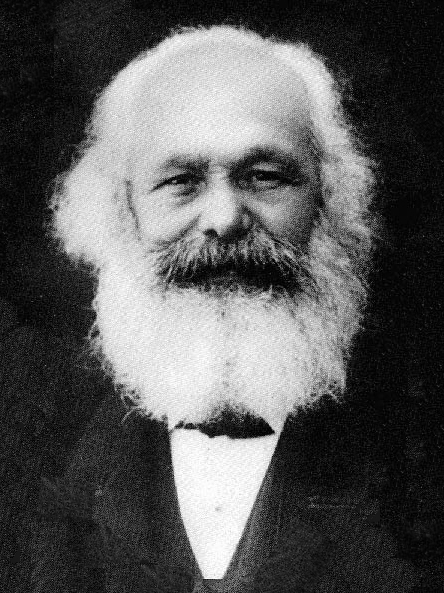
Karl Marx

Karl Marx

Never, ever, ever mention the name Marx! Americans hate that. Especially in a sermon. [See yesterdays’ “In the Footsteps of Mary“].

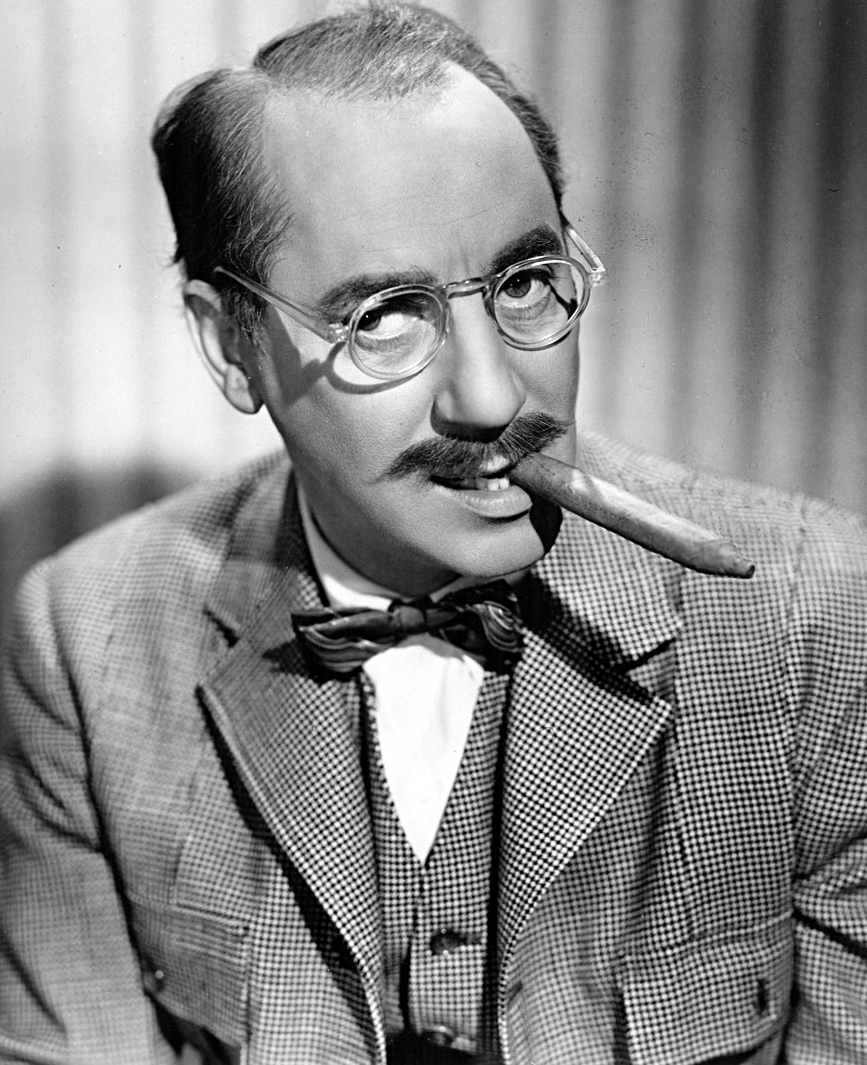
Unless it’s Groucho.

“All people are born alike – except Republicans and Democrats.” – Groucho Marx

Groucho Marx

Groucho Marx

In the Footsteps of Mary

A sermonic reflection on America today, Dec. 14, 2014.

Today’s texts speak indirectly to the national outrage over the deaths in Ferguson, Cleveland, and Staten Island and to the larger context of the economic Law – Capitalism – under which they’ve taken place.

The Spirit falls upon Isaiah

…to provide for those who mourn in Zion– to give them a garland instead of ashes, the oil of gladness instead of mourning, the mantle of praise instead of a faint spirit….They shall build up the ancient ruins, they shall raise up the former devastations; they shall repair the ruined cities, the devastations of many generations. (Is. 61:2-4)

I am in mourning. Even in the midst of Zion. Though I already taste the fruit of the Kingdom of God which is yet to come in fullness, I am in mourning. In ashes. Faint in spirit. Living among the ancient ruins, the former devastations, the ruined cities, the devastations brought on by many generations including my own.

There is anger out there. Lots of it. There are calls for justice out there. There are “die-ins” on Interstate Highways blocking traffic, interrupting business as usual. And it’s good. It’s right. It’s an American thing to do.

But, like most movements, this one will pass in a few weeks or maybe months. It will go the way of Occupy Wall Street.

For while protesters were were being hand-cuffed for “die-ins”, Congress was taking the hand-cuffs off Wall Street and the “too-big-to-fail” banks. The Dodd-Frank restrictions enacted following the 2008 meltdown were being quietly removed by hidden-away paragraphs in the down-to-the-wire spending bill. There will be no more hand-cuffs. No more probation. No more accountability to the American people. The legal limits on dealing in the “derivatives” market were being deleted on Capitol Hill, and, perhaps worse, the Dodd-Frank provision prohibiting a second government bailout was replaced by a commitment to bail them out again.

While on Capitol Hill the Law was being re-written to deliver automatic bail to Wall Street, individuals protesting law enforcement tyranny on the streets were hauled off to jail hoping a friend would bail them out.

Only within the larger economic puzzle do the various pieces begin to make sense.

For all of America’s national wealth, we are among the poorest of nations. We are a classist society bordering on a caste society. Class has always been the issue in America. Race and class have always gone hand-in-hand, but classism has other hands as well.

The wider context surrounding the law enforcement racial divide is the classism embedded in a global capitalist economic structure.

We are living still amid the “ancient” devastations brought on by rich white slave traders who captured Africans like animals for a zoo to work their plantations for profit. Racism is a class issue, an ownership issue, an issue of economic privilege, before it is anything else. The coupling of race and class is as clear now as it ever was, despite the Civil Rights Movement and the election of America’s first African American president.

Capitalism is the issue. The accumulation of wealth. The increasing concentration of wealth. The hoarding of wealth. Wealth disparity, power disparity, racial disparity, electoral disparity, legal disparity; what’s enforced and what’s not; who’s in handcuffs and who’s not; who’s bailed out and who’s not; who’s charged and who isn’t; who’s in prison for what and who’s not; who’s on probation or parole and who’s not; who’s elected to Congress and who’s not; who owns what and who doesn’t; who can pay for an election and who can’t – are all about class, the control of the means of production and capital and the expropriation of cheap labor and natural resources that can’t talk back.

Enter now into this world the psalmist of today’s readings who dared to dream of a great reversal of fortunes:

When the LORD restored the fortunes of Zion, we were like those who dream.

Then our mouth was filled with laughter, and our tongue with shouts of joy; then it was said among the nations, “The LORD has done great things for them.”

“The LORD has done great things for us, and we rejoiced.

Restore our fortunes, O LORD, like the watercourses in the Negeb.

May those who sow in tears reap with shouts of joy.

Those who go out weeping, bearing the seed for sowing, shall come home with shouts of joy, carrying their sheaves.”[Psalm 126:1-6]

The tears of weeping bear the seeds for sowing and reaping of the sheaves of the new economic order. It is no accident that the psalmist mixes the metaphors of weeping, seeds, sowing, and shouts of joy, and sheaves. It is, as it were, a vision for the Earth itself. Honest weeping is the beginning – the sowing – that leads to earthly transformation and shouts of joy.

Mary, the newly pregnant peasant girl, becomes the representative, singing her song amid the ancient devastations, announcing the hope that will engage the powers of class “to provide for those who mourn” [Is.61:1]:

My soul magnifies the Lord, and my spirit rejoices in God my Savior, for he has looked with favor on the lowliness of his servant. Surely, from now on all generations will call me blessed; for the Mighty One has done great things for me, and holy is his name. His mercy is for those who fear him from generation to generation. He has shown strength with his arm; he has scattered the proud in the thoughts of their hearts. He has brought down the powerful from their thrones, and lifted up the lowly; he has filled the hungry with good things, and sent the rich away empty. He has helped his servant Israel, in remembrance of his mercy, according to the promise he made to our ancestors, to Abraham and to his descendants forever.” [Luke 1:46b-55]

Put differently by Philip Clayton, Ingraham Professor of Theology at Claremont School of Theology, we are living

“…at the dawn of a new form of human civilization. Individuals, societies, and nations are now deciding whether to keep fighting to preserve the dying order, or whether to take leadership in building the new. It’s not a matter of waiting for more data; we already know what the old practices are doing to our planet, and we know what it takes to build a global society that is socially, economically, and environmentally sustainable. The ones who make the greatest difference are those who work and live with wisdom, with diplomacy, and with restraint, placing the good of the whole planet first.” [Philip Clayton and Justin Heinzekehr, Organic Marxism: An Alternative to Capitalism and Ecological Catastrophe, Process Century Press, 2014]

I’m still mourning. But I feel better. I know that the mourning is a holy thing, the hint of a coming “garland instead of ashes, the oil of gladness instead of mourning, the mantle of praise instead of a faint spirit” and so, I write. I pray. I sing. I mourn to the tune of Isaiah. I march to the dream of the Psalmist. I walk in the footsteps of Mary.

– Rev. Gordon C. Stewart, Honorably Retired, Views from the Edge, Third Sunday of Advent, Dec. 14, 2014.

The Funeral at the Megachurch

“Jesus, you’re the best…” he said.
His open collar showed his chest
was tan even in December.
“We just want to thank you, Lord,
for taking Joe to be with you.
We’ll miss him, but we know it’s best
for him to be in heaven.”

We sang Amazing Grace, but Joe,
it seemed, had clawed his way up high
through generous gifts to the church,
by staying married, raising kids,
and praying often. He would reach
the Golden Gates, receive the pie
in the sky. Not so, you and I.

– Steve Shoemaker, Urbana, IL, Dec. 10, 2014

Victoria’s Secret Angels

All the reports say people
who see real Angels fear them.
They blaze in glory from bringing
their message from the Holy One.
There are no descriptions
of high heels or underwear.

Steve Shoemaker, Urbana, IL, Dec. 9, 2014

EDITOR’S REFLECTION

Readers unfamiliar with Jewish and Christian Scripture may not have heard of Isaiah’s vision in the Temple (Isaiah 6:1-8) that begins his work to reform his nation:

In the year that King Uzziah died I saw the Lord [“the Holy One] sitting upon a throne, high and lifted up; and the train of his robe filled the temple. Above him stood the seraphim [“angels”]. Each had six wings: with two he covered his face, and with two he covered his feet, and with two he flew.  And one called to another and said:

“Holy, holy, holy is the Lord of hosts;
vthe whole earth is full of his glory!

And the foundations of the thresholds shook at the voice of him who called, and the house was filled with smoke. And I said:

“Woe is me! For I am lost; for I am a man of unclean lips, and I dwell in the midst of a people of unclean lips; for my eyes have seen the King, the Lord of hosts!”

Then one of the seraphim flew to me, having in his hand a burning coal that he had taken with tongs from the altar. And he touched my mouth and said: “Behold, this has touched your lips; your guilt is taken away, and your sin atoned for.”

And I heard the voice of the Lord saying, “Whom shall I send, and who will go for us?” Then I said, “Here I am! Send me.”

Good News and Hard News – Nature and Capitalism

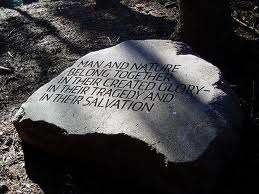
Paul Tillich quote in Tillich Park, New Harmony, IN: "Man and nature belong together in their created glory - in their tragedy and in their salvation."

Paul Tillich quote in Tillich Park, New Harmony, IN: “Man and nature belong together in their created glory – in their tragedy and in their salvation.”

A spiritual reflection for the Second Sunday of Advent, December 7, 2014.

The beginning of the GOOD news is HARD news, according to John the Baptist, calling people out into the wilderness. “We must change,” he said.  “Repent” by which the Judeo-Christian tradition means a 180 degree turn. “About face!” Only by turning will we be delivered from the consequences of the actions that have led us here.

For John the Baptist and the writer of the Gospel of Mark’s opening paragraph (Mark 1:1-8) the system at issue was Roman imperialism, an economic system centered in Rome, expanding out, and enforced by, military invasions, subjugation, religious tolerance (so long as the religious practice did not interfere with Roman prerogatives) and occupation.

One could repeat the sentence in 2014 with little change: “the system at issue [is [American] imperialism, an economic system centered in [Washington] expanding out, and enforced by, military invasions, subjugation, religious tolerance (so long as the local religious practice [does] not interfere with [American] prerogatives) and occupation.”

It is our spiritual, moral, economic, cultural and political captivity to a global system that cannot satisfy our real needs or the world’s that produces a longing in our hearts, a readiness to make the lonely trip to the wilderness.

We’re a weary people in 2014. Wearied and still disheartened 11 years after the “Shock and Awe” that took down Saddam Hussein on the pretense that he had weapons of mass destruction (WMDs) that threatened us, the Administration’s manufactured association of Saddam Hussein as the cause of 9/11. We’re wearied of lies and misrepresentations. Weary from budget fights that barely reference 10 years of un-budgeted military expenses, the loss of thousands of American soldiers’ lives and as many as 100,000 Iraqi civilians, a military venture undertaken on the assumption that the Iraqi people would welcome our presence as the beginning of democracy and a “free market” economy that would lift them all up.

That belief in the goodness of American intentions hit the rocks as quickly as Saddam’s statue hit the pavement in Baghdad. All the while we were wearied by the earlier invasion of Afghanistan, whose original justification was a quick elimination Osama bin Ladin and Al-Qaida untempered by realistic knowledge of the long history of the military interventions that mired the invaders in quagmires such as the Soviet Union found itself before leaving in defeat. To the Afghans it didn’t matter whether the troops were Soviet or American. They were the same. They were the occupation forces of an imperial power destined to fail.

In the midst of the weariness about what was happening abroad, the financial system at home took the American economy to the brink of disaster in 2008. Occupy Wall Street rose to the top of the news cycles. Although the movement fizzled over time, as such movements inevitably do, it caught the attention of television viewers, internet surfers, and newspaper and magazine readers. Occupy Wall Street and the spot light it placed on “crony capitalism” became a hot topic around water coolers at work and the table in the coffee shops.

For the first time in recent memory, capitalism was no longer sacred, no longer off limits. Time’s front cover asked the question whether Capitalism was dead. But, as with Occupy, public attention is short-lived. Amnesia sets in when people are weary. How soon we forget…until some new John the Baptist issues the cry for a 180 degree turn for the sake of something better.

Maybe Naomi Klein is edition of John the Baptist. This Changes Everything: Capitalism vs. the Climate, reviewed by the New York Times – places the over-riding systemic issue squarely before the general public again. Senator Bernie Sanders, America’s only socialist Senator who names climate action as among his four top priorities, is gaining attention as a possible presidential candidate. Elizabeth Warren, the Senate’s bulldog on holding Wall Street accountable is creating a wave of populist momentum. Put them with Bill McKibbon and 350.org and you begin to hear the echo of John’s all to the hard truth that is the beginning of the good news.

The hard truth that precedes good news is the discovery of the myth that has coupled democracy with capitalism in the American psyche, while demonizing socialism as democracy’s opposite. Ideological blinders are to nations and peoples what blinders are to horses on a race track: they limit vision to the straight-ahead narrow limits of the track. Ideological blinders prevent the owners’ horses from thoughts of anything but the track on which they’ve been placed to race each other.

But when the climate is changing our track in ways that compel our attention, and when we ask how we will make it through the changes together, the bigger question of the economic system – the race track itself – comes into view by virtue of necessity. It calls us off the track into the wilderness of Nature.

The words ‘economy’ and ‘economics’ derive from the Greek words for ‘house’ and ‘the management of the household’.  Economics not about markets, free or otherwise, or about the technicians and pundits who monitor investments and predict quarterly outcomes. It is not an academic discipline, the exclusive province of experts on Wall Street or in university Economics departments who understand how the free market works.

Economics is a spiritual perspective like the one on Paul Tillich’s marker in Tillich Park in New Harmony, Indiana. “Man and nature,” he said, “belong together in their created glory – in their tragedy and in their salvation.” There is no humanity with nature; the human calling of our time is to reshape our lives for the wellbeing of the one house in which all life lives.

During this Advent season of longing expectation, John the Baptist with his axe aimed at the root of the tree reminds us that economics is the spiritual issue of the first order. The good news is what the Hebrew Bible calls “the Day of the Lord” and John the Baptist and Jesus of Nazareth called “The Kingdom [i.e. Society] of God”. The hard news is we’ve been running on the wrong track, or, you might say, barking up the wrong tree.

The planet – this home we call “nature”, without which no person, society or form of life exists – is an economy that requires different management. The economy for which our hearts long is the one house imagined by the psalmist and announced by John in the wilderness beyond the Pax Romana: the good news awaiting our longing hearts to embrace it, a planetary home where “righteousness and peace will kiss each other” (Psalm 85:10) and wars will be no more.

The beginning of the GOOD news is HARD news. “Repent, for the kingdom of heaven is at hand.”

– Gordon C. Stewart, Chaska, MN, December 7, 2014

Father and Son – Bob and Alan

Bob Smith and his first-born child, my cousin Alan, never had what you and I would call a normal conversation. But I suspect they “talked”more deeply in their own father-son ways.

Alan’s tongue and body were held captive from birth by Cerebral Palsy. He never spoke a word that I could understand.

Each morning Alan’s mother, my Aunt Gertrude, and his father, my Uncle Bob, lifted Alan from his bed, cared for his morning needs with tender respectfulness, carried him downstairs to the kitchen for breakfast. Sitting on his father’s lap, the spoon and fork came to his mouth from the hand of his father. Uncle Bob would then carry Alan to the parlor, the back room on the first floor of the house on Porter Street, where Alan would lie until lunch. Uncle Bob came home from the Oxford County Court House for lunch every day  to be with Alan, Gertrude, and Alan’s young brother and sister, my cousins Dennis and Gwen. He would go to the den, lug Alan to the kitchen, feed him lunch…. Repeat, repeat, repeat at dinner. Carry Alan upstairs, prepare him for bed, and, as I imagine it, say a prayer that Alan could hear and understand but could not speak. He did that for 14 years.

My time with Uncle Bob and Alan dates back to my earliest years. Every summer I stayed at my uncle and aunt’s house for a week while the rest of my family stayed with my grandparents. My relationship with my cousin Dennis, only six months older than I, was special enough to separate me out for special time at the house on Porter Street.

Looking back on it now awakens me to the sense of heaviness that came over me watching Alan, seeing the joy in his eyes and the contorted smile that broke out on his face, and listening to the moans of greeting and sheer delight that came from his palsied vocal chords whenever he and I would see each other after the long year’s absences between my family’s vacations.

There was a bond deeper than words. The bond of eyes and smiles. The bond of kinship and shared joy, as well as sorrow. I always wondered what was going on in Alan’s head. Aunt Gertrude, an elementary school teacher, claimed he was very intelligent, but there was no way to measure it. Had he been born 40 years later Alan might have been a Stephen Hawking “talking” by other means, but he wasn’t. He was born in 1939. And if there was a silent bond of awkwardly expressed love between two cousins whose visits were annual, how much deeper and familiar was that bond between the father and his son?

I’ve often wondered what it was like being Alan. I’ve scolded myself in times of self-pity, and sought the deep courage and joy that emanated from Alan.

I’ve also marveled at Uncle Bob, a wrrior in the trenches, fighting despair over Alan’s plight, what might have been and would never be for him, rising to the daily-ness of it all, some days resenting it, some days wishing he could take his family of vacations like other families, some days finding comfort and courage playing a great sacred music piece on the organ of First Congregational Church of South Paris where he served as Organist and Choir Master for 40 years. Perhaps the familiar hymn tune “Serenity” set to John Greenleaf Whittier’s poem “Immortal Love, Forever Full”, encouraging the love he bore for his speechless son:

Im-mort-al Love, for-ev-er full,
For-ev-er flow-ing free,
For-ev-er shared, for-ev-er whole,
A nev-er ebb-ing sea!

The heal-ing of [Christ’s] seamless dress
Is by our beds in pain;
We touch Him in life’s throng and press,
And we are whole a-gain.

At the end of really good days when joy was high with thanksgiving for the father-son bond with Alan, I imagine him walking down Main Street to the darkened church, taking his seat on the organ bench with the lights out except for the organ light, his feet pumping the pedals, his fingers flying over the keyboards and reaching for the stops to play the Widor Toccata he played every Easter, a lush oasis “in life’s throng and press.”

Prayer in Public Schools – Letter to the Editor

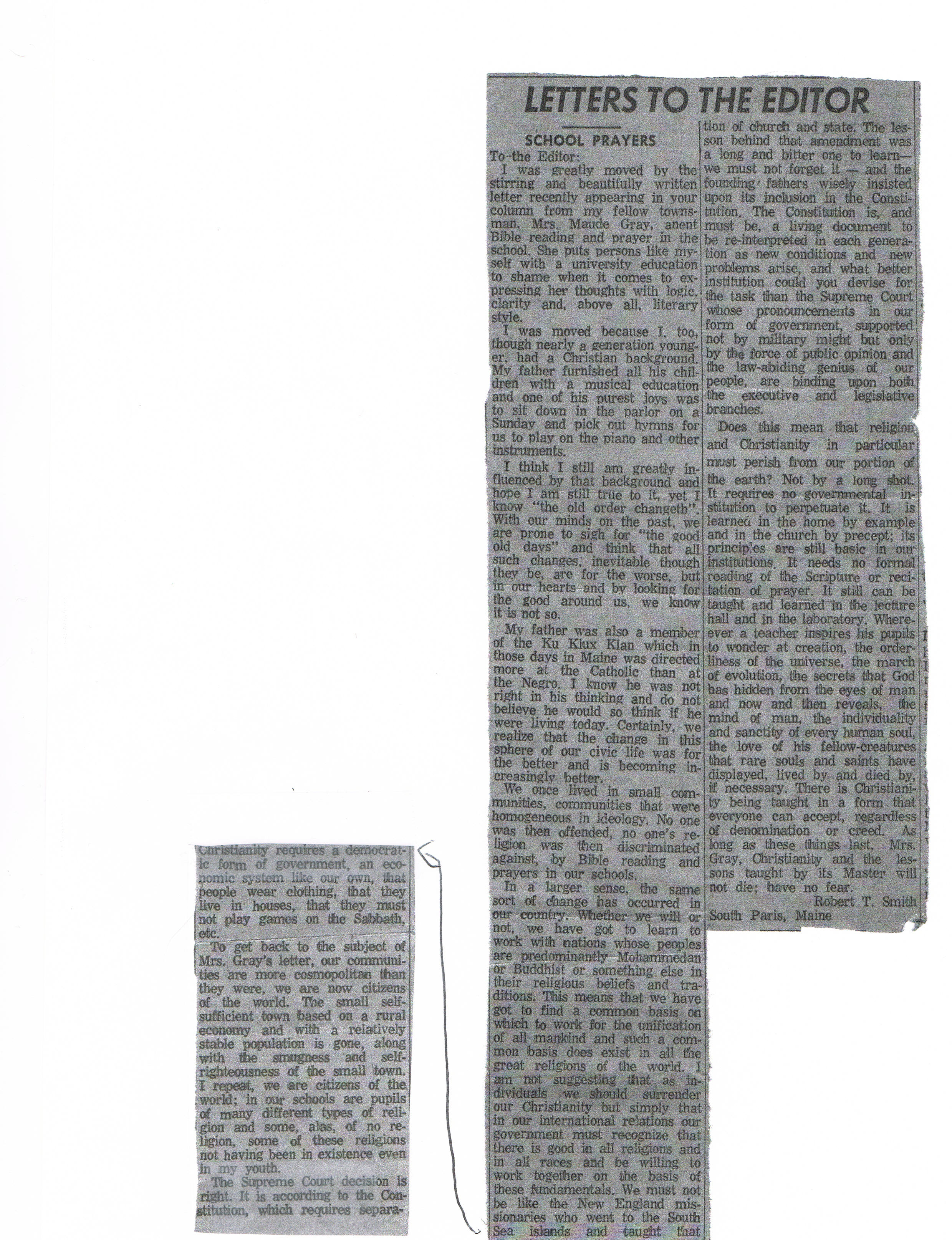
Uncle Bob's letter to the Editor - 1963

Uncle Bob’s Letter to the Editor – 1963

Does this look old? It is. Typed on a manual typewriter in 1963. Some things are worth their weight in gold. This Letter to the Editor is one of them.

Robert Smith, my Uncle Bob, sent this Letter to the Editor of the local paper in South Paris in Oxford County, the poorest county in the State of Maine.  A native of Kennebunk, Maine, he was a relative of John Smith of the legendary tale of Pocahontas, who  married my mother’s sister, Gertrude, after graduating first in his class at Harvard Law. He opened a law office in South Paris, met the love of his life and courageously raise a family: my first cousins Alan (who never spoke a word because of Cerebral Palsy), Dennis, and Gwen.

He became the District Attorney and then the Probate Judge in Oxford County. A Republican of the Nelson Rockefeller brand, he wrote his Letter to the Editor after the U.S. Supeme Court ruled that prayer in the public schools was unconstitutional. To the chagrin of many of his neighbors, he supported the Supreme Court decision.

His daughter, my cousin, Gwen, sent this to me. with a note:

“I am amazed at how ‘global’ his thinking was, especially when you think of South Paris! I couldn’t wait to get out as I saw it as being so insulated from the real world…knew there was something better out there. Dad would be drummed out of the Republican party he so strongly supported with this thinking, but all politicians could take a lesson in civility from this!”

Bob Smith died of a cerebral hemorrhage leading a congregational meeting of the First Congregational Church of South Paris where he was the President of the Congregation, Choir Master and Organist. He died the way he lived – with the courage of his convictions and a faith in Divine providence that does not depend upon or favor the tyranny of the majority.

Keep Awake – Undelivered sermon #1

KEEP AWAKE!

First Sunday in Advent, 2014
Texts: Isaiah 64:1-9
Mark 13:24-37

“And what I say to you I say to all: Keep awake.” [attributed to Jesus, Gospel of Mark 13:37].

It’s hard to stay awake in times like these. To be conscious means grief, helplessness, anger at the state of the world.

“Heaven and earth will pass away, but my words will not pass away” is supposed to bring comfort but it doesn’t, unless the heaven and earth of which Jesus speaks are the ones our pride has created. The imaginary ones. The heavenly and earthly projects that rise out of human insecurity as in the Genesis story of Babel, the story of what never was but always is, according to which the building of the ideal city is interrupted and the tower “with its top in the heavens” is “left off”.

But the word – the story about it – has not passed away. It endures. As fresh today as it was when first shared around a campfire as a way of telling each generation the respective places of God and man (humankind).

The Tower of Babel by Pieter Bruegel.

The Tower of Babel by Pieter Bruegel.

Fourteen years after the World Trade Towers collapsed in NYC, a new tower, “One World Trade Center” – taller, stronger, bolder – stands where the old towers fell on 9/11.

One World Trade Center, symbolizes a resurrection of the crashed myth. Standing a few blocks from Wall Street, where the global economy is reconstructed every day, One World Trade Center re-erects the myth of national supremacy, benign goodness, and the virtue of the American economic system. Which is different from a resurrection.

We could have left Ground Zero empty, void of monoliths and phallic symbols. We could have turned it into a plaza, a memorial to the error of pride, a turning away from global arrogance. A repentance from the economic-military-religious complex that expropriated the oil fields in the Middle East, assassinated the elected President of Iran in 1958, installed the Shah in his place, ignored the human rights of Palestinians, supported and installed western-friendly oligarchies and strong men in Saudi Arabia, Iraq (Saddam Hussein), Libya (Muammar Gaddafi), and Egypt (Hosni Mubarak) until, except for Saudi Arabia, they turned against us.

Instead of listening to the word that does not pass away, we Americans, to the sorrow of New Yorkers like Michael Kimmelman (” A Soaring Emblem of New York, and Its Upside-Down Priorities, NY Times, Nov. 29, 2014), opted for the old words and worn-out scripts that have failed us.

The Arab Spring in Libya, Egypt, and Tunisia did not do what the NeoCon exporters of Western democracy had imagined. It unleashed a seething volcano of anti-American resentment. Meanwhile, Afghanistan, Iraq, and now Syria, have become desert quagmires – Vietnams without jungles.

One World Trade Center

One World Trade Center

Eisenhower’s last speech to the nation warning of an emerging military-industrial complex is all but forgotten as One World Trade Center stands like a phoenix raised up…and up…and up from the ashes, the world’s tallest building, symbol of global dominance re-erected from the horrifying deadly collapse of 9/11.

Words and symbols are everything in this world.

As Mr. Kimmelman put,

“…[The World Trade Center Twin Towers] never really connected with the rest of Lower Manhattan. There had been talk after Sept. 11 about the World Trade Center re-development including housing, culture and retail, capitalizing on urban trends and the growing desire for a truer neighborhood, at a human scale, where the windswept plaza at the foot of the twin towers had been.”

It’s all about human scale. A plaza. Not a tower with its top in the heavens.

Staying awake is hard. Being attuned to what is not passing away takes faith. It takes hope. I takes courage. Maybe even love.

“From the fig tree learn its lesson: as soon as its branch becomes tender and puts forth its leaves, you know that summer is near.” [Mark 13:28]

Jesus often seems to have said that the word we need to hear is spoken by nature. Learn from the fig tree. It waits through the dormant season to become tender again, to put forth its leaves toward summer when it produces its sweet figs.

Nature is calling. Nature is our home. Nature is what is – the real heaven and earth – the word that will not pass away, the word that will survive when we are gone. We need to love nature again. Awaken to nature. Re-imagine ourselves as part of nature, “creatures” like all the other creatures. Our words will pass away, even the best of them. Our Creator’s word will not.

During Advent – this most puzzling of seasons, the season of wakeful, wait-ful anticipation of a Coming in fullness – I find myself crying out like Isaiah. “You have hidden your face from us, and have delivered us into the hand of our iniquity.” [Isaiah 64:7]

“O that you would tear open the heavens and come down, so that the mountains would quake at your presence—as when fire kindles brushwood and the fire causes water to boil– to make your name known to your adversaries, so that the nations [the ‘ethnoi’ in New Testament Greek, i.e.” the peoples”] might tremble at your presence!” [Isaiah 64:1-2]

The “nations” have always been God’s adversaries, closed in on themselves, puffed up, defensive against intruders foreign and domestic, plunderers of nature and other nations, hostile to the foreigner, both human and Divine.

In this season of “economic recovery” when the poor continue to get poorer, the rich get richer, and the middle class shrinks, I pray “Good Lord, deliver us, from ‘the hand of our own iniquity’. Remember, ‘O LORD, you are our Father; we are the clay, and you are our potter; we are all the work of your hand.’ [Isaiah 64:8]”

This word is the only word that lasts.

Stay awake, my soul. Stay awake to the whole of it, all of it – the sorrow and the grief of it, the loneliness of it, the anger in it, the guilt of it, the finger pointing out and away and the finger pointing back at me, a nation to myself, and the presence of the Potter – and my soul will be well.