
Religion and the White House

Gordon C. Stewart          Feb. 14, 2012
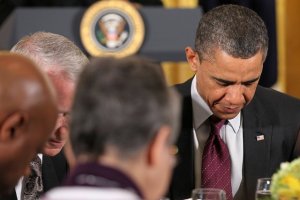
Is the religion of presidential candidates off limits?

President Obama’s remarks at the 2012 National Prayer Breakfast and Mitt Romney’s statement about the poor and the wealthy resurrect a question regarded since 1960 as off the table.

The religious issue in 1960 was the Roman Catholicism of John Fitzgerald Kennedy. No Roman Catholic had ever been elected President. The question was whether a faithful Catholic would be subservient to the Bishop of Rome, the Pope, in matters of state. Finally the question was put to Kennedy himself.

Since that time, with the exception of conservative fundamentalist Christians, American culture has increasingly accepted the separation of one’s religion from one’s politics. Religious faith is regarded as private; political beliefs are public.

The old adage that the way to best assure civil tranquility is to steer clear of religion, sex, and politics is good advice at family reunions and the like, but does it serve the public interests of an informed electorate in a democratic republic?

It should not go unnoticed that then-candidate Obama’s faith was brought into the national spotlight when his political opposition sought to paint Mr. Obama as un-American because of comments made by pastor Jeremiah Wright.

The unspoken journalistic rule that “religion is off-the-table” was set aside by ABC’s investigative reporting into 500 hours of sermon tapes by Mr. Obama’s pastor and its decision to air a one-minute excerpt from one of Mr. Wright’s sermons.

It made no difference that the sermon from which the excerpt came was biblically-based and in the bold African-American preaching tradition of Sojourner Truth, Dr. Martin Luther King, Jr., and Howard Thurman that thunders the Hebrew prophet’s voice in scripture as it apply to today’s news. Nor did it matter that the statement about the chicken’s coming home to roost on 9/11 came after a long recitation of the history of American violence at home and abroad. Mr. Obama’s religion was on the table.

The public wanted to know. Was the President a Christian? Or was he, as some of his opponents claimed or insinuated, a Marxist, a secret Muslim, or un-American?

Mr. Obama eventually denounced the excerpt from Rev. Wright’s sermon, resigned from the church, and used the controversy to spell out his own views in a brilliant speech in Philadelphia on race in America called “A More Perfect Union.”

So here we are in 2012.

Mitt Romney is a member of the Church of Jesus Christ of the Latter Day Saints (LDS), a Mormon. His statement about the very poor, the middle class, and the wealthy became the center of media controversy. “I’m in this race, he told CNN following his primary victory in Florida, “because I care about Americans. I’m not concerned about the very poor. We have a safety net there. If it needs repair, I’ll fix it. I’m not concerned about the very rich, they’re doing just fine. I’m concerned about the very heart of America, the  90-95 percent of Americans who right now are struggling.” To be fair, his statement, like the Rev. Wright’s ignoried his earlier remarks. Nevertheless, the statement deserved careful scrutiny.

At the same time, President Obama’s religion was in the news again because of heavy criticism for connecting his faith with his public policies at the 2012 National Prayer Breakfast  where he described his motivation as “living by the principle that we are our brother’s keeper. Caring for the poor and those in need.”  “These values,” he said, “they’re the ones that have defined my own faith journey.”

In doing so, Mr. Obama voiced a conviction central to the Judeo-Christian tradition. The belief goes to the heart of the Christian faith – the Golden Rule: “Do unto others as you would have them do unto you” and Jesus’ parable of the Last Judgment in which Jesus tells his listeners that, if they want to know where to find “the Son of Man,” they will find him among the poor and destitute (Matthew 25:31-4.).”Insofar as you have done it to one of the least of these, you have done it to me.”

Mr. Obama’s view came under attack from a number of quarters. One response came in the Washington Times with the headline “President Obama misrepresents the teachings of Jesus at National Prayer Breakfast,” arguing that “Jesus did not teach that wealthy people should give more money to the government or charity than others should.” And on CNN on-line, the public comments re: the President’s position ran heavily against his view.

At the same time, Mitt Romney’s stock was rising. So is his religion. Years ago Leo Tolstoy asked the American Ambassador to Russia about the new religion in America, the Ambassador pleaded ignorance, Tolstoy described Mormonism as “the quintessentially American religion” that would one day catch fire and be unstoppable.

Is religion on the table or off the table in 2012? If it’s on the table for discussion, as in Mr. Obama’s Prayer Breakfast statement, the question about the “quintessentially American religion” should also be on the table. How would Mr. Romney’s religious views affect his public policy decisions? What difference would it make to his conduct of foreign policy that his religion is American-centric, believing that “Christ  appeared in the western hemisphere between his resurrection and ascension to heaven; that the State of Missouri is the site of the Garden of Eden as well as the site where Jesus will return at the Second Coming? “For this and other reasons, including a belief by many Mormons in American exceptionalism, Molly Worthen speculates that this may be why Leo Tolstoy described Mormonism as the “quintessential ‘American religion'” (Wikipedia).

One does not need to be a partisan opponent or a despiser of religion to ask whether a candidate for the Presidency believes that America is sacred, God’s chosen people, and if so, what the implications are for how he would use American power and influence in a world that is always just one step away from nuclear holocaust.

It was the pernicious idea of American exemption from the way of the nations that got us into Iraq, and it is the rejection of that idea that has allowed us to begin to pull back into a more humble and realistic way of being America. The idea of American exceptionalism is widespread across party and religious lines in America, and, most sadly, an electorate that fears the future may fall for whichever candidate continues the illusion that America is God.

If I could ask one question to those who aspire to the White House, I would ask them to reflect, line by line, on the Clifford Bax’s hymn (1919):

Turn back, O man, forswear thy foolish ways.
Old now is earth, and none may count her days.
Yet thou, her child, whose head is crowned with flame,
Still wilt not hear thine inner God proclaim,
“Turn back, O man, forswear thy foolish ways.”

Earth might be fair, and all men glad and wise.
Age after age their tragic empires rise,
Built while they dream, and in that dreaming weep:
Would man but wake from out his haunted sleep,
Earth might be fair and all men glad and wise.

Earth shall be fair, and all her people one:
Nor till that hour shall God’s whole will be done.
Now, even now, once more from earth to sky,
Peals forth in joy man’s old undaunted cry—
“Earth shall be fair, and all her folk be one!”

Melody from The Genevan Psalter


“It’s not easy being real”

Last night I listened to President Obama’s speech on contraception and religion institutionso courtesy of Unedited Politics. I then looked to see if there were comments. There was only one:

“This has nothing to do with so called women’s health, it’s Marxism 101.”

With no elaboration as to how or why the President’s speech or position on women’s health care, on the one hand, and religious liberty, on the other, was Marxism 101, the comment accomplished what such comments nearly always do, until they are challenged. It called someone by a name. End of discussion. No need to explain how or why it’s Marxism. “Bad! Boogie Man! Evil in the White House!! The Marxists are out to get us!”? So I wrote my own comment:

Oh, my! Dear friend, whoever you are, you must never have taken Marxism 101. This isn’t Marxism. It’s the work of a democratic republic – messy, balancing values that sometimes conflict with each other, protecting the rights of the minority against the tyranny of the majority, and guaranteeing equal protection (in this case, health coverage) to all citizens. It’s comments like this – confusing a health care position with Marxism (i.e. communism?) – that divert the discussion and take us back to the darkest time of American history, the Senate Hearings of Sen. Joseph McCarthy that painted decent, patriotic Americans as evil. The President is NOT a Marxist, my friend. Time to rescind the comment for the sake of civil discussion that helps to solve real problems.

The reply came soon after:

Try reading his books and consider the fact that he attended a Marxist church for 20 years.

Again, I replied:

I’ve read Marx. I spent the summer of 1966 in Bratislava, Czechoslovakia as the Chicago Ambassador of the Experiment in International Living. I lived with the Schulz family, all members of the Communist Party. Marxism is more than a figment of my imagination. And the church Obama attended is a CHRISTIAN Church, United Church of Christ, one of America’s historic “mainline” denominations. ABC watched 500 sermon videos and chose to air a one-minute clip from a sermon on one of the Hebrew prophets that led viewers to conclude Jeremiah Wright was a communist. Radical? Yes. Off the wall? Sometimes. But Marxist (i.e. not Christian, not a disciple of the Jesus who turned over the money-changers tables)? No. And to talk about this President as a Marxist is…go back and watch Joe Welsh’s final rebuke to the character assassination campaign of Sen. Joe McCarthy: “Have you no decency, Sir. Have you no decency left?” Please think twice before raising McCarthy’s ghost. It’s ugly.

In 1966 I was certain that my finalist interview with the selection committee of the Chicago Chapter of the Experiment in International Living had disqualified me as a candidate as Chicago Ambassador to Czechoslovakia for the summer of ’66.

“You’re a Christian and a seminarian, asked Paul Harvey. “Why would you want to go to a communist country?”  I responded at some length that I didn’t trust the stereotypical representations of Eastern Bloc countries any more than I would trust their representations of the West. I felt there was propoganda on both sides of the Cold War. I wanted to see for myself.   I also told them that there was a theologian in Czechoslovakia named Josef Hromadka, the father of Christian-Marxist dialogue. I had been reading Hromadka and others and wanted to participate in this discussion. I believed that the Marxist classless society was a rendition of the central biblical message of the Kingdom of God. I came out of the interview and said to another candidate, “Well, I just eliminated myself. Hope you have a great summer.”

To my surprise, they selected me. The generosity of Pan Schultz and Pani Schultzova, their son Vlado and daughter Jana who welcomed me like a member of their own family, conversations with students about Franz Kafka and the existentialists at the university coffee shop, and the ugliness of fellow-American Ambassadors (there were 11 of us) who insisted on ice cubes in their drinks combined to further open the aperture of my camera lens as I look at the world.

I decided long ago not to keep silent when the labels like “Marxism 101” march across the field of my camera. My experience is only mine, but it’s the only experience I have, and God knows how limited it is. But, I decided to to heed Frederich Buechner  counsel – “Listen to your life”, he wrote – and to speak out loud what I see and hear, hoping and praying, as I do every Sunday morning before I dare to preach, that in some inscrutable way, “the words of my mouth and the meditations of all of our hearts will be pleasing in Thy sight, O Lord, our Rock and our Redeemer.”  I’d love to hear your meditations. Leave comment to share.

“Say the word ‘freedom'”

When the political campaigns speak of ‘freedom,’ listen with care

Gordon C. Stewart, published By MPR, aired on “All Things Considered”, August 31, 2011 Click LISTEN to hear the commentary on Minnesota Publc Radio.

My hearing continues to get worse. In the sound-proof booth of the hearing test, the audiologist asks me to repeat the words I hear…

“Say the word ‘good’.”

“Wood.”

“Say the word ‘cold’.”

“Hold.”

“Say the word ‘gold’.”

“Goal.”

It’s not easy inheriting my mother’s hearing loss. Getting the words wrong often separates me from normal conversation.

But it also has its advantages. I listen more carefully, and the world of silence brings me to a deeper reflection about the words we hear every day.

I’ve begun to listen more carefully when the word “freedom” is used.

“Say the word ‘free.'”

“Free,” we say. And something deep within us hears the national anthem: Land of the free, and the home of the brave.

We Americans love freedom.

Future anthropologists will likely observe that freedom was the most treasured word in the American vocabulary. It is the most powerful word in our language.

No one understands this better than the handlers of political candidates. They know that the word evokes an unspoken reverence, and that perceived threats to freedom alarm us and cause us to get back in the ranks of freedom’s faithful. They know the nature of language and of word association.

“Say the word ‘freedom’,” they say.

“Democracy.”

“Say the word ‘regulation’.”

“Socialist.”

“Say the word ‘socialist’.”

“Un-American.”

“Say the word ‘government’.”

“Enemy.”

“Say the word ‘American’.”

“Free.”

Freedom stands alone in the American pantheon.

Ironically, in the hands of the unscrupulous, the word we associate with individual liberty can cause a collective stampede. It calls us from grazing freely in the pasture to joining a mindless herd.

We don’t like heresy; we’re afraid of being heretics.

My hearing will continue to get worse. It will take me into a world of increasing silence. In a way, I wish the same for the rest of my countrymen. We could all use some time away from the word-association games.

When we hear the word “freedom,” we should be free to listen carefully and understand it for ourselves.

The American Dream on the Ropes

Gordon C. Stewart | MinnPost.com, Wednesday, March 16, 2011

“Sometimes I feel like a motherless child.” The homeland I mourn is the world I once thought I knew. It was far from a perfect world, by any measure, but its ideals seemed intact. There was set of shared expectations of fairness, some measure of equality, the vision of a more just and peaceful world freed from poverty, oppression and war.

Today that world is as much of a memory as my boyhood home. Something has died. The American dream is rising in Egypt, in Tunisia, and across the Arab world, but it is on the ropes here in America. The cry for democracy, basic human rights, and an end to Mubarak’s self-serving economy has its echo in Madison, Wis., where workers have stood tall for the right of collective bargaining. But not tall enough to stop the turning back of the clock. Nor are they bold enough to strike, as unions would have in my youth.

All across America the hard-earned gains of the labor movement are being painted as evil, yet not a single person on Wall Street has gone to jail for the fraudulent, greedy schemes that brought the American economy to its knees in September-October, 2008. Not one. The idea of democratic rule — the rule of ordinary, hard-working people — has been high-jacked by a ruling class that has no shame while it takes home most of the cookies. It pays little or no taxes, cries foul about spending, raids the Social Security Trust Fund to pay for its wars, blames the deficit on liberal social programs, and leaves the crumbs from its budget-cutting for the rest of us to fight over.

The Soviet Union was feared

My generation’s formative years during the Truman and Eisenhower administrations had us ducking under our school desks in preparation for a nuclear bomb that was sure to drop on my little town outside of Philadelphia. The U.S.S.R. was the enemy and was out to get us. “Getting us” would mean, we thought, an end to democracy, an end to freedom.

Never did it occur to us that the end of democracy and freedom would come from what President Dwight Eisenhower later warned of: the American military-industrial complex that would usurp the people’s right to rule themselves. Never would it have occurred to us that a U.S. Supreme Court would rule that corporations are “persons” when it comes to the electoral process — people just like us free to spend the money none of the rest of us “persons” has to buy an election.

Sunday mornings after church I remember turning on the religious show that featured Oral Roberts ranting and raving and waving and “healing” his bizarre church in Oklahoma City — thinking that this must be some kind of joke. What was bizarre then has become mainstream today. Michele Bachmann, whose law degree comes from Oral Roberts University Bible-based O.W. Coburn School of Law (now defunct) and Sarah Palin, whose church makes Oral Roberts look temperate, would have been laughed off the stage when I was a kid. Today they own the stage, and their Annie Oakley, winner-take-all politics and economics set the agenda — not only in Minnesota and Alaska, but in Wisconsin and in Washington, D.C. Patriotism has become a white fundamentalist Christian packing a semi-automatic on the lookout for the same people Sen. Joseph McCarthy hunted down in the early ’50s.

I remember Joe McCarthy. I didn’t like him then. I don’t like him now. And I don’t like those who imitate him wearing lipstick on their beauty-queen faces and have the gall to call the president of the United States “un-American.”  We no longer need a House Un-American Activities Committee to conduct our witch hunts. The verdicts are rendered ad hoc by demagogic politicians with law degrees from a law school founded by Oral Roberts that lasted only seven years before closing its doors.

Americans want ‘real’ people as leaders

Who needs Harvard, Yale, Princeton, the University of Minnesota, the University of Wisconsin, the University of Michigan or Notre Dame?  We want our elected leaders to be “real” people untainted by elitist educations. And we want them to tell us that “taxes” — the word that once upon a time stood for my share of personal responsibility for America’s infrastructures, values, financial security and national defense — are greedy government conspiracies to rob our us of what is rightfully ours.

“Sometimes I feel like a motherless child a long way from home,” sang the African-American slaves picking cotton out in the fields. Some who sang the songs were children who had been separated from their mothers and families as prize chattel on the slave blocks. Others sang it mourning their African homeland. Sometimes “home” stood for heavenly release from the terror of the plantation. The mournful tones from the cotton fields echoed off the walls of the plantation owners’ mansions. The owners considered their work force part of their plantation American Way of Life, while the enslaved workers sang of a different homeland right under their masters’ noses.

I have not been stolen away. But the sense of grief, anger and sadness could not be more real. My mother has died. My country has been stolen. “Come, my brother, come my sister, a long way from home.”

Sorrow Floats: the Healthy Deregulated Capitalism Myth Just Keeps Re-surfacing

Gordon C. Stewart | Thursday, Sept. 10, 2009MinnPost.com

“Sorrow floats.” Perhaps the line from a John Irving novel — in which “Sorrow,” the stuffed family dog preserved by a taxidermist, floats to the surface of the lake after a plane crash — helps explain what is happening in America.

Something dear to the American family died one year ago last September-October. Prior to the series of chilling events of that period, most of us had lived with the illusion of relative economic and financial health. Then Sorrow was rushed to the emergency room for government resuscitation.

Since then our memories of that pre-September 2008 world have taken a turn that families often take at funerals when the eulogies bear little resemblance to the reality of the deceased. We’re quarreling over what was real and what is mythical reconstruction.

Following the plane wreck that takes the lives of the Berry family parents in Irving’s “The Hotel New Hampshire,” the stuffed family pet bobs to the surface of the lake, floating among the wreckage. Sorrow floats. So does the thing we lost last fall.

What died? A ruling assumption

What died last year was the ruling assumption that an unregulated free-market system was the best way to organize an economy and that laissez-faire capitalism is democracy’s natural ally. The market almost crashed. It didn’t crash only because the federal government intervened to prevent a repeat of the crash of 1929. Sometime between mid-September and Oct. 7, when Congress passed its bill to stabilize the financial markets, the myth of the virtue of deregulated capitalism died. It was stuffed by the taxidermy of government intervention, but it still floats.

When a conviction or a myth dies, it doesn’t go away. It continues to bob to the surface. Sometimes, as in the case of the Berry family, the old dog is much easier to love after it is dead. Sorrow — obese, lethargic, and persistently flatulent in its old age — no longer waddles through the dining room to foul the air and ruin everyone’s dinner. In the public psyche, the unpleasant memories of the real life Sorrow give way to the stuffed Sorrow, a thing of nostalgia that lives on … even after it’s dead, and long after the plane has crashed.

Over and over, we forget

Sorrow and its old illusions float every time the reconstructed memory, forgetting the real Sorrow, barks about “socialism.” Sorrow floats every time we shout each other down in town-hall meetings. Sorrow floats every time nostalgia forgets that it was only by government intervention that Sorrow is still around. Sorrow floats every time we forget the voracious appetite, unscrupulous predatory practices, insatiable greed, and the obesity that led to the deaths of Lehmann Brothers, Merrill Lynch and Bear Stearns, not to mention insurance giant AIG and all the banks that had taken the plunge into a market of deregulated derivatives and mortgages that led to the epidemic of home foreclosures, bankruptcies, pension-fund collapses and job losses. Sorrow, the old dog that failed us, still floats and still barks a year after the crash when the mind forgets and nostalgically remembers a system we thought was working in our interest.

Old ideas and convictions die hard. The powerful economic forces that grew fat during the years when government was viewed as the people’s enemy will stoke the fires of public anxiety and anger, taking advantage of the floating Sorrow that reminds us of something that we love more in retrospect than we did the day it died of its own obesity.

The Rev. Gordon C. Stewart is pastor of Shepherd of the Hill Presbyterian Church in Chaska. He is the moderator of Shepherd of the Hill Dialogues and former executive director of the Legal Rights Center. The views expressed in this article are his own and do not represent the views of anyone else.

Deadly Political Rhetoric

When Political Rhetoric Brings Out the Worst in Us

by Gordon C. Stewart, March 29, 2010

Click the title for full commentary published by Minnesota Public Radio) Here are some Excerpts (Opening and closing paragraphs):

Our nation is being poisoned by inflammatory rhetoric from both sides of the political aisle. How else does one explain the sending of a used condom to a Minnesota congresswoman, or the phone message left on  Rep. Keith Ellison’s answering machine: “Timothy McVeigh said dead government workers are good government workers.  Goodbye, Sambo”? And that’s just here in Minnesota….


 Where are the likes of Edward R. Murrow and Joseph Welsh now? We need them again.
Yesterday’s post “The Gospel and the Chicken Coop” (scroll down) quotes from President Dwight Eisenhower’s Farewell Address. This morning Unedited Politics, a blog dedicated to respecting viewers’ ability to draw their own conclusions (no punditry on this blog), posted the speech.

A Journey of Faith into Economics

 – Gordon C. Stewart Feb. 12, 2012

North Philadelphia street scene

Where I grew up Karl Marx was the enemy of all that was good and true. The United States and the Soviet Union were in a dead heat in the Cold War between the Christian and capitalist West, and the atheistic, Communist East. In elementary school we dove under our desks during air raid drills to prepare us for the atomic bomb that would be dropped on Broomall, Pennsylvania, population 1,000. We began the school day reciting the Pledge of Allegiance – “one nation under God” – and a prayer that asked for God’s blessing. In World War II our fathers had beaten back the evil of Nazism. Now, evil was threatening once again from fascism’s opposite, godless Communism. It was either us or them.

It took a while before I asked about the coupling of Christian faith and capitalism or read Marx himself. To read him or to entertain the idea of a classless society was heretical treason, or treasonable heresy. Church and nation were two sides of the same thing. But the more I recited the Pledge of Allegiance, went to worship and youth group,  and became acquainted with the poverty of north Philadelphia, I began to realize that “freedom and justice for all” was, at best, an aspiration, not a fact.  At worst, it was a compelling myth that allowed us to think of ourselves as the chosen whose job was to eliminate evil from a fallen world.

Two summers working as a street worker for the Presbytery of Philadelphia in the poorest neighborhoods rattled my world and shook me to my knees. Every Monday through Friday during the summers of 1961 and ’62, I traveled an hour-and-a-half by bus and subway from my suburban home in Broomall to north Philadelphia and back trying to make some sense of these two very different worlds. How and why did they exist – one white; one black? One materially satisfied; one not? Martin Luther King, Jr. and the civil rights movement were answering that it was because of  the politics and economics of white privilege.

When I read the work of Willem Zuurdeeg, a Dutch philosopher of religion who grew up as part of the underground resistance during World War II, I found the philosophical mind that looked below the surface to the deeper convictions that hold our hearts and minds captive. The rest of the story is too long to tell.

Capitalism, like Communism, is an idol manufactured by the human heart, one of the convictions, often unexamined, that vie for our worship and allegiance. No economic system is now, or ever will be, perfect. Its efficacy and utility are to be judged by what it does to the people who live under its mindset and institutions.  Today, I hear strident voices that sound like the voice of the late Senator Joe McCarthy who turned over the tables looking for America’s internal enemies. I would like it to be said when I am gone that I honored the memories of Edward R. Murrow whose courageous reporting exposed McCarthyism, and of Joseph Walsh, the attorney for the Army who spoke aloud the words that brought an end to the power of the McCarthy Hearings to destroy decent, dissenting American citizens: “Have you no decency, Sir? Have you no decency left?”

Ours is a later time. The issues of our day are complex. But underneath the debates, the “us against them” mindset of World War II and the Cold War is no less alive than it was then. However and wherever McCarthy’s eyes flash while his finger points and his voice rises again, those of us who hear a Deeper Voice must not be silent. The Deeper Voice is the “still small Voice” of conscience and dissent.

The Gospel and the Chicken Coop

The Gospel and the Chicken Coop – The Chaska Herald, March  06, 2009

Gordon C. Stewart

For too long the foxes have run the chicken coop, and, when the rightful  owner decides to take back the chicken coop, the foxes aren’t happy.

The warning came in President Dwight D. Eisenhower Final Address to the nation  way back in 1961. Add the rapacious practices of financial institutions to his  military-industrial complex, and his words hold up a mirror for where we are  today: “The total influence [of the new military-industrial complex] – economic, political, even spiritual – is felt in every city, every state house,  every office of the federal government.

Read more:  Chaska Herald – Perspectives The gospel and the chicken coop

How a single voice threatened to set the world on fire

Minnestota Public Radio (MPR, 91.1 FM) published this commentary after a Florida pastor threatened to burn the Quran. Some things don’t seem to change.

– Gordon C. Stewart, September 28, 2010

Everyone from time to time feels insignificant. As I did, while watching fires burn across the world, lit by the words of one pastor in Florida. I felt like a spectator in the stands watching the game I care about go terribly wrong, a hostage of verbal terrorism uttered in the name of Christ.

I would imagine that the Rev. Terry Jones and his small congregation also had felt insignificant before they announced the 9/11 Quran burning, and that they were stunned when their pastor’s voice, although terribly misguided, lit the forest on fire without ever burning a Quran.  One of their own, one who had felt insignificant, had raised his voice and now had the ear of a commanding general, the secretary of defense and the president of the United States.

The difference between the Rev. Jones and most people is that he has a pulpit.  On any given Sunday he speaks and a few people actually listen.  Most of us do our ranting and raving in the shower, at the water cooler or with like-minded people at the coffee shop, but we don’t much expect anyone to listen.

But as the Jones story developed, those of us with pulpits were feeling no less beside the point.  Then, as I prepared for worship, I was drawn by some old lines about spiritual arson. “Consider what a great forest is set on fire by a small spark. The tongue is a fire … a restless evil, full of deadly poison” and “the seeds of righteousness are sown in peace by those who make peace” (Letter of James 3).

The thought crossed my mind: We could invite a Muslim friend to join me in the pulpit, perhaps my neighbor Muhammad or Abdi or one of their children, whom I meet daily while walking the dogs.  I decided to invite Ghafar Lakanwal, a Pashtun Afghan-American cultural diversity trainer, a Muslim and naturalized U.S. citizen, to bring greetings of peace and share some passages about peacemaking from the Quran in our Sunday worship on 9/12.

Our little church in Chaska welcomed Ghafar, and his words about the spiritual “obligation to learn, not burn” still ring in our ears. Our service drew media attention, and Ghafar’s words were heard on the evening news  and noticed by a stranger in Australia, who sent a message through the church website. “I was touched,” he wrote, “when I read about your recent Sunday service in the news. …  I for one can testify that it has certainly comforted a far away Muslim to know that there are neighbors who will stand together in difficult times.  My salaam [to you].  May we all grow together to attain Allah’s pleasure.”

“Ah!” someone will say. How can any Christian rejoice when the author uses the name “Allah” for God?  But the reaction to the “name” is misbegotten.  It is not the name of God; it’s the Arabic word for what we in English call God.   The forest fire lit in defense of “God” in advance of the anniversary of 9/11 reminds us that two kinds of religion potentially exist everywhere people gather to practice their faith. One kind burns. The other kind learns.  One hates; the other loves.

As James, writing to those who would follow Jesus, put it: “With [the tongue] we bless the Lord and Father, and with it we curse those who are made in the likeness of God. From the same mouth come blessing and cursing. My brothers and sisters, this ought not to be so” (James 3:9-10).  We can set the forest ablaze with our small spark or we can use it to light a candle of hope and peace. But, after the events of this month, none of us can again think that what we say is insignificant.

I would imagine that the Rev. Terry Jones and his small congregation also had felt insignificant before they announced the 9/11 Quran burning, and that they were stunned when their pastor’s voice, although terribly misguided, lit the forest on fire without ever burning a Quran.  One of their own, one who had felt insignificant, had raised his voice and now had the ear of a commanding general, the secretary of defense and the president of the United States.

The difference between the Rev. Jones and most people is that he has a pulpit.  On any given Sunday he speaks and a few people actually listen.  Most of us do our ranting and raving in the shower, at the water cooler or with like-minded people at the coffee shop, but we don’t much expect anyone to listen.

But as the Jones story developed, those of us with pulpits were feeling no less beside the point.  Then, as I prepared for worship, I was drawn by some old lines about spiritual arson. “Consider what a great forest is set on fire by a small spark. The tongue is a fire … a restless evil, full of deadly poison” and “the seeds of righteousness are sown in peace by those who make peace” (Letter of James 3).

The thought crossed my mind: We could invite a Muslim friend to join me in the pulpit, perhaps my neighbor Muhammad or Abdi or one of their children, whom I meet daily while walking the dogs.  I decided to invite Ghafar Lakanwal, a Pashtun Afghan-American cultural diversity trainer, a Muslim and naturalized U.S. citizen, to bring greetings of peace and share some passages about peacemaking from the Quran in our Sunday worship on 9/12.

Our little church in Chaska welcomed Ghafar, and his words about the spiritual “obligation to learn, not burn” still ring in our ears. Our service drew media attention, and Ghafar’s words were aired on the evening news and heard by a stranger in Australia, who sent a message through the church website. “I was touched,” he wrote, “when I read about your recent Sunday service in the news. …  I for one can testify that it has certainly comforted a far away Muslim to know that there are neighbors who will stand together in difficult times.  My salaam [to you].  May we all grow together to attain Allah’s pleasure.”

“Ah!” someone will say. How can any Christian rejoice when the author uses the name “Allah” for God?  But the reaction to the “name” is misbegotten.  It is not the name of God; it’s the Arabic word for what we in English call God.   The forest fire lit in defense of “God” in advance of the anniversary of 9/11 reminds us that two kinds of religion potentially exist everywhere people gather to practice their faith. One kind burns. The other kind learns.  One hates; the other loves.

As James, writing to those who would follow Jesus, put it: “With [the tongue] we bless the Lord and Father, and with it we curse those who are made in the likeness of God. From the same mouth come blessing and cursing. My brothers and sisters, this ought not to be so” (James 3:9-10).  We can set the forest ablaze with our small spark or we can use it to light a candle of hope and peace. But, after the events of this month, none of us can again think that what we say is insignificant.