Click During campaign season, maintaining serenity is a good trick to read last Friday’s guest commentary published by MPR. The commentary will also air on All Things Considered, “the most listened-to, afternoon drive-time, news radio program in the country”.
Category Archives: Politics
Capture the Flag
Long before I got hooked on Facebook, my childhood friends and I used to play outside until it got dark. Capture the Flag was our favorite game.If you had the flag, your job was to keep it; if you didn’t, your job was to capture it. Only one person had the flag; the rest of us worked together until one of us got it. And when one of us did, the game started over again.
Even if you hadn’t captured the flag that night, you went home knowing that tomorrow you had another chance. Nothing was forever in the game of Capture the Flag.
We were learning how the game of democracy is played. We were learning how to win and how to lose. We were learning the importance of continuing to play the game because no one knew how things would turn out the next night before our Moms called us home at bedtime.
All these years later, we’re playing Capture the Flag on Facebook. Some of us are Democrats. Some are Republicans. Some are Libertarians. Some are Socialists. Some of us are Cynics who’ve decided that the game is stacked and that no matter how hard they try to capture the flag for what they believe in, the same bullies always win.
When we played the game as kids, there was a nearly level playing field. The slowest of us had less of a chance than the fastest, but even the slowest and the smallest had a shot, if we worked together to capture the flag.
It’s not that different now, except that the bullies have money the rest of us don’t have. They’ve also learned how to divert our attention. Well-funded mind-bending scare tactics seek to convince voters that the flag has actually been in our pocket and that we, not they, are losing control of our country if health care reform, action on climate change, and reigning in Wall Street are the results of the November election.
It’s time to go out to the backyard and play the game again. Time to stand up together to reign in Wall Street and the U.S. Chamber of Commerce and to tell our friends in the Tea Party that deregulated, laissez-faire capitalism will serve only the fittest, not the many. Time to snatch the Stars and Stripes out of the deep pocket of the bullies who paint themselves as America’s last, best hope. No one gets to keep the flag in the United States of America.
How to handle a heckler: Romney and Obama
Yesterday Unedited Politics re-posted this video of a would-be president.
It led me to this post of the President Obama handling a heckling reporter at the White House.
Now that you’ve seen them, notice the difference in the summary headings over the two videos. “Mitt Romney heckled by.…” focuses only the heckler, not on the candidate’s response. It evokes sympathy for Mr. Romney. “President scolds reporter….” elicits sympathy for the heckler. Language frames perception.
But the video-tapes tell a different story, no matter what the words say. The tapes tell the story of the character and style of Mr. Romney and the President and the way they handle a rude opponent.
How do you describe the difference? What qualities of character and style do you want in the Oval Office next January? Leave your comment here.
This hour in history….
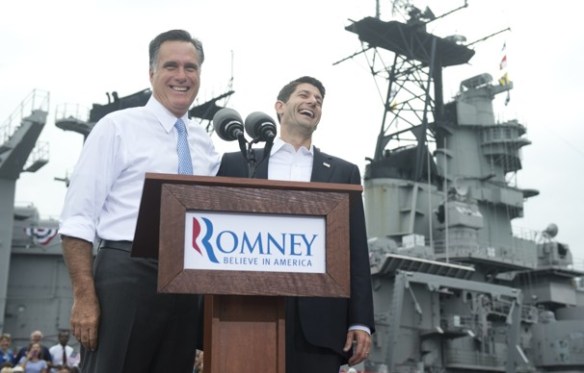
Romney-Ryan: Day One
“Romney announced his selection in dramatic fashion Saturday morning, with each
man stepping down the deck of the USS Wisconsin — a World War II-era battle ship
named for Ryan’s home state — to the soundtrack of the movie ‘Air Force One.’
– Washington Post
World War II? A battleship? Doesn’t that say it all? “Air Force One” – a film about a President who defeats a terrorist (Obama, perhaps?). Makes a grown man want to cry!
The Copper Collar
Its my 70th birthday. I get to say whatever I want…flat out. I’m too old a dog to worry. 🙂
America is on the leash…in the collar of Big Money.
Free speech is a basic right in America. But some of us are freer than others. Because the Supreme Court has ruled that money is speech. Some of us have lots of it. Most of us have a buck or two to support candidates for public office.
Montanans once referred to “the copper collar” worn by elected officials (federal, state and local), policy-makers, newspaper publishers and editors, journalists, business people, asnd relgious leaders. The copper collar kept them on the leash of the state’s largest employer and wealthiest campaign contributor, Anaconda Copper Mining Company. Montana was one big company town.
Step in a direction Anaconda didn’t like, and you’d feel a quick tug on the leash – a phone call, a note, a pink slip, or worse. Want to run for office? Here’s the money. Money for things the average Montanan cannot buy, money for the “free” speech few can afford. Money for professional pollsters to learn voter attitudes and what scares them. Money for advertizing agencies that turn the polling data into ads that flood the airwaves, the internet, roadside billboards, and the print media.Money puts candidates and political parties in the collar. On the leash. Candidates who start to sniff to the side of the path on their morning walks feel a yank on the collar, a reminder that the dog isn’t walking on its own. It’s walking on a leash. The “free” speech of candidates who stray or bite the hand that feeds them soon disappear. It was paid for by the owner.
The American colonies revolted against the ideas of a king and colonial rule. The political idea of royalty appalls us. We think of ourselves as the home of the brave and the land of the free. But aversion to kings and queens doesn’t mean we can’t be fooled into hoping that any one of us can climb to the top. We gripe about the wealth yet we aspire to it, and we think in personal terms we can understand more easily than the complicated matters of economics and arrangements between private and public institutions. The royalty and colonial privilege we love to hate find a way to disguise themselves as just another citizen with freedom of speech.
The Supreme Court’s Citizens United ruling that corporations are “persons” with the same rights as a voter with “free speech” campaign contributions has put the collar on every candidate for public office. When candidates wear a collar, freedom of speech is a fiction, and the country we love becomes one big corporate town, the colonial town of the new kings and queens.
America is fast becoming a corporate town. We can bark. We can whine. We can vote. But the speech that matters isn’t free. It’s paid for. Democracy and freedom are on the leash…wearing the copper collar.
For a closer work at how it works, click “Goodbye to All That: Reflections of a GOP Operative Who Left the Cult,” an insider’s look at what’s happening to America. Or click “Confronting Ethical Emptiness of Wall Street” for a powerful piece, including the picture below of the raging bull.
Every day four or five emails arrive asking for a campaign contribution to fight Big Money. Just a $3 or $5 contribution will make a hug difference, say the appeals. But I know that once I give $3, the next one will be for $50 and then $100, and then…. Makes me feel real small…facing the bull.
But…if I don’t give….
The next time I watch a campaign ad, I’m going to read the small print to see who’s holding the leash to the collar.
You’ll make an old dog happy on his birthday by leaving a comment to promote some discussion.
“…That side was made for you and me”
This morning my friend Steve asked if I remembered the last line of Woody Guthrie’s folk song “This Land Is Your Land”? Here’s the last stanza. Scroll down to hear it.
There was a great high wall there
That tried to stop me;
A great big sign there
Said private property;
But on the other side
It didn’t say nothin’.
That side was made for you and me!
Behind the high wall of the U.S. Supreme Court’s “Citizens United” decision, join Pete Seeger and Bruce Springsteen singing Woody Guthrie’s song on the way to “the other side.” And remember to celebrate hope Organize. Organize. And keep on singing.
“Love your neighbor” NOT unconstitutional
Rabbi Arthur Waskow of the Shalom Center in Philadelphia sent this email regarding the Supreme Court decision on the Affordable Care Act.
The Supremes have decided:
“Love your neighbor as your self”
is NOT unconstitutional.
Mazeltov to them and to all of us that, when push came to shove, the Justices of the U.S. Supreme Court mostly reaffirmed the notion that fellow-human beings and fellow-citizens owe loving-kindness to each other.
That we owe each other food when we are hungry, a place to live when some bank takes our home away, money to tide us over when some boss or some bank takes away our job. And health care when we are sick.
That notion is rooted, thanks be to God, in our ancient religious traditions. But over and over, it’s up for grabs.
And I do mean “grabs” –- grabs of the merely wealthy to be super-wealthy, grabs of the super-wealthy to invest hundreds of millions in campaign ads and lobbying, to grab still more power…
Even this decision treated some neighbors as not quite worthy of the same respect and loving care as others. This one gave the states a way out of their Medicaid obligations — to the very very poor. No surprise. If somebody’s gonna be left out, who else?
It’s also true that this Supreme Court has done some terrible damage — that ironically misnamed decision “Citizens United,” worst of all. And yet I’m tickled that this time Chief Justice Roberts did what his appointer, President “W,” would not have wanted. The history of Justices whose lives turn out to have a tiny taste of freedom tucked away — it’s delicious.
So there is still more work to do. In the New Declaration of Independence from Corporate Domination we sent yesterday in honor of July 4, we mention Medicare for All. That’s still the fully decent answer.
But for now, take a deep breath, grab your sweethearts and dance a dance of joy.
In the Passover Seder, there is a really strange song. It says, “If we had reached the Red Sea but it had not split, Dayenu! – good enough! If we had reached Sinai but there had been no Revelation, Dayenu! – good enough!”
At one level, this makes no sense. At another, it makes EVERY sense. If we want to transform the world, then we must celebrate each step on the journey, even if it’s only half a step. We know there must be another step; the song has many verses. But if we refuse to celebrate, we will burn out before we can take another step.
Today, right now, rejoice. Tonight, tomorrow, on the FOURTH itself, begin to plan the steps we still must take.
Enjoy the fireworks. They are celebrating one small step of Independence from the Corporate King George.
And — fly the Flag of Freedom. It’s right here.

Blessings of justice and joy — Arthur
Father Hardon
Things seem to have quieted down recently regarding the objection of the U.S. Conference of Catholic Bishops (USCCB) to a federal mandate to include contraception in health care coverage.
Back in February Catholic News Service (“Obama’s revised HHS mandate won’t solve problems, USCCB president says”) reported on the story. Cardinal-designate Timothy Dolan, President of the USCCB, “said the bishops are ’very, very enthusiastic’ about the Respect for Rights of Conscience Act, introduced by Rep. Jeff Fortenberry, R-Neb. The cardinal said the legislation would produce an ‘ironclad law simply saying that no administrative decrees of the federal government can ever violate the conscience of a religious believer individually or religious institutions.”
A few days later, my son-law’s neighbor left something on Chris’s doorstep. It was an article from The Catholic Servant about someone named Father Hardon, S. J. I’d never heard of Father Hardon.
I love the Jesuits. A small group of Presbyterian and Jesuit students met together for beer and theology the last Friday of the month in 1966 in Chicago. The Jesuits are brilliant.
My first impression reading the piece Chris handed me on Fr. Hardon was that it was a spoof, that John Hardon was a fictional priest, or, if the article was serious, I thought it must be misspelling. Surely it was Harden. Or Hardin. Not Hard-on.
I went home and looked him up. There he was…Father John Hard-on.
I found him him on a website dedicated to his memory, including a famous speech of his entitled “Contraception, fatal to the faith?”
“What do we mean by the title,” asks Fr. Hardon, “and what is the thesis of this presentation? We mean that professed Catholics who practice contraception either give up the practice of contraception or they give up their Catholic faith.
“The grave sinfulness of contraception is taught infallibly by the Church’s ordinary universal teaching authority. Therefore, those who defend contraception forfeit their claim to being professed Catholics. Consequently, those who persist in their defense of contraception, deprive themselves of the divine graces which are reserved to bona fide members of the Roman Catholic Church.”
Every one of my priest friends is horrified by Father Hardon. Like him, they are celibate and know how difficult it is to stay morally erect, but, unlike Father Hardon, they don’t walk around calling men and women who use condoms, diaphragms, or the pill “mortal sinners” who have placed themselves beyond the graces if the Church or its God.
My old buddies from the Bellarmine School of Theology welcomed the Second Vatican Council as a breath of fresh air, as did my Protestant classmates. They are now holding their breath because old Father Hardon is back with a vengeance.
None of my Catholic friends – priests or laity – has lived by what Father Hardon believed was an infallible teaching on contraception. Even if, like Father Hardon, they’ve never worn a condom, they’re no longer entitled to the graces of the Church or the grace of God.
The elevation of Fr. Hardon (he’s been nominated for sainthood) causes me to grieve the loss of something very, very precious. I grieve it for all my catholic friends. I grieve for my own loss…. And I wonder…
I wonder if my religious conscientious objection to militarism and war might exempt me from paying my federal income taxes. I think I’ll write Rep. Fortenberry for inclusion in the Respect for Rights of Conscience Act.
Why is pop culture fascinated with the end of the world?
Minnesota Public Radio’s Public Insight Journalism asked the question after release of the film Seeking a Friend for the End of the Earth. Here’s how I responded.
Ernest Becker’s The Denial of Death makes the case that our culture is death-denying.
One could argue that our fascination with end of the world films and stories is an entertaining and objectified way of dealing with one’s own personal destiny. Every death is “The end of the world.” The end of the world writ large on the planetary screen moves the issue into the world of fiction, fantasy and myth from which, like all cultures before ours, we create meaning in the midst of time.
There are other reasons for our fascination, of course. Supreme among them, in my view, is the dualism and the violence that saturate Western culture: God/Satan, Good/Evil, Moral/Immoral, Saved/Damned, Blessed/Cursed.
It is this misreading of ancient Jewish and Christian texts that makes the will to power the central theme of our time. The late Japanese Christian theologian Kosuke Koyama said that all “sin” has the same root. It is the claim of “exceptionalism.” Under the banner of nationalist exceptionalism’s shameless stealing of the metaphor of “the city set on a hill” away from its proper setting in Jesus’ nonviolent Sermon on the Mount, we assume Western Culture and the U.S.A. to be the Golden City and the agent of divine will. The exercise of that fallacious conviction results in wars of foreign intervention, occupation, and “pre-emptive strikes” in the name of national security.
We have become a national security state. The “end of the world” fascination in our time is heightened by the knowledge that global destruction – nuclear night – is entirely possible. We fear it. We know it. Yet we are also a culture addicted to entertainment where our worst nightmares get projected onto a movie or television screen where we know that what we’re watching is fiction. The fiction is almost always a high-tech version of the old racist and xenophobic dualism my generation grew up on: cowboys and Indians.
Beneath the question of why our culture is fascinated with end of the world is human nature itself. We human beings, like all other animals, are mortal. We may be exceptional in that we are (more) conscious and self-conscious, but first and last, we are animals. We are born. We live. We die.
As conscious animals, we are capable of great feats. We are also, so far as we know, the only animal capable of self-deception, denial, illusion, and species suicide. The denial of death is the great denial, and immortality is the human species’ great illusion.
The fact of death looms over life for each of us existentially and for the species itself from the beginning and in the middle, not just at the end. Death is our shared destiny. Death is extinction. Our fascination with the end of the world is a strange Molotov cocktail comprised of all of the ingredients of the human condition, most especially the spiritual terror of annihilation, and the illusion of winning. It is the ongoing legacy of the biblical myth of Cain, humanity’s “first-born” who kills his brother Abel, the myth that describes our time and place in history.
If, like in the movie, you had only three weeks left before the end of the world… What would you do?
I’d do what I’m doing now only more consciously. I’d continue to write each morning. I’d do my best to live gratefully, attending to beauty in nature and in art (classical music and paintings) and to family and friends. I’d pray more thoughtfully. I’d walk my dogs more joyfully, stop yelling at them for barking, and find a place on the North Shore to look out to the horizon of Lake Superior. I’d eat lobster and Dungeness crab with lots of hot butter and salt, rib-eye steaks, garlic mashed potatoes. I would avoid Brussels sprouts! I’d end each meal with a Maine blueberry pie, flan, or Graeter’s ice cream, and a Makers Mark Manhattan. Then I’d settle down on the couch next to the love of my life, Kay, by the fireplace, turn off the news, see if we can make a little fire of our own, get anchored again in the Sermon on the Mount, and return to sources of joy and laughter in the poems of Hafiz. I’d give up being intentional/purposive. I’d live in the moment.