
The Common Ground beneath the Gun Debate

Gordon C. Stewart, February 22, 2013 – Copyright.

“Ninety-nine percent of reality is perception.” Analytical philosopher Willem Zuurdeeg argued that perception itself is the expression of something far deeper, far more powerful.

Zuurdeeg, author of An Analytical Philosophy of Religion and Man Before Chaos: Philosophy Is Born in a Cry, spent his life listening to human speech, listening more deeply for what lay under the surface of the language.

Homo loquens (“man-who-speaks”) is homo convictus (“man-who-is-convicted/convinced”), the creature who establishes finite existence in time by powerful, unshakeable ‘convictors’ that anchor us against the chaos.

What we often describe as irrational speech, is, in fact, “convictional language”, the hidden power of which can only be understood by a kind of “situational analysis, i.e., the life “situation” (historical-convictional context) of the one who is speaking. Our varying perceptions are determined by the less conscious hidden convictions of implicit needs and unquestioned cultural traditions.

What is missing in the national debate is public expression of the non-rational perceptions of the word ‘gun’ and the unspoken convictions that shape our different perceptions.
We not only hear the word ‘gun’ differently. We hear different things differently.

Until we come together to discuss what we hear when we hear the word – our non-rational (not un-rational, as in opposed to reason, but non-rational, as in beneath the presumptions of reason) convictional worlds, the gun debate will be a shouting match that finds no common ground.

A simple exercise of word association demonstrates the difference.

Say the word ‘gun’ and listen for what it evokes in the hearer. In the ears of one, the word ‘gun’ means ‘safety’ and ‘protection’. In the ears of others, it means ‘without protection’ or ‘threat’.

But if we listen carefully to the apparently opposite responses, we discover a common ground they share: the threat of insecurity. The threat of chaos.

Whenever we hear a scream, something powerful is under assault. Chaos threatens. We cry out against the chaos. We cry out against death and extinction.

In Man Before Chaos, Zuurdeeg claims that, from its very beginning, western culture has been bound up with a powerful dread of chaos. Even Plato’s philosophy, argues Zuurdeeg, is born of a cry.

“Socrates has died. He himself does not fit very well into Athens’ political life. He is naked and defenseless and is not ashamed of it. He has the courage to cry against chaos and for Being and Goodness. All this has been smothered by the comfortable, although often quarrelsome, classical and medieval philosophy and theology. Who can live by a cry? Who can stand to hear such disturbing noise? Clear and calm reasoning under the guidance of venerable old philosophical schools (or just as respectable church fathers) enables us to live, make church and civilization possible. Who can endure permanently Plato’s uncertain, unsafe balance on the b rink of the abyss of chaos? By what does a man live? By a cry? Claims? The careful and broad elaboration of philosophy? All of them?” (Man Before Chaos, pp 43-44)

In the current debate about guns, the life situations, cultural traditions, and life experiences of the hearers are “worlds” apart. Perhaps…perhaps…if we could find the space to listen more deeply to our different cries in the face of chaos, we would find the common ground of homo convictus and move to something deeper than the shouting.
It takes one

Click HERE to read “It takes one” – a poem sent to Views from the Edge today from nuclear-free New Zealand by David Earle in response to “The Home of the Scared and the Land of the Tyrannized.”

It all begins with one.

Tribute to Miriam Makeba

Video

Like Nelson Mandella, like Desmond Tut, like Martin Luther King, Jr., like Sojourner Truth…there is only one Miriam Makeba.

“Mama Africa” won a Grammy Award for “the Click song” (a Xhosa wedding song), so unique to western ears, that made her famous in the United States. But in South Africa she was more than a performer. She was a Civil Rights activist, a national hero, who paid a high price in the movement to end Apartheid and bring majority rule to her South African homeland. Her passport was cancelled. Her music was banned from being played or bought in South Africa. She was in exile for 30 years. There is nothing more dangerous than a human voice, and the South African regime knew it. Like Pete Seeger, whose “God’s Countin’ on Me” was posted here yesterday, Miriam was a voice of hope in the struggle for racial justice all over the world. She died at the age of 76 while performing in Italy on November 10, 2008.

Thank you, Miriam Makeba. “Well done, good and faithful servant.” Rest in Peace.

A song for the weary soul

Video

Listen to the spiritual that soothed the mind and heart of The Rev. Dr. Martin Luther King, Jr. when he was rebuked and scorned. Sit back and feel the music sung by Odetta.

Guest Commentary on Minnesota Public Radio today

Click THIS LINK to read today’s Minnesota Public Radio (MPR) commentary “A ‘Well-regulated militia’ has little in common with the arsenals of today” – a short version of yesterday’s “The Meth Shows” published here on Views from the Edge.

I invite you to read the MPR piece. Then add your views as a “comment” on the MPR site and here on the blog.

Every view is important to hear. Mine is my own and mine alone. It represents no one else. The members of Shepherd of the Hill and members of my family are of different minds about this vexing issue. What we share in common is the belief that only honest, open public discussion of the causes and remedies of increasing violence in America will lead to something that better fulfills the Declaration of Independence’s three basic human rights: “life, liberty, and the pursuit of happiness.” I look forward to your comments.

The Meth Shows

Gun show

Gun show

Gordon C. Stewart, February 15, 2013

Had I grown up on a farm or a ranch, I might see things differently. Had I had a good use for a gun – to protect the sheep from the coyotes or to put down an injured horse – I would likely feel differently.

We all see things through our own eyes. It’s difficult to see through someone else’s eyes when talking about the Second Amendment: “A well regulated militia, being necessary to the security of a free state, the right of the people to keep and bear arms, shall not be infringed.”

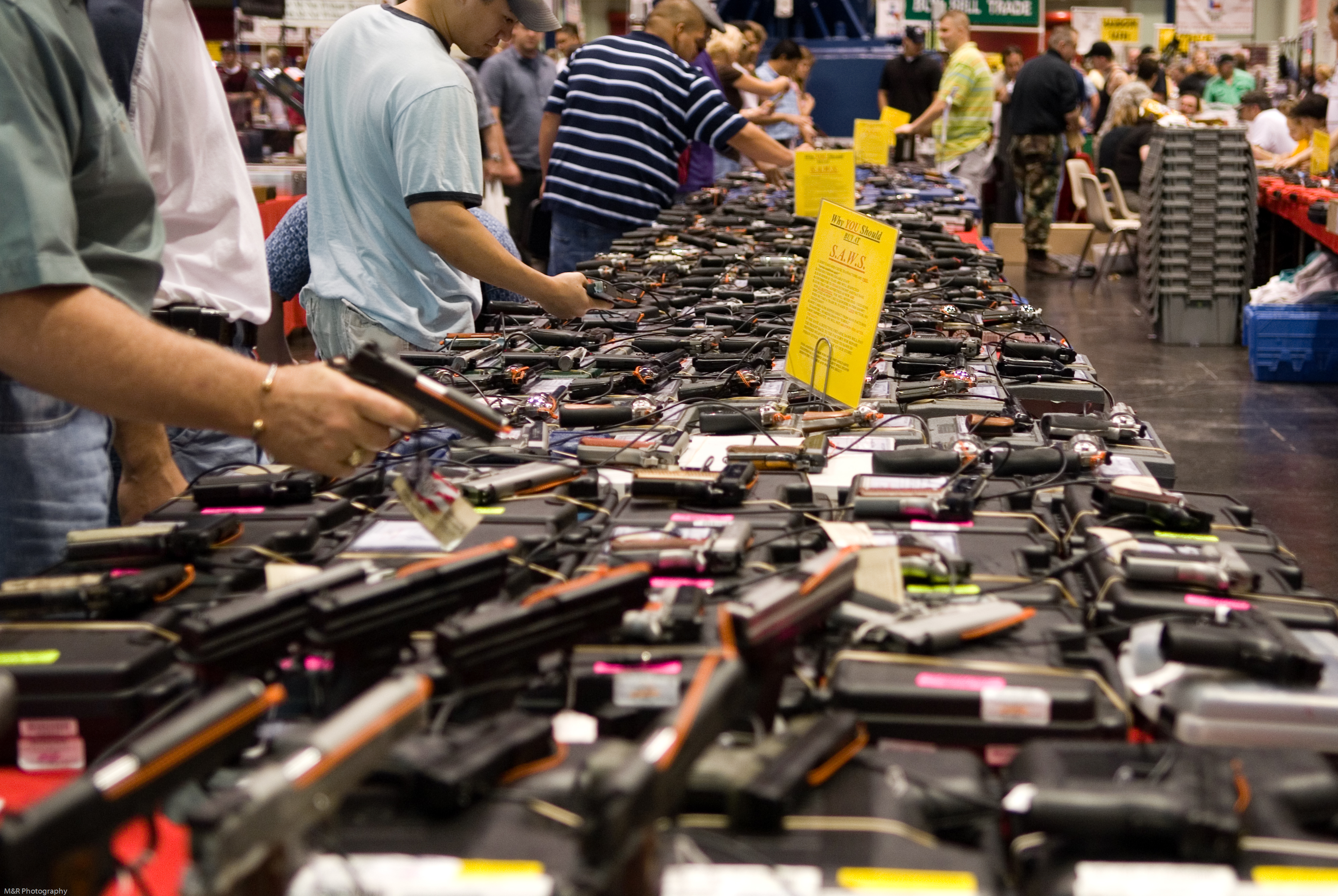
Walk into a gun show or a gun shop. What do you see? Do you see the arms of a well-regulated militia necessary to the security of a free state?

The photos of gun shows send chills up my spine. What I see is a drug store for addicts – precision, man-made machinery. Do the tables have on them the equivalent of Methamphetamine or crack cocaine to a gun aficionado?—ready to take the shopper into the illusionary highs of power and invulnerability, the cocoon of god-like power over life and death?

A bow and arrow is a hunting instrument. One shot at a time is all you get or need. The well-regulated militia seen as “necessary to the security of a free state” assumed arms like that: load, shoot…re-load…. Equally important, the “well-regulated militia” in the Second Amendment was a concession to the demands of the slave-holding states whose plantation economies were threatened by slave revolts. Those “states” insisted on the right to state regulated militias. Once the slaves were freed, the militias took another form: they moved under the white sheets and hoods of the not-so-well-regulated militias of the Ku Klux Klan, burning crosses on the lawns of uppity blacks, and of whites who had forgotten who they were as members of a superior race. “The people” were white supremacists then—are they white supremacists still? Their weapons were midnight torch parades; burning crosses left on unbelievers’ lawns; rifles; and the white militias’ hanging nooses and trees that secured their sorry state of mind.

My experience with guns is shaped in no small part by playing cops and robbers and cowboys and Indians with the neighbors in the back yard of the small town where I grew up. The closest we came to a gun was a water-pistols or a cap-gun. “Bang, bang! You’re dead!” and the victim would fall down playing dead…and then we’d get back up to play again. We were also trying to make sense out the world of cowboys and Indians, cops and robbers – shorthand for “good guys” and “bad guys” but even then we sometimes wondered whether maybe the Indians with their bows and arrows were better than the better-armed “good guys” who had conquered them and their land.

When I see a convention center filled with tables of every imaginable pistol, rifle, and semi-automatic, I see an unregulated drug store filled with shoppers sorting through the different brands of methamphetamines. I see a form of legal insanity: the fascination with power and the worship of power over another life.

A friend posted on Facebook a photograph of a hunter posing proudly with the wolf he had killed with his bow and arrow. The arrow was still protruding from the wolf’s left eye. The wolf was dead. The archer was alive and smiling.

What would a shaman say about this picture? Would the totems of a tribal people use the image of the conquered wolf with an arrow protruding through its left eye as a symbol? A symbol for what? Their bravery? Their marksmanship? Where is the sacredness in this picture?

I have no answers, just images to share: The picture of tables with addiction written all over it? “Good guys” protecting themselves from the “bad guys”? “Cowboys and Indians”? The bow and arrow in the wolf’s eye? A well-regulated militia necessary to the security of a free state?

Home of the scared and the land of the tyrannized

This afternoon from 3:00 to 4:00 Protect Minnesota will host a demonstration in the MN Capitol Rotunda in support of state legislation re: gun violence.

As part of its efforts, Protect Minnesota invited individuals to write letters to MN Senate and House Judiciary Committee members. This letter went out this morning.

Greetings,

I am a Christian Pastor. I write you out of deep concern for the unrestrained violence taking place in the name of “the right to liberty” that imperils “the right of life…and the pursuit of happiness”. The three rights proclaimed in The Declaration of Independence are intended to be mutually supportive, not mutually exclusive. The right to liberty was never intended to take the other two rights hostage.

I strongly support legislation and enforcement of laws that place gun ownership in its proper place in our common life. The Second Amendment does NOT grant unlimited rights for anyone to purchase and use a gun anywhere anytime any more than the First Amendment on free speech allows speech that slanders or libels, lies under oath, or yells “Fire!” in a crowded theater.

As Senators and Representatives, you were elected by the people in your districts. Once you took the oath of office, your responsibility changed. You entered the halls of representative democracy where leadership requires you to act by your own consciences, not by public opinion polls in your districts. We are a representative democracy, not a pure democracy). Your responsibility as Senators and Representatives is to LEAD WISELY not only for the sake of your own constituents but for the greater good of the entire State of Minnesota.

We are quickly becoming, if we are not already, an armed camp in which the “neighbor” of Jewish, Christian, and Islamic teachings is regarded as an anachronism. Unless you plug the holes in our background check system by requiring a check for every pistol or assault weapon sale, the rights of life and the pursuit of happiness will be held hostage by unrestrained liberty, and the home of the brave and the land of the free will continue on the way to become the home of the scared and the land of the unrestrained individual tyranny.

Thank you for listening.
Respectfully,

Gordon C. Stewart

Sermon on the Sane Man

This sermon was recorded Sunday, Feb. 17. It was delivered to the congregation of Shepherd of the Hill Presbyterian Church in Chaska where we had concluded regretfully that a second scheduled community program on gun violence in America would not serve the purposes of constructive dialogue.

Two texts interact in this sermon. The first is the traditional First Sunday of Lent account of the temptations of Christ in the wilderness. While two later Gospels, Matthew and Luke, tell the story of three temptations in the wilderness, the earlier Gospel of Mark describes the entire wilderness temptation with one curious phrase: “he was with the wild beasts.” The second text (Mark 5:1-20) is the encounter of “Jesus, the Son of the Most High God” with the insane man living alone among the tombs, “possessed” by the “Legion” (a Latin word in a Greek text, the word for a unit of the Roman occupation forces). The story ends with the man who had been possessed/occupied by the Legion “sitting there, clothed and in his right mind” to everyone astonishment.

Gun companies playing hardball

“Six gun companies have announced plans to stop selling any of their products to any government agency in states that severely limit the rights of private gun ownership. Click HERE to read the story.

A Critique of the State of the Union

The climax of last night’s State of the Union Address was the President’s call for an up or down vote on proposals to curb gun violence in America. The applause was uproarious and continuous.

This violence must stop.

But what of the underground stream of violence that erupts in gun violence in the nation that prides itself on the greatest military the world has ever known and the greatest economy the world has ever known?

Is it a coincidence that the geysers of unprecedented school, mall, and street massacres in the homeland have come at the same as America’s wars in Iraq and Afghanistan?

Is the world’s greatest military something to celebrate?

How does one measure a military’s greatness? By its superior capacity for violence over other militaries, or its ability to subject foreign nations to the American will for freedom and democracy? By the number of dead it leaves behind in other military ventures?

Is an economy’s greatness measured by the size of a nation’s Gross National Product?

The measure of an economy- from the Greek word oikonomia, the management of a household- is how well it serves the inhabitants who live in the house.

How well is the American economy serving its members?

An economy is not measured by the amount of stuff it produces. It’s also measured by the fairness of the distribution of those goods within the one household, the oikonomia.

By that measure, can we really declare that the American economy is the greatest in the history of the world?

During last nights State of the Union Address the loudest shouts came in response to a call to end to gun violence in America. But it doesn’t mean we want to stop the violence. The applause through the rest of the night took for granted the essential goodness of the underlying systemic violence of the American military-industrial-corporate-complex and the military whose superior capacity protects those interests abroad while creating Rambos on our own streets at home.

The home of the brave and the land of the free is neither so brave nor so free. We will only be brave and free when we connect the insanity that shoots innocent school children here at home with the carnage the world’s greatest military has left overseas.

The American republic was born in the violent occupation by Western Europeans who believed they were God’s special people. That belief has morphed over time. But it continues to be the case that violence is as American as apple pie. While we applaud the attempt to end gun violence in our schools, malls and streets, the underground stream of violence rolls on undetected beneath the the nation’s delusions of grandeur about the exceptional greatness of our economy and our military. Violence is enthroned as the god of the not-so-free and the no-so-brave.