
Out from the caves of fear

Fear.

“There is no passion so contagious as that of fear,” wrote Michel de Montaigne.

During the five minute drive to Auburn Manor in downtown Chaska Monday morning, I turn on the radio to hear what they’re saying about the Vikings’ overtime victory over the Bears.

I turn to the ESPN sports channel. But it’s not about sports. It’s Glenn Beck advising listeners to buy food insurance. On the heels of the call to buy food insurance in preparation for catastrophe comes the advice on how to buy your first gun.

Passion. Contagion. Fear. They’re everywhere. Not just Glenn Beck and the far right, but on the left, in the middle, and among the apathetic and the cynical. Fear does not have one opinion. It is a contagious passion that has a thousand different voices. While the foundations of the familiar shake, we are infected by a pandemic of fear.

Fear does terrible things to a person and to a society. It is for this reason that the New Testament Gospels see fear as the root source of ill-will, self-absorption, greed, and war. The “Fear not” uttered by the heavenly messengers in Luke’s birth narrative is repeated in the middle and at the end of the Christ story. “Fear not, little flock.” “Fear not, for I am with you.” It is both invitation and command: “For you did not receive a spirit of slavery to fall back into fear…”.

We are always prone to fall back into fear. We fear because we are mortals. We die and we know it. We seek to secure ourselves against the threats, overt or covert, that cast death’s dark shadow over us.

In such times the psalmist comes to mind. “Yea, though I walk through the valley of the shadow of death, I will fear no evil.” I will buy no food insurance. I will buy no gun. To do so is to run straight into the arms of death as a living power that robs us of life’s goodness and meaning.

“Man’s self-absorption is the movement of our flight from death,” writes Sebastian Moore OSB. “This is what is meant by the scripture’s description of man as ‘under the shadow of death’. It does not mean ‘man knowing he will die’ but ‘what man does and becomes under this knowledge.’. It is not to our mortality, our animality, that scripture offers a remedy. It is to the death that we become in our self-absorption. It is to what we allow death to become in us by fleeing from it in the hopeless pride of man.” (The Crucified Jesus Is No Stranger, Paulist Press, 1977)

I turn off the radio. I dial back the passion. I interrupt the contagion of fear by repeating an old psalm, and drive over to the community food pantry to volunteer.

Lao Tzu on Planet Earth

In harmony with the Tao
The sky is clear and spacious
The Earth is solid and full
All creatures flourish together
Content with the way they are
Endlessly repeating themselves
Endless renewed.

When man interferes with the Tao,
The sky becomes filthy
The earth becomes depleted
The equilibrium crumbles
Creatures become extinct.

The Master views the parts with compassion
Because he understands the whole.
His constant practice is humility
He doesn’t glitter like a jewel
But lets himself be shaped by the Tao
As rugged and common as a stone.

– Lao Tzu

This was sent by the Brazilian flutist and saxophonist who played last Friday evening in Hudson, WI. He is the first of the artists to respond to the Call to create artists “Before the Planetary Requiem” in the face of scientific evidence for Climate Departure. “Before the Planetary Requiem” was posted here on Views from the Edge yesterday. Interesting that his response is from one of the ancient figures of holy and practical wisdom.

Before the Planetry REQUIEM

If scientists are right (see Nature), by 2020 the first effects of Climate Departure should already be a part of the human experience.

In light of both science and faith, Shepherd of the Hill Presbyterian Church in Chaska, MN is issuing this invitation in anticipation of Earth Day, 2020, in hopes it will catch on. The Call is conceived by visual artist and scientist John Lince-Hopkins, a member of Shepherd of the Hill:

EARTH DAY
Wednesday, April 22, 2020

A GLOBAL CALL TO CREATIVE PEOPLE OF ALL TYPES TO CREATE, PERFORM, AND DISPLAY THEIR BEST WORKS:
COMPOSERS,
MUSICIANS,
MUSICAL GROUPS,
RECORDING ARTISTS,
AUTHORS,
POETS,
VISUAL ARTISTS,
PHOTOGRAPHERS,
VIDEOGRAPHERS,
FIBER ARTISTS,
PERFORMANCE ARTISTS,
DANCERS,
…AND THOSE UN-NAMED.

JUST SEVEN SHORT YEARS TO CREATE SEMINAL WORKS ABOUT THE STATE OF OUR PLANET AND OUR REALIZATION OF THE INEVITABLE CONSEQUENCES OF OUR CLIMATE TO ALL LIVING THINGS AND THE ECOSYSTEMS THAT SUPPORT THEM.

Think Globally, Act Locally!

Illinois Tornadoes

God did not send the tornados.
Evils come from nature just like
Blessings. Gentle rain, tomatoes
Sweet corn, food for all the livestock
(Beans and field corn), also come from
Mother Earth–we need look no
Further.

……….Of course, there is now some
evidence from science: we know
Homo-less-than-sapiens cause
Causes of the storms as well as
Food. Will we be able to make
Changes, or will we try to take
No responsibilities as
Eden’s ungrateful gardeners?

-Steve Shoemaker, Urbana, Illinois, November 18, 2013

Editor’s Notes:
1) Steve lives on the wide-open plains of Illinois.
His home is a sitting duck.

Steve's prairie haven - home of the Urbana  "Morning Chorus"

Steve’s prairie haven – home of the Urbana “Morning Chorus”

2) The Editor wasn’t able to accomplish the original
form of the poem. The ten .s were added to bring the
spacing into conformity with Steve’ poem.

The World in a Tunnel

Can the whole world shrink to the size of a walking path tunnel in Chaska, Minnesota?

On our morning walk, while Barclay sniffs his way along the path for signs of smaller creatures who might not have made it through the night, my eyes were drawn to the graffiti on the both sides of the tunnel. Boldly painted in black or red, the logos belonged to gangs or gang wannabes.

Eight years at the Legal Rights Center in Minneapolis left me we a knowledge of graffiti and tagging. Our defense attorneys sometimes defended “taggers”, self-proclaimed creative artists who used public space as their canvasses. Other times the graffiti was posted by a gang member to announce the gang’s claim to a block or a neighborhood. Often the gangs were competing for control. In that case, there were at least two “tags” and sometimes many: Latin Kings, the Crips, or the Gangster Disciples. The graffiti meant, “Don’t mess with us. We own this neighborhood.”

In Chaska this morning the tunnel walls were filled with gang symbols, most likely by kids who are gang “wannabes”, kids in a small city pretending to be gangsters the way my generation used to play cops and robbers or Cowboys and Indians. You couldn’t be both a cop and robber. You couldn’t be a cowboy and an Indian. You were either in the one gang or the other. We’re all in some kind of gang where we get our sense of identity and the security that comes with belonging to something.

Walking through the tunnel was like living for a moment in a microcosm of the world where the small town folks’ claims of ownership and the threats of violence mirror and replicate the power of greed, the lust for power and “the good life” that filters down from The Boss, Trump’s Tower, Wall Street, the Mall, Afghanistan, Iraq, and Washington, D.C. where the will to security and power is the motive force.

Meanwhile, six-month-old Barclay, the 10-pound puppy on my leash ignores the walls and sniffs the macadam for a mouse that has already died, unaware of handwriting on the walls of the superior species of his master.

– Gordon C. Stewart, Saturday morning, November 16, 2013

Communio Sanctorum

As a boy I thought of All Saints Day and the Communio Sanctorum, the Communion of Saints, the way I felt about Halloween. It was spooky.

Today it’s no longer spooky. I’m thinking about all the people who have touched my life along the way. Few of them are saints in the sense our culture has come to understand the word, but they were all saints in my book. The extraordinary thing about saints is that they know they are not extraordinary. They refuse to believe they are exceptional.

The people I’m remembering drew little attention to themselves, for the most part. Some of them, like Uncle Dick Lewis, who was an uncle not by blood but by affection only, were people of few words. Uncle Dick stood under the maple tree every Sunday morning waiting for our weekly routine: nothing more than a handshake, the strength of which tested and honored my growing toward manhood. The handshake is the only speech I remember. During the week Uncle Dick’s hands painted houses. On Sunday morning he clasped his hands together after painting a boy into a man under the maple tree.

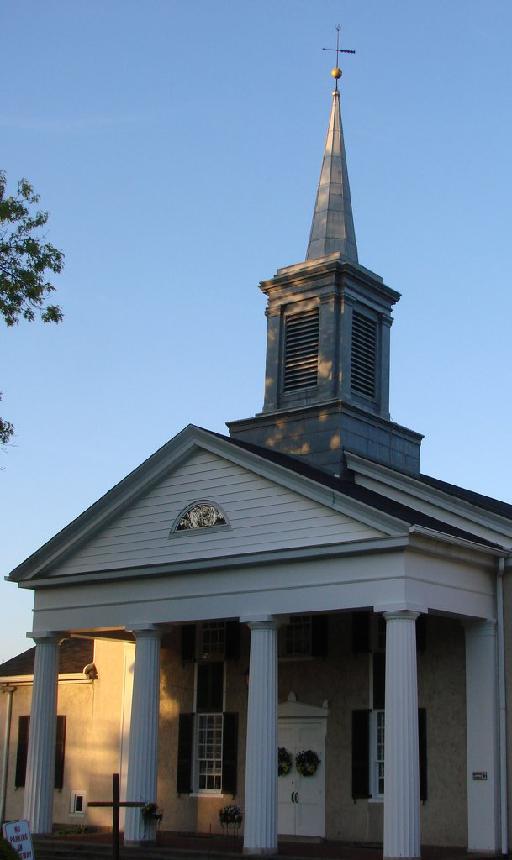
The place where I grew up was a working class community with a working class church. Its members were house painters, plumbers, carpenters, and bus drivers with a few middle management people sprinkled in, and one generous rich man named George. George and Phoebe always sat in the front row.

Marple Presbyterian Church, Broomall, PA

Marple Presbyterian Church, Broomall, PA

George decided one day to donate a stained glass window. Although much of the money for the new building had come from George, a stained glass window was inappropriate for Colonial architecture. The church board, with some fear and trepidation, refused the proposed gift. George left the church in a huff. He moved his and Phoebe’s membership to the wealthy church in Bryn Mawr, leaving the carpenters, plumbers, and bus drivers with a clear message: “Good luck. You won’t have George to kick around any more! You’re on your own.”

Karl Marx observed that the rich will do anything for the poor but get off their backs, and that the ruling ideas of any society are the ideas of its ruling class. After George left, they didn’t love Karl, the man everyone at Marple loved to hate, any less than before, but they re-discovered the Beatitudes of Jesus: “Blessed are you poor. Blessed are the meek. Blessed are you who mourn.” Blessed are the peacemakers.”

George was always kind to me in a distant kind of way. He got a chuckle watching the mischievous tow-head preacher’s kid break the rules he didn’t dare break. My only pictures from childhood were taken by Phoebe’s camera. I still see George in his three-piece suit with a big cigar, looking like a statue of William Randolph Hearst, the newspaper magnate – not quite that rich, but likely every bit as lonely before and after the church refused his stained glass window.

Approaching All Saints’ Day this year, I see them all compacted, you might say, into a single communion, the communion of the dead who have left behind every illusion that they were exceptional to the common lot of humankind. I see them gathered again at Marple Church, but gathered differently: George in Uncle Dick’s painter’s coveralls and Uncle Dick dressed in George’s three piece suit smoking George’s Cuban cigar, and Phoebe still taking her snapshots of a community now repaired by the common threads of love and death, dragged kicking and screaming into the Communion of Saints that knows no exceptions.

Treasure in Earthen Vessels

Creating hell in the name of heaven

Imagine there’s no heaven
It’s easy if you try
No hell below us
Above us only sky
Imagine all the people living for today
– John Lennon

The bombs were heard in my living room last night.

The echoes of last Sunday’s suicide bombing of a church in Pakistan that killed 80 people sounded in the voices of two Pakistani members of Shepherd of the Hill Presbyterian Church in Chaska, Minnesota where I serve as pastor. Twelve members of the church had gathered to talk about something totally unrelated to Pakistan, Afghanistan, or Christianity and Islam. We were there to share. The quiet horror of Samuel and Nasrin – “I was sad all day.” – was like a bomb going off in the living room. I ask myself, why? What is happening?

I am a Christian, a disciple of Jesus. Strange as it may seem, I often feel the way John Lennon did. I dream of a different kind of world where there are no more bombings or shootings in a Kenyan mall, in Peshawar and Lahore, Pakistan, in Baghdad, Damascus, or Boston in the name of God. I am tired of all claims to righteousness, whether professedly religious or professedly secular. I would like to wipe the human GPS of its magnetic field between due North heaven) and due South (hell) and re-orient us all toward the rising sun.

The voices that fight for heaven to erase hell do not all sound the same. They speak Urdu, Parsi, Arabic, Hebrew, and English. They claim different names: Muslim, Jewish, Christian, and sometimes secular. They live in different parts of the planet in different time zones and different climates. But if you listen, they all sound alike and they do the same thing.

They do not look up at the sky. They look down. They march in lockstep rhythm because the Quran or the Bible or nationalism tells them to. They live for tomorrow – for heaven or some version of it – not for today. One doesn’t have to strain to see what’s happening, and, when anyone sees it, how can one help but imagine a different world, a different kind of humanity: one without religion?

The bombing in Peshawar last Sunday is said to have been a payback for American drone strikes that had killed innocent civilians in Pakistan. For the suicide bombers, the Cross was the emblem on the shields and helmets of Christian Crusaders. Back then the Knights Templar of Holy War killed with swords. Today the suicide bombers associate the Cross with the drone attacks of the Christian West.

Religion is with us and, depending on how one defines it, always will be. A wise elder statesman, Elliot Richardson, observed toward the end of his life that religion is the problem, but that if we erased all of the religions were erased from the face of the Earth, they would re-invent themselves in a heartbeat. Why? Because that’s how we’re made. As defined by the likes of Emile Durkheim, Margaret Meade and Paul Tillich, religion spans a much wider terrain than the belief systems for which heaven and hell are essential. Furthermore, whether or not we are professedly religious, each of us has some kind of inner GPS, some version of a societal ideal (heaven) and a social and personal horror (hell).

What’s happening across the world is profoundly and earth-shakingly religious. Though our languages are as different as Arabic is from English, and as far from each other as Peshawar and a mall in Kenya are from a Quran-burning church in Florida, the voices of Abraham’s three children (Judaism, Christianity, and Islam) all sound the same whenever we create hell on Earth in the name of heaven.

For the Pakistani friends in my living room last night the Cross stands for a divine interruption of the cycle of violence and all claims to righteousness. In the crucifixion of a Palestinian Jew of the First Century C.E. what we see is anything but the excuse for a crusade to eliminate hell in the name of heaven.
The Jesus we seek to follow threw his life into the spokes of the wheel of violence to stop it, and we must do the same.

Every Sunday worship service concludes with a “Charge” – an instruction in how to live.

Go forth into the world in peace.
Have courage.
Hold on to that which is good.
Return no one evil for evil.
Support the weak.

When the bombs tear through a church or a mosque or a neighborhood in the name of our imagined heaven for the righteous, we need to remember that there are Muslims, Jews, secularists, and other religious practitioners who seek to practice the way of peace…”living for today” throwing themselves into the spokes of the wheel of violence.

Human Evolution

This NPR piece Attenborough’s muddled thinking can’t stop human evolution came to our attention this morning by way of David Earle from New Zealand.

David’s blog is In the Company of Hysterical Women.

His comment on yesterday’s Views from the Edge post The American Religion reads, in part:

Fortunately Sir David is totally wrong on all counts. It is only a small fraction of humanity that benefit for these improvements and even then, it has little to no measurable impact apparently on generic change across population. …

But he is tapping into a wider sentiment that some day we might be so in control of our own destiny that we are no longer subject to this nasty, animal based thing called evolution.

Isn’t that when we force our way back to the garden and eat from the second tree?

Editor’s note: David is referring to the Genesis story (Gen. 2 and 3) where what David calls “the “first tree” is the tree of the knowledge of good and evil (the tree of control/mastery by which they will “be like God”). “The second tree” is the tree of life (by which the characters in the story would become eternal.)

The Garden story is not history; it’s anthropology and theology. It never happened; it’s always happening.

Your thoughts on the matter are welcome. Leave a comment to promote the discussion.

The American Religion

“A religion is a unified system of beliefs and practices relative to sacred things, that is to say, things set apart and forbidden, beliefs and practices which unite into one single moral community…all those who adhere to them.” – Emile Durkheim, The Elementary Forms of Religious Life, p. 17.

Emile Durkheim is one of the fathers of the social sciences and the father of sociology. When he first studied the aboriginal people of Australia, he carried with him a bias against all religion.

“During Durkheim’s life, his thinking about religion changed in important ways. Early in his life, as in Division, he argued that human societies could exist on a secular basis without religion. But later in his life he saw religion as a more and more fundamental element of social life. By the time he wrote Forms, Durkheim saw religion as a part of the human condition, and while the content of religion might be different from society to society over time, religion will, in some form or another, always be a part of social life. Durkheim also argues that religion is the most fundamental social institution, with almost all other social institutions, at some point in human history, being born from it. For these reasons he gave special analysis to this phenomenon, providing a philosophy of religion that is perhaps as provocative as it is rich with insights.

“According to Durkheim, religion is the product of human activity, not divine intervention. He thus treats religion as a sui generis social fact and analyzes it sociologically. Durkheim elaborates his theory of religion at length in his most important work, Forms. In this book Durkheim, uses the ethnographic data that was available at the time to focus his analysis on the most primitive religion that, at the time, was known, the totemic religion of Australian aborigines. This was done for methodological purposes, since Durkheim wished to study the simplest form of religion possible, in which the essential elements of religious life would be easier to ascertain. In a certain sense, then, Durkheim is investigating the old question, albeit in a new way, of the origin of religion. It is important to note, however, that Durkheim is not searching for an absolute origin, or the radical instant where religion first came into being. Such an investigation would be impossible and prone to speculation. In this metaphysical sense of origin, religion, like every social institution, begins nowhere. Rather, as Durkheim says, he is investigating the social forces and causes that are always already present in a social milieu and that lead to the emergence of religious life and thought at different points in time, under different conditions.”
– Paul Carl’s entry on Emile Durkheim published June 3, 2012 in Internet Encyclopedia of Philosophy: a Peer-Reviewed Academic Resource.

QUESTION

Later sociologists like Robert Bellah look today at American society and ask what “sacred things” are enshrined in American culture and practices.

What are the equivalent beliefs and practices, “sacred things” set apart or forbidden, that give coherence to a fast-changing American society?