Sojourners publishes again today

Sojourners today re-published “A Song for Each Kind of Day” on their blog – “God’s Politics: a blog with Jim Wallis and friends.” Click HERE to see it on their blog.

Yesterday they picked up “I Wish We Were All that Crazy.”  Click HERE to see it.

Thank you, Sojourners – and thank you Steve Shoemaker for the heart of the piece.

Drug Wars

“Drug Wars”

Steve Shoemaker, Urbana, IL, April 26, 2012

The prisons are full and profit only

the investors in the rich companies

that plan, build and manage the “Custody

Industry.”  All that the prisoner sees

is injustice:  blacks serve more time than whites,

the rich with high-priced lawyers pay a fine,

the poor endure the filth, the rapes, the fights,

and learn to do sophisticated crime.

Released with prison records few can find

a decent job, or a safe place to live.

Back on the streets often their only friend

is the one who had sold them drugs, who give

them yet another chance to forget pain.

Their land will never let them forget shame.

Homeless men on Corinthian Aveune in Philadelphia

Homeless men on Corinthian Avenue in Philadlephia

Returning last year to the street where I once worked with homeless men and youth gangs in North Philadelphia, I took this shot from the car window. The scene was all too familiar.

“Sojourners” republishes piece today

Thanks to Sojourners for republishing a piece that first appeared here. Click I wish we were all that Crazy” to read the piece on Jim Wallis’ blog, “God’s Politics.”

If you missed it, it was a reflection on the late Bishop James Pike and the late William Stringfellow, the lawyer and lay theologian who defended the Bishop at the Episcopal Church’s heresy trial.

The Estate Sale and a Thousand Years

Last Saturday I bit my tongue and went to an estate sale in hopes of buying a patio set. It was sold by the time I got there. Here and gone in a heartbeat.The rest of the stuff, except for the men’s suits (wrong size) was junk.

The memory that lasts is the house itself. Highland Park is a lovely neighborhood in Saint Paul. Beautifully constructed old Tudor homes on a tree-lined street…except for…the house with the estate sale…a lavishly done white retro Art Deco house…plopped down like a fly on top of a French Soufflé.

I blurted out to another shopper, “This place is really strange.”  “Yes!” she said. “What were they thinking?”

Right then I thought of the ongoing conversation with Dennis Aubrey of Via Lucis Photography about the Romanesque and Gothic churches that still inspire reverence and awe eight centuries after they were built.

Dennis: “One of the wonderful things about these [Gothic and Romanesque] churches was that they took so long to construct and design that the intellectual currents that drove the builders were deep and powerful, not short, erratic eddies of fashion.”

Dennis had posted a question about a contemporary artistic installation at the Church of Saint Hilaire in France.  Would the newly created installation at the Church of St. Hilaire stand the test of  time. Might it also come from sources that are “deep and powerful, not short, erratic eddies of fashion”? Would it stand the test of time as compared with Gothic and Romanesque structures with their high vault ceilings that lift our eyes and hearts to something else for which we human beings long?  I had shared with Dennis that I find most contemporary church architecture banal and uninspiring.

I wrote to Dennis: “The culture of individualism is NOT Romanesque or Gothic where the glory is directed away from the individual, where the individual gets to feel…well…very small, humble, rather insignificant in the best way. I, too, see wonderful works of contemporary architecture, and I hope I’m not just being a cranky old man here. The comment about banality is not about those magnificent creations but rather about what I believe is the prevailing dumbing down of our time that leaves us bereft of awe, the sense of grandeur, wonder, or humility [one feels in Gothic and Romanesque spaces]. There’s a flattening, a leveling of existence itself to human proportions. The belief in species superiority displaces everything that suggests otherwise. My comments, I think you know, are not so much about the new installation at St. Hilaire – which, in and of itself, strikes me as quite lovely – but more about the age in which we live where nothing much seems to be of lasting value.”

Dennis: “Gordon, I think it was a form of this ‘prevailing dumbing down’ that inspired us to these churches in the first place. I became increasingly disturbed by rampant      commercialism, when the point of commerce is to create obsolescence so that goods can be replaced whether necessary or not. Fashion and styling is substituted for value. PJ and I wanted to concentrate on something that had intrinsic value, and when we began exploring these churches in  2006, we found that something.

“One of my favorite books of all time is Raymond Chandler’s The Long Goodbye [published in 1953]. In it, there is a speech by the wealthy Harlan Potter:

“’You can’t expect quality from people whose lives are a subjection to a lack of quality. You can’t have quality with mass production. You don’t want it because it lasts too long. So you substitute styling, which is a commercial swindle intended to produce artificial obsolescence. Mass production couldn’t sell its goods next year unless it made what it sold this year look unfashionable a year from now. We have the whitest kitchens and the most shining bathrooms in the world. But in the lovely white kitchen the average American housewife can’t produce a meal fit to eat, and the lovely shining bathroom is mostly a receptacle for deodorants, laxatives, sleeping pills, and the products of that confidence racket called the cosmetic industry. We make the finest packages in the world, Mr. Marlowe. The stuff inside is mostly junk.’”

Well, the kitchens today aren’t just for the “housewives,” thank goodness, but the rest hit too close to home.

I think of the height of the Gothic arches and the things that will last when someone says at my departure “Dust to dust, ashes to ashes” and holds an estate sale.

I sit down with the Scriptures for something longer lasting than deodorants, laxatives, sleeping pills, or a plastic patio set.  I want something like the lasting value of the Gothic and Romanesque architecture “took so long to construct and design,” where “the intellectual currents that drove the builders were deep and powerful, not short, erratic eddies of fashion.”

I’m drawn to the English translation that preserves the clear distinction between the Divine and the human – the use of the archaic word “thou” for God. Like the vaults of St. Hilaire, the language lifts up my heart from the flat banality of our self-preoccupations and species grandiosity.

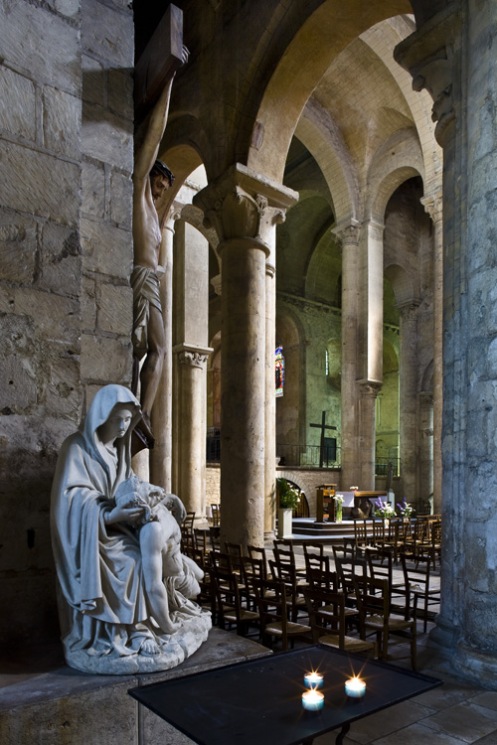
Basilique Saint Hilaire, Poitiers (Vienne) Photo by PJ McKey

“O Lord, how majestic is thy name in all the earth!

When I look at the work of thy heavens, the work of thy fingers,

The moon and the stars which thou hast established;

What is man that thou art mindful of him…?


O Lord, our Lord, how majestic is thy name in all the earth!” (Psalm 8)


“Lord, thou hast been our dwelling place in all generations.

Before the mountains were brought forth, or ever thou hadst formed the earth and the world,

From everlasting to everlasting thou art God.

Thou turnest man back to the dust, and sayest, ‘Turn back, O children of men!’

For a thousand years in thy sight are but as yesterday when it is past, or as a watch in the night.” (Psalm 90:1-4)

Supply and Demand

“Rats and roaches live by competition under the laws of supply and demand; it is the privilege of human beings to live under the laws of justice and mercy.”
― Wendell Berry

The Germans at the Service Club Meeting

Pledge of Allegiance

Five visitors from Germany were guests of an international service club recently where my friend Steve Shoemaker is a member.After the meeting, they asked Steve some questions.

Why ask Steve?

For starters, he’s 6’8″ and he’s up for Club President soon…unless he’s impeached before taking office for his Letter to the Editor.

Dear Editor,

Five folks from Germany recently visited central Illinois as part of a local service club program to improve international understanding.

At one point they asked me about something they did not understand:  why do Americans begin so many gatherings with a ‘”patriotic” song, the Pledge of Allegiance, and a prayer?

As foreign visitors, of course, they felt excluded from at least the first two–often at events designed supposedly to welcome them…  And if from a non-Christian religious tradition, they felt excluded from all three.

Perhaps especially because they were from Germany, remembering the horrors of two world wars begun partly from excessive beliefs in the superiority of their nation and religion, they were sensitive to expressions of exceptionalism at U.S.A. sports events and service club meetings.

Can we welcome others better by showing the American virtue of hospitality, finding rituals that affirm the equality of all, and treating others the way we wish to be treated?

Steve’s an affable chap and hard not to like. At the next meeting Steve and some of the members had a nice chat. There’d been some conversation, they had a different opinion, they said, and the good thing was they were all free to disagree.

Hmmm.

Click HERE for a quick history lesson on the evolving text of the Pledge of Allegiance.

What do YOU think? Chime in with a comment to expand the discussion. I’ll send them to Steve for the next meeting.

I wish we were all that crazy

Bishop James A. Pike (February 14, 1913 - September 1969)

Bishop James A. Pike (February 14, 1913 - September 1969)

It was a crazy week.I should rather say…I was a little crazy last week…in the sense that Bishop James Pike was a little crazy the night he walked down the hotel corridor in the altogether to knock on his friend William Stringfellow’s door at 4:00 in the morning.

According to the story, as told by Bill Stringfellow, the knock on his door awakened him from a sound sleep.

He opened the door to see the Bishop stark naked with a book in his hand. “Bill, you have to hear this! This is amazing!” The Bishop was oblivious to his nakedness. He plopped down in a chair and proceeded to tell his lawyer and his friend what he thought he had just discovered about Jesus in the wilderness. When he had shared the information, we wandered back down the hallway to his own room with his nose stuck in the book.

James Pike had become obsessed with Jesus in the wilderness. So absorbed in the Gospel accounts that he ate, drank, and slept them. His naked self was in those stories. Something about the wilderness temptations of Jesus consumed his total attention.

James Pike died sometime later in the Judean wilderness where the Gospels say Jesus spent 40 days and 40 nights. The date of his death is known only as the month of September in the year 1969, about the same time that I met Bill Stringfellow.

Why do I tell this story now? I was a little like the Bishop last week with the story of Barabbas. I get like that sometimes. I’ve remembered to pull my pants on to take the dogs for a walk, but in every other way, I can identify with the completeness of James Pike’s attention to the biblical story. I’m a little ”nuts” – with apologies to everyone who knows better than to use that kind of pejorative language to describe a state of mental illness.

I write this today not to arrive at your door in the altogether to tell you what I think I’ve discovered about Barabbas. I write quite simply because I miss the likes of Bishop Pike and Bill Stringfellow. I feel the need to honor the sacred memory of two very strange saints, one of them (the Bishop) tried for heresy and the other (Bill) who defended him in the church courts. I’m grateful for the courage and idiosyncrasies that left the more conventional, less curious church bureaucrats and the House of Bishops mystified. Bill Stringfellow’s own words of tribute to his friend Jim speak, in hindsight, not only of the Bishop but of the Stringfellow himself. May the both rest in peace.

William Stringfellow (April 26, 1928 – March 2, 1985), lay theologian, lawyer, author, social critic, alien in a strange land.

“The death to self in Christ was neither doctrinal abstraction nor theological jargon for James Pike. He died in such a way before his death in Judea. He died to authority, celebrity, the opinions of others, publicity, status, dependence upon Mama, indulgences in alcohol and tobacco, family and children, marriage and marriages, promiscuity, scholarly ambition, the lawyer’s profession, political opportunity, Olympian discourses, forensic agility, controversy, denigration, injustice, religion, the need to justify himself.By the time Bishop Pike reached the wilderness in Judea, he had died in Christ. What, then, happened there was not so much a death as a birth.”

I wish we were all that crazy.

To learn more about Bishop Pike, click HERE. For William Stringfellow, click HERE.

President Obama Speech at National Holocaust Museum – 4/23/12

President Obama Speech at National Holocaust Museum – 4/23/12. to watch the speech.

UneditedPolitics.com publishes speeches by current and former Presidents, Senators, Congressinal Representatives, Governors in American public life. I have found it a great source of  information without comment. I hope you find it the same.

The foreign visitor

In this acrostic verse Steve Shoemaker imagined Simon of Cyrene, the innocent foreign (Libyan) bystander conscripted to help carry Jesus’s cross. Jesus of Nazareth was found guilty of “subverting the nation and refusing to pay tribute to Caesar.”

SIMON OF CYRENE 

Since I was in Jerusalem for Passover,

I  bought nice gifts both for my wife and the two boys.

Money I had, position in Cyrene, power…

Only meaning was missing, reason for my days.

Now my bags are knocked down and a Roman soldier

Orders me to carry a young condemned man’s cross.

From deep within his eyes I see a place of peace.

Crying women followed us all along the road.

Years later I could still recall, he turns and says,

Remove your tears for me, there are for you ahead

Even worse times to come:  no men,  no pregnancies,

No children, no city–for battles, sieges, war

End families, prosperity, leave just the poor.

  • – Acrostic Verse  – Steve Shoemaker – Urbana, IL, April 22, 2012

Steve (1943-2016) continued the work of Simon of Cyrene. He lived his life on behalf of the poor. We’re missing him today.

  • Gordon C. Stewart, Chaska, MN, March 28, 2017.


The World in an Oyster – an Earth Day reflection

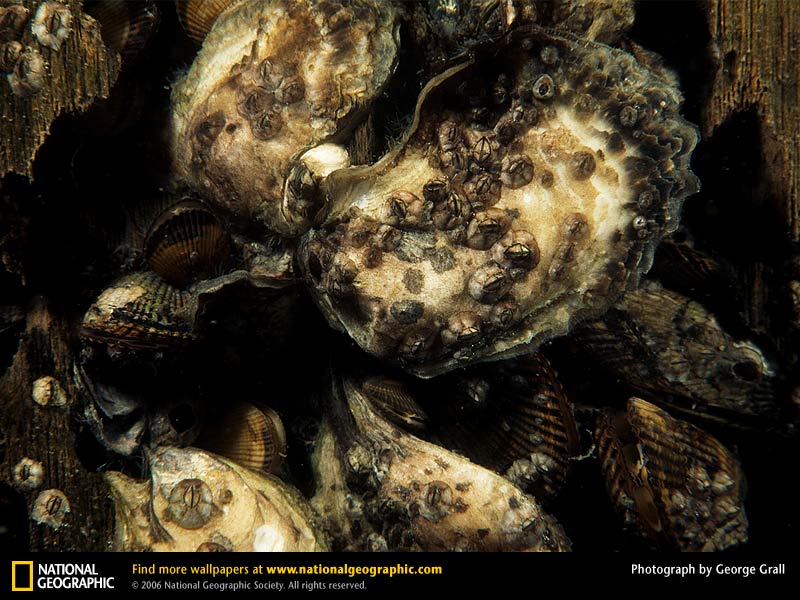
Oysters

A COMMENTARY FOR EARTH DAY – Rev. Gordon C. Stewart | Friday, June 4, 2010 – published by MinnPost.comThe “spill” in the Gulf of Mexico raises the most basic questions about how we humans think of ourselves.

We’re at a turning point. The crisis we can’t seem to kill in the Gulf of Mexico puts before us the results of a more foundational crisis than the black goo that is choking the life out of the Gulf. The uncontrolled “blow-out” raises basic questions about how we think of ourselves and the order of nature.

Fifteen years ago I was with a group of pastors who spent four days with the Chesapeake Bay Foundation, whose mission is to protect and clean up the Chesapeake Bay. Our time there began with a day on the bay on a Skipjack, one of the last remaining motorless sailing vessels that used to harvest oysters by the tens and hundreds of bushels from oyster beds. The director of the Chesapeake Bay Foundation and an old waterman named Earl, who had worked the bay for 54 years, took us to school.

Back then the oyster population had shrunk to a fraction of 1 percent of what it used to be. Fifteen years before our visit the oyster population would filter all the water in the bay in three days’ time. A single oyster pumps five gallons of water through its filtration system every day.

The oysters were close to extinction; the bay’s natural filtering system was in danger. “It’s humans who’ve done this,” said the old waterman. “They’ll come back; I have to believe they’ll come back.”

Others were less hopeful. The Maryland Department of Natural Resources discussed the damage to the wetlands and the estuaries, the seedbeds of life. It had sounded the alarm for public action to protect the birthplaces of all the seafood we eat, the places on which the whole chain of life depends.

Deepwater Horizon fire

This week we heard from the Gulf of Mexico that the attempted “top kill” has failed and that the “spill” is spreading in every direction — not only on the surface, but below the surface — a glob the size of the state of Texas. I think of Earl and his Skipjack as I see the poisoned oysters in the hands of Louisiana oystermen whose livelihood depends on clean Gulf waters. “It’s humans who have done this.”

But it’s not every human who has done this violence to the Gulf. It was not the indigenous people of North America, nor was it the Moken people (“the sea gypsies”) who, because they see themselves as part of nature, anticipated the 2004 Asian tsunami while the rest of the world was caught by surprise. It was a specific form of humanity known as Western culture that sees humankind as the conqueror of nature.

Our language is not the language of cooperation with nature. “And God said, ‘… fill the earth and subdue; and have dominion over the fish of the sea and the birds of the air and over every creeping thing that creeps upon the earth’ ” — (Genesis 1:28), a conquering view based in the idea of species superiority expressed in the phrase “top kill” for the attempt to plug the hole that is killing the oysters and fish of the sea.

Insofar as interpreters of the Book of Genesis have shaped this Western hubris, my Judeo-Christian tradition bears responsibility for this crisis. The idea of human exceptionalism springs from the Bible itself.

But no sooner do I sink into confession and despair than I remember a prayer that Earl called to my attention on the Skipjack 15 years ago, the prayer of St. Basil from the third century that offers a more hopeful understanding of ourselves, a view like Moken people’s that knows that the whole world’s in an oyster:

“The Earth is the Lord’s and the fullness thereof. O God, enlarge within us the sense of kinship with all living things, our brothers and sisters the animals to whom You have given the Earth as their home in common with us. We remember with shame that in the past we have exercised the high dominion of man with ruthless cruelty, so that the voice of the Earth, which should have gone up to You in song, has been a groan of travail. May we realize that they live not for us alone, but for themselves and for You, and that they have the sweetness of life.”