Events: You’re Invited

Join the celebration of the spirit of emancipation in the 150 Year Anniversary of The Emancipation Proclamation

Emancipation: Becoming Free – Go Fly a Kite,Tuesday, October 1, 7:00 – 8:30 p.m.

Steve Shoemaker and President Bill Clinton

Steve Shoemaker and President Bill Clinton

Rev. Steve Shoemaker, host of Univ. of Illinois Public Radio interview program “Keepin’ the Faith” and published poet. Location: Shepherd of the Hill Presbyterian Church, 145 Engler Blvd. in Chaska

The Slaves Speak: Voices from Slavery, Tuesday, October 15, 7:00 p.m.

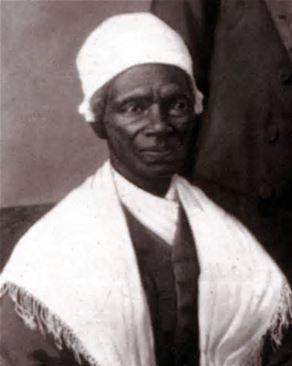
Sojourner Truth

Sojourner Truth

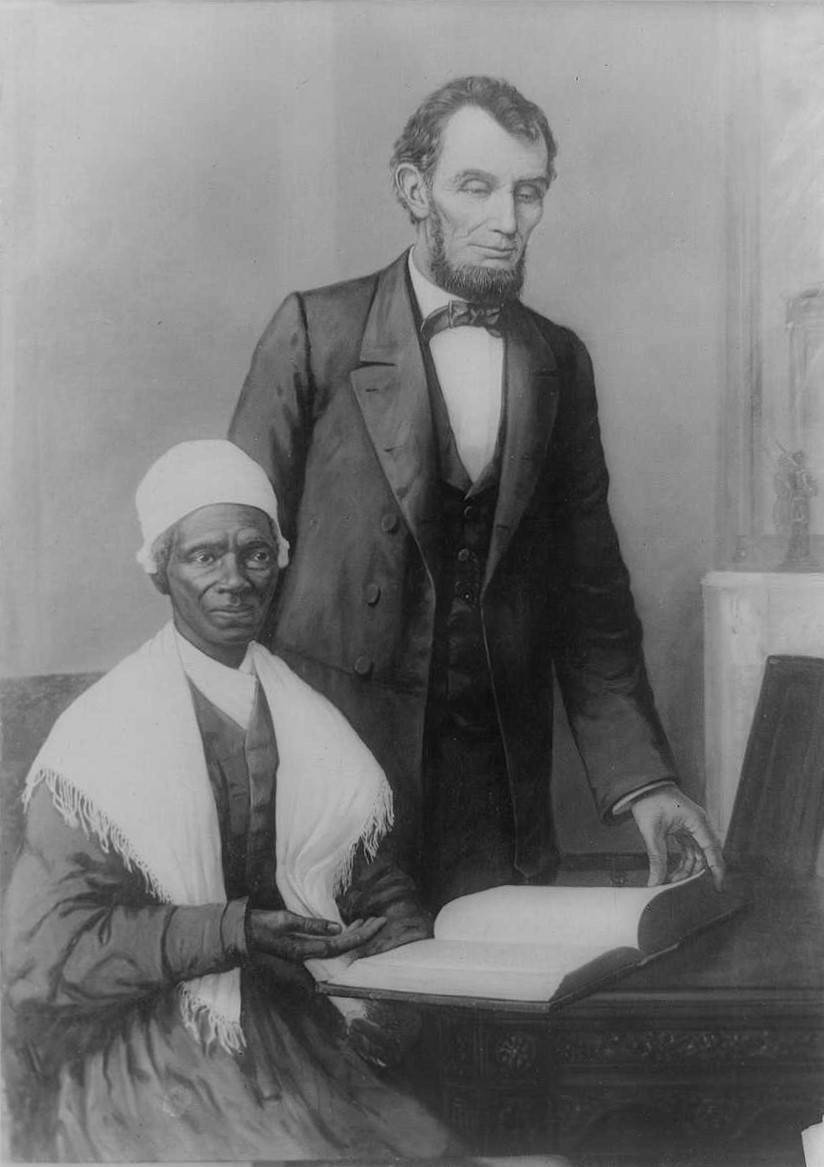
Anticipating Emancipation Day (Oct. 26) Shepherd of the Hill Dialogues presents dramatic readings from the hearts and minds of the slaves and ex-slaves, like Sojourner Truth, pictured here with Abraham Lincoln.

Dramatic readings, insight into the period, the movement toward emancipation in our own time, and communal singing of the songs from the cotton fields (Swing Low, Sweet Chariot; My Lord! What a Morning, and other spirituals).
Location: Shepherd of the Hill Presbyterian Church.

Emancipation Day Celebration, Saturday, October 26 3:15 – 8:30 P.M. Location: Chaska High School

Sojourner Truth and President Abraham Lincoln

Sojourner Truth and President Abraham Lincoln

Mark the 150th Anniversary year of the Emancipation Proclamation celebrate the spirit of on-going spirit of emancipation for our time. Guest speaker and Music by guest artists Dennis Spears, Jerry Steele, Momoh Freeman , and the Valley Band and Chaska High School Choir.

Sponsors for Oct. 26 Emancipation Day Celebration: the Cities of Carver, Chanhassen Chaska and Victoria (Mayor’s Proclamations); Chaska Police Department, Chaska Human Rights Commission; Shepherd of the Hill Presbyterian Church; District 112 Office of Community Education; Carver County Library.

Ted Cruz and demagogic innuendo

Notice how it works in this speech attacking President Barack Obama. The President stood, said Ted Cruz, on the EAST side (i.e. the former Communist side) of the Brandenburg Gate. Ted Cruze’s Subtext: “Obama is a Communist.” That’s the 21st Century voice of Sen. Joseph McCarthy.

ObamaCare 2

The tactic of innuendo used to hold hostage the Affordable Care Act is nothing new on the American political stage. It has a history in the theater of American politics – the substitute of demagogic character assassination for substantive, rational, discussion of public policy. Here Edward R. Murrow exposes the tactics of Sen. Joseph McCarthy.

ObamaCare

They want you to believe that the Patient Protection and Affordable Care Act is a sinister plot. They do not call the Act by its name. They call it “ObamaCare” after the man they love to hate, President they paint as either a secret Muslim or Socialist or Communist. We’ve seen this kind of demagoguery before. Those who forget their history are doomed to repeat it.

This 1954 video of Joseph Welch brought the tsunami of demagoguery, led by WI Senator Joseph McCarthy, to a screeching halt. An exasperated Welsh, Chief Counsel for the Army in the Army-Senate Hearings, finally put the question directly to McCarthy: “Have you no decency, Sir?” The same question pertains to the Right Wing ad scaring the public about a lecherous Uncle Sam (government). Views from the Edge posted that video an hour ago.

Lecherous Old Uncle Sam

Video

There is nothing quite like sexual brutality and fear to scare people to death.

In this TV ad a lecherous, sadistic, evil Uncle Sam substitutes himself for the doctors for a young women’s gynecological exam and a young man’s annual prostate exam. This is the definition of demagoguery. When and where will the Right Wing stop? The actual name for “Obamacare” is The Patient Protection and Affordable Care Act. It was enacted by Congress after many compromises. Demagoguery is leading the populace, in this case the American public, by appealing to prejudices and emotions.

Creating hell in the name of heaven

Imagine there’s no heaven
It’s easy if you try
No hell below us
Above us only sky
Imagine all the people living for today
– John Lennon

The bombs were heard in my living room last night.

The echoes of last Sunday’s suicide bombing of a church in Pakistan that killed 80 people sounded in the voices of two Pakistani members of Shepherd of the Hill Presbyterian Church in Chaska, Minnesota where I serve as pastor. Twelve members of the church had gathered to talk about something totally unrelated to Pakistan, Afghanistan, or Christianity and Islam. We were there to share. The quiet horror of Samuel and Nasrin – “I was sad all day.” – was like a bomb going off in the living room. I ask myself, why? What is happening?

I am a Christian, a disciple of Jesus. Strange as it may seem, I often feel the way John Lennon did. I dream of a different kind of world where there are no more bombings or shootings in a Kenyan mall, in Peshawar and Lahore, Pakistan, in Baghdad, Damascus, or Boston in the name of God. I am tired of all claims to righteousness, whether professedly religious or professedly secular. I would like to wipe the human GPS of its magnetic field between due North heaven) and due South (hell) and re-orient us all toward the rising sun.

The voices that fight for heaven to erase hell do not all sound the same. They speak Urdu, Parsi, Arabic, Hebrew, and English. They claim different names: Muslim, Jewish, Christian, and sometimes secular. They live in different parts of the planet in different time zones and different climates. But if you listen, they all sound alike and they do the same thing.

They do not look up at the sky. They look down. They march in lockstep rhythm because the Quran or the Bible or nationalism tells them to. They live for tomorrow – for heaven or some version of it – not for today. One doesn’t have to strain to see what’s happening, and, when anyone sees it, how can one help but imagine a different world, a different kind of humanity: one without religion?

The bombing in Peshawar last Sunday is said to have been a payback for American drone strikes that had killed innocent civilians in Pakistan. For the suicide bombers, the Cross was the emblem on the shields and helmets of Christian Crusaders. Back then the Knights Templar of Holy War killed with swords. Today the suicide bombers associate the Cross with the drone attacks of the Christian West.

Religion is with us and, depending on how one defines it, always will be. A wise elder statesman, Elliot Richardson, observed toward the end of his life that religion is the problem, but that if we erased all of the religions were erased from the face of the Earth, they would re-invent themselves in a heartbeat. Why? Because that’s how we’re made. As defined by the likes of Emile Durkheim, Margaret Meade and Paul Tillich, religion spans a much wider terrain than the belief systems for which heaven and hell are essential. Furthermore, whether or not we are professedly religious, each of us has some kind of inner GPS, some version of a societal ideal (heaven) and a social and personal horror (hell).

What’s happening across the world is profoundly and earth-shakingly religious. Though our languages are as different as Arabic is from English, and as far from each other as Peshawar and a mall in Kenya are from a Quran-burning church in Florida, the voices of Abraham’s three children (Judaism, Christianity, and Islam) all sound the same whenever we create hell on Earth in the name of heaven.

For the Pakistani friends in my living room last night the Cross stands for a divine interruption of the cycle of violence and all claims to righteousness. In the crucifixion of a Palestinian Jew of the First Century C.E. what we see is anything but the excuse for a crusade to eliminate hell in the name of heaven.
The Jesus we seek to follow threw his life into the spokes of the wheel of violence to stop it, and we must do the same.

Every Sunday worship service concludes with a “Charge” – an instruction in how to live.

Go forth into the world in peace.
Have courage.
Hold on to that which is good.
Return no one evil for evil.
Support the weak.

When the bombs tear through a church or a mosque or a neighborhood in the name of our imagined heaven for the righteous, we need to remember that there are Muslims, Jews, secularists, and other religious practitioners who seek to practice the way of peace…”living for today” throwing themselves into the spokes of the wheel of violence.

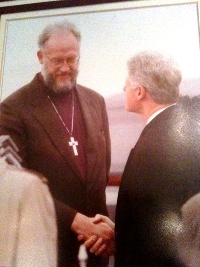
Meeting President Bill Clinton

January 28, 1998

He gave the State of the Union address
the night before, and flew on Air Force One
to our college town in the middle-west
to check out press and public reaction.
(The sex with an intern story made news
the week before.) For six years he had met
not politicians, but “Local Heroes”
at airports (Do-Gooders the Democrat
Party chose.)
Our church worked with homeless men.
As Pastor, I was picked to shake his hand
as he came off the plane (in a long line
with 14 other folks.) He called each one
of us by name. He firmly gripped my hand,
looked in my eyes, pretending to be fine…/

– Steve Shoemaker, Urbana, IL, January 28, 1988

Steve Shoemaker with President Bill Clinton

Steve Shoemaker with President Bill Clinton

Join Steve next Tuesday at 7:00 p.m. at Shepherd of the Hill Presbyterian Church.

Sojourner Truth – Ain’t I a Woman?

Video

Anticipating Shepherd of the Hill Dialogues’ “Voices of the Slaves” program celebrating the 150th Anniversary of the Emancipation Proclamation, we offer Sojourner Truth’s speech here on Views from the Edge. The Tuesday Dialogue on Oct. 15 (7:00 P.M.) will feature dramatic readings like this one and the music that originated in the cotton fields.

Sojourner Truth

Sojourner Truth

Human Evolution

This NPR piece Attenborough’s muddled thinking can’t stop human evolution came to our attention this morning by way of David Earle from New Zealand.

David’s blog is In the Company of Hysterical Women.

His comment on yesterday’s Views from the Edge post The American Religion reads, in part:

Fortunately Sir David is totally wrong on all counts. It is only a small fraction of humanity that benefit for these improvements and even then, it has little to no measurable impact apparently on generic change across population. …

But he is tapping into a wider sentiment that some day we might be so in control of our own destiny that we are no longer subject to this nasty, animal based thing called evolution.

Isn’t that when we force our way back to the garden and eat from the second tree?

Editor’s note: David is referring to the Genesis story (Gen. 2 and 3) where what David calls “the “first tree” is the tree of the knowledge of good and evil (the tree of control/mastery by which they will “be like God”). “The second tree” is the tree of life (by which the characters in the story would become eternal.)

The Garden story is not history; it’s anthropology and theology. It never happened; it’s always happening.

Your thoughts on the matter are welcome. Leave a comment to promote the discussion.

The American Religion

“A religion is a unified system of beliefs and practices relative to sacred things, that is to say, things set apart and forbidden, beliefs and practices which unite into one single moral community…all those who adhere to them.” – Emile Durkheim, The Elementary Forms of Religious Life, p. 17.

Emile Durkheim is one of the fathers of the social sciences and the father of sociology. When he first studied the aboriginal people of Australia, he carried with him a bias against all religion.

“During Durkheim’s life, his thinking about religion changed in important ways. Early in his life, as in Division, he argued that human societies could exist on a secular basis without religion. But later in his life he saw religion as a more and more fundamental element of social life. By the time he wrote Forms, Durkheim saw religion as a part of the human condition, and while the content of religion might be different from society to society over time, religion will, in some form or another, always be a part of social life. Durkheim also argues that religion is the most fundamental social institution, with almost all other social institutions, at some point in human history, being born from it. For these reasons he gave special analysis to this phenomenon, providing a philosophy of religion that is perhaps as provocative as it is rich with insights.

“According to Durkheim, religion is the product of human activity, not divine intervention. He thus treats religion as a sui generis social fact and analyzes it sociologically. Durkheim elaborates his theory of religion at length in his most important work, Forms. In this book Durkheim, uses the ethnographic data that was available at the time to focus his analysis on the most primitive religion that, at the time, was known, the totemic religion of Australian aborigines. This was done for methodological purposes, since Durkheim wished to study the simplest form of religion possible, in which the essential elements of religious life would be easier to ascertain. In a certain sense, then, Durkheim is investigating the old question, albeit in a new way, of the origin of religion. It is important to note, however, that Durkheim is not searching for an absolute origin, or the radical instant where religion first came into being. Such an investigation would be impossible and prone to speculation. In this metaphysical sense of origin, religion, like every social institution, begins nowhere. Rather, as Durkheim says, he is investigating the social forces and causes that are always already present in a social milieu and that lead to the emergence of religious life and thought at different points in time, under different conditions.”
– Paul Carl’s entry on Emile Durkheim published June 3, 2012 in Internet Encyclopedia of Philosophy: a Peer-Reviewed Academic Resource.

QUESTION

Later sociologists like Robert Bellah look today at American society and ask what “sacred things” are enshrined in American culture and practices.

What are the equivalent beliefs and practices, “sacred things” set apart or forbidden, that give coherence to a fast-changing American society?