
Was Jesus guilty?

by Gordon C. Stewart (copyright)

Was Jesus of Nazareth guilty as charged?

The charge against Jesus of Nazareth was that he “refused to pay tribute to Caesar” and that “he stirred up the people.” One translation called him a “seditionist” or, in a congressman’s language, a subversive, an enemy of the state. The late lay theologian and lawyer William Stringfellow argued that Jesus was a revolutionary. Not a rhetorical revolutionary, but one whose very existence threatened his world in a revolutionary way.

Years of pouring over the Gospel texts and the Dead Sea Scrolls for clues as to the nature of the time of Jesus of Nazareth have not quite brought me to the stark nakedness of Bishop James Pike, but I’m close.

The Bishop was in Washington, D.C. for a meeting of some sort. His friend Anthony Towne went to his hotel room to take him to breakfast. When Anthony knocked on the door, the Bishop shouted out, “Come on in, Tony, the door’s open.” He opened the door to find the Bishop sitting in an arm chair, Dead Sea Scroll manuscripts scattered around the floor surrounding the chair, sitting there in the altogether. The Bishop was so entranced with the Scrolls and the Scriptures that he had forgotten to dress; he was unaware of his nakedness. Bishop Pike later died alone in the Judean wilderness searching for the historical Jesus.

I’m not as obsessed with the question as James Pike was, but I am nonetheless intrigued, fascinated, confused, and excited by Jesus of Nazareth and the New Testament witness to him precisely because of the new information that invites us to ask again who Jesus was.

Christians often see the cross as something that God intended for Jesus as the Son of God, as if God sent his son into the world that we might kill him and that Jesus was surely innocent of the charges brought before Pilate. Rarely do we consider the possibility that Jesus was guilty as charged. Likewise, what we in the church call Palm Sunday/Passion Sunday is often observed in a way that paints Jesus as the non-political spiritual man whose kingdom is not of this world, contrary to the people on the street who mistakenly hailed him as the warrior king whose aim was to throw Rome out of Palestine.

Palm Sunday provides a window into the question of whether Jesus was guilty as charged. Go beneath all theological assumptions to step onto the road with the people who waved the branches and ask what they were doing there and why Jesus did what he did. But before we look at the parade into Jerusalem we remember that the death we observe on “Good Friday” was a political execution, the Roman equivalent of the electric chair, the firing squad, and the gas chamber. The charges against him at the trial are clearly political. “We found this man inciting our people to revolt, opposing payment of the tribute to Caesar, and claiming to be Christ, a King” (Luke 23:2, Jerusalem Bible). Jesus was executed as a revolutionary against the Roman Empire.

Behind the New Testament texts lie the familiar strains of the older texts from Zachariah and II Maccabees.

The background of Palm Sunday in the Book of Zachariah

One of the first things to notice about the Palm Sunday episode, the “triumphal entry” into Jerusalem, is that the demonstration is not spontaneous. “The master has need of it” – the words the disciples have been instructed to speak to a man in town who owns a donkey – is code language, arranged in advance. Furthermore, Christ rides on the donkey, not a horse. Traditionally this has been taken to mean that he refuses the title of king and prefers to come instead in humility, riding on a donkey. But look more closely at the setting for the donkey passage in the literature of Zachariah and you will find an oracle against a foreign occupier. It is in the context of his oracle against oppression that Jesus chooses to ride on a donkey (or two donkeys!). Here’s the Zachariah passage:

“Near my house I will take my stand like a watchman on guard against prowlers; the tyrant shall pass their way no more, because I have now taken notice of its distress. Rejoice heart and soul, daughter of Zion! Shout with gladness, daughter of Jerusalem! See now, your king comes to you; he is victorious, he is triumphant, humble and riding on a donkey, on a colt, the foal of a donkey. He will banish chariots from Ephraim and horses from Jerusalem; the bow of war will be banished. he will proclaim peace for the nations. His empire shall stretch from sea to sea, from the River to the ends of the earth. As for you, because of the blood of your covenant, I sending back your prisoners from the pit (in which there is no water?” – Zachariah 9:8-11, Jerusalem Bible.

Jesus’ entry into Jerusalem is rooted in the hope of Zachariah. Riding the colt identifies Jesus with the long-held hopes of Jesus’ people for an end to their bondage – economic, political, financial, cultural, spiritual, imperial bondage. The Zachariah text occurs in a section of curses against oppressors. To cherry pick humility from the text while ignoring the context and symbolism of the donkey fails to do justice to the sweeping hope of an altogether new and totally revolutionary transformation.

The background of Palm Sunday in Second Maccabees

The people lining the streets are waving branches hailing Jesus as the Messiah, the liberator of the nation from foreign occupation. The palm was a symbol of Jewish resistance. At an earlier time in the Second Century BCE Simon Maccabaeus was hailed with palm branches after a successful Jewish warfare that had regained the nation’s freedom and reclaimed the integrity of the Temple. Here’s the text:

“Maccabaeus and his companions, under the LORD’s guidance, restored the Temple and the city, and pulled down the altars erected by the foreigners in the market place, as well as the sacred enclosures. They purified the sanctuary and built another altar; then striking fire from flints and using this fire, they offered the first sacrifice for two years, burning incense, lighting the lamps and setting out the loaves. When they had done this they threw themselves flat on the ground and implored the LORD never again to let them fall into such adversity, but if they should ever sin, to correct them with moderation and not to deliver them over to blasphemous and barbarous nations. This day of the purification of the Temple fell on the very day on which the Temple had been profaned by the foreigners, the twenty-fifth of the same month, Chislev. They kept eight festal days with rejoining, in the manner of the Feast of Tabernacles, remembering how, not long before at the time of the Feast of Tabernacles, they had been living in the mountains and caverns like wild beasts. Then, carrying branches, leafy boughs and palms, they offered hymns to him who had brought the cleansing of his own Holy Place to a happy outcome. They also decreed by public edict, ratified by vote, that the whole Jewish nation should celebrate the same every year.” (II Maccabees 10:1-8)

In times such as this I join Bishop Pike in asking who he was and find myself quite naked and often alone in the search. But one thing I think I know. Bill Stringfellow nailed it. Jesus was a revolutionary of the most profound sort. His very existence – his being – was enough to bring charges from a world that refused to be disturbed by him. “See now, your king comes to you; he is victorious, he is triumphant, humble and riding on a donkey, on a colt, the foal of a donkey. He will banish chariots from Ephraim and horses from Jerusalem; the bow of war will be banished. he will proclaim peace for the nations. His empire shall stretch from sea to sea….”

Will we shrink Jesus of Nazareth to our own small size and purposes, or will we line the streets with festal branches for the humble man on the colt whose kingdom of justice, peace, and love is always being crucified but can never be extinguished?

NOTE

This sermon was preached March 19, 1978 in McGaw Chapel at The College of Wooster, Wooster, OH.
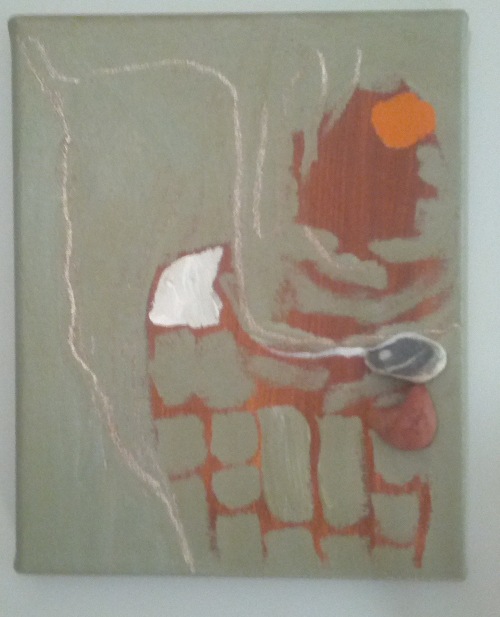
Listening to the Stones from the Wall Street Wall

Last evening we published Susan Lince’s wonderful poem “Every Stone Shall Cry” and her accompanying art work. Thanks to Susan for permission to publish them.

Not everyone is familiar with this line about the stones. The poetry of the stones crying out has its roots in Hebrew Scripture in a poem from the Book of Habakkuk, later echoed by Luke as Jesus’ response to those who want to silence his disciples and protesters to Roman occupation – “I tell you,” says Jesus riding on an ass into the city occupied by the Romans, “if these [people] were silent, the very stones would cry out” (Luke 19:40).

The original Ode of Woe against the Chaldeans’ foreign interventions and military-economic occupation becomes, on Jesus’ lips, the ode against the Roman system of occupation and internal collaboration by indigenous leaders, and, on Susan’s lips, it echoes from the walls of intractable powers that nature itself will not long abide in silence. Nature will not be silent! Think of the stones in the wall of Wall Street. Even the stones cry out against the abuse. Here’s the text from the Book of Habakkuk where the reference to the crying stones first appears:

Woe to him who heaps up what is not his own—
for how long? —
and loads himself with pledges!”
Will not your debtors suddenly arise,
and those awake who will make you tremble?
Then you will be spoil for them.
Because you have plundered many nations,
all the remnant of the peoples shall plunder you,
for the blood of man and violence to the earth,
to cities and all who dwell in them.
Woe to him who gets evil gain for his house [society/empire],
to set his nest on high,
to be safe from the reach of harm!
You have devised shame for your house
by cutting off many peoples;
you have forfeited your life.
For the stone will cry out from the wall,and the beam from the woodwork respond.
Woe to him who builds a town with blood…

– Habakkuk 2: 6b-12a

The ode against the Chaldean Empire ends with a lovely line looking for the day when the most intimate knowledge of the Breath of Life will cover the earth “as the waters cover the sea” and the stones will no long cry.

Susan is a writer, painter, poet, composer, environmental and social justice activist. She and her spouse, John Lince-Hopkins, developed the movement Requiem2020. They will lead the First Tuesday Dialogues event on Climate Departure at Shepherd of the Hill Presbyterian Church in Chaska, MN Tuesday evening, March 4, at 7:00 P.M.

Poem: Every Stone Shall Cry

Original art by Susan Lince - "Every Stone Shall Cry"

Original art by Susan Lince – “Every Stone Shall Cry”

The stone lies
Near the pile of boulders
In the city park
Watching over the man asleep
In his cardboard shelter
And cries.

And every stone shall cry

The stone cries
Along the roadside
As the bomb explodes
Killing young soldiers
As well as the children nearby.

And every stone shall cry

The stone knows to cry
Even before the excavator
Upheaves the earth
To take away the coal
And leaves only a ragged empty space.

And every stone shall cry.

The ancient stones
Of the wailing wall
Cry as they have cried for centuries,
Listening to the prayers
Of the sufferers
And the selfish,
The grieving,
And the greedy
That reverberate
With echoes of misunderstanding
About who has been left out
Of the Kingdom of God on Earth.

And every stone shall cry.

Every stone shall cry
Yet goes unheard,
As humankind,
With hardening core,
Pushes violence, power,
Injustice, and neglect
Rumbling across the world
Like boulders.

– Susan Lince, artist and poet, Chaska, MN.

The headless chicken brigade

Prince Charles recently called climate deniers “the headless chicken brigade”.</p>

“It is baffling, I must say, that in our modern world we have such blind trust in science and technology that we all accept what science tells us about everything – until, that is, it comes to climate science. 

“All of a sudden, and with a barrage of sheer intimidation, we are told by powerful groups of deniers that the scientists are wrong and we must  abandon all our faith in so much overwhelming scientific evidence.

“So, thank goodness for our young entrepreneurs here this evening, who have the far-sightedness and confidence in what they know is happening to ignore the headless chicken brigade and do something practical to help.

“As you may possibly have noticed from time to   time, I have tended to make a habit of sticking my head above the parapet and generally getting it shot off for pointing out what has always been blindingly obvious to me. 

“Perhaps it has been too uncomfortable for those with vested interests to acknowledge, but we have spent the best part of the past century enthusiastically testing the world to utter destruction; not looking closely enough at the long-term impact our actions will have.”

– Prince Charles at award ceremony honoring young green entrepreneur.

Think Headless Chicken Brigade Keystone Pipeline.


Winston Churchill on Climate Departure

What might Winston Churchill say about climate change and the prognosis of climate departure around 2020?

“So they go on in strange paradox, decided only to be undecided, resolved to be irresolute, adamant for drift, solid for fluidity, all-powerful to be impotent…  Owing to past neglect, in the face of the plainest warnings, we have entered upon a period of danger.  The era of procrastination, of half measures, of soothing and baffling expedients, of delays, is coming to its close.  In its place we are now entering a period of consequences….  We cannot avoid this period, we are in it now…” 

                 – Winston Churchill, November 12, 1936


The Last Lion - Winston Churchill

The Last Lion – Winston Churchill

Pete Seeger to the rest of us

Video

Pete Seeger sings a song that rallies the best in us to continue his work of changing the world. God’s countin’ on me; God’s countin’ on you!

The Perpetual Question

Yet Again, for the 21st Century:

The Perpetual Question
 
Based upon a preponderance of evidence, the question of climate change and its potential ramifications is no longer a valid debate for the 21st century.  Once again, like thunder reverberating from Genesis, comes the ancient and perpetual question:

                             “Am I my Brother’s Keeper”?

As we reach the tipping point of climate and climate departure becomes a global concern through the remainder of the 21st Century, a driving and as yet unaddressed question looms large before us:

          “In light of what we now know, how are we to be the keepers of our brothers and sisters as our world changes and climate stress affects vast populations”?

The UN High Commission on Refuges (UNHCR) and the governments of the world have not yet addressed this question nor adopted a legal definition of “Climate Refugee”.

The year 2020 is a statistical marker, more or less, when we begin to see the first indications of climate departure in the western Pacific near Indonesia.  In the ensuing 50 years or so, climate departure is projected to spread from the tropics to the poles until it becomes global.

The time is NOW to begin the discussion. 

– John Lince-Hopkins, scientist, artist, and developer of Requiem.org. (http://requiem2020.org)

NOTE TO THE READER: Please chime in here or on Requiem.org and help spread awareness and the consideration of the question. Thank you, John, for raising the perpetual question.

I, Judas

They will say I did it. And I did. We all did. But it doesn’t matter. The kiss, the “shalom”, I gave him in the olive grove was as real as real can be. I kissed him, and everything that was in me was in that kiss. My love, my affection, my admiration, my fear…and my belief that it would wake him up to what was really happening and what he had to do.

The world is a cruel place. It plays by hard rules. He wouldn’t play by the rules, which is why we loved him but also why we pushed him at the end. We pushed him over the cliff.

He’d escaped the cliff once before when his neighbors tried to throw him over it. He walked right through that crowd and went on with his life, and that’s why we gathered around him like newborn kittens with their mother. He became the source of nourishment, the mother whose eyes always saw the good in us, and he taught us to forget about the cliffs. Live to the full. Forget the cliffs! But there comes a time in everyone’s life when you can’t avoid the cliff.

We were standing at the edge of it right there in the Mount of Olives – a fatal cliff of soldiers, clubs, and daggers, a Roman battalion who’d come there, where we always met at night among the olive trees so they couldn’t hear us or see us. I led them there to the private place.

They will say I ratted on him. But I did what I knew I had to do, or thought I had to do, and then scurried away before it was over. I couldn’t watch. I hated those bastards as much as I loved him, hanging there where the skulls were left. As I ran, I looked back over my shoulder at the horror of it, hearing the sounds of the hammers and the grinding of the pulleys hoisting him up on those pieces of imperial lumber, and him screaming with pain suspended mid-air… half way between horizontal and vertical…and I fleeing for my life into fatal despair.

I understand why they’ll say what they they’ll say. They have to say it. Denial is one of God’s great gifts. They had to deny their own responsibility for what happened. We were all in this together, except for the Beloved Disciple, Lazarus, the only one of us who knew already that death is not the final Word, no matter how it comes, the disciple who will disappear into silence in the later texts about what happened. But Lazarus was there watching, listening, seeing what the rest of us could not see until after it was over.

Unlike the others, I didn’t give myself time to get it. I fled the scene, running for my life, never wanting to look back on it, howling in silence, rushing out into the field to hang myself from a tree. Symbolic, some will say: the tree of the knowledge of good and evil and all that … but to me it was just a tree with limbs to throw the rope over, a place to end my pain.

I think now of the olive trees and of hiding among them and wonder why we hid. I think of him as the olive branch that the dove brought to Noah as the violence of the flood receded. And I wonder if that was maybe what he was all about, if the olive branch instead of clubs and daggers and scapegoating was why he let me kiss him there and turn him over before he rebuked Peter for drawing his dagger.

They won’t tell you that we all had daggers. Not just Peter. We were revolutionaries. Ready for the fight. Itching for the fight. Yeshua was the new Joshua who would throw the bums out, restore the fortunes of our people, give us back our land, our destiny, our power to rule ourselves as we had in David’s time and Solomon’s. There was that day in the Temple, Solomon’s Temple, when he went crazy with the whip against the money-changers, snapping the whip wildly, out of control, angry at the abuse of his religion and our’s, tossing the money everywhere, yelling about the money-handlers’ abuse of the poor who could barely afford to buy a pigeon for their sacrifices. For him, it wasn’t just about self-determination. It was about the Romans, about the end of foreign occupation and the collaboration of the religious establishment. But it was deeper than throwing out the foreign occupiers. It was about something so deep that the mind and heart can barely comprehend it: the fearful conspiracy of self-interests that betrays and kills all that is good and pure and decent and loving.

Only Lazarus understood what he was about in standing up to the rule of death enshrined in the Temple and imperial threats. He saw in Yeshua the scapegoat who could unmask the conspiracy, the new Joshua who would shift us from eating the forbidden fruit of the tree of the knowledge of good and evil, dividing the world into the good and the evil, to eating of the fruit of the tree of life.

I broke my neck on the tree of the knowledge of good and evil, certain that I, one of the “good” ones, had become as evil as the soldiers who crucified him, and that there was no redemption, no way to the tree of life, no way to atone, no way to erase the kiss that killed him and was killing me. Death was my just desert and worse. If only I had known that the kiss would be the kiss of death.

It gives me little comfort that they tell me he begged the Father from the cross for forgiveness, like a defense attorney pleading with a judge that those who were crucifying him didn’t know what they were doing. It is what it is. Or so I thought at first. But the weight of his words led me to the sound of them, coming as they did from the high heat of that awful scene, soft and genuine or loudly shrieking, invoking a mercy on us all that made no sense, no sense at all.

Peter will say, as will the church three centuries after my death on the tree and burial in potters field, that “he descended into hell” at his death and preached to those imprisoned there. If anyone was ever there in that place of self-hate, remorse, guilt, despair and hopeless self-loathing, it was I.

He met me there with a holy kiss. “Shalom,” said he. I kissed him back. And left my sorrow in the emptied cell.

– Gordon C. Stewart, January 10, 2014.

Oceans of Acid

The acid smog in the air
rains into rivers
and joins factory sludge
and field chemicals
on their way to the sea.

The obscene slime
spreads from ocean
to ocean and from coast
to oily coast.

The air cannot wash its
hair because trees and shrubs
have not been replanted
most places by most people.

Wood and coal and oil burn on,
rivers are damned, mostly
unfresh water remains
turning a blue planet brown.

We humans might see
our world changing,
but we see screens
and windshields more
than we see our skies.

[Thanks to Elizabeth Kolbert for her
two recent New Yorker articles
reporting on the research for this.]

Steve Shoemaker, Urbana, IL, January 4, 2014

It’s all there in the Christmas story