MinnPost is a nonprofit online newspaper in Minneapolis, founded in 2007, with a focus on Minnesota news. “MinnPost is a nonprofit, nonpartisan enterprise whose mission is to provide high-quality journalism for people who care about Minnesota. We publish online at http://www.minnpost.com Monday through Friday with a limited edition on Saturday and a Sunday Review.” Wikipedia’s description adds further information.The site does not endorse candidates for office or publish unsigned editorials representing an institutional position. MinnPost encourages broad-ranging, civil discussion from many points of view, subject to the discretion of a moderator.
Funny how things come together, crisscross, intersect, lead us down roads no one has ever walked before. Neil Postman offers insight into what’s happening. I read it one morning last week at the cabin, away from everything that entertains and distracts me from that little plot of land on the edge of the wetland in Central Minnesota.
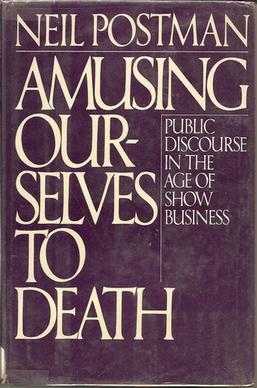
Contrary to popular belief. . . Huxley [Brave New World] and Orwell [1984] did not prophesy the same thing. Orwell warns that we will be overcome by an externally imposed oppression. But in Huxley’s vision, no Big Brother is required to deprive people of their autonomy, maturity and history. As he saw it, people will come to love oppression, to adore the technologies that undo their capacity to think.
What Orwell feared were those who would ban books. What Huxley fears was that there would be no reason to ban a book, for there would be no one who wanted to read one. Orwell feared those who would deprive us of information. Huxley feared those who would give us so much those that we would be reduced to passivity and egoism. Orwell feared that the truth would be concealed from us. Huxley feared the truth would be drowned in a sea of irrelevance. Orwell feared we would become a captive culture. Huxley feared we would become a trivial culture, preoccupied with some equivalent of feelies, the orgy porgy, and the centripetal bumblepuppy . . . . In 1984, Huxley added, people are controlled by inflicting pain. In Brave New World, they are controlled by inflicting pleasure. In short, Orwell feared that what we hate will ruin us. Huxley feared that what we love will ruin us. This book is about the possibility that Huxley, not Orwell, was right. —Neil Postman, Amusing Ourselves to Death
Neil Postman, Amusing Ourselves to Death
The wetland pond, the flyway, and return home
At the cabin, the water in the wetland is unusually high this year because of record-breaking rainfall. The flocks of Buffleheads and other non-diving ducks have by-passed their familiar stop on the flyway; the water is too deep to for them to reach the food sources below. Only the long-necked Trumpeter Swans, Sandhill Cranes, and Canadian Geese, and the diving Loons and Mergansers that can reach the bottom have stopped by this year.
Leaving the cabin and the wetland lead home to the world Huxley feared where the truth is drowned in a sea of irrelevance. We settle back into the lounge chairs in front of the television and flip through Netflix, YouTube, and other means of entertainment in what Postman later called the Technopolis in which our capacity for critical thought is numbed.
The new normal
We turn on the evening news and see two very different versions of Speaker of the House Nancy Pelosi speaking to the press. One is real. The other is altered by technology that deceives viewers into believing the Speaker is drunk, on drugs, or mentally impaired by slowing and altering the pace of her speech. The culture of amusing ourselves to death in the Technopolis distorts truth into propaganda, the first wave of what will become the new normal.
We’re not in make-believe Mayberry anymore. What we love — entertainment — is drowning us. In the world foreseen by Huxley, Orwell, and Postman, truth is hard to find. “Where there is no critical perspective, no detached observation, no time to ask the pertinent questions, how can one avoid being deluded and confused?” wrote Thomas Merton in Faith and Violence: Christian Teaching and Christian Practice.
Only the long-necked Trumpeter Swans, Sandhill Cranes, and Canadian Geese, and the smaller, deep-diving Loons and Mergansers can reach or swim to the bottom to see what’s real and what’s not in the Technopolis. William Britton’s Wisdom from the Margins with Neil Postman, Aldous Huxley, George Orwell, and Thomas Merton took me there this morning.
It’s no longer a partisan question. It becomes clearer every day. It’s not a strategic question. It’s no longer a question of how much more, or when is enough enough. It’s a constitutional question. It’s an oath of office question, the oath taken by every member of Congress under the U.S. Constitution.
U.S. Constitution Article VI. clause 3
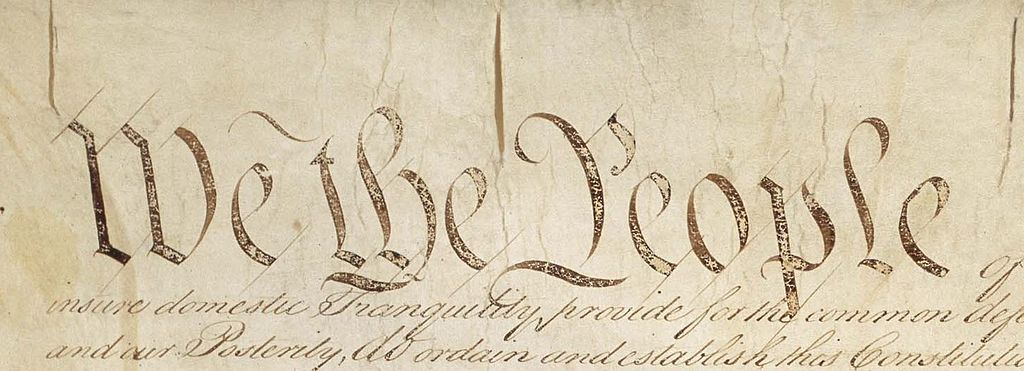
“The Senators and Representatives … and the Members of the several State Legislatures, and all executive and judicial Officers, both of the United States and of the several States, shall be bound by Oath or Affirmation, to support this Constitution . . .”— U.S. Constitution, Article VI, clause 3.
“I, __, do solemnly swear (or affirm) that I will support and defend the Constitution of the United States against all enemies, foreign and domestic; that I will bear true faith and allegiance to the same; that I take this obligation freely, without any mental reservation or purpose of evasion, and that I will well and faithfully discharge the duties of the office on which I am about to enter. So help me God.”
The Integrity of Office and Democratic Republic
With every passing day, some who have taken the oath of office side-step the duties of their offices by “purpose of evasion” in the face of the growing constitutional crisis. It is no longer a question of which side of the aisle you are on. Supporting and defending the U.S. Constitution means, at very least, upholding the constitutional checks and balances among executive, congressional, and judicial branches designed to protect a democratic republic from its implosion. Assaults and circumventions around that division of powers are assaults on the Constitution and the rule of law it protects.
Purpose of evasion
EVASION. A subtle device to set aside the truth, or escape the punishment of the law; as if a man should tempt another to strike him first, in order that he might have an opportunity of returning the blow with impunity. He is nevertheless punishable, because he becomes himself the aggressor in such a case. Wishard, 1 H. P. C. 81 Hawk. P. C. c. 31, Sec. 24, 25; Bac. Ab. Fraud,
Loyal Opposition and Loyal Majority
The British idea of “loyal opposition” — loyalty to the nation and to the oath to “support and defend” the Constitution — is a long-standing tradition. The loyalty is to the Constitution. Faithfulness to one’s oath of office, not loyalty to a person. Loyal opposition holds the party in power accountable. Loyal opposition infers loyalty to the Constitution by members of whatever party is the majority.
Patisan stone-walling against the Constitutional duty of Constitutional oversight — whether by a President, the House of Representatives, or the U.S. Senator — constitutes violation of the oath of office by “purpose of evasion”.
The Twinkling of an Eye: No time to blink
Some argue that an impeachment inquiry by the House of Representatives, regardless of its findings, is destined to fail because the majority party in the Senate will exonerate the President of the majority party.
We do well to remember the wisdom of an earlier American President:
Democracy… while it lasts is more bloody than either aristocracy or monarchy. Remember, democracy never lasts long. It soon wastes, exhausts, and murders itself. There is never a democracy that did not commit suicide.
Some things cannot wait. Some things have time limits. Constitutions, the rule of law, and democratic republics can disappear in the twinkling of an eye.
Dennis Aubrey of Via Lucis became a friend after we found each other’s work through the web. As he has many times before, Dennis has spoken for me.
By the rivers of Babylon, there we sat down
Yea, we wept, when we remembered Zion.
We hanged our harps upon the willows in the midst thereof.
For there they that carried us away captive required of us a song;
And they that wasted us required of us mirth, saying, Sing us one of the songs of Zion.
How shall we sing the Lord’s song in a strange land?
Psalm 137:1-4 (King James Version)
When I lived in Los Angeles from 1972 to 2000, the city was filled with men and women who lived and died on the streets. It seemed an inevitable part of urban life, where displaced humanity would collect in the hidden corners of our cities. Facilities for the mentally ill had closed, prices for homes had accelerated and more people lost their ability to own or even rent. I knew what was happening in the rust…
This brief video addresses questions that continue to stump me. Will we ever get it back? Whatever one’s view of Barack Obama, one cannot refute the flagrant juxtapositions between the values the current Republican Party professes and the real life disdain for those same values.
President Barack Obama to Republican supporters of Donald Trump.
It’s time to stop the White House’s frontal assault on the equality among the three branches of federal government defined under the U.S. Constitution. Time for us, the American people, to tell those in Congress to do what Congress is supposed to do. Contempt of Congress is partisan. It is contempt for the institution itself, and for the Constitution that establishes and protects the American experiment under the rule of law. It’s time for boldness.
Anyone who witnessed Attorney General Barr’s testimony before the Senate Judiciary Committee saw and heard the AG’s disdain for truth-telling. He lied. The next day he refused to appear before the House Committee. This is not time for patience. It’s time for Congress to act swiftly and boldly with arrests for contempt of Congress.
“I notice that as soon as writers broach this question, they begin to quote. I hate quotations. Tell me what you know.” — Ralph Waldo Emerson, Journals
If we don’t say what we know, what happens next will be on us. We can’t let that happen.
The question to which Ralph Waldo Emerson referred in his journal was different from the one we broach now, but — with apologies for the quotation he would have hated — his challenge to us would be the same: Tell me what you know. If we don’t speak what we know, the shredding of the U.S. Constitution’s system if checks-and-balances among three equal branches of government will be on us.
Emerson was referring to immortality. He knew what many others did not. No one reallyknows about immortality. Not first-hand. His advice can be understood differently by reading the last sentence aloud, stessing different words— tell me what you know, or tell me what you know — but no matter where you put the emphasis, Emerson’s point seems to have been the same. Don’t speculate. Speak of what you know from your own experience..
What you see with your eyes, hear with your ears, smell with you nose can be delusional, but seeing, hearing, and smelling are the ways mere mortals know whatever we know, or think we know.
What my EYES know
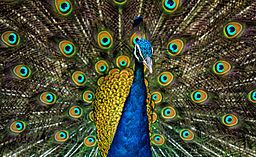
Whenever Donald Trump comes into view — I see a peacock. A peacock’s feathers are stunning. They’re beautiful. And they know it. They strut. A peacock commands everyone’s attention. You can’t help but look. Such confidence! Look at all those eyes!
But, as I Iearned years ago visiting wealthy parishioners whose peacocks had free reign on the grounds of their estate, you keep your distance from a peacock. If you get too close, they make a ruckus. They shriek to put you on notice. Come closer and you will pay the price. Peacocks are mean.
Watching the current American president feels like that. I see facial expressions when he tells an audience what he knows they want to hear instead of what he knows. He’s lying. Even his secure base knows it. I see the 2020 rallies, the crowds cheering for a peacock strutting around, fanning his feathers.
What my EARS know
You don’t need to have stood in the Rose Garden to know when a peacock is feeling cocky. Or threatened. You know from the sound. Bring a friendly television camera crew to show off his feathers by fanning his tail, and give him a microphone with free range and the peacock is in his glory. Camera crews permitted on his property have taken orher photos of the peacock strutting across the lawn with one of his harem, knowing the cameras already are rolling to show other TV-watching peacocks what he has that they don’t — except in their dreams — a hen with feathers like that! The peahen is all show. She never makes a squack. She only speaks out to shine the light on school bullies, guys like Daryl at my elementary school and like whoever bullied her peacock before he learned to preen and parade his way to the world’s biggest playground.
The peacock hardly ever tells the truth. Everyone knows he lies all the time. He may know it; he may not. It’s hard to tell. He speaks convincingly as one who knows, and knows more than all the other peacocks and members of the camera crews. He never quotes anyone, routinely referring to himself in the third person, as though someone else is speaking about him. What we hear is very strange. Ornotholigists provide a more objective description of the peacock’s behavior.
The peacock’s behavior is a common cause for fear. They are known to be aggressive, fiercely territorial birds…. The peacock’s low intelligence has caused wild peacocks in urban areas to attack dark-colored luxury cars: the birds see their reflections, interpret it as a second bird and attack. Peacocks have also been seen chasing people to take their food. At the same time, when a peacock is angry they have a tendency to spread themselves out – and seeing a bird your size or larger fan out, with feathers that could be misconstrued as eyes, is more than enough to cause a child to develop a long-standing phobia.
I hear loud shrieks as the peacock chases the camera crews off the property. But the shrieks are not loud enough to drown out the sound of paper shredders shredding the papers the camera crews have come to see.
What my NOSE knows
I have a long-standing fear of fire. I remember watching the flames and smelling the smoke from the four alarm fire I watched through my bedroom window. My father, a volunteer fireman, had left home that night to put out the fire. I was afraid he wouldn’t come back.
I’m no longer five years old, but my nose knows the smell and knows that where there’s smoke, there’s fire. I smell smoke coming from the White House. I smell the Constitution burning, and see a peacock running loose, attacking his own reflection on the presidential limousine.
Leave YOUR COMMENT to widen the conversation. Tell me what you know.
–Gordon C. Stewart, Chaska, MN, April 26, 2019.
Donald Trump Photo Attribution: Donald Trump speaking at CPAC 201; photo by Greg Skidmore.
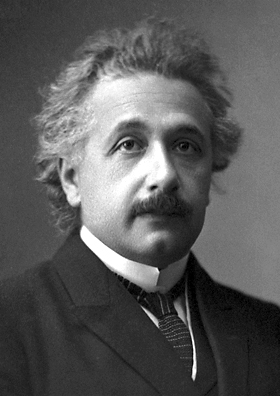
Nationalism is an infantile disease. It is the measles of mankind.
Albert Einstein to George Sylvester Viereck, 1921.
There is a world of difference between nationalism and patriotism. Patriots love their country. Nationalists idolize it.
WHO IS DISLOYAL IN AMERICA?
Who are the really disloyal? Those who inflame racial hatreds, who sow religious and class dissensions. Those who subvert the Constitution by violating the freedom of the ballot box. Those who make a mockery of majority rule by the use of the filibuster. Those who impair democracy by denying equal educational facilities. Those who frustrate justice by lynch law or by making a farce of jury trials. Those who deny freedom of speech and of the press and of assembly. Those who demand special favors against the interest of the commonwealth. Those who regard public office merely as a source of private gain. This who would exalt the military over the civil. Those who for selfish and private purposes stir up national antagonisms and expose the world to the ruin of war.
Propaganda must always address itself to the broad masses of the people. (…) All propaganda must be presented in a popular form and must fix its intellectual level so as not to be above the heads of the least intellectual of those to whom it is directed. (…) The art of propaganda consists precisely in being able to awaken the imagination of the public through an appeal to their feelings, in finding the appropriate psychological form that will arrest the attention and appeal to the hearts of the national masses. The broad masses of the people are not made up of diplomats or professors of public jurisprudence nor simply of persons who are able to form reasoned judgment in given cases, but a vacillating crowd of human children who are constantly wavering between one idea and another. (…) The great majority of a nation is so feminine in its character and outlook that its thought and conduct are ruled by sentiment rather than by sober reasoning. This sentiment, however, is not complex, but simple and consistent. It is not highly differentiated, but has only the negative and positive notions of love and hatred, right and wrong, truth and falsehood.
Propaganda must not investigate the truth objectively and, in so far as it is favourable to the other side, present it according to the theoretical rules of justice; yet it must present only that aspect of the truth which is favourable to its own side. (…) The receptive powers of the masses are very restricted, and their understanding is feeble. On the other hand, they quickly forget. Such being the case, all effective propaganda must be confined to a few bare essentials and those must be expressed as far as possible in stereotyped formulas. These slogans should be persistently repeated until the very last individual has come to grasp the idea that has been put forward. (…) Every change that is made in the subject of a propagandist message must always emphasize the same conclusion. The leading slogan must of course be illustrated in many ways and from several angles, but in the end one must always return to the assertion of the same formula.
In this short video Karl Barth addresses the question of how the German people were led to sacrifice a democratic constitutional republic for the dream of Adolf Hitler.
Karl Barth, theologian, professor, author, founder of the Confessing Church which refused to participate in the surrender of faith to the ideology of the Third Reich, and author of The Declaration of Barmen.
NOW: VIOLATION OF THE OATH OF OFFICE
What we see in the U.S.A. in 2019 is chilling. During his visit to the U.S.–Mexican border the American President violated his oath of office “… to the best of my Ability, to serve, protect, and defend the Constitution of the United States of America.” (Article II, Section One, Clause 8, U.S. Constitution). If, during his recent visit to Calexico, the President advised U.S. Border Patrol officers to pay no attention to judges, as reported by CNN and Jake Tapper, the President committed an impeachable offense. He not only did not serve and protect the Constitution. He openly defied it. He put himself above the law.
EYE DISEASE and THE LORDLESS POWERS
It takes what Barth called “eye disease” not to seethe systematic erosion of the rule of law by what Barth called “political absolutisms and lordless [i.e. unaccountable] powers” built around a charismatic madman’s dream. The parallels between then and now smack us in the face every day: requiring from cabinet members a sworn loyalty oath and breach of silence agreement; telling the U.S. border patrol to ignore the law and the courts and do what he says; ignoring the law and court orders upholding the legal and human rights of asylum-seekers; separating migrant children and their parents; declaring that his knowledge of world affairs superior to career State Department, Department of Defense, military, and intelligence professionals; ignoring wise advice and counsel; ridiculing past presidents as inferior to himself; assaulting freedom of the press guaranteed by the First Amendment; encouraging violence by refusing to criticize white supremacy, white nationalism, and white hate groups; replacing legitimate patriotism — love of one’s country — with national idolatry; putting personal and family wealth, power, and fame ahead of the checks and balances of the U.S. Constitution.
SEEING THROUGH OBFUSCATION AND DELAY
Wednesday’s (April 10) news further to the sense of a kind of coup d’état — the bloodless undermining of the rule of law in this constitutional republic by those sworn to uphold it. Attorney General William Barr’s refusal to answer questions posed by a Congressional committee re: his decisions about redaction and release of the Mueller Report, and Treasury Secretary Munchen’s deferral to the Department of Justice re: the Congressional demand from the IRS for the past six years of President Trump’s tax returns led me back to Barth.
FAITH AND ETHICS: UNMASKING THE LORDLESS POWERS
“We do not know what we are doing when we pray ‘Thy Kingdom come,’ namely that, negatively at least, we are asking for the gracious unmasking, overcoming, and ultimate abolition of these absolutisms that rule us per neras [i.e. by wrong].” – Karl Barth, The Christian Life, p. 219.
A friendly reader suggested that “Get Off My Corner” (Be Stil! Departure from Collective Madness, p. 133-36)is more poignant today than the day it was written during the Obama presidency. With nothing better to say, we lay humility aside — a very Minnesotan thing to do, but, increasingly a very un-American thing to do.
GET OFF MY CORNER!
Let us hope and pray that the vast intelligence, imagination, humor, and courage will not fail us. Either we learn a new language of empathy and compassion, or the fire this time will consume us.
— Cornel West, Race Matters
I’m sitting calmly in my office when the phone rings. It’s a parishioner who lives near the downtown post office. “I don’t know what’s happening,” she says, “but there’s some kind of ruckus on the corner. There’s some kind of booth on the corner.”
I drive to the Post Office. I park the car half a block away and see a large booth on the street corner. The woman handing out literature is yelling at a man who’s crossing the street, and he’s yelling back. I can’t hear what they’re saying until I draw closer. A man crossing the street to get away from the booth is shouting over his shoulder. “You’re not only anti-Semitic! You’re anti-American!”
The booth features . . . [a photograph] of the President of the United States. But this is no ordinary photograph. There’s a mustache imposed on President Obama’s picture, the mustache of Adolf Hitler and a call for his impeachment, “Dump Obama!”
I approach the booth.
“What’s happening?” I ask.
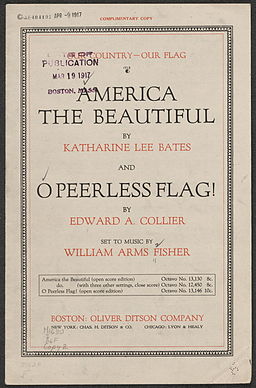
She slides a flyer toward me across the counter. “Read it,” she says. I put my finger on the mustache. “You don’t want to hear what we have to say. You’re a spy!” she says as she steps backward, tilts her head in the air, and bellows out “O beautiful for spacious skies, For amber waves of grain, For purple mountain majesty, Above the fruited plain. America! America! God shed His grace on thee….” But before she sings the last line of the stanza – “and crown thy good with brotherhood…” – she stops and orders me off her corner. “Get off my corner!”
She is carrying the message of Lyndon LaRouche, a perpetual candidate for President whose only consistency over a long checkered history of ideological swings on the political spectrum is the red-hot lava of righteous rage.
The behavior of the woman at the Post Office, like that of the Florida pastor whose threat to burn Qur’ans nearly set the world on fire several years ago, is bizarre. But the rage she expresses is not unique to her. Because it is so outrageous, it shines a light into the darkness of the widespread incivility of our time, an incivility that erupts from a core conviction hidden below the surface of our consciousness.
We’re street brawling over what kind of America we will be, and “Can’t we all just get along”- the plea of Rodney King as he witnessed the Los Angeles riots following the “innocent” verdict exonerating the police officers whose beatings of him had been aired repeatedly on national television– is long forgotten. We’re dividing ourselves into true believers and heretics, patriots and traitors, suspicious of each other all the way to the White House.
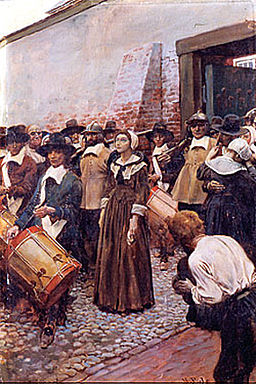
This is not new. This volcano of anger erupted in the trial of Anne Hutchinson (1637), banished by the court of the Massachusetts Bay Colony as “a woman not fit for our society” who, when banished, went on to co-found the State of Rhode Island. It erupted in the execution of Mary Dyer, a Quaker hanged for heresy in 1670, and in the Salem Witch Trials. The horrors of powerful religious dogmatism led the Founders of the new American republic to write into the constitution that there would be no established religion. The American republic would a secular republic with freedom of religious expression. It would not be a theocracy.
This is not new. This volcano of anger erupted in the trial of Anne Hutchinson (1637), banished by the court of the Massachusetts Bay Colony as “a woman not fit for our society” who, when banished, went on to co-found the State of Rhode Island. It erupted in the execution of Mary Dyer, a Quaker hanged for heresy in 1670, and in the Salem Witch Trials. The horrors of powerful religious dogmatism led the Founders of the new American republic to write into the constitution that there would be no established religion. The American republic was to be a secular republic with freedom of religious expression. It would not be a theocracy.
As the new nation was being conceived, demagoguery often replaced politics, i.e. the art of compromise, as it often does now. One does not compromise with the enemy. One eliminates him. Rodney King’s plea is regarded as the way of the ill-informed, cowards, heretics, and Anti-Americans.
The lava of anger originates from a hidden, unexamined conviction that the United States is the chosen people, the messianic people whose job is to eliminate evil within and without in the war of good against evil. It is an idea born of the rape of the Judeo-Christian tradition by nationalism which installs America as the exception to history, the nation divinely ordained to banish Anne Hutchinson in 1637, hang Mary Dyer in 1670, and destroy the reputations of decent people as un-American in Senator Joseph McCarthy’s purge of secret communists in the early 1950s. It’s the belief that America is the exception…and that the real America is only some of us, the righteous believers.
In the unspoken consciousness of our collective memory, “You are the light of the world” becomes the declaration of fact spoken about America, not an itinerant preacher’s call to a small band of first-century disciples to persist in the hard politics of love and peace in a time of hate and violence. The ensuing lines from the primary text, The Sermon on the Mount – “You have heard that it was said, ‘You must love your neighbor as yourself,’ but I say to you, love your enemy and do good to those who persecute you” – are forgotten, ignored, torn out, blacked out or burned on the altar of messianic nationalism.
Even more ironic is that those who attack others, including a sitting president, as un-American – i.e. heretics who do not bow to the idea of America as the collective messiah of history– scream against government and taxes as enemies, socialist intrusions on their individual freedom to hoard what is theirs. The biblical city is no longer for a community of sharing of the wealth and care for the least; it becomes a sandbox of greed and competition where the highest value is my freedom to get and keep what is mine.
The irony is that in the minds and hearts of those who have been raped, “America the beautiful…God shed his grace on thee…” is not a statement of aspiration but of fact. And the prayer “God mend thine every flaw” – the flaws of selfishness and greed, our meanness to each other, our name calling and stereotyping, our entrenched partisanship, our collective global nationalist arrogance – become a distant memory of a censored sentiment.
The irony is that in the minds and hearts of those who have been raped, “America the beautiful…God shed his grace on thee…” is not a statement of aspiration but of fact. And the prayer “God mend thine every flaw” – the flaws of selfishness and greed, our meanness to each other, our name calling and stereotyping, our entrenched partisanship, our collective global nationalist arrogance – become a distant memory of a censored sentiment.
In times like these when ugliness replaces beauty, America the beautiful is, as it always has been, a courageous aspiration and prayer for sanity in the midst of collective madness.
— Be Still! Departure from Collective Madness (2017 Wipf & Stock, Eugene, OR) available for reviewing and purchase through the publisher or Amazon Prime.
Whatever the Mueller Report’s findings, recommendations and conclusions, our work is the same. Like the midwives, we continue the vocation of compassionate resistance. This sermon is long, but more timely now than the day it was preached (2014). If you decide to take the time to listen, please leave a comment to let the preacher know what you’re thinking.
“But the midwives feared God, and did not do as the king of Egypt commanded them, but let the male children live” (Exodus 1:17).
For further reflection on the vocation of compassion in an anxious time, read “Being Human: Nothing Less and Nothing More,” p.40-41, in Be Still! Departure from Collective Madness (2017, Wipf & Stock). Click HERE to take a look inside Be Still!







 Views from the Edge